
Report from the 15th Coleridge Summer Conference (Part I)
Thank you to Jonatan González (@jonatangonzg) for this engaging account of the 2016 Coleridge Summer Conference. Jonatan is a first-year PhD student at the University of La Rioja researching Anglo-Spanish literary relations and the reception of British Romantic poetry in continental Europe. His thesis examines the afterlife of William Wordsworth in nineteenth and twentieth-century Spain.
This part of Jonatan’s report covers the first two days of the conference.
Hosted by the Friends of Coleridge (@FriendsofSTC) at Will’s Hall, University of Bristol, and held from the 1st to the 5th of August 2016, the 15th edition of the biennial Coleridge Summer Conference aimed at bringing together cutting-edge research on the literature of Coleridge’s circle in Bristol and beyond. A tightly scheduled week that boasted fifty-three papers distributed over twenty-six panels and three keynote lectures, it made for an engaging, inspiring and friendly conference that bears witness to the fact that Coleridgeans are a warm and welcoming breed amongst Romanticists.

15th Coleridge Summer Conference

Will’s Hall, University of Bristol
Following a special welcome address by the Academic Director of the conference, Tim Fulford, the first panel kicked off to a superb start. Focused on Coleridge’s symbolic imagination, it featured two absorbing papers by Michael Raigner and R. D. Hedley, which made for an engaging discussion about the impact of the Coleridgean concepts of imagination and symbol in the Romantic era. After that, the conference split in parallel sessions, with delegates having to choose, firstly, between Stuart Andrews’s comprehensive examination of the representations of the Duke of Wellington and the Battle of Waterloo in the poetry, prose and correspondence of Coleridge, Southey, and Wordsworth; and Kiran Toor’s discussion of the coincidences between the damned voyage of Jean-Baptiste Chappe d’Auteroche in 1769 following the transit of Venus, and Coleridge’s “Rime of the Ancient Mariner”.
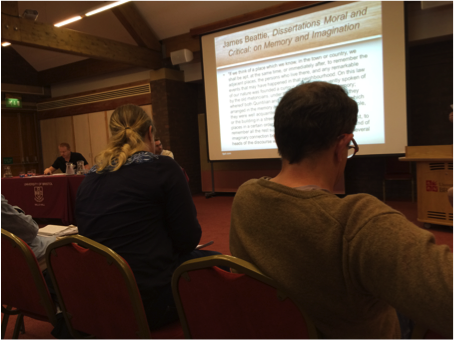
The closing parallel sessions of the day included, on the one hand, Grace Rexroth’s close work on the influence of James Beattie’s writings on “artificial memory” upon Wordsworth’s practice of associating poetry with architectural space, mediated through Coleridge’s readings of the former; Gregory Leadbetter’s remarkable paper on the connections between Thomas McFarland and Coleridge’s thinking on education as the cultivation of the mind; and Tom Duggett’s thorough consideration of the links between Coleridge’s On the Constitution of the Church and State and the historical fiction of Walter Scott and Ann Radcliffe. The other final panel of the day featured Joanna Taylor’s superb discussion of the use of grammatical symbols in Coleridge’s private correspondence concerning his infamous climb down Broad Stand on August 1802 to illustrate how, for the poet, the body’s reactions to and impact on the landscape have the potential to alter his imaginative responses to it; Kimberly Page-Jones and her fascinating examination of melancholia in Coleridge’s 1803 autumnal fragments written after a nightmarish 263-mile Scottish walk; and Robin Jarvis’s remarkable account of Coleridge’s and Wordsworth’s adventuresome Rhine Tour of 1828 as an example of the persistence of their wanderlust in old age.
After a brief coffee break came Peter Manning’s engaging first keynote lecture of the conference, “Edward Irving: Coleridge, Sign, and Symbol”, which kept all delegates glued to their seats with an excellent examination of the Scottish’s clergyman’s gain of influence over Coleridge and his loss of it over the course of the years. The programme for the first day closed with an official reception sponsored by the University of Bristol Centre for Victorian and Romantic Studies, followed by dinner in the college’s premises, and the first of many nights spent at Will’s Hall pub.
Tom Duggett

Peter Manning
After a hearty English breakfast on Tuesday morning, the conference crew had to make the choice between heading to the Conference Hall for Brandon Chao-Chi Yen’s examination of the iconographical presence of trees in the poetry of Coleridge, Hannah Dow’s close reading of Dorothy Wordsworth’s later journals in relation to Modernist poetry, and Bethan Roberts’s enthralling exploration of the relationship between poetry, science and the environment, literary and natural history, manifest in Coleridge’s “The Nightingale”; or going to the Lounge of Will’s Hall for Monica Bushling’s paper on the theme of guilty love in “The Pains of Sleep” and Christabel, Daniel Laron’s thorough engagement with Coleridge’s 1798 fragment “The Wanderings of Cain” to uncover the relations between burial practices and state power in early-nineteenth century England, and Paul Cheshire’s paper on the connection between William Gilbert’s The Hurricane: a Theosophical Western Eclogue and Thomas Taylor’s Dissertation on the Eleusinian and Bacchic Mysteries.
With the discussion of the second parallel sessions of the morning this conference report becomes slightly biased, as the first panel featured my own paper, which engaged with the afterlife of the Coleridge persona in the nineteenth-century Spanish press. Also presenting were Adam Neikirk, giving a study of Coleridge’s 1796 Poems on Various Subjects, and Deven Parker explaining her remarkable work on the way in which early nineteenth-century live drama performances and mechanical stage technologies shaped the writing and production of Coleridge’s 1813 Remorse. The other parallel panel opened with a discussion of Coleridge’s deployment of the sublime in On the Constitution of the Church and State in charge of Murray J. Evans, followed by Sharon Tai’s on the development of Coleridge’s philosophical theology in the comprehensive paper light of the changes he made over the years in the various versions of ‘Religious Musings’, ‘The Eolian Harp’, and ‘This Lime-Tree Bower My Prison’; and Jane Bolin’s close work on the way in which repetition and reflection worked for and against the endings of “Kubla Khan” and Christabel.
The following parallel sessions featured Anastasia Stelse’s careful reading of Dorothy Wordsworth’s use of aural qualities in her journals as denoting more poetic qualities than her standard verse poetry, followed by Sue Edney’s consideration of William Barnes’s poetry as an application of a Romantic linguistic philosophy to the Victorian cultural and social dilemmas. Anna Mercer opened up the other panel with a terrific examination of the complex nuances that feature in the poetical dialogue between Coleridge and his daughter Sara, focusing on the conversation poems as well as on “Poppies” and “Edith Asleep”, thereby illustrating how though tackling similar themes, Sara’s poetry is marked by her unique perspective and tone. This paved the way for Jeffrey Barbeau’s absorbing account of Sara Coleridge’s usually-forgotten daughter Bertha Fanny Coleridge. His paper argued that a recovery of little-known manuscripts describing her life and death contributes to a fuller understanding of Sara’s obsession with baptism and spiritual regeneration in the final decade of her life.
Following such an intense morning of scholarly work, a chilled out afternoon awaited us Coleridgeans. The social programme featured a Romantic walk around Bristol, led by the wonderful authority on Romantic pedestrianism Robin Jarvis, and the knowledgeable Stuart Andrews, who made us travel back in time and feel as if we were actually walking alongside Coleridge and Southey. Some highlights included visits to the Georgian House Museum, Thomas Chatterton’s House, as well as the former site of Joseph Cottle’s bookshop on the corner of High Street and Corn Street, one of the most important literary landmarks that any Romanticist could think of. The city walk culminated with a visit to the impressive St Mary Redcliffe, where we were granted access to the Muniment Room where Chatterton found, so he said, the manuscripts of the Thomas Rowley poems. The second day of the conference was over, and we all went back to Will’s Hall for dinner, and another evening of networking at the college pub.

Robin Jarvis

Joseph Cottle’s bookshop
Part II will appear on the blog next week.