
‘Rowley’s Ghost’ is an online text resource, cataloguing as many creative responses to Thomas Chatterton and examples of his influence as can be identified, from 1770 to the present day. The latest version can be found here.
So, it started as a simple list of creative responses to Chatterton, whose mock-medieval poems and supposed despairing suicide at the age of 17 (nowadays seriously questioned as such: see ODNB), caused a sensation in the 1780s and thereafter. It was compiled for the first book of essays on the poet, edited by Nick Groom (1999). I had ten-thousand words, two bibliographies, many tip-offs and a copyright library for further research. Three years on, the ‘Thomas Chatterton and Western Culture’ conference at the University of Bristol, marking the poet’s 250th birthday in 2002, alerted me both to further influences, and to deeper ones. Chatterton’s influence ran right through some poets’ work. Coleridge re-worked his ‘Monody’ on Chatterton for most of his life. For the poet Barry MacSweeney (1948-2000) the ‘myth of exemplary failure and belated recognition’ Chatterton represented was a lifelong inspiration in itself. Then there were the artists – from Blake and Flaxman through to Sam Taylor-Wood; dramatists, musicians, novelists. I found that some very familiar names had added a stone to the cairn: Vita Sackville-West’s play ‘Chatterton’ was her first publication; Peter Akroyd wrote a well-received and thoughtful novel. Rock star Pete Doherty even gave himself a Medieval alter-ego (‘Villein’) to match Chatterton’s ‘Rowley’. The poet’s influence hugely increased after Alfred De Vigny’s 1835 play, which caused a sensation when it was first performed in Paris, with ripples spreading through Europe. ‘Perhaps no other poet,’ as David Fairer puts it, ‘offers such a contrast between a brief and obscure life and a vast and powerful posthumous existence’.
Clearly a simple list was not enough. Not only were there many more creatives to include, but the echoing works themselves needed some analysis, to show where Chatterton’s influence resided, and what exactly each individual contributed to the tapestry of his ‘vast’ posthumous existence. One had to track the progress of Chatterton’s influence more carefully through complexly responsive figures like Wordsworth or Keats. Putting it online freed me from word-limits and fixed versions, so I could begin to analyse as well as list, adding and revising as time allowed. It became more like an encyclopaedia of Chattertonian influence, or a gathering of short essays, bringing with them the freedom to explore issues such a Chatterton’s role as ‘The Father of Romanticism’ or in the development of the Pre-Raphaelite movement; or his influence on particular categories of creative figures: women writers, or working-class and autodidact poets, or abolitionists (through his ‘African Eclogues’). One could even see – as noted in entries for Oscar Wilde and Patricia Highsmith – Chatterton cited as a formative figure in the creation of the modern individual. Andrew Wilson links Highsmith’s amoral character Ripley with Chatterton and Thomas Wainewright (‘Wainewright the Poisoner’), as filtered through Wilde’s views on art: ‘Men like Wainewright and Chatterton were, Wilde believed, works of art in themselves and, similarly, Ripley can be read in this way. Emptied of his essence, he is the perfect embodiment of modern man – self-created, self-determined, a constantly changing, protean personality existing in a world where, as Wilde said, “lying, the telling of beautiful untrue things, is the proper aim of Art”’. In such discussions, literary influence becomes much deeper than a few verbal echoes, a fondness for antiquified poetry or the tale of a tragically short life.
On Chatterton as ‘The Father of Romanticism’, the most famous statement is Wordsworth’s formulation, ‘the marvellous boy’ (first applied to Chatterton some years before ‘Resolution and Independence’, in a little-known poem by Francis Garden). Wordsworth admired Chatterton’s youthful precocity, how he ‘excelled in every species of composition’. Coleridge was perhaps the most prominent poet who saw in Chatterton a ghostly friend or mentor figure, a companion or kindred spirit. For Keats it was all about language, the ‘purest English’ of Chatterton’s linguistic re-workings. Blake asserted an almost mystical belief in the authenticity of what were often called Chatterton’s medieval ‘forgeries’, and John Clare went further, imitating Chatterton’s strategies by sending off his own disguised ‘antique’ poems. (James Montgomery at the Sheffield Iris saw through this strategy, but shrewdly published the poems anyway.)
As much as the poetry, the life and especially the death of Chatterton have always inspired fresh creativity. ‘Rowley’s Ghost’ lists dozens of poems and artworks sparked, for instance, by Henry Wallis’s famous deathbed portrait, ‘Chatterton’ (1856), described by John Ruskin as ‘faultless and wonderful’ (though by Barry MacSweeney as a ‘romantic fraud’). As early as 1780, John Flaxman was painting Chatterton into the gothic tradition. Last speeches and final words by the poet are common creative responses, as are indignant condemnations of those who supposedly failed to support him, especially Horace Walpole, often cast as the villain of the story, or the poet’s home city of Bristol. Ann Yearsley added her own disappointments to Chatterton’s in introducing a late poem, sarcastically trusting that ‘as the city of Bristol is the scene for the pathetic poet, and as every poet who has hitherto sung in her shade has been rewarded, the author expects her civic Wreath’. Other Bristol writers, from Hannah More to Robert Southey, were equally engaged with the story of Chatterton, for this was local, and personal. But Chatterton’s influence spread far and wide across Europe and America, too, and it continues to do so.
‘Rowley’s Ghost’ has been expanding and evolving for over a quarter of a century now as discussion evolves around this extraordinary figure, his influential life-story, and his rich body of work. Updated versions are regularly posted on academia.edu – with older versions on Knowledge Commons and Researchgate. – And comments, suggestions and contributions are always very welcome.
John Goodridge, Nottingham Trent University
johnagoodridge@gmail.com
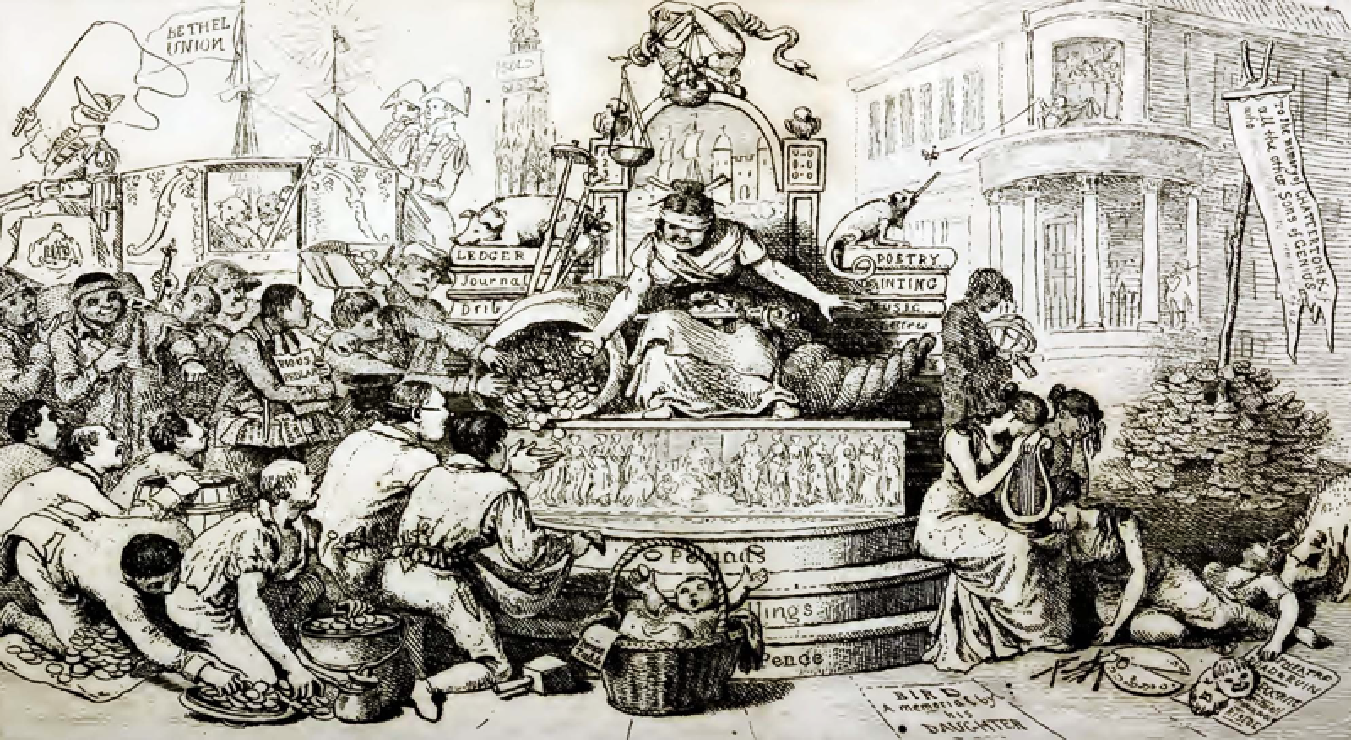
Edward Villiers Rippingille (1790?-1859), ‘Bristol Rewards the Arts’ , Frontispiece to [John Eagles], Felix Farley: Rhymes, Latin and English, by The Man in the Moon (Bristol: J. M. Gutch, 1826). Note the devastated Muses, on the right, and the drooping banner there reading, ‘To the Memory of Chatterton, & all the other Sons of Genius…’
John Goodridge is Emeritus Professor of English at Nottingham Trent University and President of the John Clare Society. His research focuses on 18th and 19th Century labouring-class poetry. He will be giving the John Halstead Memorial Lecture at the John Rylands Research Institute, Manchester, on Saturday 13 June 2026, 2pm, entitled ‘Reading by Glow-worm: The Struggles of Labouring-Class Poets’.