
Keerthi Vasishta, Postgraduate Helper at the Shelley Conference 2024 discusses below the exhibition at Keats House which ran alongside the conference:
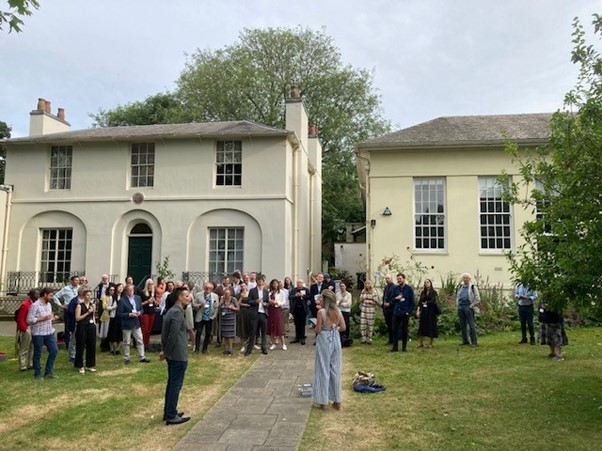
The Shelley Conference 2024 featured a special exhibition from the collections of Keats House inspired by the 1824 Posthumous Poems, corresponding with the theme of this year’s conference. The volume Posthumous Poems was edited and compiled originally by the recently-widowed Mary, who worked through her grief to produce the book. On display at Keats House is a first edition of Posthumous Poems (1824) ed. by Mary Shelley (John and Henry L. Hunt), the first of the many posthumous publications of Percy Shelley’s writing. Dr. Andrew Lacey, University of Lancaster and the official ‘interpreter’ for the exhibition, explained the thinking behind the items on display:
The Shelley relics collected in our exhibition illustrate Mary Shelley’s careful superintendence of Percy Shelley’s posthumous reputation over almost two decades, and, taken together, gesture towards the diverse nature of Shelley’s various literary afterlives.
Percy Shelley has been subject to constant reinvention and rediscovery by successive generations since his untimely death in 1822. Therefore, Lacey’s gesture towards the ‘diverse nature of Shelley’s various literary afterlives’ creates an exciting moment for readers of Percy Shelley coming to the exhibition. In viewing the physical object, readers conversant with the language and history of Percy and Mary Shelley’s first posthumous collaboration, were instantly transported to the world of 1824.
Seeing the book is a transformative moment. The conference was suddenly not just about words, not about arguments, not about ideas. The materiality and historicity of the events and people under scrutiny came to life to the participants. Any ideas and arguments one might have arrived with to the conference had to reckon with the lived history of the objects on display. Words fall away in viewing the Posthumous Poems because participants were witnessing a testimony of one remarkable woman’s labour and love for her remarkable husband. It is a testimony also to the birth of one of the greatest editorial efforts on the work of any single poet, an object therefore unlike any other, demanding the attention of viewers. As Lacey explained further,
Although, for Mary, the years after Shelley’s untimely death were blighted by grief and adversity, they were also marked by remarkable industry and productivity. The obstacles that Mary successfully negotiated were many, making the establishment of her ‘Collected Shelley’ – a fitting monument to the Shelley that she knew – an all the more remarkable achievement.
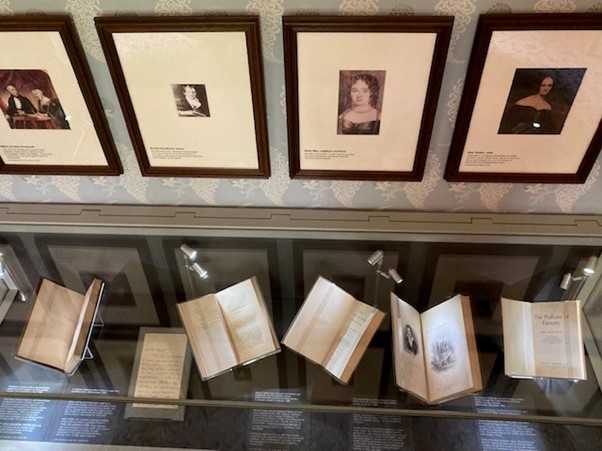
It takes a village to nurse a child, and it is much the same with the Shelley’s Posthumous Poems as well as Percy Shelley’s posthumous afterlives and reputation. Mary Shelley’s ‘Autograph letter to Leigh Hunt, undated but c. 23 December 1839’, placed beside Posthumous Poems hints at the many hands that came together to make Shelley the poet we know today. The text of this letter details Mary Shelley’s anxieties in answering G.H. Lewes, who was compiling a life of her late husband (Lewes’ work remained unpublished). Confessing the difficulties to Leigh Hunt, a long-time friend of the Shelleys, Mary shares her continuing pain from the loss of her husband more than a decade and a half prior. She writes in her letter to Hunt, ‘I cannot write or speak of Shelley to any purpose according to my views without taking a seal from a fountain, that I cannot bring myself yet to let flow’. The imagery of a sealed fountain is powerful in describing her volcanic grief while she wrestled with the memory of late husband. Shortly before this, Mary Shelley had headlined a complete collection of Percy Shelley’s poems, with both the preface and the editorial work done by Mary herself. This book, on display at Keats House was titled The Poetical Works of Percy Bysshe Shelley and was published by London publisher Edward Moxon in 1839. The interpretation to the book at the exhibition quotes Mary’s troubles in the effort of creating the volume:
Editing the poems and drafting the Notes caused Mary Shelley considerable distress: in her journal, she writes: ‘I almost think that my present occupation will end in a fit of illness’, adding ‘I am torn to pieces by Memory’ (12 February 1839)
Yet, Percy Shelley’s posthumous publication and reputation were growing further thanks to Mary’s efforts. Published late in 1839, although bearing 1840 on the title page was Essays, Letters From Abroad, Translations and Fragments, by Percy Bysshe Shelley ed. by Mary Shelley (London, Edward Moxon), the first edition of which is also on display at the Keats House exhibition.
If Mary’s labours were the heart of the conference and the thinking around Percy’s early posthumous reputation, the exhibition at Keats House showcases the diversity of Shelley’s after-lives. Like a leviathan, Percy Shelley’s reputation grew in breadth and scope since his death into the following centuries. His name and reputation had such value that the self-professed ‘psychic’ Shirley Carson Jenney produced The Fortune of Eternity, by Percy Bysshe Shelley, Taken Through the Clairaudience of Shirley Carson Jenney, Psychic (Illfracombe, Stockwell, 1950), on display at Keats House. The book, Jenney claimed was, as the interpretation notes: ‘transmitted wholly thro’ clairaudient dictation’. The final word on the display interpretation of Jenney’s piece has this to say:
‘While of limited scholarly value, The Fortune of Eternity stands as testament to the fact that Percy Shelley remained a subject of occultist interest well into the twentieth century.’
Here, the transformative moments of the exhibition at Keats House to the participants of Shelley Conference 2024 were complete. Not only was Percy Shelley posthumous reputation real, but here was evidence (though a hoax) of Percy Shelley having an actual ‘afterlife’!
Keerthi Sudhakar Vasishta is a PhD student at Durham University.