
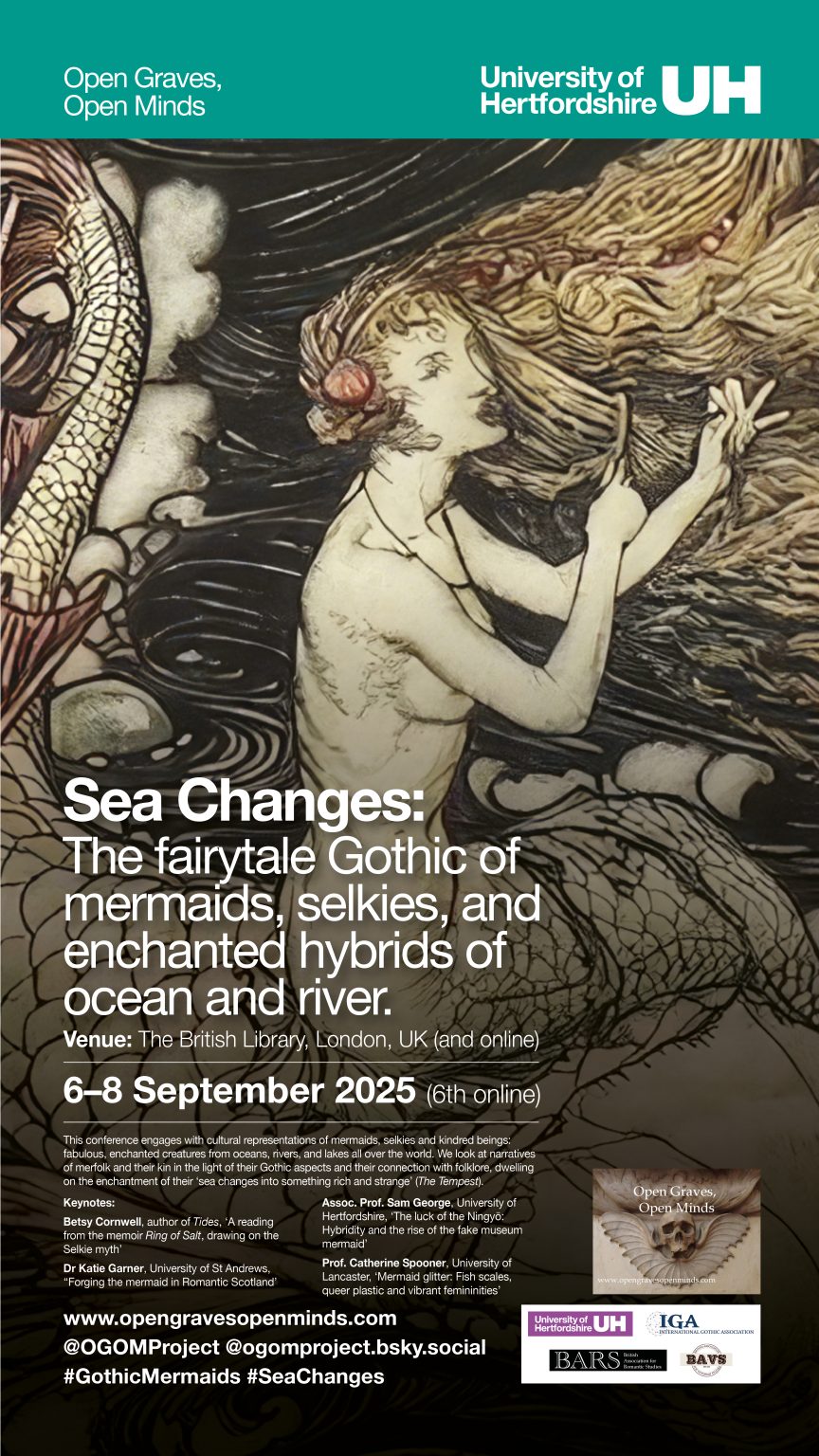
The Open Graves, Open Minds research group’s 3-day conference Sea Changes: The fairytale Gothic of mermaids, selkies, and enchanted hybrids of ocean and river at the British Library and online was a resounding success and an absolute pleasure to attend. It was a truly international affair: delegates came from Australia, Canada, the Czech Republic, Estonia, France, Germany, Greece, Iceland, India, Ireland, Italy, Japan, Mexico, Norway, Poland, Spain, Sweden, Switzerland, Trinidad and Tobago, the UK and the USA. There were a healthy number of doctoral students from the UK and beyond. BARS generously funded the fabulous Sea Changes programme design, Teams backgrounds and posters. This meant the organising committee could release funds for postgraduate tickets. You can view the fantastic design for the illustrated Sea Changes Booklet on the project’s webpages. The printed souvenir posters were popular with delegates and a PDF featured in the online conference packs for those presenting on Teams.
Romanticism informed many of the papers from presentations on Hans Andersen to lively discussions of sea changes in Keats, Wagner and La Motte Fouqué, and considerations of mermaids and other hybrid sea creatures in English, German, Polish and Czech Romanticism.
The conference began online with a full programme hosted by OGOM members Dr Daisy Butcher and Dr Ivan Phillips, of the University of Hertfordshire. There were panels on ‘hybridity, monstrosity and taxonomy’, ‘aquatic romance’, ‘mermaids and otherness’, ‘romanticism and sirens’, ‘myth and storytelling’, ‘selkie stories from Scotland to the artic’, ‘The Little Mermaid’ and adaptation’, and ‘mermaids, hybridity and aquatic environment’. The first keynote speaker, Dr Katie Garner, seamlessly interwove her experience of humanities funding with her research into Romantic Scottish mermaids, to give a creative and informative talk for Postgraduates and ECRs. This was followed by the Sea Changes Flash Fiction competition and beautifully read fictional and biographical narratives from acclaimed writer Betsy Cornwell, author of Tides and the selkie-inspired memoir Ring of Salt.
On the second day the in-person event unfolded and there was a lot of excitement as the Sea Changes signage went up at the British Library and the poster design and OGOM logo were projected onto large screens. There was an Open Graves, Open Minds display table with OGOM books, posters, postcards and fliers offering 30% off purchases for delegates from the publisher MUP.
The British Library days were hosted by the founders of the Open Graves, Open Minds project, Dr Bill Hughes and Assoc. Prof. Sam George. Proceedings got underway with an introduction to the OGOM Project and a slide show on its research strands, publications and mission statement:
The Project extends to all narratives of the fantastic, the folkloric, and the magical, emphasising that sense of Gothic as enchantment rather than simply horror. Through this, OGOM is articulating an ethical Gothic, cultivating moral agency and creating empathy for the marginalised, monstrous or othered, including the disenchanted natural world.
This was followed by Sam George’s keynote on Ningyō or Japanese human fish yokai and the rise of the fake museum mermaid. Panels ran throughout the day on ‘aqueous creatures and gender identity’, ‘hybridity and metamorphosis’, ‘re-enchanting nature’, ‘reimagining the merfolk of fairy tale’, ‘the gothic Little Mermaid’, ‘sirens selkies and the feminine’, ‘mariners and merfolk’, and ‘folklore, fairies and fish people’.
There was time for a few mermaid games and drinks at Mabel’s Tavern before a well-attended and enjoyable conference dinner at Nonna Selina, accompanied by some sea tunes.
The third day saw delegates contributing to panels on ‘nation and nature’, ‘aquatic romance 2’, ‘the divine and monstrous feminine’, ‘mermaids of poetry’, ‘water women of Japan’, ‘oceanic post colonialism’, ‘selkies and ecocriticism’, ‘ambivalent selkies’, ‘traumatic water folk’ and ‘mermaids undines and the arts’.
The final keynote was presented by Prof. Catherine Spooner, of Lancaster University, a long-standing contributor to the OGOM project. Catherine spoke generously on how much OGOM had influenced the direction of her own research before delighting delegates with her analysis of terror and wonder and the sparklification of the mermaid figure in all its glorious manifestations.
Dr Bill Hughes gave the closing remarks, after presenting earlier on selkie romance novels, and attendees joined together to celebrate fifteen years of the OGOM project. The Sea Changes edited book and special journal issue were announced, together with the planned publication of the Mermaid flash fiction shortlist. Sea Changes had a fantastic venue and striking visuals. It will be remembered for its lively theme, the quality and diversity of its papers and the kindness and warmth of its delegates. The event was made possible by the generosity of its sponsor BARS.
Dr Sam George
Sam George is Associate Professor in Research in the School of Creative Arts at the University of Hertfordshire. Sam is known as the Convenor of the popular Open Graves, Open Minds Research Project, founded in 2010. She has an unusual research specialism in literary vampires. This led to her featuring in the BBC’s Seven of the Most Unusual Areas of University Research. She is a champion of Public Humanities, successfully promoting public discourse, raising the visibility of humanities research and enhancing its impact by speaking to diverse audiences through her research.