
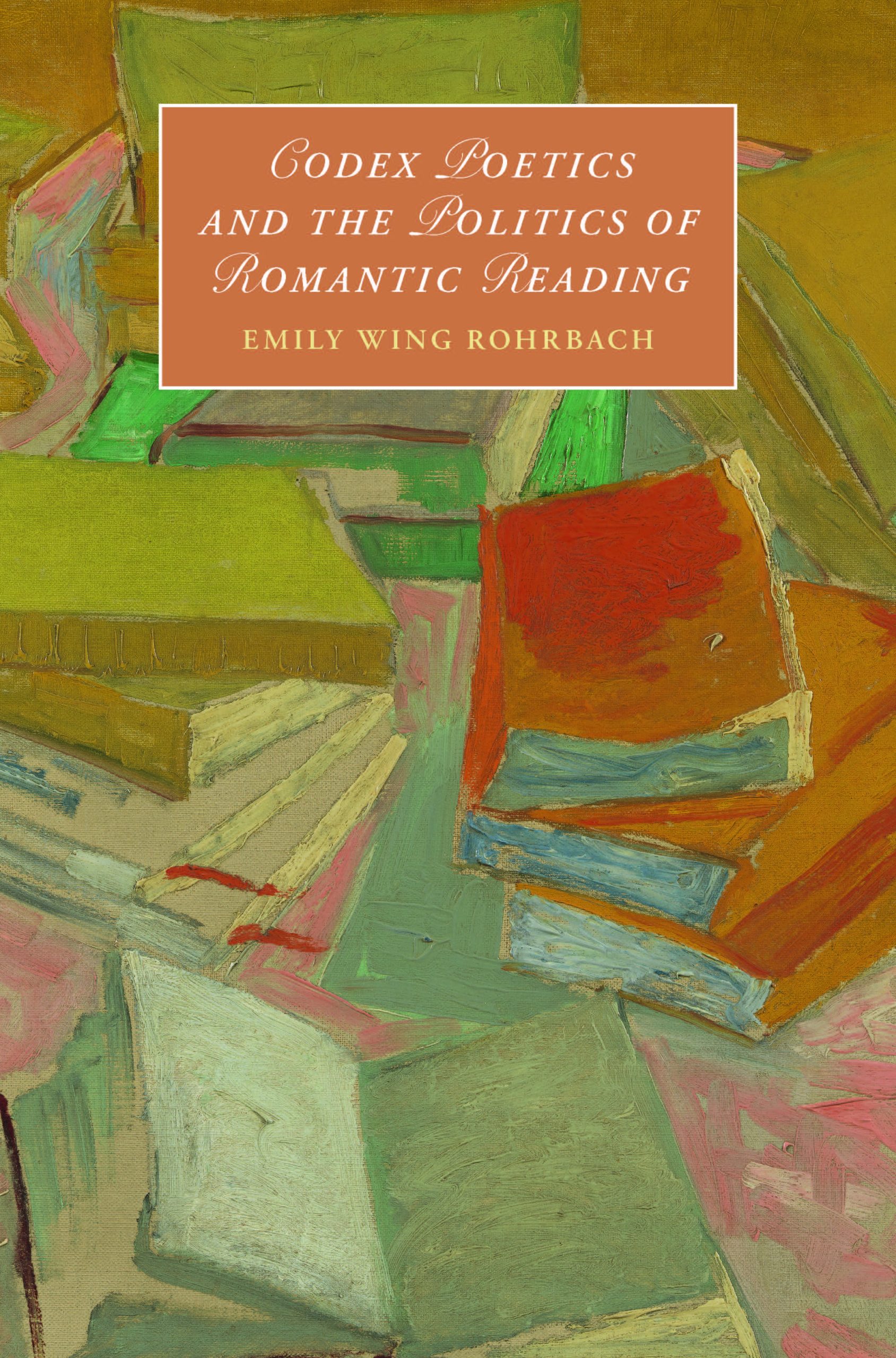
Emily Wing Rohrbach is Associate Professor of English, 1660-1832, at Durham University and the author of Modernity’s Mist: British Romanticism and the Poetics of Anticipation (Fordham University Press, ‘Lit Z’ series, 2016). She is also co-editor (with Emily Sun) of the 50th-anniversary issue of Studies in Romanticism entitled Reading Keats, Thinking Politics (2011). In 2022-23, she held a Leverhulme Research Fellowship to support work on her new book, Codex Poetics and the Politics of Romantic Reading (Cambridge University Press, ‘Studies in Romanticism’ series, 2026).
1) How did you first become interested in how Romantic-period books foster notions of contingency?
That’s an easy one. In my first book, Modernity’s Mist, I explored Romantic ideas of contingency in both literature and historiography. That interest brought me to a symposium in May 2016 on the topic of ‘literature and contingency’. There, I was fascinated by how several book historians were talking about contingency in material terms. I’d thought about the issue of contingency a lot with respect to narrative theory, poetics, and intellectual history, but I had not thought at all about contingencies of ‘the book’ as a material object with specific affordances and histories. As I was listening to their talks, which covered a wide range of historical periods up to the contemporary, I was also rereading in my head Keats’s poem ‘On Sitting Down to Read King Lear Once Again’. That’s where and when the project began. At the symposium, there were two mostly distinct conversations happening, and I thought I could see how they could be bridged with a work like Keats’s astonishing sonnet and its history of being inspired by a blank space in his Shakespeare book.
2) You write in the introduction that ‘Codex Poetics is a book about what interpretations become possible when, methodologically, we take account of […] poetics and format […] and how they might play off one another’. What for you are the biggest gains we make by paying proper attention to the ways in which bound books and their contents frame each other’s potential meanings?
‘Books’ in the Romantic period have been understood, at times, as forces of discipline and stabilization. But as my readings aim to show, when you attend to the play between format and poetics—or, as you say, bound books and their contents—one thing that comes into view is an idea of ‘the book’ as a force that illuminates things as they are as not inevitable, but formed by choice and chance. In the Romantic period, the very technology of the bound book—with pages held together by a binding that enables it to open and close and to be flipped through—gets enlisted in that reflexive and conceptualizing work. Noticing this play also shows you just how carefully, inventively, and sometimes anxiously these authors imagined the material forms in which their words would circulate.
3) How did you come to select the principal subjects for your chapters (Ignatius Sancho, Phillis Wheatley and Olaudah Equiano; Jane Austen; Letitia Elizabeth Landon; John Keats and Leigh Hunt; and William Hazlitt)?
It would have been possible to include the work of other authors in this study—to make it a book about poetry alone, for example—but I wanted to show that the conceptualizing ‘work’ described in my previous answer was happening across literary genres. Early on, I found that the exposing of things as they are as contingent was potentially liberating and, for an author such as William Hazlitt, very explicitly associated with certain kinds of freedom. That led me to ask, given that this was an age of British involvement in the global slave trade and abolitionist movements, whether the book operated in a similar way for authors of African descent. The answer, I found, is yes and no. Finally, once I had the research questions in mind, I selected the authors and works that gave the most complex, subtle, and surprising answers to these questions. I didn’t want to write a boring book.
4) What are your favourite surprising things that you discovered in the process of researching the book?
To me, each chapter feels so different from the others that it’s hard to say which surprised me most. But I was certainly surprised by how often some Romantic poets describe spaces for their books (their study, their shelves) specifically using the word ‘snug’. I was intrigued, too, to find affinities between Hazlitt and Sancho on the topic of repeat reading, and between Hazlitt and Equiano on the free play of subject-object positions vis-à-vis the book. You’d probably be surprised to hear me say that Austen envisions even Sir Walter’s beloved Baronetage as having a democratizing edge. Finally, although this may not be what your question was getting at, I was definitely surprised by how much work it took to finish this project. That said, it’s probably a good thing not to know the actual timeframe for completion when setting out.
5) What new projects are you currently working on?
Apart from writing a few short pieces on various topics, I’m now revisiting something in Romantic poetry that I started to notice while writing Codex Poetics: that is, moments in poems when a description of something in the natural world—a leaf, a landscape—turns into a description of a page or a book; or, vice versa. Romanticism is sometimes preoccupied with exploring what nature teaches versus what books teach, and I’m trying to think about what these kinds of moments uniquely say about that question. I grew up on a farm and only later came to value reading, so I guess that personal history is where my own preoccupation comes from.