Stephen Copley Research Report: Amanda Blake Davis on Percy Bysshe Shelley c.1817

      Comments Off on Stephen Copley Research Report: Amanda Blake Davis on Percy Bysshe Shelley c.1817

Here we have the latest report from Amanda Blake Davis, the most recent winner of the Stephen Copley research awards, for more information about how to apply, please see here.

In December 2021, I was grateful for the opportunity to return to the Bodleian Library in Oxford thanks to the support of a BARS Stephen Copley Research Award.

This research trip, much-delayed by the ongoing pandemic, was originally conceived in the summer of 2020 during conversations with Professor Jerrold E. Hogle for Jonathan Mulrooney and Emily Rohrbach’s ‘Romanticism in the Meantime’ series of online interviews and discussions. My interview with Professor Hogle on ‘Shelley’s Platonic Subtlety’ drew attention to Shelley’s translations of Plato beyond his crucial 1818 translation of the Symposium. I have previously written on Shelley’s translation of the Symposium and its significance to the Shelleys for BARS, [https://www.bars.ac.uk/blog/?p=2122], and my doctoral thesis, Shelley and Androgyny, traces a line of enquiry between the Symposium and androgynous language and images in Shelley’s poetry and poetical writings. In the summer of 2020, my interest in Shelley’s translations of Plato beyond the Symposium began to centre upon the Menexenus, which Shelley made a partial translation of in 1817.

Motivated by my interest in Shelley’s 1817 translation of the Menexenus, my visit to the Bodleian centred upon Shelley’s compositions c.1817, and expanded beyond the poet’s readings and translations of Plato to include my current project as Postdoctoral Research Fellow at the University of Derby where I am working on Shelley’s manuscript drawings of trees and poetical depictions of trees and botanical figures. The Bodleian holds the world’s most significant Shelley archive, and the invaluable 23-volume facsimile Bodleian Shelley Manuscripts were also readily accessible alongside the manuscript notebooks I had arranged to consult. In particular, Nancy Moore Goslee’s editorial commentary on MS. Shelley adds. e. 12 in volume 18 of the Bodleian Shelley Manuscripts directed attention to Shelley’s drawings of trees and their representation of his compositional process in this notebook. Goslee writes: ‘A full-page sketch on 203 seems to comment on the double directions of the notebook—two clumps of trees mirror one another, as if in an unseen lake’ (p. liii).[i] The major aims of my postdoctoral project are to explore and identify the presence and influence of real, living trees on Shelley’s poetry, and to examine how manuscript drawings of trees and other botanical figures act as intermediaries in Shelley’s compositional process.
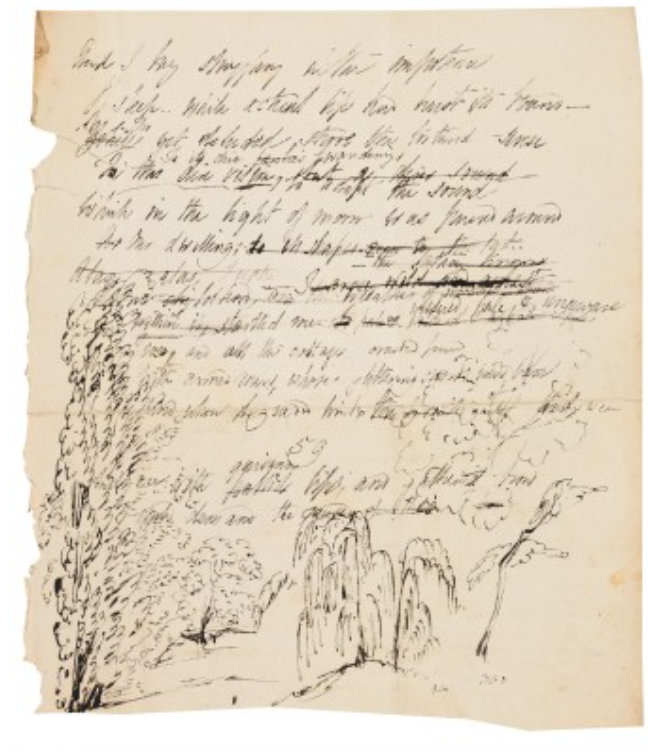
(c) Bodleian Library, University of Oxford.

An example of tree drawings in Shelley’s Laon and Cythna manuscripts, CMD 6231 [Uncatalogued Harcourt Additional Papers box 11/1], now MS. Eng. c. 7978, fol. 53. Image source: Shelley’s Ghost 2012 exhibition at the Bodleian Library, now archived by the WayBack Machine.

Two manuscript notebooks in particular were immensely useful to my research during this visit: MS. Shelley e. 4 and MS. Shelley adds. e. 16. Notably, both are landscape notebooks, and although drawings and sketches appear throughout Shelley’s manuscripts, there is a visual immediacy to these notebooks that is fostered by their landscape formats. The back pastedown of MS. e. 4 features an elaborate, full-page landscape drawing that appears to visually depict the final canto of Laon and Cythna (1817), where the eponymous pair sail across a lake, approaching the celestial Temple of the Spirit. Although manuscript material for Laon and Cythna does not appear in the extant pages of this notebook, ‘The Revolt of Islam’, Shelley’s revised title for Laon and Cythna, emerges amidst cancelled lines of ‘Ozymandias’ on the preceding page (folio 85v), suggesting the poem’s presence in Shelley’s mind at this time. The lines ‘Our bark hung there, as on a line suspended / Between two heavens, that windless waveless lake’ (12.40.356-357) seems to be visually imagined on this landscape page,[ii] where an island populated with a diverse array of trees shelters a celestial temple, overlooked by a mountain range. Being able to consult the original manuscripts revealed intricate details in this drawing and in others, such as the way in which the hanging branches of a willow tree are subtly reflected in the water of the lake, mirroring Laon and Cythna’s penultimate stanza’s emphasis upon intermediacy. I would like to extend my thanks to BARS, and to the Bodleian, for this most useful visit.

Amanda Blake Davis is a Postdoctoral Research Fellow in English Literature at the University of Derby, Honorary Research Fellow in the School of English at the University of Sheffield, and a Postgraduate Representative for BARS. Follow her on Twitter at @ABDavis1816

[i] Percy Bysshe Shelley, The Bodleian Shelley Manuscripts, gen. ed. Donald H. Reiman, 23 vols to date (New York, NY: Garland and Routledge, 1986-), vol. 18: The Homeric Hymns and ‘Prometheus’ Draft Notebook, Bodleian MS. Shelley adds. e. 12, ed. Nancy Moore Goslee.

[ii] Percy Bysshe Shelley, Laon and Cythna; or, The Revolution of the Golden City: A Vision of the Nineteenth Century. In the Stanza of Spenser quoted in The Complete Poetry of Percy Bysshe Shelley, ed. Michael J. Neth, gen. eds. Donald H. Reiman, Neil Fraistat, and Nora Crook, 4 vols to date (Baltimore, MD: The Johns Hopkins University Press, 2000-), vol. 3.

Digital Burns Night II Recording

      Comments Off on Digital Burns Night II Recording

For anybody who missed our Digital Burns Night II event last week – you can now catch up on the evening of poetry and merriment on the official BARS Youtube channel. Listen to Andrew McInnes (Edge Hill University), Jennifer Orr (Newcastle University), Gerard McKeever (University of Stirling), Rita Dashwood (Edge Hill University), Zayneb Allak (Edge Hill University), Ainsley McIntosh (Independent scholar), and Angela Wright (University of Sheffield) and don’t forget to subscribe and check out the other videos on our channel available here.

New Book Series – Race in Nineteenth-Century Literature and Culture

      Comments Off on New Book Series – Race in Nineteenth-Century Literature and Culture

RACE IN NINETEENTH-CENTURY LITERATURE & CULTURE attends to the racial and imperial logics that structured the conceptual and material worlds from which literatures of the long nineteenth century emerged. While centered on literatures and cultures of the late-Enlightenment, Romantic, and Victorian eras the series pays particular attention to the durability of long nineteenth-century racial and imperial formations in the contemporary moment. Titles included proceed from the conviction that understanding this key moment in the history of race and empire enables us to imagine revolutionary alternatives to the structures we have inherited from the nineteenth century.

Series Editors
MANU SAMRITI CHANDER, (Rutgers University-Newark)
PATRICIA A. MATTHEW, (Montclair State University)

Series & Proposal Information: bigger6.com/oup
Queries & Submissions: oup.c19race@gmail.com

Online Workshop: The Gothic Women Writers of the Minerva Press

      Comments Off on Online Workshop: The Gothic Women Writers of the Minerva Press

An Online Workshop for Postgraduate and Early Career Researchers

Monday 28th February, 1pm – 2:30pm GMT (WORKSHOP POSTPONED DUE TO UCU STRIKE ACTION – NEW DATE 10 MARCH 5pm-6:30pm GMT)

In recent years there has been a considerable rise in scholarly interest around William Lane’s Minerva Press, exemplified by the recent special issue of Romantic Intertextualities: Literature and Print Culture, 1780-1840 (2020) and the publication of Elizabeth Neiman’s Minerva’s Gothics: The Politics and Poetics of Romantic Exchange, 1780-1820 (2019). While many of the Press’ gothic women writers remain in obscurity due to the reputation of Lane’s Press as a ‘factory of cheap, formulaic novels’, reclaiming these women can in fact contribute to new formations of the Romantic canon, in turn destabilising the gendered binaries that persist within evaluations of what constitutes literary value (Neiman, p.1). As Kathleen Hudson notes in her introduction to Women’s Authorship and the Early Gothic: Legacies and Innovations(2020): ‘in seeking new paths into the gothic, we must remember that the mode itself is a study of lost, hidden and marginalised voices’ (p.18).

This PGR/ECR online workshop offers a panel of speakers focusing on ‘the hidden and marginalised voices’ of Minerva Press and raises the question: why reclaim Minerva’s gothic fiction now? Participants will have the opportunity to contribute their ideas to an informal discussion regarding the Minerva Press and its place within studies of Romanticism and the gothic. A key quotes sheet and bibliography will be circulated in advance of the event.

Programme 

13:00-13:10 – Welcome

13:10-13:50 – Flash talks from panel (Beth Brigham, Colette Davies and Fern Pullan) 

13:50-14:00 – Q&A

14:00-14:30 – Roundtable Discussion 

To register click here

NASSR/ROMANTIC CIRCLES PEDAGOGY CONTEST

      Comments Off on NASSR/ROMANTIC CIRCLES PEDAGOGY CONTEST

The contest was devised in the hopes of celebrating recent pedagogical innovation, inspiring creative new approaches, and creating an additional forum for conversations about Romantic pedagogy—both its boons and challenges.  Teachers of all ranks may submit teaching materials, and a panel of three to four finalists will be selected to discuss their pedagogy during a panel, open to the public, at the annual NASSR conference. 

Exemplary submissions consider how teaching revivifies Romanticism, in any of its myriad forms.  For a list of previous winners and their syllabi, see the Pedagogies section of the Romantic Circles website.  Submissions might include a course that rethinks the period; a part of a course that addresses a specific author, theory, or literary problem; a special project, assignment, or a particular pedagogical technique.  We welcome the use of multimedia resources, digital techniques, and courses designed to use multi-modal digital platforms for learning and communication, but they are by no means required.  Courses and projects should be recent—within the past two academic years—or projected to be taught in the following one.

After submitting a small packet of material, finalists are chosen via author-blind peer review by a committee composed of members of NASSR in the US, UK, and beyond, Romantic Circles, and the NASSR Graduate Caucus.  Finalists will give a short presentation on their courses and pedagogies at a special panel during the NASSR conference, and their syllabi will be published on the Romantic Circles Pedagogies website.  The winner, chosen after the panel, will receive a $250 award as well as recognition at the NASSR conference and in the NASSR Newsletter.

The contest is sponsored by the NASSR Advisory Board, the NASSR 2020 Organizing Committee, and the Romantic Circles website.

TO SUBMIT:

Please send a document of between 3-5 pages to nassrpedagogycontest@gmail.com by Friday, June 3, 2022. Please include a separate cover letter with identifying information, which should be left off all other documents.  Initial queries and questions are welcomed.

Potential materials might include but are not limited to:
– A cover letter and explanation of the submission, including an argument as to the course or project’s pedagogical innovation and benefits for the study of Romanticism. If the submission is a project or assignment, it has often helped participants to contexualize it within the aims of the larger course. Please include identifying information in this document, but omit it from the other documents and materials.
– Syllabus or parts of a syllabus
– Assignment sheets
– Multimedia or digital materials

CFP British Romanticism and Europe conference

      Comments Off on CFP British Romanticism and Europe conference

23-26 June 2022, Monte Verità conference center, Ascona, Switzerland

(initially planned for 2020 but delayed due to the pandemic)

Keynote Speakers: Christoph Bode, Biancamaria Fontana, Paul Hamilton, and Nicola Moorby

British Romanticism is part of European Romanticism and British writers drew inspiration from personal and cultural links with mainland Europe as well as the many forms of Continental travel. This international conference will explore the manifold relations between Britain and Europe during the Romantic period, taking advantage of recent work on transnational circulations and exchanges and a growing interest in comparative methodology. The conference will question stereotypes of Great Britain as insular by highlighting the island-nation’s European identity and its participation in a pan-European Romanticism shaped by transnational cultural dialogue and the cross-fertilization of art forms and disciplines. The aim is to uncover the channels and mechanisms by which Romantic ideas and influences were conveyed across national and disciplinary boundaries and to examine the role of individuals, communities and institutions in this complex transmission process. As well as directing attention to the often-overlooked international dimension of British Romanticism, the conference aims, by bringing together scholars working in Britain and on mainland Europe, to help develop the expanding research network on European Romanticism. Held at Monte Verità, an international conference centre in Ascona in the Swiss canton of Ticino which was formerly the site of a utopian community attracting intellectuals from across Europe, the conference will be divided between plenary lectures, invited panels, and open panel sessions. There will also be a public lecture on J.M.W. Turner and the Italian Lakes, as well as an excursion to Lake Como.

To fill the open panel sessions, we invite proposals for 20-minute papers on any aspect of the conference topic, including:

  • European Romantic networks
  • Romantic mediations and mediating figures 
  • Romantic salons, communities, and constellations
  • Romantic disseminations and circulations
  • Romantic theories of ‘Europe’
  • European Romantic politics
  • European Romantic aesthetics
  • Romantic Europhobia and Europhilia
  • Romantic exile and displacement
  • British relations with Northern, Southern, and Eastern Romanticisms
  • British Romanticism and Continental philosophy
  • British Romanticism and Continental science 
  • British Romanticism and European travel
  • Britain’s Four Nations and Europe

We encourage junior scholars from mainland Europe to apply, and in order to cut down on carbon emissions, urge attendees to travel by train.

Abstracts of approximately 250 words are due by 1 March 2022. Please send abstracts to patrick.vincent@unine.ch

Conference site here.

Organizing committee:

                     Patrick Vincent, University of Neuchâtel

                     David Duff, Queen Mary University of London

                    Simon Swift, University of Geneva

Our Subversive Voice: The History and Politics of the English Protest Song

      Comments Off on Our Subversive Voice: The History and Politics of the English Protest Song

‘Our Subversive Voice: The History and Politics of the English Protest Song’ is a two-year research project funded by the UK’s Arts and Humanities Research Council. It is based at the University of East Anglia, and involves colleagues from the universities of Warwick and Reading. We are investigating the use of song to register protest through the ages, from 1600 to 2020.

This website allows you to follow the work of the project. You will find case studies of particular songs and themes; interviews with songwriters and experts; a bibliography of scholarship and anthologies; and contributions from other writers with an interest in the history and politics of the protest song – both English and otherwise.

We are interpreting ‘English’ loosely (and contentiously) as meaning either written by an English national, or having a particular bearing or influence upon specifically English political culture.

The core of the website is its database of 750 protest songs from 1600–2020, of which 250 are showcased as the most distinctive and important. 

We hope that this resource will prove of interest to Romanticists. It features many abolitionist songs, reworkings of Shelley and Byron, and a whole platoon of labour poets and radical writers. We welcome suggestions from BARS members, particularly ideas for guest blogs.

www.oursubversivevoice.com

CFP – Freethought in the Long Nineteenth Century: New Perspectives

      Comments Off on CFP – Freethought in the Long Nineteenth Century: New Perspectives

How did atheist, secularist, and humanist ideas circulate within and across nations in the long nineteenth century? This conference seeks to consider this question at both micro and macro scales, exploring the local, national, and international networks that enabled freethought to flourish. The nineteenth century was a period during which developments across physical and social sciences, politics and activism, technology and travel gave rise to new ways of conceiving the universe and humanity’s place within it. While it is abundantly clear that this did not lay an uncomplicated path towards secularisation, there were many individuals who through their lives, writings, and actions sought to establish a secular age.

The question of terminology is often fraught and, as Nathan Alexander (2019) observes, the terms used to frame the field of historical unbelief can often serve to reinscribe particularly Western concerns. Although the category of freethinker (or Freidenkerlibre-penseursfritänkare etc.) is not exempt from such difficulties, we use it is a multivalent term that speaks more broadly to the freedom of thought, speech, and action that liberation from religious frameworks can instil. Furthermore, it was used in the nineteenth century to encompass a range of positions, from militant, antagonistic atheists to those with pantheist and deist beliefs that sit outside traditional religious frameworks, via many forms of doubt and agnosticism.

There has been a tendency for Anglophone freethought to be considered separately from European traditions, and both are often cut off from, and can overshadow, wider global currents. Recently, significant steps have been taken in making connections across such boundaries through edited collections such as the internationally orientated Cambridge History of Atheism, ed. by Stephen Bullivant and Michael Ruse (2021), and Freethinkers in Europe: National and Transnational Secularities, 1789−1920s, ed. by Carolin Kosuch (2020). This conference builds upon such publications, and as such we warmly welcome proposals which explore how freethought discourses in the period c.1789–1914 operated on a global scale, and how the legacies of these persisted across the twentieth century and through to the present.

This will be a multidisciplinary conference, with contributions welcomed from those working in the fields of history, literature, art history, politics, religious studies, sociology, anthropology, law, media studies and so on. Topics might include, but are not limited to: 

·      Blasphemy, heresy and iconoclasm

·      Class and sociocultural divides

·      Deism, pantheism, and alternative theist traditions

·      Freethinking communities and societies

·      Freethought and gender

·      Freethought press and popular media

·      Freethought spaces and practices

·      Freethought, the state, and the law

·      Global and transnational networks and exchanges

·      Humanism

·      Morality and ethics

·      Race and empire

·      Radicalism and militancy

·      Science and freethought

·      Sex and relationships

·      Socialism and communism

·      The art, literature, and music of freethought

·      The conceptual history of unbelief

·      The legacies of nineteenth-century freethought

The conference will be held on Friday 9 and Saturday 10 September 2022 at Queen Mary University of London. It is funded by the Leverhulme Trust and organised in partnership with the International Society for Historians of Atheism, Secularism and Humanism and Humanists UK. 

Please submit a 300-word proposal for a 15-minute paper plus a 50-word biography in Word format to c.stainthorp@qmul.ac.uk by Tuesday 1 March 2022. We are also interested in proposals for panels or presenting work in alternative formats, please get in contact directly to discuss these prior to submission.

Organisers: Clare Stainthorp (Queen Mary University of London), with Anton Jansson (University of Gothenburg) and Madeleine Goodall (Humanists UK)

BARS Digital Events available on Youtube

      Comments Off on BARS Digital Events available on Youtube

Just a little reminder to our readers that all of the past BARS Digital Events 2021-22 are available on our Youtube channel, click here to visit, and don’t forget to subscribe.


If you missed the ‘Irish Women, Bodies, and the Gothic Tradition‘ or ‘Zany Romanticism‘, then you can catch up on them here, along with other events from our back catalogue.

Re-envisioning Romantic Publishing
Dialogues and Receptions
State of the Arts: Reframing the Visual in the Romantic Period
Geo & Eco-Criticism: Returning to Romantic Italy
Romantic Forms
Romanticism and the Museum
The Late Mary Shelley
Burns Night Supper 2021
Digital Teaching in Romantic Studies
Digital Editions in Romantic Studies

And don’t forget to sign up on Eventbrite for our Digital Burns Night 2022 event, coming up on 27 January.

Stephen Copley Research Awards 2021 (round two)

      Comments Off on Stephen Copley Research Awards 2021 (round two)

The BARS Executive Committee established the Stephen Copley bursary scheme in order to support postgraduate and early-career research within the UK – we have extended this to a second round per year. The bursaries primarily fund expenses incurred through travel to libraries and archives necessary for the applicant’s research, but the remit was this year expanded to include other research-focused costs, such as (but not limited to) photocopying, scanning, and childcare. Please do join us in congratulating the very worthy winners. 

Ashleigh Blackwood (Northumbria University)

Bethany Brigham (Northumbria University)

Charlotte Goodge (University of Kent)

Deven Marie Parker (Queen Mary University of London)

Francesca Killoran (University of York)

Hayley Braithwaite (University of York)

Lewis Roberts (University of Cambridge)

Once they have completed their research projects, as far as the bursary scheme is concerned, each winner will write a brief report. These reports will be published on the website and circulated through our social media. For more information about the bursaries, including reports from past winners, please visit our website: www.bars.ac.uk.

Daniel Cook
Bursaries Officer, BARS
University of Dundee
d.p.cook@dundee.ac.uk

14 January 2022