
This August I was thrilled to be able to make a much-needed trip to London, with the aim of viewing several collections related to my doctoral research, thanks to the help of the BARS Stephen Copley Award. As I am currently working on redrafting my thesis for publication, it was vital to me that I felt no stone had gone unturned, and this was especially pertinent given how much the early years of my doctoral study had been affected by the limitations of the COVID-19 pandemic and subsequent archival closures. As my research concerns the literary circles active in the north of England c. 1770-1842, I strove to prioritise archival visits to Liverpool, Sheffield, Manchester, and my local York archives, rather than making an expensive and time-consuming trip to London. This was sufficient to produce a finished thesis, but now that it’s being primed for publication, it was necessary for these blind spots to be addressed. Luckily, the Stephen Copley Award provided me with the opportunity to visit a variety of relevant and exciting sites across the Greater London area.
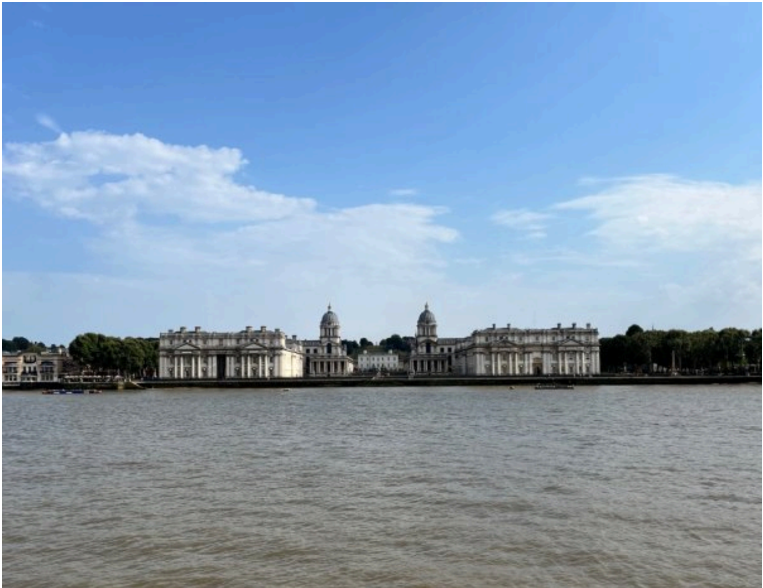
First, I visited London Metropolitan Archives in Clerkenwell. The purpose of this first visit was to view a number of commonplace books and poetry albums, which served the double use of tracking circulation and readership of regional writers’ works in the capital, and also working as a comparative for the different forms and organisational styles which commonplacing practises might manifest. Commonplacing is a more recent research interest of mine, and I was astounded by the level of organisation employed by compilers such as Thomas Whitby, who utilises a thematic alphabetised index to locate commentary on various subjects across his extensive document.[1] Furthermore, this document featured an inserted introduction from a printed book, detailing the purposes of his composition. These purposes included nurturing practical self-reliance, the instruction of others in a variety of subjects, and use in conversation, placing men ‘above the necessity of vain repetition, such as women and ignorant persons fall into for want of matter’ (!). This suggested that Whitby’s efforts were very intentionally oriented around self-improvement, contributing to an existing scholarly and social tradition, as well as one that was also self-consciously gendered. Interestingly, these collections located in the City of London, from compilers very much bound up in civic life there, did not evidence the spread of transpennine authors I predicted that they might, with such conspicuous omissions as the Sheffield poet James Montgomery (1771-1854) who, as we’ll see, was very popular in other circles.
The next day took me to the Natural History Museum, to track down some of the surviving letters between the Liverpudlian poet and polymath William Roscoe (1753-1831) and his colleague in studies of the natural sciences, Sir Joseph Banks. This proved to be a revealing series of letters, evidencing the extent of these two men’s involvement in one another’s various practical and theoretical endeavours, not least how much Banks contributed to Roscoe’s efforts to reform the moss lands surrounding Manchester in the early nineteenth century.[2] Likewise, Roscoe’s letters to the botanist and banker Dawson Turner, suggest a dedicated friendship between the two interlocutors, where professional and personal matters are often heavily intertwined with one another. This complex relationship also brought Roscoe in touch with Turner’s wife, the artist Mary Palgrave, whose etchings were met with his effusive praise.[3] This visit also yielded another opportunity to view a commonplace book in the form of Samuel Pickworth Woodward’s document, pictured below and compiled across the 1830s and 40s.[4] Much like Whitby, Woodward makes a list of thematically similar entries in his book, but also involves a list of poets and prose authors with page numbers for each of their contributions to his collection. Woodward’s favoured authors include several transpennine writers, namely Montgomery, Roscoe, the Liverpool-born Felicia Hemans, and the Mancunian authoress Maria Jane Jewsbury (1800-1833). Many of these authors, such as Montgomery and Hemans, are common in poetic albums such as these; they found a great deal of success in popular periodicals such as the Saturday Magazine, as well as in gift-books and annuals, suggesting these were the primary materials from which commonplace entries were largely sourced. This commonplace book also had the added feature of being a collaborative work, with the initials of the friend or relation who entered it into the book included art the bottom of each entry. In doing so, it forms an example of a phenomenon observed by Jillian Hess, whereby commonplacing becomes a method of testifying to the importance of, as well as itself strengthening, a compiler’s close relationships.[5]
Next was Sir John Soane’s Museum, which formed a particular highlight of my visit not merely for its beautiful exhibition, but also its remarkable archival collections. The draw for my visit was a collection of letters between Soane and the Sheffield writer Barbara Hofland (1770-1844), following her removal to London in 1811. Along with the collections at the Natural History Museum, this pack of letters really helped to flesh out my understanding of the practical and often deeply emotive relationships between transpennine literary producers and their friends in more metropolitan climes. These letters revealed a far more intimate and involved relationship between Soane (and his wife, Elizabeth) and the Hoflands than I had anticipated. Soane was frequently a sounding board for Hofland’s literary productions, while she lent him her candid opinions on various controversies within the Royal Academy.[6] Soane assisted Hofland in procuring an apprenticeship for her son Frederic with fellow architectural professionals in Yorkshire, and Hofland encouraged Soane to further his political aspirations[7] Most poignant, however, was Hofland’s response after the death of Elizabeth Soane in 1815, lamenting to her mother that ‘Mrs Soane is dead –suddenly dead […] she sought me unknown, unintroduced; invited me for the express purpose of being good to me a stranger in London, uncared for by any one, struggling with great difficulties and my past distresses as well as my past situations utterly unknown’.[8] This was clearly a relationship with profoundemotional significance, and one Hofland was eager to commemorate, not only offering Soane her company and commiserations in his time of mourning, but also eventually composing the epitaph for Elizabeth’s tomb.[9] The visit to the Museum was thoroughly enjoyable, with a particularly comfortable and attractive workspace and really amenable, understanding staff members contributing to an overall fulfilling and productive day of work. The house itself was amazing, and I was able to view parts of the exhibit relating to Elizabeth Soane, including the inscription penned by Hofland for her tomb.
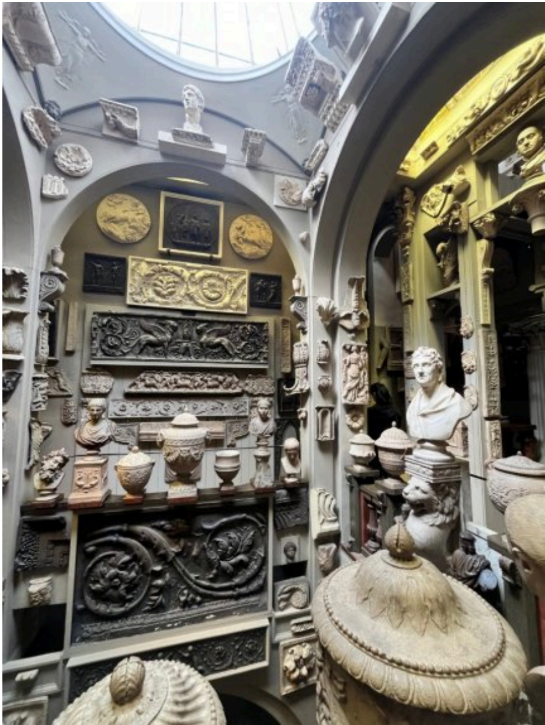
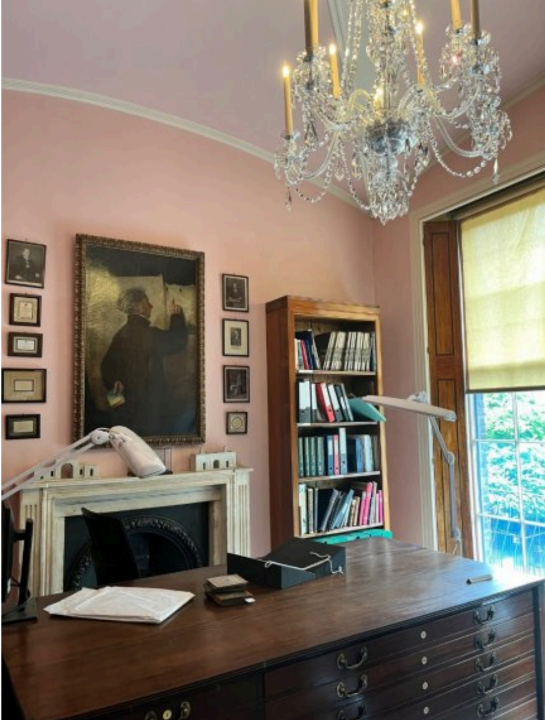
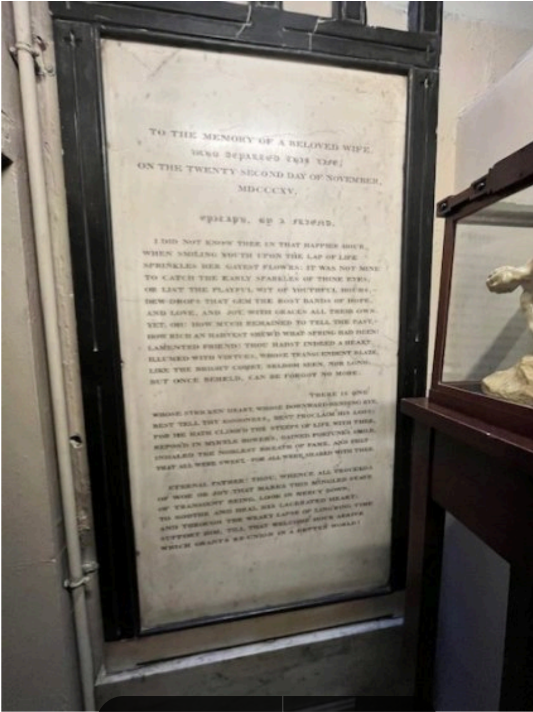
Middle: The office space of the Soane archives, next door to the Museum.
The final two days of my trip were occupied with visiting Hackney Archives, located in the CLR James Library in Dalston, with the intent of accessing material relating to the Aikin-Barbauld circle and their surviving connections to Warrington following the family’s move to Stoke Newington. Almost immediately however I was amazed to see how integrated this archive was within the area’s community library, with families and children freely exploring the collections, and the library’s summer reading challenge including an exercise prompting young readers to view archival items. This really helped demystify the archive for library users and gave off the impression that Hackney’s inhabitants are readily encouraged to explore their local histories, forming an example many archival sites across the UK might follow. The staff here were immensely friendly and helpful, and the items I selected proved very interesting indeed. Letters penned by Anna Laetitia Barbauld and her brother John Aikin delved into such topics as sugar boycotts, their shared web of dissenting contacts, and Annabella Milbanke’s impending (albeit doomed) marriage to Lord Byron.[10] Furthermore, this archive held a few commonplace books featuring Barbauld’s poetry, seen rather beautifully illustrated below.[11] Quite apart from the more organised documents by Thomas Whitby, Jane Field’s commonplace, like Woodward’s, seems to feature contributions from family and close friends, and as demonstrated, also features many decorative visual pieces, ranging from watercolour paintings, detailed pencil sketches, to insertions of engravings and postcards. This was not always spontaneous, however, as small pencil notes from Jane show she did plan to arrange her book in a particular way, inscribing “Draw an Ivy Wreath” on the head of the page below – but, as you can observe from the photograph, she didn’t always end up following these instructions!
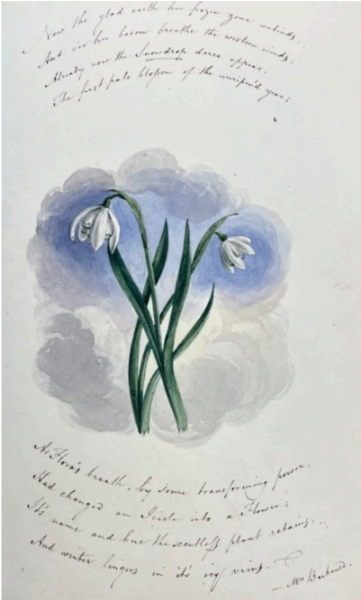
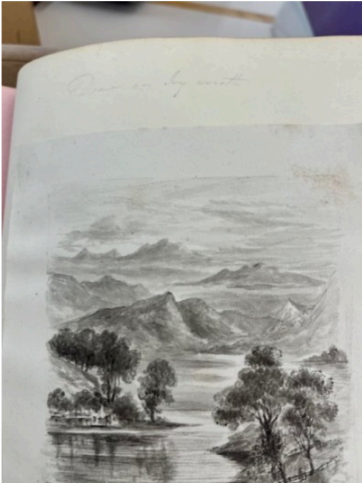
Barbauld’s short lyric ‘The Snowdrop’.
Besides this, the archives also yielded the entire spread of John Aikin’s Athenaeum (1806-1808), a magazine which commemorated many of his connections to writers across the transpennine region. In its poetry selection can be found works by Roscoe, Montgomery, the Liverpudlian sailor-poet Edward Rushton (1756-1814), and the labouring writer Charlotte Richardson (1775-1825), resident in York. This selection evidences the mixture of middling writers utilising a more conventional “polite” poetic register with the writings of labouring authors, though admittedly those with influential dissenting connections, many of them Aikin’s friends and associates across the country. Moreover, this magazine attests to the interest of liberally-minded nonconformists such as Aikin in literary matters alongside scientific, industrial, and commercial discourses. Each issue comes complete with an insight into contemporary ‘Arts, Manufactures, &c.’, involving such revolutionary advances as the development of coal-gas for lighting both industrial and urban sites. Here, literary discourse is not at odds with these more industrially-minded insights; in fact, this seems to have been a feature Aikin’s readers particularly enjoyed, with one commentator writing in 1807 to commend the Athenaeum’s inclusion of ‘curiosities in the manufactures of our country’, delighted to see that they have ‘a place along with the literary curiosities which adorn your pages’.[12] Far from being mutually exclusive, here literary production and industrial innovation are drawn into conversation with one another, displaying the faith in their synthesis which liberal dissenters such as Aikin espoused.
All in all, my visit to London as provided by BARS not only provided further evidence to help support the arguments presented in my thesis – especially those suggestive of the nationwide influence of regional authors, and the coexistence of literary and technological discourses – but also to add further nuance to my observations, with the full confidence of having utilised all of the resources available to me. I’d like to thank the BARS committee for making this journey possible, as well as the librarians and archivists at the Metropolitan Archives, the Natural History Museum, Sir John Soane’s House and Hackney Archives, who made it so easy and so enjoyable too! If any researchers of the Romantic perio find themselves considering other options for research besides larger collections at the National Archives or British Library, I truly can’t recommend these sites enough.
Roseanna Kettle is a recent doctoral graduate from the University of York's Centre for Eighteenth-Century Studies (CECS). Her research interests include poetry associated with regional Britain, the literature of industrialism, labouring-class literature, and regional cultures of reading in the Romantic period. She has a forthcoming book chapter on the poetry of labouring women in Yorkshire, projected for publication with Boydell & Brewer in Summer, 2025.
[1] London Metropolitan Archives, Thomas Whitby, Commonplace Book (undated MS, c. 1832-1844),
CLC/515/MS00202/001; for more on the purposes of commonplacing, see Roseanna Kettle, ‘The Commonplace Book of Edmund Pear (c. 1829 – 1834)’, Keats-Shelley Journal+ Special Issue: Commonplacing and Commonplace Books, vol. 1, ed. by Kacie L. Wills and Olivia Loksing Moy.
[2] Natural History Museum, Letter from Sir Joseph Banks to William Roscoe, c. Sept 1809, Botany Manuscripts, MSS ROS 180.
[3] Natural History Museum, Letter from William Roscoe to Dawson Turner, 20 May 1822, Botany Manuscripts, MSS ROS 4916.
[4] Natural History Museum, Samuel Pickworth Woodward, “Poetic Gleanings” (Commonplace Book, c. 1838), General Manuscripts, L. MSS WOO.
[5] Jillian M. Hess, How Romantics and Victorians Organized Information: Commonplace Books, Scrapbooks, and Albums (Oxford: Oxford University Press, 2022), p. 194.
[6] Sir John Soane’s Museum, Letter from Barbara Hofland to Sir John Soane, 31 March 1814, Correspondence of Sir John Soane III, H9. 7; Letter from Barbara Hofland to Sir John Soane, 10 Nov 1813, H9.3
[7] Letter from Barbara Hofland to Sir John Soane, 5 April 1814, H9.9; Letter from Barbara Hofland to Sir John Soane, 29 Aug 1816, H9. 28.
[8] Letter from Barbara Hofland to Mrs. Wreaks [undated, c. 1815], H9. 16, pp. 1-3.
[9] Letter from Barbara Hofland to Sir John Soane [undated, c. 1816], H9. 21.
[10] Hackney Archives, Letter from John Aikin Jr. to Anna Laetitia Barbauld, 20 Nov 1791, Letters and Associated Material from Stoke Newington Library, M3710, p. 2; Letter from John Aikin to J. Cooper Walker, 15 Apr 1799 M3712; Letter from Anna Laetitia Barbauld to Mrs. Taylor, 29 Dec 1814, M3732, pp. 2-3.
[11] Hackney Archives, Commonplace Book of Jane Field, 1834, M4388.
[12] Anonymous, “On Cotton Spinning”, The Athenaeum, a Magazine of Literary and Miscellaneous Information, 1 Jun 1807, vol. 1.6 (p. 571).