
As an avid fan of historical/Regency romance and period dramas more broadly, as well as a scholar of the long nineteenth century, I enjoy the world that Shonda Rhimes’ adaptation (2020-) of Julia Quinn’s Bridgerton book series (2000-2005) has created. I understand the critiques of the series being marketed as ahistorical or alternate from real societal issues of the time we would now consider the ‘Romantic era’, c. 1790-1850; though, from a purely entertainment aspect, Bridgerton as a series has certainly captured a large and engaging audience. Bridgerton, so far, has given viewers love interests for the eponymous siblings that are Black, South Asian, and now East Asian. This diversity enables the Bridgerton world to engage with England’s global connections and contexts (however, it has also led to the questionably magical erasure of racism by 1813 onwards, when the series is set). For the focus of this review, however, I will include some ways that Bridgerton’s fourth series engages with some recognisable Romantic context alongside some of my favourite moments:
(Some Bridgerton spoilers ahead, but mostly season four.)
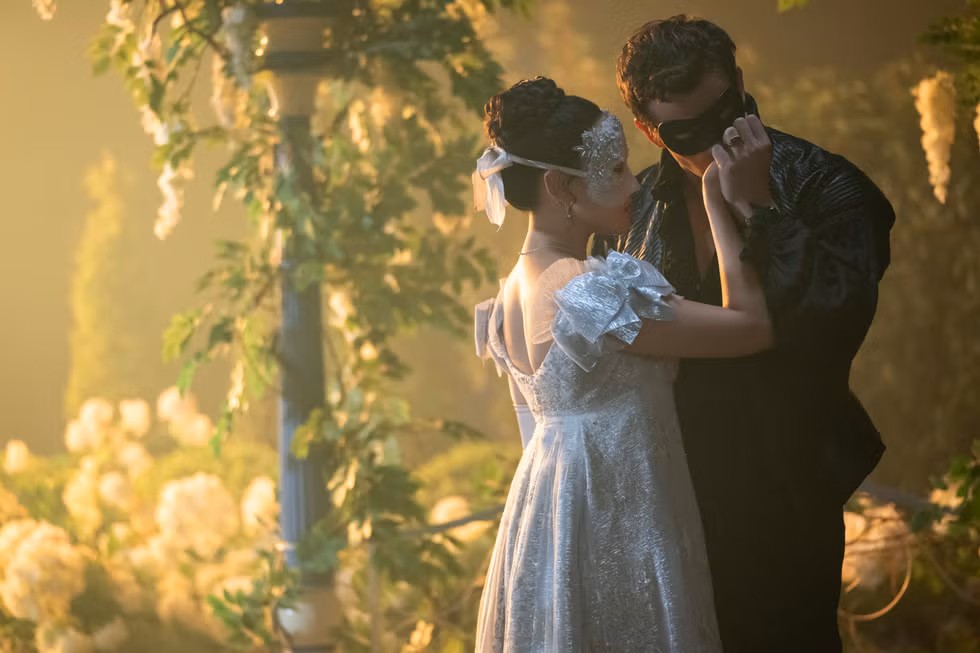
Inter-class relationships:
The focus of season four’s romantic plot is the second Bridgerton brother, Benedict, alongside his newly introduced love interest, Sophie Baek (the adapted version of the book’s Sophie Beckett), played by the incredibly talented Yerin Ha. Rhimes keeps the main plot of Benedict’s book, An Offer from a Gentleman (2001), and Sophie is introduced sneaking into Violet Bridgerton’s masquerade ball. As their romance grows, Benedict wishes to make Sophie his mistress (a status she repeatedly rejects). As the illegitimate daughter of the Earl of Penwood and a maid, she does not wish to subject a child she may have to the same fate. This inter-class relationship is much more dramatic than what is commonly featured in Romantic novels, but the trope echoes plots of Jane Austen. Austen features couples of various levels of wealth and status, though none so dramatic as what is portrayed in Bridgerton.
The marriage of Elizabeth Bennet and Mr Darcy of Pride and Prejudice (1813) is famously objected to by Lady Catherine de Bourgh, who claims such a match will cause ‘the shades of Pemberley to be thus polluted’. Unfortunately, Sophie has no Lizzie Bennet retort (‘He is a gentleman; I am a gentleman’s daughter; so far we are equal!’) to justify her relationship with Benedict, until Violet, Benedict’s mother, comes to the rescue and persuades Sophie’s stepmother agree to the lie that Sophie was actually a distant legitimate relative of the late Lord Penwood. Of course, then Sophie becomes Mrs Bridgerton and so all is well, like Lizzie becomes Mrs Darcy, despite the great protesting of Darcy’s aunt. Sophie’s story also has echoes of Austen’s Emma (1815). She most resembles Harriet Smith, who is introduced as ‘the natural daughter of somebody’. Harriet’s background similar to Sophie’s, though Harriet does not get so lucky as to marry a sexy Bridgerton brother.
The Lake Scene (or, Benedict as Byronic hero):
Benedict Bridgerton is the second-oldest brother, therefore the spare to the Viscount Bridgerton title, and a man who wishes to reject the norms of the ‘ton’. Benedict fits into the archetype of the Byronic hero. A key Romantic literary trope, D. Michael Jones defines the Byronic hero as having ‘an internal classlessness that is deepened by his exile from any recognisable domestic life’ and that ‘his class status […] is both haughtily aristocratic and sentimentally middle class’. Benedict, most notably, is torn between his duty and status as a member of the ‘ton’ and his allegiance to the Bridgerton family, and the freedom he wishes he had.
Benedict’s arc before series four has been exploring his persona as an artist who cannot commit to anything – or anyone. True to this nature, before he devotes himself to Sophie, Benedict sleeps around, constantly. Often with two or three lovers in his bed at a time. (It was a pleasant relief to me tha season four did not erase Benedict’s previously established bi/pansexuality, and a bigger relief still that Sophie unquestionably accepts Benedict’s coming out to her.)
Tying Benedict to a more modern iteration of Romanticism, he has a call-back to the infamous Mr Darcy lake scene of the 1995 Pride and Prejudice. Benedict, however, is completely naked - which for me further cements his status as a Byronic figure. Though Benedict is never truly exiled, as often Byronic heroes are, he seriously considers moving to the countryside with Sophie in order to have a relationship with her; the couple would have faced exile from polite society.
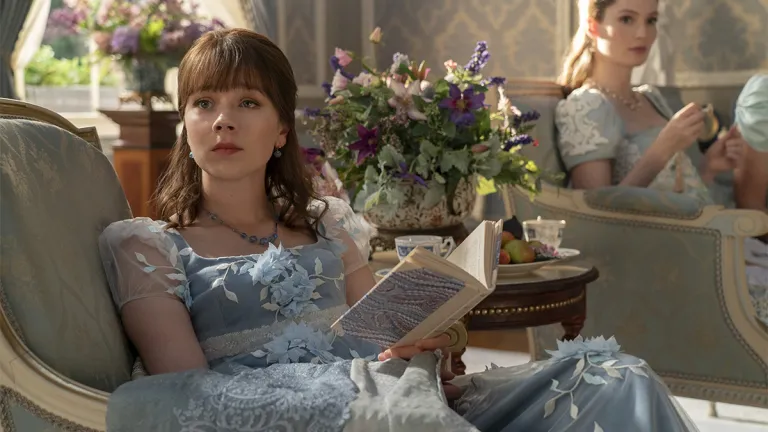
Eloise as Proto-Feminist:
In season three, Eloise Bridgerton is given a ‘silly novel’ to read by her brother Colin: Austen’s Emma. Bridgerton, it seems, is quite self-aware. Season four, however, features another Romantic reference, side character Cressida Cowper, informing Eloise that she has been reading Mary Wollstonecraft. Indeed, Cressida says that Elosie ‘would not stop talking about her’. Wollstonecraft’s Vindication of the Rights of Woman (1792) definitely seems like something that Eloise would enjoy and corresponds with the (proto)feminist views that the character exhibits.
If the rumours are true, and Eloise’s book will be the focus of the next season of Bridgerton, I look forward to seeing how her story unfolds with her relationship to such seminal texts of Romantic female empowerment, as well as what other Romantic connections the series will develop in the future.
Emma Butler is a PhD researcher in English Literature at Edge Hill University. Her thesis ‘From Health to Leisure: The Seaside Resort in the Nineteenth-Century Literary Imagination’ studies the representation of the coast as a liminal space in nineteenth-century literature in relation to literary depictions health/sickness, the working class, and the Gothic. Emma’s research interest spans the long nineteenth century, with a focus on the novels of Jane Austen and the medical humanities. She was recently the BARS Visiting Fellow at Chawton House for 2025, researching obscure Romantic period seaside-based novels and continuations of Austen's Sanditon.
She is on Instagram and BlueSky as 19thcenturyem.
Bridgerton Season 4 is now playing on Netflix.