
It is a truth universally acknowledged that a Jane Austen fan will wonder what happens to her characters beyond the scope of the novels. When asked by her nieces and nephews about what the future had in store for the secondary characters that hadn’t received as much attention in the – by then published – Pride and Prejudice, Austen is said to have told them a couple of things: Kitty married a clergyman, and Mary had to settle for marrying one of her uncle’s clerks. The answer ‘after the disappearance of her friend, Caroline Bingley found herself investigating a murder and uncovering a plot to smuggle goods traded by the East India Company,’ isn’t likely to have been one of the answers Austen gave her nieces and nephews. Yet, that is the precise scenario put forward by the recent novel by the Australian writers Kelly Gardiner and Sharmini Kumar, Miss Caroline Bingley, Private Detective.
The last few years have seen a surge in Austen-themed crime novels. One of the first of these was P. D. James’s Death Comes to Pemberley (2011), in which Wickham, by then six years into his marriage to Lydia, is accused of the murder of his friend Denny. Since then, other authors have been drawn to reimagining Austen’s characters as sleuths and detectives. In the Young Adult series Jane Austen Murder Mystery by Tirzah Price, Lizzie and Darcy – reimagined as competing solicitors – investigate a murder. In the Mr Darcy & Miss Tilney series by Claudia Grey, it’s the descendants of Lizzy and Darcy and Catherine and Henry from Northanger Abbey who investigate the mysterious death of Wickham himself. BARS spoke to Lucy Andrews earlier this year, as she discussed transforming Emma‘s Harriet Smith into a detective in her novel, A Very Vexing Murder. In novels like Jessica Bull’s Miss Austen Investigates it’s Austen herself who takes up the mantle and solves a murder.
While the idea of the Austen crime novel might seem odd, crime and romance share some decided similarities. Both are highly structured genres that move towards a happy ending: in romance, the final union of the lovers, while in a crime novel, the detection of the criminal and the restoration of justice and the social order. Both romances and crime novels are often considered “cosy”, in that they guide readers through to the inevitable. The idea of a woman detective in the Regency period also doesn’t stretch the imagination as much as we might assume. Sara Lodge’s recent book, The Mysterious Case of the Victorian Female Detective, shows how in a slightly later period there were cases of women working with the police and private agencies, some of which they managed themselves.
Turning to crime allows authors of Austen reimaginings to inquire into aspects of her novels that Austen mentions but doesn’t examine in detail. In our recent interview with Kelly Gardiner, she explained that the novel grew from her wish to explore how personality traits we see in Austen’s characters could flourish under extreme circumstances. Caroline is rational, a quality that attracted Gardiner to her, and which made her wonder: how would that capacity for reason – believed by some at the time to be anathema to femininity – help her decide whom to trust or not to trust as she seeks to bring a murderer to justice? The scenario of a murder investigation allows us to explore the darker side of the Regency period as well as the ways in which Austen’s beloved characters would hypothetically deal with this darker side.
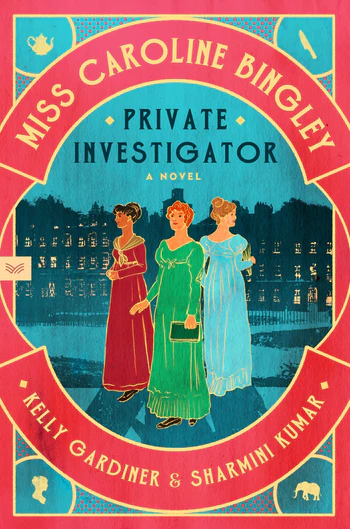
The foray into crime also allows novelists to explore other aspects of Austen’s world that exist at the margins of her novels. While Austen makes reference to the slave trade, empire and war, particularly in Mansfield Park, these allusions can easily be missed by the contemporary reader. However, crime novels can explore these elements of Regency society more fully, but within an entertaining framework that reminds readers of the pleasures of Austen’s novels.
In Gardiner’s novel, Caroline finds herself looking over a dead body of an assassinated Indian servant in the rooms of a greasy inn and fighting for her life in the docks of London after uncovering a smuggling and murder plot. Austen’s novels don’t go there for a reason. Adaptations of her novels usually don’t either. Take the recent season 4 of Bridgerton, in which we briefly see the interior of a (private) prison cell and a courthouse, only for the crime aspect of the storyline to be quickly discarded so that we can return to what we are all there for: the romance. The world of crime and punishment makes a quick appearance simply to generate some suspense before we return to the conclusion of the marriage plot. Yet, exploring the darker side just lurking underneath the poised respectability of Austen’s drawing rooms allows us a peek inside a Regency world that was, in many ways, grimy, dangerous and criminal.
Rita Dashwood and Stephanie Russo
We gratefully acknowledge the seed funding awarded to Dr Dashwood by the Partnership between Macquarie University and Ghent University, which supported the project ‘Classic Literature and History in Modern Popular Culture Adaptations,’ of which this article is an output.
Dr Rita J. Dashwood is a literary scholar and historian of the eighteenth and nineteenth centuries specialising in women’s literature and history. Her research is interested in how women have contested, negotiated, and shaped relationships to property and cultural heritage — tracing these dynamics across literary texts, historical archives, and their afterlives in popular culture. She is a Research Foundation – Flanders (FWO) Senior Postdoctoral Fellow at Ghent University. She is the author of the monograph Women and Property Ownership in Jane Austen (Peter Lang, 2022) and the duograph Reading the Romantic Ridiculous (Routledge, 2024), with Dr Andrew McInnes, and she is writing her third book, The Heiress: Single Women and Inheritance in British Literature and History of the long Nineteenth Century. You can follow Rita on BlueSky and Instagram via the links here.
Stephanie Russo is an Associate Professor of Literature at Macquarie University, Sydney. She is the author of The Anachronistic Turn (Routledge 2024) and The Afterlife of Anne Boleyn (Palgrave Macmillan 2020). She is currently completing work on the monograph Contemporary Counterfactual Fictions, to be published by Brill in 2027. She is the Editor of the Journal of Historical Fictions and a series editor of Brill’s Global Historical Fictions series. She works on historical fiction and biofiction, and is particularly interested in women’s historical fictions, historical horror, and the afterlives of female writers and artists. You can follow Stephanie on BlueSky and Instagram via the links here.