
Jonathan Gross is Professor of English at DePaul University. He was Joint-President of the International Association of Byron Societies and is the author of Byron: The Erotic Liberal (Rowman and Littlefield, 2001). His other publications include The Life of Anne Damer (Bloomsbury, 2013); editions of Georgiana, Duchess of Devonshire’s The Sylph (Northwestern, 2007), Anne Damer’s Belmour (Northwestern, 2012), and Georgiana, Duchess of Devonshire’s Emma, or the Unfortunate Attachment (SUNY, 2004); and Thomas Jefferson’s Scrapbooks (Steerforth, 2006). His monograph The European Byron: Mobility, Cosmopolitanism, and Chameleon Poetry, which we discuss below, was published by Anthem Press last year.
1) How did you first become interested in Byron’s European engagements?
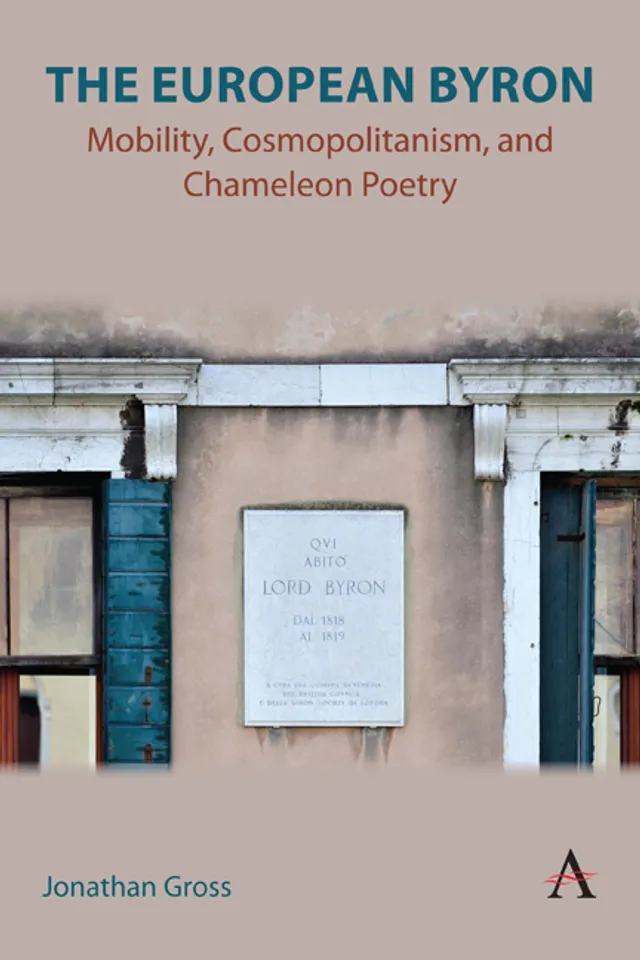
Byron conferences in Gdansk, Athens, Venice, Paris, and Valladolid prompted research in specific areas. On one occasion, I was waiting for a vaporetto and saw Byron’s name inscribed on a plaque in Venice; that influenced the cover of my book. Henry James’ The Aspern Papers and even novels based on Byronic figures prompted further research. Prof. Gregory Dowling was a great help in securing a visit to Byron’s Palazzo Mocenigo, providing opportunities to share insights at conferences that he helped organize.
2) How did you arrive at the book’s structure, with the first half examining Byron’s debts to European writers, and the second focusing on Adam Mickiewicz and Alexander Pushkin?
The structure was the hardest thing. I wrote papers on Byron over a ten-year period, starting with Prof. Naji Oueijan’s conference in Lebanon, for which I penned the marginalia essay (influenced by Alex Watson’s Romantic Marginality [2016]). Though many monographs and edited collections have been assembled on Byron’s European influence, with distinct chapters written by specialists in the field (Paul Graham Trueblood’s Byron’s Political and Cultural Influence in Nineteenth‑Century Europe [1981], Richard Cardwell’s Lord Byron the European [1997], Peter Cochran’s Byron’s European Impact [2015] and Nic Panagopoulos’s excellent and overlooked edited volume The Place of Lord Byron in World History [2013]), they do not always engage with Byron’s influence in Poland and Russia, which brought up issues of whether these countries see themselves as part of Europe. That led to the further question of what is Europe? Byron wrote a poem entitled “Mazeppa” that has had such a rich history, inspiring Pushkin’s “Poltava” and Pyotr Ilyich Tchaikovsky’s Mazepa. While specialists have much to say about a writer’s influence in a specific country, I wanted to take a cosmopolitan approach, and to see if that was possible after the Cold War. Prof. Maria Kalinowska helped arrange a lecture at the University of Warsaw which was crucial to the development of this book. I would be remiss if I did not thank Prof. Jerome McGann and Prof. Bernard Beatty, who read drafts and helped sharpen the structure, which was becoming dangerously inchoate.
3) What for you are the most important things we gain by considering Byron’s cosmopolitan European identity?
Byron’s ability to capture a country’s identity through a specific character—particularly his portrait of the Ukrainian hetman—offers a quicksilver history of Europe and how countries like Ukraine, Russia, and Poland were inspired by his nationalist example (“Who would be free themselves must strike the blow?/ Will Gaul or Muscovite redress ye? No!” [Childe Harold’s Pilgrimage 2:76]). The fact that he appealed to writers as distinct as Mickiewicz and Pushkin demonstrates his cosmopolitan appeal. Byron’s influence does not end in Italy or Greece. His “Vision of Judgement” showed how irreverent he could be towards George III; Pushkin, in turn, implicitly criticized czarist censorship of his works. Mickiewicz’s Forefathers’ Eve (1832) anticipates Pushkin’s “The Bronze Horseman” (1833), with both works addressing imperial power and Czar Peter the Great. Like no other British writer, perhaps, Byron inspired painters (Eugène Delacroix), musicians (Hector Berlioz), and sculptors (Bertel Thorwaldsen). In North America, Byron influenced Frederick Douglass’s The Heroic Slave, which includes epigraphs from Thomas Moore and Byron. During the Harlem Renaissance, many writers visited Pushkin’s statue, such as Langston Hughes, winning prizes named after the Russian poet sponsored by Opportunity Magazine (Arna Bontemps won in 1926 and 1927). I trace some of these influences to the racial politics of Byron’s “The Island” or the stanzas on political freedom in “The Giaour” and “Childe Harold’s Pilgrimage”. Writers adopted Byron’s sartorial style, his witty repartee, and his dashing improvisational methods, especially Mickiewicz, who translated “The Giaour” and “Darkness” (Ciemność ), and Pushkin, who was fascinated by Byron’s sacrifice in Greece. I studied Polish for three years, rather unsuccessfully I might add, to help the book along. I was amazed and humbled by the standard of scholarship on Pushkin and Mickiewicz (A Different Mickiewicz by Michal Kuziak [2022] comes to mind), and the work of such critics as Mirosława Mozdrewska (especially Poland’s Angry Romantic [2009], which she edited with Peter Cochran and Bill Johnston). Prof. Mozdrewska has written about Byron’s influence on the Solidarity movement in Poland, especially Adam Mickiewicz’s translated lines from Byron which were pinned to a monument in the Gdansk shipyards; she arranged a spectacular conference in Gdansk that inspired me to study Polish. Maria Janion’s important work underpins many of the arguments I make in the second half of the volume.
4) What were your most surprising discoveries while researching and writing this book?
I was surprised to learn that Adam Mickiewicz’s Konrad Wallenrod had its premiere in St. Petersburg; his future mother-in-law Maria Szymanowska provided musical settings, some of which were sung by his future wife and Maria’s daughter, Celina. Music and politics intertwine. I was surprised by the friendship between Frédéric Chopin and Mickiewicz during their Parisian exile; the origins of Pan Tadeusz, written in Paris, and its debt to Byron’s Don Juan; the relationship between Pushkin’s “Poltava” and Byron’s “Mazeppa”, and what that has to teach us about the current situation in Ukraine; and the links between “Eugene Onegin” and Don Juan, rarely discussed in British books on Byron. The Chopin/Mickiewicz/George Sand circle was also fun to explore, as were Mickiewicz’s mysticism, Towianism and Frankism, and his death while raising a Jewish battalion during the Crimean War. I think George Sand’s reading of Mickiewicz’s Forefathers’ Eve and its relationship to Byron’s Manfred is important to consider. Through a strange coincidence, I happened to visit Mickiewicz’s grave in Istanbul (thanks to Prof. Piya Pal Lapinski’s research) on the anniversary of his death, which inspired the second half of my book and my further focus on Adam Mickiewicz’s writings. I then visited archives in Warsaw, Paris, and Lithuania, struck by Mickiewicz’s expulsion from college because of the Philomath society (1817), his arrest, and the documentation of that in Forefathers’ Eve. Finally, I was amazed at Mickiewicz’s range of reference: his friendship with Margaret Fuller, editor of The Dial, who met Mickiewicz in 1847, and his references to Ralph Waldo Emerson and James Fenimore Cooper’s The Spy, as well as his famous, ground-breaking lectures at the Sorbonne on Slavic studies. Of course, Polish schoolchildren and scholars such as Warclaw Lednicki and Czesław Miłosz (The Land of Ulro) have known about him for a long time! I had much catching up to do.
5) What new projects are you currently working on?
I am working on a project on women, hip hop and their relationship to Mexican muralism, especially as manifested in Los Angeles by the work of Judy Baca, Barbara Carrasco, and film-maker Agnes Varda (Mur Murs). As a New Yorker, I was influenced by the graffiti movement of the 1980s; this project traces democracy on the walls to Chicana muralists, and draws on my previous book, Words of the Prophets (Brill, 2023). Words of the Prophets includes a discussion of Byron’s inscriptions at the Temple of Poseidon at Sounion, and Blake’s fascination with “America”, a topic treated by José Clemente Orozco’s “The Epic of American Civilization”.