Call for Papers. John Thelwall: Radical Networks and Cultures of Reform 1780-1820

      Comments Off on Call for Papers. John Thelwall: Radical Networks and Cultures of Reform 1780-1820

CfP for the Second International Conference of the John Thelwall Society which will be held in Derby in July 2017 (deadline 31 January).

Call for Papers:

John Thelwall: Radical Networks and Cultures of Reform 1780-1820

July 21-23, 2017

For its second international conference, the John Thelwall Society, in collaboration with the University of Derby, invites papers on Thelwall within interlinked regional networks of activism, sociability, dissent and reform in Britain 1780-1820.

Recent years have seen increased interest among scholars and local historians in the“conversable worlds” (Mee) of the Midlands Enlightenment and its groundbreaking intersections of politics and poetry, religion and science, doctors and dissenters, pedagogues and visionaries. As a radical polymath and itinerant lecturer, John Thelwall moved between and spoke to all of them, not only in the Midlands.  From Devon to Wales, Norfolk to Scotland, Ireland to France, Roman history to elocution, he planted the liberty tree by other names, giving voice to hope and binding together scattered communities of reform. At a time of war and repression, in the face of nationalist dogma, Thelwall championed egalitarian connections and transnational solidarities that continue to offer a way forward in our own dark times (Poole).

Representative of these regional intellectual centres, Derby, the conference location, lies at the heart of the Derwent Valley World Heritage Site, a cradle of the Industrial Revolution. The home of visionary scientists and artists, revolutionary inventors and industrialists, outspoken Philosophical and Political Societies, and the Pentrich rebellion (whose 200th anniversary the conference also commemorates), it also hosts the Derby Manuscript, the trove of Thelwall poetry whose discovery draws attention to his importance in radical networks, and theirs to an understanding of his career.The conference will celebrate this discovery through a special exhibition of the manuscript. Other highlights include excursions to sites related to the industrial revolution, Thelwall and notable residents of Derby (including Erasmus Darwin and Joseph Wright), and a radical pub night with songs and toasts in the very room where the Derby Political Society delivered its notorious 1792 Revolution Address. And of course, there will be a lively two-day program of talks, panels and keynote lectures.

The JTS invites proposals for papers or sessions on any aspects of, or relationships between, Thelwall, other radical figures like Paine, and/or reform networks in Derby or elsewhere in Britain. Contributions are welcome from all disciplines and need not focus expressly on Thelwall. Topics might include (but are not limited to):

  • Erasmus Darwin and the Derby Philosophers
  • the Derby MS and/or the relationship of poetry, politics and performance
  • the role of women in radical (and/or scientific, philosophical, artistic) networks
  • the relationship of religious and political dissent
  • Joseph Wright and/or the role of the arts in philosophic/scientific/radical circles
  • The Pentrich Rising
  • Paine and/in Derby
  • Thelwall’s lectures: politics, history, elocution
  • radicalism and reform: continuities and/or schisms 1780-1820
  • Toryism, loyalism, reaction
  • education and the dissenting academies

Please send proposals of no more than 300words to K.Hindmarch@derby.ac.uk no later than 31stJanuary 2017.

Call for Papers. Romantik: Journal for the Study of Romanticisms

      Comments Off on Call for Papers. Romantik: Journal for the Study of Romanticisms

See below for a CfP from NARS (Nordic Association for Romantic Studies).

CALL FOR PAPERS: Romantik: Journal for the Study of Romanticisms, vol. 6.

The forthcoming 2017 issue welcomes all article submissions that fit within the general scope of the journal.
 See here for submission guidelines.

DEADLINE: 1 March 2017 (full articles).

Questions and article suggestions based on abstracts may be directed to Robert W. Rix.

Romantik: Journal for the Study of Romanticisms is a multi-disciplinary journal dedicated to the study of romantic modes of thought. The articles range over the full variety of cultural practices, including the written word, visual arts, history, philosophy, religion, music and theatre during the romantic period (c. 1780–1850). Since the romantic era was characterised by an emphasis on the vernacular, the title of the journal has been chosen to reflect the Germanic root of the word. We emphasise that the journal is interested in all European romanticisms – and not least the connections and disconnections between them – hence, the use of the plural in the subtitle.

Romantik is a double blind peer-reviewed academic journal, published once a year. The journal promotes innovative research across disciplinary borders. It aims to advance new historical discoveries, forward-looking theoretical insights and cutting-edge methodological approaches.

We look forward to seeing and publishing your work.

– The Romantik editors.

Research Society for Victorian Periodicals: Forthcoming Awards

      Comments Off on Research Society for Victorian Periodicals: Forthcoming Awards

Print-culturally focused Romanticists might be interested to know that January the 31st is the closing date for two of the Research Society for Victorian Periodicals’ major awards – the Peterson Fellowship for original individual research on aspects of Victorian periodical literature, and the Field Building Award for collaborative research.  Details of the awards can be found at the Society’s web site: rs4vp.org/.

BARS Stephen Copley Research Awards 2017

      Comments Off on BARS Stephen Copley Research Awards 2017

Please see the details below for how to apply for a BARS Stephen Copley Research Award. Contact Dr Daniel Cook (d.p.cook@dundee.ac.uk) for further information and enquiries.

Stephen Copley Research Awards

Postgraduates and early career scholars working in the area of Romanticism are invited to apply for a Stephen Copley Research Award. The BARS Executive Committee has established the bursaries in order to help fund expenses incurred through travel to libraries and archives, up to a maximum of £300. A postgraduate must be enrolled on a doctoral programme in the UK; an early career scholar is defined as someone who holds a PhD (from the UK) but has not held a permanent academic post for more than three years by the application deadline. Application for the awards is competitive, and cannot be made retrospectively.

Successful applicants must be members of BARS before taking up the award. The names of recipients will be announced on the BARS website and social media, and successful applicants will be asked to submit a short report to the BARS Executive Committee within four weeks of the completion of the research trip and to acknowledge BARS in their doctoral thesis and/or any publication. Previous winners or applicants are encouraged to apply again.

Please send the following information in support of your application (up to two pages of A4 maximum in word.doc format):

  • Your full name and institutional affiliation (if any).
  • The working title and a short abstract or summary of your PhD or current project.
  • Brief description of the research to be undertaken for which you need support.
  • Estimated costing of proposed research trip.
  • Estimated travel dates.
  • Details of current or recent funding (AHRC award, &c), if applicable.
  • Name of one supervisor/referee (with email address) to whom application can be made for a supporting reference on your behalf.
  • Name and contact details (including email address and Twitter handle) of whomever updates your departmental website or social media, if known. And your Twitter handle, if applicable.

Applications and queries should be directed to the bursaries officer, Dr Daniel Cook (d.p.cook@dundee.ac.uk) at the University of Dundee. The deadline for applications is 1 February in any given year. Please note the new deadline for this scheme.

You can go to the BARS website and read earlier blog posts to see reports by previous winners of this award.


On This Day in 1816: 10th December and the tragic death of Harriet Shelley

      Comments Off on On This Day in 1816: 10th December and the tragic death of Harriet Shelley

We welcome Francesca Blanch Serrat to the BARS blog for the second time; Francesca is a pre-doctoral student and has written the following post on Harriet Shelley. She recently graduated in English Studies with a minor in Gender Studies from Universitat Autònoma de Barcelona. Her areas of research include minor women writers of the eighteenth century and British and French Romanticism. She is on Twitter.

We are always looking for new contributors. If you’d like to write something on literary/historical events in 1817, please contact anna.mercer@york.ac.uk. We also welcome proposals from those who wish to write about 1817 more generally, and not about a specific date. We hope you are enjoying this series!

The Life and Death of Harriet Westbrook Shelley

On this day, December 10th, two hundred years ago, the body of Harriet Shelley, née Westbrook, was recovered from the Serpentine in Hyde Park. It was a pensioner of the Chelsea Hospital, John Levesley (Shepherd, 2013) who saw the corpse floating in the lake and alerted the authorities. After the inquest, it was discovered that the remains belonged to a Harriet Smith (she had taken lodgings under that surname), who had disappeared a month before. She was pregnant when she took her life. The following is an account of the circumstances that led Harriet, the first wife of Percy Bysshe Shelley, to her suicide.

The Serpentine, Hyde Park section of "Improved map of London for 1833, from Actual Survey. Engraved by W. Schmollinger"

The Serpentine, Hyde Park section of “Improved map of London for 1833, from Actual Survey. Engraved by W. Schmollinger”

After a few weeks in Edinburgh, the newlyweds spent their first three years as husband and wife travelling: initially they moved to York, and then to Keswick, where Shelley began writing to William Godwin. After a while the Shelleys travelled to Ireland – Percy had noble revolutionary intentions that were not so well received by the Irish (Gilmour, 2002) – and on their return they established themselves in Wales before moving shortly to North Devon and back. In 1812, they went to London, where they finally met Godwin and his family, with the exception of Mary Wollstonecraft Godwin (later Shelley), who was in Scotland.

After that, Percy and Harriet moved to Wales, and then returned to London, where Harriet gave birth to a girl, Ianthe. By 1814, Harriet, Ianthe and Eliza (Harriet’s sister) were finally established in Windsor while Percy wandered, visiting London and meeting with friends, including Godwin and, finally, Mary. Even though Percy and Harriet married again under English law around this period, his visits became less frequent, until he eventually stopped seeing his – now once more pregnant – wife.

Harriet's husband, the poet Percy Bysshe Shelley

Harriet’s husband, the poet Percy Bysshe Shelley

During these months of estrangement, Percy began a relationship with Mary Godwin, who was to become his wife and companion. Their relationship flourished in the following months, despite Godwin’s disapproval and Harriet’s desperation. Finally, Percy eloped with Mary and her stepsister Jane (later Claire Clairmont) to the continent. It attests to his lack of maturity and irresponsible idealism that Percy wrote to Harriet from Switzerland, inviting her to join him and his lover in Europe, and to bring money with her (Hay 2011:32). At this request, she was beside herself. Even if Harriet was not economically strained (she received £200 from her father, and £100 from Shelley), she must have been emotionally traumatised as an abandoned pregnant mother.

Harriet returned to her father’s house with Ianthe and Eliza, and gave birth her second child, Charles. The Westbrooks took care of the situation as best as they could: they sent Ianthe and Charles to the countryside, which one might think could have added to their mother’s torment. Eventually, Harriet left her father’s house and took lodgings in Hans Place, Knightsbridge. It is possible that this decision was motivated by her pregnancy, but we cannot know whether she was trying to conceal it from her family, or if it had been her family’s idea, to shield her from further gossip.

On December 12, 1816, this notice appeared in The London Times:

   “On Tuesday a respectable female, far advanced in pregnancy, was taken out of the Serpentine river and brought to her residence in Queen Street, Brompton, having been missed for nearly six weeks. She had a valuable ring on her finger. A want of honour in her own conduct is supposed to have led to this fatal catastrophe, her husband being abroad.”

Harriet's suicide letter. Bodleian Libraries, Oxford.

Harriet’s suicide letter. Bodleian Libraries, University of Oxford.

Later, Harriet’s last letter, addressed to her sister, was found. It read as follows:

“To you my dear Sister I leave all my things as they more properly belong to you than any one & you will preserve them for Ianthe . Hog bless you both My dearest & much belod Sister

Sat. Eve.

When you read this letr. I shall be [no] more an inhabitant of this miserable world. do not regret the loss of one who could never be anything but a source of vexation & misery to you all belonging to me. Too wretched to exert myself lowered in the opinion of everyone why should I drag on a miserable existence embittered by past recollections & not one ray of hope to rest on for the future. […] God bless & watch over you all. You dear Bysshe [Percy, her husband]. & you dear Eliza. May all happiness attend ye both is the last wish of her who loved ye more than all others. My children I dare not trust myself there. They are too young to regret me & ye will be kind to them for their own sakes more than for mine. My parents do not regret me. I was unworthy your love & care. Be happy all of you. so shall my spirit find rest & forgiveness. God bless you all is the last prayer of the unfortunate   Harriet S–––” [i]

Harriet’s death, subject to a great deal of speculation ever since, is, if anything, an example of the situation in which married women found themselves in eighteenth-century England, tied to the decisions and whims of their husbands, for better or for worse. Percy’s irresponsibility lead Harriet to a situation of social vulnerability he seemed not to fully understand.


Bibliography

Harriet Shelley’s Suicide Letter. Bodleian Libraries, University of Oxford.

Gilmour, Ian. The Making of the Poets: Byron and Shelley in Their Time. London: Pimlico, 2002.

Hay, Daisy. Young Romantics: The Shelleys, Byron an Other Tangled Lives. London: Bloomsbury, 2011.

Shepherd, Lynn. “‘This fatal catastrophe’: The sad life and strange death of Harriet Shelley”  [consulted 22/11/16].

The BARS First Book Prize 2017

      Comments Off on The BARS First Book Prize 2017
Readers

The British Association for Romantic Studies

is delighted to announce

The British Association for Romantic Studies First Book Prize, 2017

Awarded biennially for the best first monograph in Romantic Studies, this prize is open to first monographs published between January 2015 and January 2017.  In keeping with the remit of the British Association for Romantic Studies, it is designed to encourage and recognise original, ground-breaking and interdisciplinary work in the literature and culture of the period 1780-1830.  The prize will be awarded to the value of £250 and will be presented at the BARS biennial conference, ‘Romantic Improvement’, to be held at the University of York in July 2017.

Eligibility and nomination procedures

The competition is open to scholarly monographs by authors who have not published a monograph before.  Books must be nominated through the BARS membership.  Nominations should attest to the importance of the book within the field, detailing its particular strengths and describing the nature of its original contribution.  They should be no longer than one side of A4 in length.  Please send nominations to the Secretary of BARS, Helen Stark (h.stark@qmul.ac.uk), by the closing date, January 31, 2017.  The BARS Executive will provide the panel of judges, which will be chaired by Professor Nigel Leask, University of Glasgow.


Editorial Transitions II

      Comments Off on Editorial Transitions II

Editorial Transitions        

To all members of BARS, and readers of the blog –

I am honoured to take up the position of Blog Editor. I am now your first point of contact for the following areas of the blog (Matthew Sangster will continue to edit the ‘Five Questions’ series):

  • Calls for papers
  • Conference reports
  • The ‘On This Day’ series
  • Stephen Copley Award research reports
  • All other general notices

If you have any ideas about a new series of posts related to the study of Romanticism that we could potentially set up in 2017, please do not hesitate to get in touch with me. One-off posts are also welcome.

Don’t forget to follow us on Twitter for all the latest blog updates; you can also the join the British Association for Romantic Studies Facebook group.

I’d like to extend a special thank you to Matt for training me up for this role, and allowing me to curate the ‘On This Day’ series, which has now been running for over a year, and which I’ve thoroughly enjoyed doing (we are still seeking posts for 2017!). Thank you also to the contributors we’ve had on all the different strands of the blog. Your work is what makes the blog a success, and I hope to continue to help BARS members, and others, to provide great online content for the benefit of our readers.

Any questions or ideas send them my way.


– Anna Mercer (PhD candidate, University of York)

Editorial Transitions

      Comments Off on Editorial Transitions

Over the past few years, BARS has begun to conduct a lot more of its activities online – as well as the website, we now have this active blog, the BARS Exchange, The BARS Review and our social media accounts on Twitter (which I co-run with Dan Cook) and Facebook.

Keeping all of these things updated at this point is a rather bigger job than it was when I originally took up the position of Website Editor, so the Executive has decided to appoint a second person to edit the blog so that I can work on improving our (somewhat ancient) main website and continue enhancing the Review.  From this point forward, therefore, Anna Mercer – who you’ll already know from the long-running series of On This Day posts that she’s curated – will be taking over the editorship here.  She’ll now be the first point of contact for submitting material for posting and for conference reports, as well as for On This Day.  She’s been a joy to work with over the past year, so I’m very glad to be placing the blog in an extremely capable pair of hands.

I’ll still pop up here occasionally and will keep editing the Five Questions series for the moment, but over the next few months, I’ll be turning my attention to the main site in order to try and make this a better resource for the association.  If anyone has suggestions about things that they’d like to see as part of an updated site, I’d be very grateful to hear these.

Five Questions: Emma Peacocke on Romanticism and the Museum

      Comments Off on Five Questions: Emma Peacocke on Romanticism and the Museum

romanticism-and-the-museum-cover

Emma Peacocke is currently a Banting Post Doctoral Fellow at Queen’s University, Ontario.  Before moving to Queen’s, she completed her PhD at Carleton University.  She has published articles and book chapters that examine historiography, circulation, periodical culture, collecting and visual culture and that deal with figures as diverse as Walter Scott, William Paley, William Buckland and Thomas Moore.  Her first monograph, Romanticism and the Museum, which draws together many of these interests and which we discuss below, was published by Palgrave Macmillan in 2014.

1) How did you come to decide that you wanted to write a monograph on museums in the Romantic period?

It happened in a coup de foudre as I was reading The Wanderer, Frances Burney’s final novel, published in 1814.  The heroine, Juliet, is fleeing in disguise from her forced marriage to a murderous Jacobin ruffian, so you can imagine how anxious she is throughout the novel.  Near the climactic showdown, her eccentric elderly protector Sir Jaspar Harrington decides on a whim to pass Juliet off as his grandchildren’s new nursemaid and have her shown all around the glorious art collection at Wilton.  Juliet feels so harried and miserable that she has almost lost the will to live – she is in a “torpid state” of “morbid insensibility.”  However, one object is so powerful that it can reawaken Juliet to herself and even to a moment’s pleasure: the “fascinating picture” by Van Dyck of Charles I and his family, with its “extraordinary attraction.”  One chapter later, the experience of seeing an artwork indoors, in a very museum-like setting, is paralleled with wandering among the stupendous and sublime ruins of Stonehenge.  It turned my idea of what Romanticism is and what Romantic authors valued on their head.

Lots of historians and art historians, including Linda Colley, read the eighteenth-century stately homes that opened their doors to the general public as precursors to, or stand-ins for, public museums, so looking at the proto-museums and newly minted public museums of the Romantic era suddenly seemed like a very promising way to see something new in Romantic literature.  Carol Duncan’s Civilizing Rituals has a very powerful passage comparing art museums with the ambulatories of medieval cathedrals, pathways that pilgrims could follow to gain a closer understanding and bond with figures like Christ.  This really strengthened my decision to write about museums in the Romantic period – it’s such an eloquent testimony to their significance and puissance.

2) How did you select the four case studies (Wordsworth’s Prelude, Scott’s Waverley, Edgeworth’s Harrington and the discourse around the Elgin Marbles) which form the cores of your chapters?

It sometimes felt as though they chose me!  I was reading Ormond, by Maria Edgeworth, because I wanted an Irish Tale to read on my first trip to Ireland, and so I was originally going to write on Ormond rather than Harrington.  There’s an extraordinary scene in Ormond in front of the now lost portrait of Marie Antoinette by Gautier-Dagoty; the eponymous hero’s Anglo-Irish identity suddenly comes becomes completely clear to him, as his reactions to the portrait differ so markedly from his French friends’ more demonstrative response.  Edgeworth wrote these two novels as companion pieces, when her father was dying and was desperate to see just one more work of his daughter’s in print, and she needed to come up with enough text to fill three volumes.  I only read Harrington in the first place to do my due diligence about Ormond, but it completely captivated me and it is even more about scenes of representation, display, and the national imaginary than Ormond.  So it seems a bit serendipitous – but it also testifies to the ubiquity of museums and galleries in Romantic writing.

I always knew that I would need to write on the discourse around the Elgin Marbles, because the Marbles sparked the largest museum-based controversy of the Romantic period.  I think that it set the terms for centuries to come on questions of provenance and the ethics of museum acquisitions.  That chapter felt the hardest to structure, because it was really led by the topic, whereas all the other ones had been led by the texts whose settings had complexities and nuances that I wanted to tease out.  Keats’s “On Seeing the Elgin Marbles” is among the greatest of ekphrastic poems – but despite its clear relevance, I didn’t spend very much time on it, because I didn’t have much to say to amplify its meanings.  Of course, just a few weeks ago, when I was teaching this poem, I found myself saying that perhaps Keats simply physically couldn’t describe the statues in great detail; the Elgin Marbles had attracted one of the earliest crowds to visit the British Museum, and perhaps he and Haydon had trouble getting and remaining close enough to the sculptures to support a traditional ekphrasis.  There’s always room for new insights!

3) Did you find that museums principally served as useful foci for discussions of particular concerns, or did they serve as flexible metaphors, easily repurposed by different auditors?

In each text that I wrote about, the museum becomes the place where authors represent the nation to itself.  That is the major concern for which the museum provides the ideal locus; however, each author and each text easily repurpose the museum to talk about a different aspect of that representation, and they often focus on a different aspect of the museum, too.  Scott uses portraiture and changes in the nature of gallery display to talk about the nation’s history and the profound differences between past and present.  Horace Smith imagines the Parthenon’s statues in the British Museum coming to life; while overtly they are talking about defamation in Classical Athens, it’s quite clear that Smith has the ancient statues uttering a veiled critique of the current British press.

I think that Wordsworth may have been most invested in how his readers – or the “auditors” of his poetry – could repurpose his museum settings and images.  Wordsworth loves writing about art display during the French revolution because he can powerfully testify to how utterly the Revolution changed everything, but doesn’t have to commit himself to saying whether the changes are largely for good or ill.  Wordsworth’s narrator has a rapturous moment like a pre-Revolutionary Grand Tourist in front of Charles Le Brun’s Penitent Magdalene before the painting was nationalized – as his auditors, we aren’t sure if Wordsworth would like to turn the clock back on the French Revolution, or whether he is delighted that the painting has become accessible to more and more people.  Byron, by contrast, comes out swinging against George IV in Don Juan, saying that even his fossilized remains will seem so monstrously large as to be inhuman to museum-goers in the distant future.  There’s no way that Byron wants to exploit the way that auditors could repurpose museum-based metaphors.

4) To what extent did the literary and visual forms in which writers addressed museums change the ways in which they were employed and represented?

You raise a really good point here.  I wonder if there wasn’t often a bit of a time lag between the most highbrow of Romantic visual arts and Romantic literature.  My theory is that authors wanted to refer to an accepted canon of taste, so that when they invoked a work of art, its significance would be stable and well-established to readers.  For instance, in Eighteen Hundred and Eleven, Barbauld write that “Reynolds [shall] be what Raphael was before” – yet Sir Joshua Reynolds, the brilliant founder of the Royal Academy, had been dead since 1792.  Most of the artworks that my authors place in their texts date from previous generations, from Periclean Athens through the Renaissance and the 17th and 18th centuries.

As for the literary forms of Romanticism itself, it was an age that married wonderful periodical essays on art with the nascent form of the guidebook.  William Hazlitt’s Sketches of the Principal Picture-Galleries in England began as a series of articles in the London Magazine; the critic generally dedicated one essay to each gallery, which seems like a practical way to keep up with print deadlines.  Hazlitt then published his essays in collected form as a book. Its organization makes it very convenient for gallery-goers, who can consult the relevant chapter for that gallery. By contrast, George Walker’s Descriptive Catalogue of a Choice Assemblage of Original Pictures (1807) gives all kinds of valuable information about various paintings – but doesn’t organize them at all geographically or by collection.  Hazlitt’s Sketches have a kind of user-friendliness that makes seeing, understanding, and studying the artworks in museums seem less daunting.  That change in representation is quite closely linked to the literary form of the Romantic periodical.

I’m going to leave it to another scholar to talk about the new literary and visual forms in William Blake’s work!  House museums, like the Jane Austen’s House Museum at Chawton, are very common commemorations of Romantic authors.  Blake, however, made his family home at 28 Broad St. into a museum during his lifetime, holding an exhibition of his own watercolour and tempera paintings there in 1809.  Someone really ought to write a study on Blake and Romantic museums.

5) What new research projects are you presently working on?

My present project is on Romanticism and the University.  One can never have too many institutions of education in one’s life!  University reform was a huge topic for Romantic periodicals like the Edinburgh Review from about 1808 onward, and the colleges of the University of London were founded in 1826, so it’s an era of great introspection and change.  There’s also extraordinary figures like Thomas Campbell, a highly popular poet who became a magazine editor, a popular lecturer, a founder of the University of London and Rector of the University of Glasgow.

Another part of my project is to look at undergraduate writing from Romantic universities.  The poems that students wrote for prizes, like the Newdigate Prize, were highly valued; when a commercial press collected and printed them, they sold like hotcakes and went swiftly into a revised second edition, but that is a whole tranche of acclaimed poetry that we don’t really look at today.  Jeffrey Cox, in Romanticism in the Shadow of War, is the only scholar whom I know of who analyses any of these poems at all.  I’m also looking at student-run periodicals; the University of Edinburgh had an imitation of Blackwood’s that is often, in my opinion, much funnier than the original, and even contains an article about better ways to find cadavers for the medical school, years before the nefarious activities of Burke and Hare came to light.

My study also takes in universities as, rather like museums, being the sites of pilgrimage.  I focus on the Shelley Memorial at University College, Oxford, and the story it tells us about the poet’s reception history.  It’s delightful to be able to keep a strong visual and architectural component in my work!

On this day in 1816: 17 November, Marriage, Scandal and the Death of a Lover

      Comments Off on On this day in 1816: 17 November, Marriage, Scandal and the Death of a Lover

The ‘On This Day’ series continues with a post by Brianna Robertson-Kirkland (University of Glasgow).

Brianna completed her PhD in 2016 (funded by the College of Arts Internship Scholarship). Her research examines the 18th century castrato singer Venanzio Rauzzini and the education and career of his operatic students. She regularly performs in solo recitals and has taken part in masterclasses with Emma Kirkby, Robert Toft and Nicholas Clapton. She was part of a recording project for The Centre for Robert Burns Studies, which was also filmed as part of the BBC documentary Burns, My Dad and Me, that aired in 2016.

As always, if you’d like to contribute to this series with a post on literary/historical events in 1816/1817, please contact Anna Mercer.

On this day in 1816: 17 November, Marriage, Scandal and the Death of a Lover

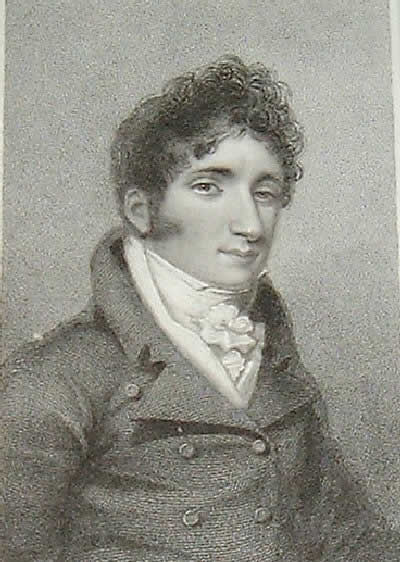
Figure 1: John Braham as "Lord Aimworth", steel line engraving by Thomson/Foster, 1818, Wikicommons

Figure 1: John Braham as “Lord Aimworth”, steel line engraving by Thomson/Foster, 1818, Wikicommons

On 17 November 1816, the eminent British tenor John Braham (1774-1856) was married to the young and wealthy Frances Elizabeth Bolton of Ardwick (1799-1846). Though Braham was 25 years her senior (he was aged 42, while Miss Bolton was 17) the marriage appeared to be a happy one, producing six children (two daughters and four sons), all of whom survived into adulthood. However, Braham’s motivation to marry a young and virginal bride was perhaps not entirely altruistic. In fact, his choice was of particular significance, since the marriage was perhaps an attempt to wash away a summer of scandal that threatened both his reputation and his future musical career. At least this was strongly speculated by Joseph Norton Ireland in 1863:

Mr. Braham married in early middle life, and the rectitude of his latter years served to redeem his reputation from the gallantries and follies that marred the days of his youth (p. 343).

The ‘gallantries and follies’ to which Norton was referring, was perhaps not just the summer of 1816, but the fact that Braham had been in a long-term, unmarried relationship with the Anglo-Italian prima donna Nancy Storace (1765-1817).
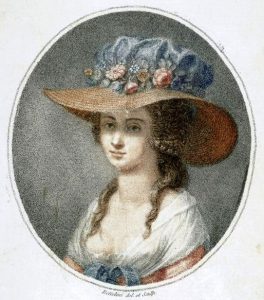
Figure 2: Bettelini, Pietro (1763-1829) Portrait of Nancy Storace (1765-1817), English soprano. Printed in April 12, 1788 by Moltens Colnaghi & Co No. 32 Pall Mall, and in Paris by chez Tessari Zanna et Ce. Quay de Augustins No 42.

Figure 2: Bettelini, Pietro (1763-1829) Portrait of Nancy Storace (1765-1817), English soprano. Printed in April 12, 1788 by Moltens Colnaghi & Co No. 32 Pall Mall, and in Paris by chez Tessari Zanna et Ce. Quay de Augustins No 42.

The pair had been introduced by their shared vocal teacher, the Italian castrato Venanzio Rauzzini (1746-1810). Storace was first trained by Rauzzini in England, before developing an illustrious career on the continent, most notably singing the role of Susanna in the premier of Mozart’s Le Nozze de Figaro. In 1784, she was married to the English violinist John Abraham Fisher (1744-1806), though it was publically known that he was violent and abusive to Storace, resulting in Joseph II, Holy Roman Emperor (1741-1790) forcing him to quit his continental tour and leave Storace behind. Though Storace returned to England in 1787, she never saw Fisher again, but they were still legally married until his death.

Braham was trained by Rauzzini from 1794-1796, where he developed his initial skills in an Italianate style of singing, something for which he would gain much celebrity throughout his career. Rauzzini frequently obtained professional engagements for his students but also showcased their talents through his popular Bath Concert Series. Storace came to perform in this series during the 1796-97 season alongside Braham. In the same year Braham as offered the leading role in Mahmoud, which was written and composed by Storace’s brother Stephen. This would begin a long professional and personal relationship between two of Rauzzini’s most successful students (Robertson-Kirkland, 2016).
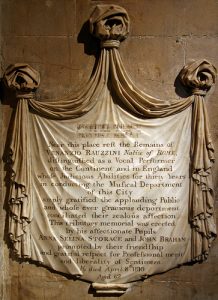
Figure 3: Rauzzini Memorial, Bath Abbey, Photograph by Paul Turner, Licensed under a Creative Commons Attribution 2.0 Generic (CC-BY2.0). Accessed 17 May 2015. https://www.flickr.com/photos/11602696@N00/5277396962/

Figure 3: Rauzzini Memorial, Bath Abbey, Photograph by Paul Turner, Licensed under a Creative Commons Attribution 2.0 Generic (CC-BY2.0). Accessed 17 May 2015.

However, Braham was at the beginning of his career and though he had been offered the leading role in the Drury Lane theatre, known as the home of English opera, his performance was not well received. It was not until he was offered a role at The King’s Theatre, aka the home of Italian opera, that he received favourable reviews:

As a singer [Braham] has infinite merit as his powers are much better calculated for the Italian opera than the English stage (1796, p. 2).

The following year, contemporary periodicals reported contradictory information about Storace and Braham’s intentions to travel to the continent. True Briton stated that Storace was ‘going to Italy to improve herself in singing’ with Braham accompanying her to ‘practice duets’ (1791, p. 1). The Oracle and Public Advertiser, on the other hand, stated that Braham went ‘to Italy for improvement’ and Storace accompanied him ‘for the purpose of managing his points’ (1791). Other reports did not attempt to spin a professional guise but crudely stated their relationship outright:

Braham has promised Storace to give her an animated description of Moses erecting his serpent in the wilderness (1797, p. 3).

The continental tour proved a success for both Braham and Storace, but there can be no doubt that it was through Storace’s former contacts that they were able to obtain illustrious engagements, improving Braham’s visability as a tenor of note. This exposure allowed his career to flourish, particularly upon their return to Britain, where Braham’s singing was in high demand.

Yet Storace’s career diminished somewhat, with reports frequently teasing that her lack of stage appearances was due to pregnancy. These reports were a continuous reminder that the pair were more than friendly, professional colleagues (1798, p. 4). For the most part, the reports were true; by 1802, Storace gave birth to Braham’s son, William Spencer Harris Braham.

Though Storace may still have been married to Fisher and William born out of wedlock, Braham and Storace were received in good company and it was generally accepted that they were unofficially man and wife. Even so, after Fisher’s death in 1806, one might expect that the pair would have made their relationship official, if for no other reason than to appease Georgian society. But this was not to be. Storace and Braham continued to live unwed until his betrayal in the summer of 1816.

On 23 July, The Times reported that Braham was being sued for damages by Mr Wright in the amount of 5000l. It transpired that Braham had run off with Mr Wright’s wife earlier in year resulting in a very public affair to the detriment of Braham, the Wrights’ and Storace’s reputation. While Storace and Braham’s relationship may have been initially accepted in polite company, the public immediately turned on them both, placing particular blame on Storace for leading Mrs Wright astray (1816, p. 3). Braham was forced to pay Mr Wright 1000l in damages and his career was threatened after he was hissed off the stage by the audience at Drury Lane theatre (1991, p. 302).

His hasty marriage to Miss Bolton just a few months after his public affair with Mrs Wright and break-up with Storace established that he was settling down to a socially acceptable life and for the most part, the public forgave his prior descretions. Unfortunately, Storace was not as lucky, as she suffered two strokes the following year, the second resulting in her death. Was Braham’s betrayal responsible or was this merely a coincidence? Though reports suggested the former, Braham’s singing career returned to its former glory and he became one of the most internationally sought after vocalists of the day (1817, p. 3). The marriage served its purpose, so in many ways 17 November 1816 was Braham’s rebirth as an honourable man.


Works Cited

Morning Post and Fashionable World, July 10, (London: William Griffin, 1797).

Observer, October 28, (London: W S Bourne, 1798).

Oracle and Public Advertiser, July 8, (London: P Stuart and James Boaden, 1797).

Sun, October 31, (London: B McMillan, 1796).

The Times, July 24, (London: James Lawson, 1816).

The Hull Packet and Original Weekly Commercial, Literary and General Advertiser September 30, (Hull: Robert Peck, 1817).

True Briton (1793), July 5, (London: A Wilson, 1797).

Ireland, Joseph Norton, Records of the New York stage, from 1750 to 1860, 2 volumes, (New York: T H Morell, 1863), vol. 2.

Ed. Highfill, Philip H; Burnim, Kalman A; Langhans, Edward A, A Biographical Dictionary of Actors, Actresses, Musicians, Dancers, Managers, and Other Stage Personnel in London, 1660-1800: S. Siddons to Thrnne, (Illinois: Southern Illinois University Press, 1991), Vol. 14.        

Robertson-Kirkland, Brianna Elyse, Are we all castrati? Venanzio Rauzzini: ‘The father of a new style in English singing’. PhD thesis, (University of Glasgow, 2016).