On This Day in 1823 – Mary Shelley’s Valperga was first published

      Comments Off on On This Day in 1823 – Mary Shelley’s Valperga was first published

The BARS ‘On This Day’ Blog series celebrates the 200th anniversary of literary and historical events of the Romantic period. Want to contribute a future post? Get in touch.

The BARS ‘On This Day’ series marks 19th February 2023, 200 years to the day from the first publication of Valperga with this blog post by Almudena Jiménez Virosta.

The 19th of February 1823 was not a regular entry in William Godwin’s diary. Like any other day, he had noted down both what he had been working on, and his reading materials. However, he also marked that day as the publication date of his daughter’s Valperga, or, the Adventures of Castruccio Prince of Lucca [1]. Set amidst the wars between the political factions of the Guelfs and the Ghibellines in fourteenth-century Italy, Valperga is Mary Wollstonecraft Shelley’s second long work of fiction and a historical novel which Godwin particularly liked. ‘Beatrice is the jewel of the book’, he wrote to ‘Mrs. Shelley’ on the 14th of February 1823: 

not but that I greatly admire Euthanasia, and I think the characters of Pepi, Binda, and the witch decisive efforts of original genius [2]. 

Although the main plot is about the coming of age and into power of Castruccio Castrani, as the novel’s full title reads, Valperga significantly revolves around the intertwined stories of the two powerful women that Godwin so highly praised in his letter. Having been studied as representations of the female character as explored by Mary Shelley’s mother, Mary Wollstonecraft, in A Vindication of the Rights of Woman (1792), both Euthanasia and Beatrice seem to symbolize, however, two sides of the same coin [3]. As an educated, independent, and poised ruler Euthanasia epitomizes the perfect equilibrium between the rational and the sensible woman, while fanatic prophet Beatrice lives a life entirely governed by her unruled passions. Nevertheless, such different paths converge in their respective relationships with Castruccio, revealing thus how the fourteenth-century societal and political tissue constricted women’s fate only because of their sex. Of course, like many other novels of the day, Valperga also doubles as a denouncement of its own times, having Percy Bysshe Shelley compare Castruccio to ‘a little Napoleon… with a dukedom instead of an empire for his theatre’, just as John Gibson Lockhart also noted in his review for Blackwood’s Edinburgh Magazine defining the novel as a ‘drumming at poor Buonaparte’ and an attempt ‘to shadow out Napoleon under the guise and semblance of some greater or smaller usurper of ancient days’ [4]. 

This double historical dimension of the novel is possible thanks to the diligent research carried out by Mary Shelley, who understood the politics of her times and those depicted in the book. Valperga is indeed heavily based on historical sources, including Machiavelli’s romance of the real Castruccio and Sismonde de Sismondi’s Histoire des Républiques Italiennes de l’Âge Moyen (1807). It is also inspired by literary works of that era, such as Dante’s Divina Commedia (1472), and others inspired by it, such as Percy Shelley’s The Cenci (1819)- both of these works strongly influencing the development of the character of Beatrice. It is no coincidence that Percy Shelley’s play came into being right in the middle of the conception of the novel, which Mary Shelley started to envision during the winter of 1817 [5]. Converting a novel supposedly conceived to narrate the adventures of Castruccio into focusing on the story of two relevant female characters, Euthanasia and Beatrice, has been attributed to Godwin. He played a significant role not only as an influence for the novel, as has been widely studied, but also as its editor. As he confesses in the letter above, he had ‘taken great liberties’ in editing it, to the point he feared his daughter’s ‘amour propre [to] be proportionally shocked. For instance, we know he changed the title to the name of Euthanasia’s fortress, Valperga, echoing in its subtitle, as Tilottama Rajan has pointed out, his very own 1794 Things as they are, or The Adventures of Caleb Williams [6]. 

Among other reasons, the fact that the sources in Valperga were so easily recognizable, along with the disappointment Mary Shelley’s readers experienced when they found out how different this novel was from Frankenstein (1818), provoked a general disinterest in Valperga for decades. One of her most neglected novels, it also fell into the category of the works she composed after Percy Shelley’s death when in need of money and was therefore not seen as possessing any artistic value––Nora Crook reminds us –– until F. L. Jones reconsidered this in 1944 [7]. This lack of attention also caused the indifference of the book industry and a subsequent problem of accessibility. In fact, it was not reprinted from the Romantic period until the 1970s and then only made wholly accessible during the 1990s with a hard-back library edition by Crook for Pickering and Chatto; and the paperbacks of Broadview Press, by Rajan, and Oxford University Press, by Stuart Curran, then by Michael Rossington in the year 2000 [8]. These are still today key sources for all those who want to start researching Valperga or indulge themselves in a novel that is increasingly gaining relevance. Due to the growing number of studies devoted to the book by disciplines as varied as Queer Theory, Political Theory and Radical Ecology, Valperga is being more and more celebrated each day. Only this year, and after having hosted a series of online seminars since the summer of 2021, the Gothic Women Project, supported by the British Association for Romantic Studies and headed by scholars such as Daniel Cook, Laura Kirkley, Anna Mercer, Deborah Russell, and Lauren Nixon, will commemorate its bicentenary with a conference that will be held this August of 2023 in Dundee [9]. Valperga surely still has much to teach us: from fourteenth-century politics and literature to how we live our lives today. For that, we have ‘the Author of Frankenstein’ to thank, for, after all, as Godwin proudly wrote to her in his letter:

‘I need no to tell you that all the merit of the book is exclusively your own’

Almudena Jiménez Virosta (@jimenezvirosta) is an MA student at the University of Geneva. She researches the cultural and political interrelations between England and Spain (1600-1850), with a special focus on education and communications in the Spanish Golden Age and British Romanticism. 

REFERENCES:

[1] Diary entry for 19 February 1823 – The Diary of William Godwin, (eds) Victoria Myers, David O’Shaughnessy, and Mark Philp (Oxford: Oxford Digital Library, 2010). http://godwindiary.bodleian.ox.ac.uk (accessed: February 2023)

[2] Letter from William Godwin to Mary Shelley (14 February 1823), in The Life & Letters of Mary Wollstonecraft Shelley Vol. II by Florence Asthon Thomas Marshall. London: Richard Bently & Son, 1889 –– All further mentions of a letter from Godwin to Mary Shelley will refer to this one.

[3] See the introduction to the edition of Valperga by Tilottama Rajan (Peterborough: Broadview Press, 1998) and ‘Mary Shelley’s Valperga: The triumph of euthanasia’s mind’ by William D. Brewer in European Romantic Review, vol. 5, 1995; pp. 133-148. 

[4] For Percy Shelley’s commentary, see his letter to Charles Ollier (25 September 1821) in The Letters of Percy Bysshe Shelley II, edited by Frederick L. Jones. Oxford: Oxford University Press, 1964. | For Lockhart’s review, see Blackwood’s Edinburgh Magazine, vol. XIII, January-June 1823. Also available in Romantic Circles: https://romantic-circles.org/reference/chronologies/mschronology/reviews/valpbw.html (accessed: February 2023)

[5] See The Collaborative Literary Relationship of Percy Bysshe Shelley and Mary Wollstonecraft Shelley by Anna Mercer. London: Routledge, 2019. 

[6] See the aforementioned introduction to Rajan’s edition of Valperga, where this is broadly discussed as a Godwinian novel.

[7 & 8] Crook, N. Review of ‘Mary Shelley, Valperga. Ed. Stuart Curran. New York and Oxford: Oxford University Press, 1997’. Romanticism on the Net, n. 12, 1998 (accessed: February 2023)

[9] Gothic Women also commemorates the bicentenary of Ann Radcliffe’s death and celebrates other lesser-known gothic women writers. You can take a look at the project here: https://gothicwomenproject.wordpress.com (accessed: February 2023)
Bursaries available for NASSR 2023 ‘Romanticism and Justice’

      Comments Off on Bursaries available for NASSR 2023 ‘Romanticism and Justice’

We are delighted to offer support to members who will be presenting at the ‘Romanticism and Justice’ 2023 international conference hosted by the North American Society for the Study of Romanticism (NASSR) between 30 March and 1 April 2023. The BARS Executive has approved 4 bursaries of up to £250 each to cover the international travel costs of members scheduled to present a conference paper (or equivalent) at NASSR 2023. Priority will be given to those who have limited or no access to institutional funding, and is open to postgraduate and early career members of BARS. The final decision of the panel will seek to balance the case for support with the quality of the abstract in each case. Please send a brief statement and a copy of your conference abstract to our Bursaries Officer, Dr Daniel Cook (d.p.cook@dundee.ac.uk). The statement should cover the following aspects:

·      Your current employment status

·      Details of any other funding available to you and/or secured

·      A summary of your costs to attend NASSR 2023

·      How the bursary will support your attendance at the conference

The deadline for submissions is 10 March 2023. You need to be a member of BARS at the time of application.

BARS Executive: Elections 2023/24 and Recently Vacated Posts

      Comments Off on BARS Executive: Elections 2023/24 and Recently Vacated Posts

Dear BARS Members,

Those of you who attended the BARS BGM last summer at the BARS/NASSR 2023 New Romanticisms conference at Edge Hill will recall our plans to address the composition of the BARS Executive in the wake of the COVID-19 pandemic. The BARS Executive is a friendly and collegial gathering of Romanticists from a wide range of career stages, which supports activities and initiatives in the field undertaken by the BARS Membership. Being part of the Executive gives you the opportunity to shape Romantic studies in the UK, and to meet our ambitions to provide a variety of financial support, events, training and resources for Romanticists both at home and overseas.

Our initial plan was to use the disruption as an opportunity to rationalise our protocols to improve the diversity and openness of the Executive while ensuring that important ‘institutional memory’ would be retained during periods of transition. This work, which involves some constitutional changes, has proven unfeasible in the short term, in the wake of other pressures such as the return to work post-pandemic and the ongoing industrial action taking place in UK universities. The Executive have agreed that this work should form the focus of a future iteration of the Committee, which has time to undertake the duties attached with due diligence and appropriate resources.

In the meantime, we are keen to move forward on this matter as it currently stands as expeditiously as possible, and propose a Special Election that responds to the challenges of the pandemic while maintaining the robustness of our current democratic processes. To this end, we are proposing the Re-election of the following post-holders (subject to any objection raised by the Membership) to 2024, when we will gather for our next conference BGM (venue TBC):

Re-election 2023–2024

  • President: Anthony Mandal
  • Secretary: Jennifer Orr
  • Treasurer: Cassie Ulph
  • BARS Review Editor: Mark Sandy
  • Website Editor: Matt Sangster

We are also inviting submissions of Expressions of Interest for the following posts, to span an initial two-year term to summer 2025

Recently Vacated Posts, to run 2023–2025

  • Vice-President (outgoing: Gillian Dow)
  • Membership Secretary (outgoing: Tess Somervell)
  • Communications Officer (outgoing: Anna Mercer)
  • Bursaries Officer (outgoing: Daniel Cook)

These post-holders will join the Executive members who were elected in Summer 2022 (PGR Representatives Cleo O’Callaghan Yeoman and Yu-Hung Tien; ECR Representative Amanda Blake Davis), as well as our Co-opted Members who are currently not elected (Outreach and Impact Jeff Cowton; Schools & Education Liaison David Fallon; Conference 2022 Lead Andrew McInnes; Book Prize Chair TBC).

Submitting your Expression of Interest
Please send Expressions of Interest to the BARS Secretary (jennifer.orr@newcastle.ac.uk): these should include an up-to-date CV and a short statement (no more than 500 words) outlining how you would hope to contribute to BARS in the role. We will publish the statement online for the BARS Membership to consider as part of the election process. Any queries should be directed to the BARS President (Mandal@cardiff.ac.uk), as should any objections or intentions to contest the Re-election of the post-holders named above.

Timeline

  • EOIs to be returned to the BARS Secretary (jennifer.orr@newcastle.ac.uk) no later than midnight, 6 March 2023
  • Candidates’ statements to be published no later than 10 March 2023
  • Voting to take place between 13 and 19 March 2023 (Members will be emailed with precise instructions)
  • Candidates notified/Results published by 23 March 2023
  • Re-elected and newly elected candidates to attend BARS Executive Spring 2023 meeting (online) on 29 March 2023, 12–2pm

BARS First Book Prize 2022-23: Call for Panel Members  

      Comments Off on BARS First Book Prize 2022-23: Call for Panel Members  

Deadline: 24 February 2023 

Send your EoI to the BARS Secretary, Jennifer Orr (Jennifer.Orr@newcastle.ac.uk), and any questions to the BARS President, Anthony Mandal (Mandal@cardiff.ac.uk). 

We are looking to fill two roles on this year’s panel: Panel Chair and Reader. The Book Prize is awarded biennially for the best debut monograph in Romantic Studies and is open to first books published between 1 January 2021 and 1 January 2023.  

The incoming Chair will be invited to attend the BARS Spring Executive meeting (online) at the end of March where the committee timeline will be established. 

Please send a short expression of interest along with your CV. Applications from Early Career Researchers to the Reader role are particularly welcomed.  

Query: The Letters of Thomas De Quincey

      Comments Off on Query: The Letters of Thomas De Quincey

Dear everyone,

I am editing the letters of De Quincey, forthcoming in two volumes with OUP. I have conducted an extensive search of online manuscript catalogues, auction house catalogues, bookseller catalogues, and so on. I have found De Quincey letters in several of the major archives in the UK and US, as well as in places ranging from the Maine Historical Society to the Auckland City Libraries. 

I am writing now to ask if anyone knows of De Quincey letters that might be in uncatalogued manuscript collections, or in Asian or European archives, or that, for one reason or another, might not turn up in the kinds of searches I have done so far.

I am especially interested in letters that are in private hands. There is, for example, a collection of thirty-seven unpublished De Quincey letters to his publisher William Tait, dated from 20 February 1838 through 15 August 1846. These letters were in private hands in 1941 and, as far as I have been able to determine, they are still in private hands. For more details, please see Claude E. Jones, ‘Some De Quincey Manuscripts’ in ELH, 8.3 (1941), p. 216.

Any information or leads would be very welcome. Thank you very much your assistance.

With best wishes,

Robert

r.morrison@bathspa.ac.uk

Robert Morrison

British Academy Global Professor

Bath Spa University

HWA Crown Awards 2020: The Regency Revolution (London: Atlantic, 2019)

Thomas De Quincey: Selected Writings (Oxford: Oxford University Press, 2019)

CFP and Registration: The Wordsworths: An Early Spring Symposium

      Comments Off on CFP and Registration: The Wordsworths: An Early Spring Symposium

Presented by the Wordsworth Conference Foundation

Hosted at Dove Cottage, Grasmere and the Jerwood Library

2-4 March 2023

Proposals
Please email a paper proposal of 200-250 words, with a title and outline of your proposed presentation, to proposals.wsc@gmail.com to arrive by 1 February 2023, 12 noon UK time at the latest. We are particularly keen to attract papers from postgraduate, post-doctoral students and early career academics. Topics may include any aspects of the Wordsworths’ writings, lives, times, and contexts.

Bursaries
8 bursaries of £250 are available to postgraduates and early career post docs, on presentation of a single academic reference to support their paper presentation.

Registration
The registration for the Symposium is £130 per person.
To register, please fill out the attached form and return it to wordsworthsummerconference@gmail.com.

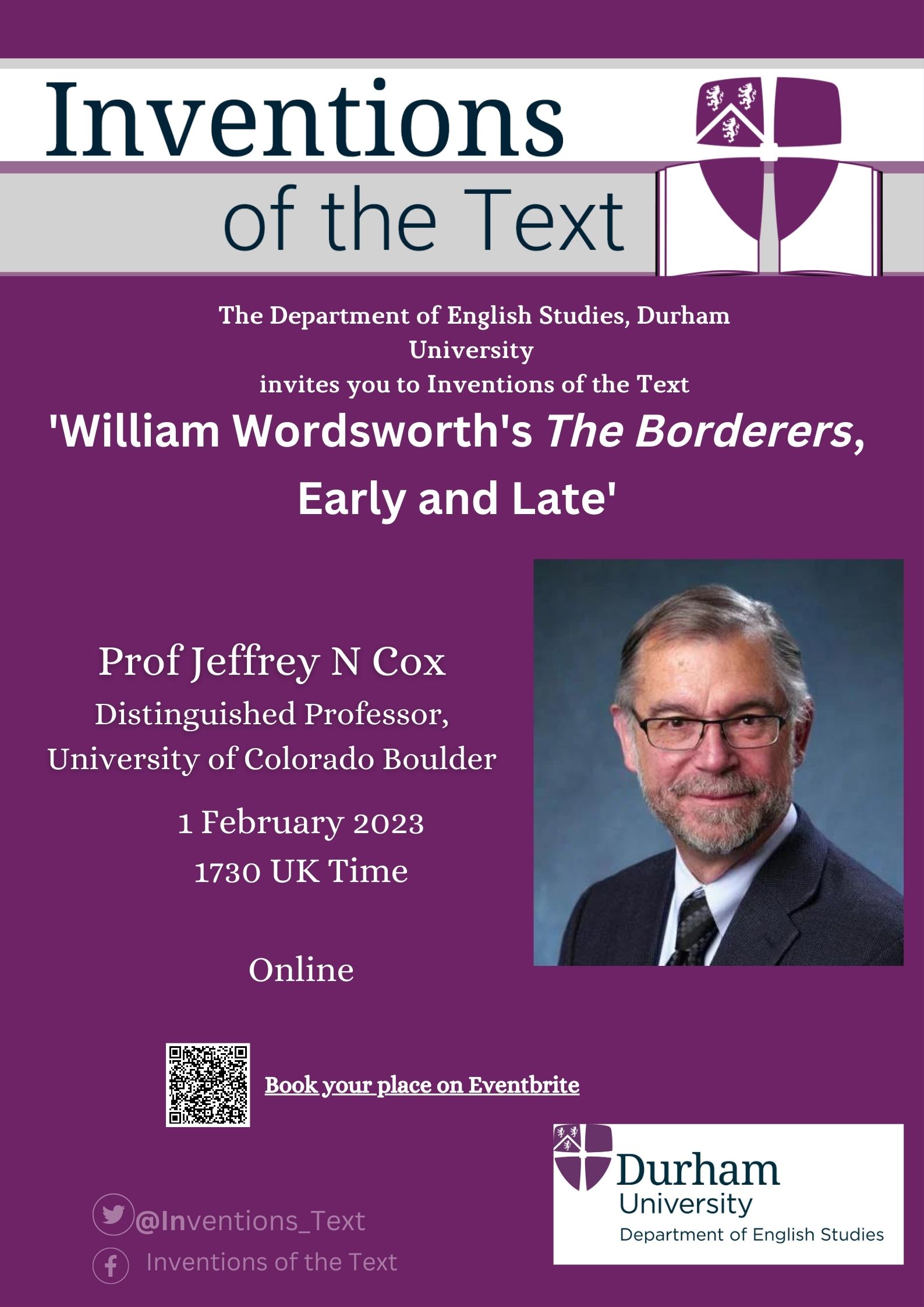
Inventions of the Text: Professor Jeffrey N. Cox, 15 March 2023

      Comments Off on Inventions of the Text: Professor Jeffrey N. Cox, 15 March 2023

Session 4, 2022-23

15th March 2023, 17.30 UK time. DATE CHANGED DUE TO STRIKE ACTION (Please disregard date on poster).

Prof Jeffrey N Cox, University of Colorado Boulder will be talking to us:

Wordsworth’s The Borderers: Early and Late

Abstract:

While we have, with good reason, been interested in The Borderers for what it tells us about Wordsworth’s intellectual and aesthetic development as a poet at its point of composition, I will be interested in thinking about it, first, in relation to the drama and theater of the 1790s and second, as a cultural act in 1842, as Wordsworth seeks to define his place one more time on the literary scene. Wordsworth’s sole tragedy, while written in the late 1790s, did not appear until 1842, in his last volume of new poetry, Poems, Chiefly of Early and Late Years; including the Borderers, A Tragedy. Supporting my view is the back matter of the collection. There are two series of advertisements: one for the other six volumes in the newest edition of Wordsworth’s poetry and the other for his publisher’s Edward Moxon’s “Dramatic Library” which includes plays by key playwrights from Shakespeare to Congreve, with the editors spanning the romantic movement from Thomas Campbell to Leigh Hunt to Hartley Coleridge. One set of these print paratexts places Wordsworth’s play within his life’s work, but another group relates the play to the dramatic tradition from Early Modern to the romantic periods.

About Prof JN Cox:

Professor Jeffrey N Cox, Distinguished Professor of the Arts and Sciences at the University of Colorado Boulder. His latest book William Wordsworth: Second Generation Romantic (CUP, 2021) was awarded the Marylin Gaull award from Wordsworth-Coleridge Association.

For a detailed overview of Prof JN Cox’s research and expertise, please visit: https://www.colorado.edu/english/jeffrey-cox

Register here (link to eventbrite.co.uk)

ALL ARE WELCOME!

Registration is free and links to the Zoom meeting will be sent to the registered email address shortly before the event. Thank you and look forward to meeting everyone on February 1st.

Sincerely,

Inventions of the Text,

Department of English Studies,

Durham University

Vision of Judgement Zoom Reading: 22 January 2023

      Comments Off on Vision of Judgement Zoom Reading: 22 January 2023

The Vision of Judgment

by Lord Byron

Dozens of readers, one diabolically divine poem!

Have you ever wondered whether George III is whiling away infinity in heaven or in hell—and how he got wherever he is? You now have the chance to find out. Following the international amusements of a group Zoom reading of The Eve of St. Agnes last January and The Mask of Anarchy this past August, a reading of The Vision of Judgment by 53 readers is coming up on Sunday, January 22nd (Byron’s 235th birthday!), at 2:00 p.m. Eastern Standard Time. If you would like to get on the attendance list, please contact Alice Levine (alice.levine@hofstra.edu) or Susan Wolfson (wolfson@princeton.edu). The link will be sent to you the day before the event.

Hoping to see you there!

Alice Levine (The Byron Society of America)

Susan Wolfson (Princeton University)

John Bugg (The Fordham Romantics Group)

CFP: The Routledge Companion to Drag

      Comments Off on CFP: The Routledge Companion to Drag

We are currently looking for contributions to The Routledge Companion to Drag, a volume that will  provide an accessible reference work to drag.  This is an area which has garnered much attention through the popularity of TV series such as RuPaul’s Drag Race and Pose. The Routledge Companion to Drag is a long over-due response to the popularity of drag cultures, providing detailed critical insights to the world of drag that goes beyond the narrow version of the glitz and glamour on TV screens. The volume will signal a major new direction for a form that has become cultural currency in the media and, more recently, of growing importance for the academy. 

The Routledge Companion to Drag will be a comprehensive reference work on the multi-limbed topic of drag. The volume connects contemporary concerns around identity and intersectionality to the field of drag studies, including essays on race and ethnicity, disability, class – areas that reflect the current cultural backdrop and social activism of today’s potential readers. The international and interdisciplinary focus will lay out the field in such a way that it includes both mainstream, non-mainstream, established and emergent practices and cultures.

The editors of The Routledge Companion to Drag, Mark Edward, Stephen Farrier, and Garjan Sterk, aim to create and widely disseminate a collection of trans/interdisciplinary scholarly papers on drag across a wide range of subject areas. 

We therefore call upon drag academics, drag practitioner-researchers, drag activists, drag performers, drag fans, and cultural theorists, gender studies scholars, critical race scholars, historians etc. working on/researching drag to contribute to this collection.

We are currently seeking expressions of interest in areas such as: 

  • drag histories,
  • street and activist drag agendas,
  • underexplored ball culture and drag,
  • drag cultures in popular culture, 
  • the contemporary and historical diversity of drag, drag kings/queens to sissies, AFAB queens/kings, post/alt-drag, trad drag and non-binary and trans drag, drag that exceeds our current understanding of drag,
  • popular drag cultures and class,
  • drag and disability and ableism,
  • drag and gender: awkward bedfellows? 
  • drag and race,
  • drag and colonialism – the colonial in drag practice,
  • drag and fashion.

If your preference and expertise is to write on another topic, please feel free to send us an email about your idea.

We seek authors who can write on drag practices beyond the global North, to include work from Oceania, Asia, Africa and Latin America. We are looking for contributions that explore, critique and celebrate drag in its local contexts and historical specificity. 

The Routledge Companion to Drag will be around 54 contributions. Each of them will be around 6,000 words in length and form a coherent, carefully focused entity. The various chapters will be clustered in cohesive parts, each preceded with an introduction to that specific field. 

Planning

If you are interested, could you please confirm your intention to contribute to The Routledge Companion to Drag before 30 January 2023

We would expect an abstract (300 words max) and a bio (200 words max) by 30 March  2023.

Your abstract should provide the following information:

  1. your name, postal address, email address, and contact telephone number 
  2. your institutional affiliation (if applicable) and ORCID-number (if you have one)

Please e-mail your abstract and bio in a Word file titled: [last name].CompanionToDrag

Send the file and possible questions to: garjansterk@gmail.com

We will inform you about acceptance by the end of May 2023

We expect the full chapters around 1 December 2023

>> Please notify us if you have trouble meeting these dates. There is some leeway.

The Routledge Companion to Drag is expected to be launched in hard back, digital form and eventually paperback in the Spring of 2024.

CFP: ‘(Re) Imagining Value’: An Interdisciplinary Symposium

      Comments Off on CFP: ‘(Re) Imagining Value’: An Interdisciplinary Symposium

26 May 2023, Newcastle University, Newcastle upon Tyne.

Keynote speakers: Professor Nicky Marsh (University of Southampton) and Professor Paul Crosthwaite (University of Edinburgh)

The Economic Humanities Network for the Newcastle University Humanities Research Institute (NUHRI) invites proposals for a one-day interdisciplinary symposium to be held on 26 May 2023.

The theme of the symposium investigates the role of value within the emerging field of economic humanities, which brings together researchers who identify a reciprocal relationship between the arts and social sciences. Recent scholarship within this field has interrogated the cultural metamorphosis through which economics was divested of the humanitarian concerns that were crucial to its Enlightenment origins, and became aligned with the ‘dismal’ pursuit of profit. By forging dialogues between literature, history, business studies, law, philosophy, politics and beyond, our network explores how economics shares with the humanities a view that individuals are motivated by desire, imagination and creativity, as well as considers how this perspective transforms how we understand value today. The symposium opens up discussions about what value means in an era driven by capitalism and post-pandemic recovery. We are particularly interested in the way that value measures what is ‘useful’, yet remains an enigma that evolves with the spirit of its age. 

Ranging across the higher education and public sectors in their areas of specialisation, our keynote and guest speakers will address how the theme of value not only informs their work, but is also shaped by the disciplinary or critical lens through which it is studied. This methodology will provide delegates with an opportunity to reflect upon the benefits and challenges of defining value in their own research. Accordingly, we invite proposals for papers which broadly consider how value is imagined and reimagined across a range of scholarly fields and historical periods.
Possible topics could include, but are not limited to:

  • Imagining value then and now: shifting linguistic or historical terms
  • The public arena: visions of value in institutions and/or government 
  • Depictions of value in music, the visual arts, film, theatre, and performance
  • The representation of value through literary forms: prose, poetry, periodical, and pamphlet
  • Value in the market: finance, economics, and trade
  • Demonetising value: morality, relationships, and wellbeing
  • The evolution of value: scientific discovery and medical advances
  • Value at the margins: gender, class, race, and sexuality
  • Conserving value: museum and heritage studies
  • Religious values: faith, fanaticism, and revelation
  • Reading in new ways: approaching value across disciplinary lines
  • Dialogues of value: collaborations with industry, education and policy makers

Abstracts of 250 words for 20-minute papers should be submitted to reimaginingvalue@gmail.com by 1 April 2023. Informal queries may be sent to the Economic Humanities Project Lead, Dr Leanne Stokoe (leanne.stokoe@ncl.ac.uk)

The symposium is generously supported by a NUHRI Pioneer Award, and will therefore be free to attend. We are delighted to be able to offer a number of travel bursaries for postgraduates and unwaged speakers. Please indicate in your abstract if you would like to be considered for a bursary.
For more information please visit the NUHRI website: https://www.ncl.ac.uk/nuhri/research/current-projects/