PhD Bursary: The Byron Society

      Comments Off on PhD Bursary: The Byron Society

The Byron Society invites applications for a PhD bursary of up to £5,000 per year.

Applications are open to new and existing full-time PhD students enrolled at a UK university and working on a thesis addressing any aspect of the life, work and /or influence of the poet Lord Byron. Applications are also welcomed from those studying multiple poets or authors, including Byron.

Each bursary covers just one year, however multiple applications can be made and postgraduates whose research focuses solely on Byron can receive up to three annual bursaries. (Those who study Byron alongside other poets and authors can only be awarded one bursary).

Applications can be made by students with additional sources of funding, but please list these in your application. The applications should also include a summary of the applicant’s academic record, an outline of his / her proposed research and the names of two referees who may be contacted. Please also state what year of study you are in.

Please provide the following information:

  • Name
  • Institution
  • Year of Study
  • Thesis title
  • Thesis outline (300-500 word summary)
  • Supervisor names and contact details (who might be contacted as referees if required)
  • Any additional / existing sources of funding

Applications should be sent by email to Dr Emily Paterson-Morgan, Director of the Byron Society, at contact@thebyronsociety.com.  In addition please cc in emily@p-m.uk.com as a back-up.

The application process for 2026//2027 is now open. It will close on the 1st of May 2026. However, please get in touch if you have any questions.

The Byron Society

Upcoming BARS Digital Events: Volcanic Romanticism & Shelley’s Anni Mirabiles

      Comments Off on Upcoming BARS Digital Events: Volcanic Romanticism & Shelley’s Anni Mirabiles

Volcanic Romanticism (30 October 7PM UK time)

https://www.eventbrite.com/e/bars-digital-events-volcanic-romanticism-tickets-1810749413239?aff=oddtdtcreator

In the ‘Year Without A Summer’ of 1816, a remarkable meeting of minds took place at the Villa Diodati near Lake Geneva. Lord Byron, Percy Shelley, Mary Shelley (then Mary Godwin), Claire Clairmont, and John William Polidori spent much of the time indoors, sheltering from the rain, and engaging in discussions that would lead to some of the most influential works of British Romanticism, including Byron’s ‘Darkness’, Mary Shelley’s Frankenstein and The Last Man, and numerous poems by Percy Shelley. The Diodati Circle were unaware that the unusually cold and stormy weather that summer had been largely caused by the massive eruption of the Indonesian volcano Mount Tambora the previous year. Nonetheless, the anomalous weather, in combination with the sublime Alpine landscape and their intensely speculative conversations, had a powerful impact on their work.

The aim of this panel is to offer a new perspective on the Diodatic Circle by reflecting on the relationship between weather, climate, and planetary volatility in their writings of 1816 and after. It will address, in particular, how they understood the volcanic as a sublime, apocalyptic force, and how it inflected their powerful visions of the future. Attention will also be paid to the longer history of Romantic responses to vulcanism and planetary catastrophe.

Presentations:

· ‘From Diodati to the End of the World: The Volcanic Origins of The Last Man  Dilara Kalkan (Ataturk University)

· ‘Before Tambora: Cowper, the Laki Haze and the Emergence of Volcanic Romanticism’ – Katerina Liontou (University of Leeds)

· ‘“The veil of life and death” – The Volcanic Sublimity of Shelley’s Mountains’ – Chloe Melvin (University of Birmingham)

· ‘“Meteorological Imaginations” and the Solastalgic Skies of Percy Shelley’ – Kate Nankervis (University of York)

Chair: David Higgins (University of Leeds)

———————————————————————————————-

Shelley’s Anni Mirabiles: The Complete Poetry of Percy Bysshe Shelley (12 November 6PM UK time)

https://www.eventbrite.co.uk/e/shelleys-anni-mirabiles-the-complete-poetry-of-percy-bysshe-shelley-tickets-1782940165029?aff=ebdsoporgprofile

Our Panellists:

Professor Neil Fraistat (Professor Emeritus, University of Maryland)

Professor Nora Crook (Professor Emerita, Anglia Ruskin University)

Professor Stephen Behrendt (Professor Emeritus, University of Nebraska-Lincoln)

Dr Madeleine Callaghan (University of Sheffield)

Chair: Dr Amanda Blake Davis (University of Derby)

This roundtable will celebrate the publication of the latest volume, Volume IV, of the acclaimed Johns Hopkins University Press edition of Percy Bysshe Shelley’s poetry, covering the years 1818 to early 1820, the first phase of Shelley’s Italian period. Volume IV contains some of the masterpieces that Shelley produced during the first part of these years: Julian and Maddalo, inspired by conversations conducted on horseback near Venice between himself and the self-exiled Byron; The Cenci, an indictment of tyranny, domestic and political, probably the most actable of Romantic dramas and containing one of the most chilling studies of a psychopathic sexual abuser in nineteenth-century English literature; The Mask of Anarchy, the “greatest poem of political protest ever written in English” (too inflammatory to be published in 1819); Peter Bell the Third, a brilliant satire on Wordsworth; lesser known poems like his eclogue for women’s voices, Rosalind and Helen, and some of his best known shorter poems (“England in 1819,” “Love’s Philosophy,” and “Stanzas, Written in dejection”).

This event also commemorates the late Professor Stuart Curran, who died in October 2024. He described Shelley’s annus mirabilis as the year in which “the poet discovered his genius in the fertile warmth of Italy and produced a series of works which, for diversity and brilliance, have seldom been matched by any writer” (Shelley’s Annus Mirabilis: The Maturing of an Epic Vision, xiii). Amongst his innumerable scholarly achievements and contributions to Romantic Studies over 55 years, Professor Curran was a major contributing editor to Volume IV, which thus contains his last academic writings.

We anticipate lively conversation and discussion about some of the major works of Shelley’s anni mirabiles, including some new discoveries.

Volume IV of The Complete Poetry of Percy Bysshe Shelley is available to pre-order here: https://www.press.jhu.edu/books/title/9831/complete-poetry-percy-bysshe-shelley

BARS Independent Researcher Bursary Call for Applications

      Comments Off on BARS Independent Researcher Bursary Call for Applications

Independent researchers with an interest in any aspect of Romantic Studies (including literature, architecture, art, politics, culture, history etc) are invited to apply for the Independent Researcher Bursary. 

The purpose of the Independent Researcher Bursary is to enable professionals working outside of academia to attend and present at the British Association for Romantic Studies (BARS) International Conference. 

We recognize that there is limited funding available for independent scholars, whether those in alternative-academic (alt-ac) professions such as university administration, information management, the heritage sector and teaching, or those pursuing careers in non-academic professions. We are therefore creating a new bursary, thanks to a generous directed donation, to address this need. 

The higher education sector is facing significant headwinds at present, and there is no doubt that the field of literary studies is facing substantial cuts in the number of available jobs. We want to ensure that everyone feels encouraged to become part of the BARS community, especially non-traditional academics and interested external professionals – and to support a wider range of valuable contributions to our academic field.

The Bursary

The bursary will be for £500. 

The bursary should be used to help defray costs associated with attending and presenting at the BARS Conference. This might include travel, accommodation, or registration fees. 

The bursary can also be used to cover the cost of a year’s membership of BARS (currently £37.00), as all those presenting at the conference must be a member of the organisation. 

The award is contingent upon the applicant’s presentation being accepted for inclusion in the conference programme by the conference organising committee. 

Awards will be made based upon the level of projected engagement with the BARS community, together with the significance of the proposed conference abstract. 

Applicant criteria

Eligible applicants include all those participating in the wider network of invested communities supporting the field of Romantic studies, such as: members and managers of relevant literary/learned societies (without academic affiliation); curators and archivists; members of the teaching profession; those with relevant alt-ac positions; those pursuing careers in non-academic professions; historians; those without academic affiliation publishing original research in relevant topics. Given the scope of potential professions, this list is not exhaustive – so if your profession is not listed, please do not assume you are excluded from this application process. 

Ineligible applicants include: students, full-time researchers, those in established academic posts, those retired from established academic posts, and those actively seeking full-time academic roles – as other sources of funding are already available for these groups.

Application process

For the application process, we require a document containing:

  • Your name
  • Your job title and employer details
  • A short professional biography
  • A short outline of your personal interest in Romantic studies, explaining why you wish to attend and present at the conference
  • Details of how you would use the bursary

This document should be 250-500 words long.

In addition, a copy of the presentation abstract submitted to the BARS Conference organisers should be included in the application. 

Application deadline

The deadline for the current round, which will support attendance at the 2026 BARS International Conference at the University of Birmingham, is Friday 28th November 2025. 

Applications should be emailed to the BARS Bursaries Officer, Gerard McKeever: gerard.mckeever@ed.ac.uk

Questions

If you have any questions about the bursary, eligibility criteria, or other matters, please get in touch with our Executive Committee Member for Independent Researchers, Emily Paterson-Morgan (emily@p-m.uk.com)

BARS Conference 2026 News: Panel Session Calls

      Comments Off on BARS Conference 2026 News: Panel Session Calls

Listed below are calls for panel contributions for the 2026 Conference. If you would like to send out a similar call for contributions, please write to the conference organisers at: bars2026@contacts.bham.ac.uk  

Letitia Elizabeth Landon and the Poetics of Retrospection, BARS Birmingham 2026

Convenor: Emily Rohrbach, University of Durham

This in-person session invites proposals for papers addressing the conference topic of retrospection in the poetry and/or prose writing of Letitia Elizabeth Landon. Themes of personal and/or historical pasts, loss, grief, regret, forgetting; the pleasures and/or pains of memory; subjectivity and the processes of retrospection and anticipation; comparisons between Landon and other Romantics vis-à-vis retrospection; Landon’s relations to authors from previous generations (e.g. the eighteenth century, the Classical world).

Please send a proposal of 250 words and a very brief bio by 14 November 2025 to emily.rohrbach@durham.ac.uk. Informal inquiries prior to this deadline are also welcome.

*

Repetitions and Innovations in Late German Romanticism

Convenor: Joanna Neilly, St. Peter’s, Oxford

In the final poem of Heinrich Heine’s  ‘Lyrical Intermezzo’ (1827) the poet asks for a coffin in which to bury the old songs of German Romanticism that inspired youthful dreams, which in turn occasioned adult disappointment. In an irony typical of Heine, this desire to kill off songs is placed within the wider project of his own Book of Songs. And having called for the death of the Romantic song, twenty years later Heine claims to have written ‘perhaps the last free woodland song of Romanticism’ (veilleicht das letzte / Freie Waldlied der Romantik) in his mock epic Atta Troll (1847). In this panel, papers will address how the writers of Spätromantik (German Late Romanticism) overcame the tenacious hold of seemingly worn-out Romantic forms, tropes, and motifs, repurposing them for innovative political, cultural, or aesthetic critique. The folk song; the overdetermined Gothic plot; figures such as the wanderer, the postilion, the beautiful muse; Romantic transcendence itself; are all, by the late 1810s onwards, at risk of becoming mere ciphers for a highly commercialised literary mood. This panel will investigate how and why writers who came belatedly to the Romantic scene, born too late to be among the earliest innovators of the Jena circle, nonetheless found ways of reinventing Romanticism, even if paradoxically through repetition.

Please send a proposal of 250 words and a very brief bio by 14 November 2025 to joanna.neilly@mod-langs.ox.ac.uk. Informal inquiries prior to this deadline are also welcome.

*

Creative-Critical Writing and Romantic Studies

Convenor: Adam Neikirk

This session would consider, broadly, the role and status of creative-critical writing in Romantic studies. “Creative-critical” refers to a range of writing practices that center on a literary text or texts: defined by Peter Wilson as “creative writing not in response to text, creative writing in response to text, critical-creative re-writing, critical writing in response to text, critical writing not in response to text” (“Creative writing and critical response” 440). Such writing can take on many forms—almost infinitely many—but for that reason, perhaps, its place in the ever-shifting landscape of Romantic studies might be more obscure than the thoroughgoing article or monograph, even if it has “profound pedagogical payoffs” for in the teaching of Romantic works (Rachel Feder, “Zonkey Romanticism”).

This session therefore invites both artists and scholars to consider submitting both creative-critical pieces, written in response to Romantic literary texts or other Romantic works, as well as papers that consider the role of such writing in Romantic studies from a meta-disciplinary perspective. Of course, cross-pollination is welcome. Possible subthemes include but are not limited to:

  • Creative-critical writing as a pedagogical or liberational tool;
  • Versification of Romantic prose; & “prosifying” Romantic verse;
  • The use of history/biography/time/space in creative writing;
  • Romantic literature as therapy/creative response as therapy;
  • Contemporary creative-critical responses to Romanticism;
  • Romantic creative-critical responses to contemporaneity;
  • Romanticism, creative-critical writing, and parasocial relationships;
  • Creative-critical writing and Romantic literary coteries;
  • Creative-critical writing and Romantic cultures.


Please send a proposal of 250 words and a very brief bio by 14 November 2025 to adamneikirk@gmail.com. Informal inquiries prior to this deadline are also welcome.

CfP: Romantic Elements: Rocks, and Stones, and Soil, 1750–1850

      Comments Off on CfP: Romantic Elements: Rocks, and Stones, and Soil, 1750–1850

Romantic Elements: Rocks, and Stones, and Soil, 1750–1850

Symposium at The University of Manchester, 25–26 June, 2026

Dreams hang on every leaf: unearthly forms
Glide through the gloom; and mystic visions swim
Before the cheated sense. – Anna Letitia Barbauld, ‘To Mr. C[oleridge]’

Rolled round in earth’s diurnal course,
With rocks, and stones, and trees. – William Wordsworth, ‘A slumber did my spirit seal’

Mont Blanc appears—still, snow, and serene;
Its subject mountains their unearthly forms
Pile around it, ice and rock; … – Percy Bysshe Shelley, ‘Mont Blanc’

Keynote Speakers
Dr Jeremy Davies (University of Leeds)
Dr Stephanie O’Rourke (University of St Andrews)

Romantic-era writing is littered with stones, as Noah Heringman brilliantly demonstrated in his
influential Romantic Rocks, Aesthetic Geology over twenty years ago. Whether they offer a
source of deep-time wonderment, as in Wordsworth’s ‘Resolution and Independence’, a
playful disruption of subject–object distinctions, as in Blake’s ‘The Clod and the Pebble’, or an
analogy between geological and political revolutions for poems such as Charlotte Smith’s
‘Beachy Head’, rocks in the Romantic era are less stable surfaces than they are porous
substances: sublime, strange, and open to inquiry.

Earth and earthiness are ubiquitous in the period’s many modes of nature writing, but elements
of the ground do not flow or yield their depths like water, nor mediate like air. Earth as physical
entity obscures, obstructs, and sullies, proving a less tractable ground for what we might still
think of as defining Romantic-era postures of idealism and spontaneity. What literary forms,
what knowledge practices, does earthly matter press poetics into? Is the geological record
hostile to the human and human expression in its radical alterity, as Heringman at times
suggests? Or are there underground places of passage, sympathy, even love, as Mary
Jacobus, Susan Wolfson, and Tristram Wolff have more recently proposed? Is there a whole
spectrum of attachments to rocks and stones, amounting to (in Wolff’s phrase) a ‘gray
romanticism’, in which writers can both resist and relish digging in the dirt?
‘Romantic Elements: Rocks, and Stones, and Soil, 1750–1850’ aims to explore these
questions. We seek to go beyond the exhilarating stony subjects of mountains, deep time, and
fossils, widening the remit of Romantic-era writing about the earth to include more particulate
matter and more conceptual treatments. We want to add soil, dirt, dust, sand, and ashes to
the Wordsworthian catalogue of Romantic elements; and we want to expand our theoretical
and metaphoric range to excavate the implications of Barbauld’s and Shelley’s ‘unearthly
forms’.

We invite proposals for 20-minute papers on the theme of earth, unearthing, and the unearthly
in Romantic-era poetry and prose (1750–1850). When engaging with the theme, prospective
speakers may wish to explore topics such as the following:
• Earth, earthiness, and literary form/genre
• The subterranean/undercommons
• The components of earth: mud, soil, clods, dust, sand
• Earthy elements as sites of affect or criticality
• Poetic and/or epistemological obscurity
• Images or forms of burial and concealment
• Images or forms of unearthing, unveiling, or revelation
• Earth as generative, fertile, life-giving
• Earth as a site of labour and resource extraction
• Earth as gendered, queered/queering, racialized, classed
• Formalist, ecocritical, queer, and affective approaches to earth, earthiness, and
unearthing

Please send proposals for 20-minute papers in the form of a 250-word abstract and an author
biography (150 words) to James Metcalf (james.metcalf@manchester.ac.uk) and Millie
Schurch (millie.schurch@english.su.se) by Friday 30 January 2026.

Please note: this will be an in-person meeting only. With thanks to support from the Swedish
Research Council, there will be no conference fee for speakers, other than to attend the
optional conference dinner at the end of the first day. Food and refreshments will be provided
on both days (coffee and pastries; lunch; tea-break snack).

We are particularly keen to encourage the participation of early career researchers and
scholars on precarious employment contracts. We are pleased to be able to offer up to 10
bursaries to cover accommodation and travel within the UK for those without access to
institutional support for research activities. Please indicate with your abstract submission if
you do not have access to institutional financial support and would like to be considered for a
bursary.

We hope to hear from you!
Millie and James

CfP: British Society for Literature and Science Annual Conference

      Comments Off on CfP: British Society for Literature and Science Annual Conference

The twenty-first annual conference of the British Society for Literature and Science will take place at the University of Strathclyde, on 9th-11th April 2026 (in person).


The BSLS invites proposals for twenty-minute papers, or panels of three papers, or roundtables, on any subjects within the field of literature (broadly defined to include theatre, film, and television) and science (including medicine and technology). The BSLS remains committed to supporting and showcasing work on all aspects of literature and science, including (but not limited to) animal studies, disability studies, the medical humanities, eco-criticism and the environmental humanities, science fiction studies, the blue humanities, and more.

Abstracts of no more than 200 words, together with the name and institutional affiliation of the speaker, should be submitted via this form. Proposals for panels should include a description of each paper. The closing date for submissions is Friday 12 December 2025.

Keynote talks will be given by:
Dr Zoë Lehmann Imfeld (University of Bern)
Dr Elsa Richardson (University of Strathclyde)
Registration details and costs will be available soon.

Conference bursaries: the conference fee will be waived for two PGR members in exchange for written reports on the conference, to be published in the BSLS Newsletter. If you are interested in being selected for one of these awards, please mention this when sending in your proposal. You must be registered for a PhD at the time of the conference.

The Centre for the Social History of Health and Healthcare at the University of Strathclyde is also pleased to offer a special bursary, waiving conference fees, for a PGR or ECR presenting on a medical humanities topic. If you are interested in being selected for this award, please mention this when sending in your proposal. This bursary is open to all PGRs and ECRs not in permanent employment.

About the Conference: the conference will be held at the University of Strathclyde. All talks, tea breaks, and lunches will take place in the University Technology & Innovation Centre (99 George Street, Glasgow, G1 1RD). The conference dinner will take place at the National Piping Centre, a short walk from the University. A drinks reception will be held on Thursday the 10th April at Glasgow’s City Chambers.

Membership: all conference delegates are required to be members of the BSLS in order to attend the conference (£26 waged/£11 unwaged): https://www.bsls.ac.uk/membership/join-us/. There will also be the opportunity to join or renew membership when you register for the conference. (Please note: you must only be a member to attend the conference in April; you do not need a membership to submit your abstract).

For further information and updates about the conference, please contact Jordan Kistler at bsls2026-conf@strath.ac.uk or visit the website: Conference – The British Society for Literature and Science (bsls.ac.uk).

Romanticism Now: 1816: The Year Without a Summer, a new student musical

      Comments Off on Romanticism Now: 1816: The Year Without a Summer, a new student musical

The ‘Romanticism Now’ series on the BARS Blog discusses where Romanticism pops up in contemporary culture. In this instalment, Chloe Wilcox (BARS Communications Fellow) looks at 1816: The Year Without a Summer. If you would like to write for ‘Romanticism Now’ or any other of our blog series, please send us an email at britishassociationromantic@gmail.com

The summer of 1816 at the Villa Diodati has spawned a number of biopics and fictionalisations. Gothic was released in 1986 and Mary Shelley in 2017. One of Hugh Grant’s earliest film appearances was as Lord Byron in Rowing with the Wind (1988), and the same year saw Alex Winter play John William Polidori in Haunted Summer. A recent addition to this tradition is 1816: The Year Without a Summer, a new musical written and composed by Nat Riches and Natasha Atkinson and directed by Gina Stock. After an initial run at the Camden Fringe (6th-7th August 2025), they have moved to the Lion & Unicorn Theatre in Kentish Town (30th September-4th October) and will soon be performing at Cambridge’s ADC Theatre (15th-18th October). A few hours before seeing the show myself on 30th September, I met up with the writers, Nat and Natasha, in a café to chat about it. 

They decided to write a musical before landing on the subject of the summer of 1816. They told me that the medium of a musical works well for the story because it offers the opportunity to pause and explore each character in some depth, as well as exploring the “abstract” ideas in their works.  They also said they used the music to create a sense of the period, drawing on Mozart in the musical’s second song, ‘Lake Geneva’, and moving towards later Romantic music for the song ‘Frankenstein’. One song I found particularly interesting was about the creative process, depicted (to quote from the Lyrical Ballads preface) as an “overflow”—if not always a “spontaneous” one—as the writers try to “feel the rush” and “let it out” whilst dealing with writer’s block (you can watch a snippet of this song on their Instagram: https://www.instagram.com/reel/DOy4jYejVtO/). 

Nat and Natasha told me they used Polidori’s diary as their main source (supplemented by Claire Clairmont’s letters, poetry by Percy Shelley and Byron, the 1831 introduction to Frankenstein, and academic writing), and the show has Polidori introduce scenes as diary entries a couple of times. Although the show spent time exploring each of its five characters (Mary Godwin—who goes by Mary Shelley, Percy Shelley, Clairmont, Byron, and Polidori), Polidori certainly receives a great deal of focus, opening and closing the show, addressing the audience, and appearing in the centre of the posters. Nat and Natasha told me they did this, alongside focussing more on Claire Clairmont than depictions of this summer tend to, because they wanted a “chance to bring some justice and respect to his legacy”. Both Clairmont and Polidori are presented in the show as mistreated and ignored by their companions, and the revelation of Clairmont’s pregnancy acts as the moment when things really collapse in the villa. Despite their range of sources, they waited to watch any films about the summer of 1816 until after writing the script. 

The show contained plenty of historically informed jokes, including about Percy Shelley accidentally swallowing arsenic (1) (https://www.instagram.com/reel/DOHMwpyDfeh/) and about “Darwin’s noodles”, a reference to Erasmus Darwin’s “vermicelli” (vorticella) experiment described in the 1831 Frankenstein introduction (and joked about in Young Frankenstein). I asked Nat and Natasha about their use of comedy, and they emphasised their aims of humanising these literary figures, who were ultimately “young adults”—and are played here by student actors from Cambridge University—who are bound to “have moments of teenage drama”. The first half of the show is much more light-hearted than the second—the writers said they wanted to use the comic first half to introduce their characters and ease the audience into the show before it gets darker in the second half.  

This is the second Romanticism-inspired musical I’ve seen this summer, having watched Frankenstein: The Musical at Edge Hill University in August (watch our TikTok about that here: https://www.tiktok.com/@bars_romanticism/video/7547346568932789526?is_from_webapp=1&sender_device=pc&web_id=7492906737819059734), and it’s been excellent to see such exciting new creative work about these writers, particularly from undergraduates, who have been heavily involved in both of these productions. 

Chloe Wilcox

(1)  According to Thomas Jefferson Hogg, “he used to speak with horror of the consequences of having inadvertently swallowed, through a similar accident, some mineral poison—I think arsenic—at Eton, which he declared had not only seriously injured his health, but that he feared he should never entirely recover from the shock it had inflicted on his constitution.” Hogg, Shelley at Oxford (London: Methuen, 1904), p. 38.

BARS 2026 First Book Prize: Calls for Nominations

      Comments Off on BARS 2026 First Book Prize: Calls for Nominations

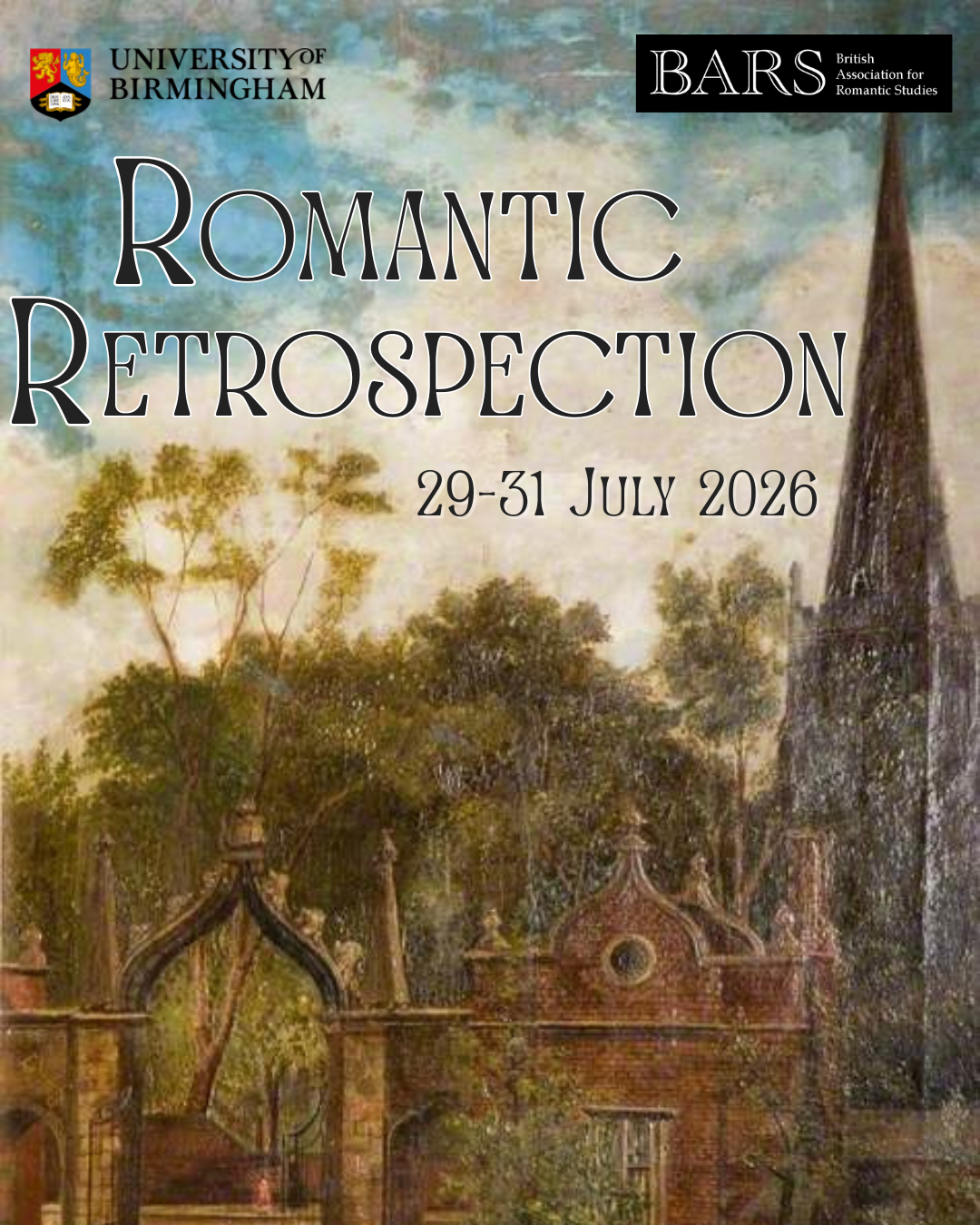
Awarded biennially for the best first monograph in Romantic Studies, this prize is open to first monographs published between 1 January 2023 and 31 December 2025. The prize will be awarded at the ‘Romantic Retrospection’ conference at the University of Birmingham in 2026. In keeping with the remit of the British Association for Romantic Studies, the prize is designed to encourage and recognise original, ground-breaking, and interdisciplinary work in the literature and culture of the period c. 1780-1830. The prize is awarded to the value of £300.

The BARS Executive has appointed a panel of judges consisting of: Susan Civale (Canterbury Christ Church University); Daisy Hay (University of Exeter); Andrew McInnes (Edge Hill University); Cleo O’Callaghan Yeoman (University of Stirling); Emily Paterson-Morgan (The Byron Society); Amy Wilcockson (Queen Mary University of London). The panel is chaired by Ross Wilson (University of Cambridge).

Eligibility, Nomination, and Submission

The prize is open to scholarly monographs published in English by authors who have not published a monograph before. Books may be nominated by publishers, by members of BARS, or by authors themselves, using the form at the link below. Nominations should attest to the significance of the book’s scholarly contribution, detailing its particular strengths and describing the nature of its originality in no more than 300 words. To ensure this remains a prize for Early Career Academics, the book’s official date of publication will be no later than 10 years after the award of the author’s PhD.

Please use the below nomination form:

Deadlines

Nomination forms, accompanied by e-copies or hardcopies of the book submitted, should be received by the chair of the panel no later than 12th January 2026. Successful entrants will be notified shortly prior to the ‘Romantic Retrospection’ conference where the prize itself will be awarded.

Email address for all submissions and queries: barsfirstbook@english.cam.ac.uk.

Postal address for hardcopies of books: Prof. Ross Wilson, Emmanuel College, St Andrew’s Street, Cambridge, CB2 3AP.

BARS Mailbase Update

      Comments Off on BARS Mailbase Update

As BARS’s Communications team, we are writing to you to inform you of a change that will be made to the processing of messages sent to the BARS Electronic Mailbase. As you know, BARS sends a weekly series of emails containing notices of news and funding, calls for papers, book announcements, and much more.

From October 2025, all notices sent around the Mailbase will contain the name of the sender. This is to ensure that the source of all notices is as transparent as possible. The circulation of notices from members via the Mailbase does not constitute an endorsement by BARS; rather, the Mailbase is a service that BARS provides for disseminating news of activities, events, publications, etc. that current members have identified as of interest to the Romanticist community. Providing the names of senders will clarify from whom notices originate. News and notices coming directly from BARS will continue to contain ‘BARS News’ in the email subject line. 

As per the update in January 2025, emails will only be sent to the Mailbase if the sender of the original notice is a member of BARS.

Very best wishes
Amy Wilcockson (Communications Officer) and Chloe Wilcox (Communications Fellow)
British Association for Romantic Studies

Stephen Copley Research Award Report: Jordan Welsh on Samuel Taylor Coleridge and Hyman Hurwitz’s Friendship

      Comments Off on Stephen Copley Research Award Report: Jordan Welsh on Samuel Taylor Coleridge and Hyman Hurwitz’s Friendship

During the summer of 2025, as part of my Stephen Copley Research Award, I was able to further investigate the friendship between Samuel Taylor Coleridge and the Hebrew scholar Hyman Hurwitz.

Arguably, many notable friendships were formed during the Romantic period, with Coleridge closely linked to Wordsworth, Southey, Lamb, and others throughout his lifetime. During my PhD, which I submitted in 2024, I became intrigued by Coleridge and Hurwitz as friends, collaborators, and mentors, yet I was surprised by how little Hurwitz features in biographies on Coleridge. To me, there was something fascinating and unique about their situation, and the more I started to dig, the more things I began to find.

The funding from the BARS Stephen Copley Research Award allowed me to take several research trips to archives, libraries, and locations that shed more light on the Coleridge-Hurwitz friendship. They notably collaborated on two poetic projects: Coleridge translated Hurwitz’s Hebrew verse into English, creating Israel’s Lament (1817) and The Tears of a Grateful People (1820). These works commemorated the deaths of Princess Charlotte of Wales and King George III, respectively. Coleridge also relied on Hurwitz’s expertise in Hebrew and religion, which deepened his own understanding of the Bible and Christianity. They stayed in regular contact and frequently cited each other in their other writing projects, including Hurwitz’s Hebrew Tales (1826), which contained three tales translated by Coleridge.

Their friendship, therefore, was not a footnote in history but one that yielded so many connections, ideas, and activities. My research project aimed to uncover more and create a fuller picture of Coleridge and Hurwitz. I sought to gather and view as much as possible on Hurwitz and bring him further into the conversation about Romanticism, as well as positioning him as a scholar and poet in his own right.

My first trip was to the British Library in London, where I saw many original texts by Coleridge and Hurwitz up close. Seeing a reprint of their collaborative project, Israel’s Lament and The Tears of a Grateful People, printed on silk pages, showed the care and attention given to this particular volume. Coleridge’s name was listed only on the title page of Israel’s Lament, whereas the English translation of The Tears of a Grateful People was attributed to simply a “friend” of Hurwitz. Despite the omission of his name, a copy of the poem from the Ashley collection held at the BL has been signed by Coleridge on the endpaper and on the title page. Subsequent letters show that Coleridge tried to use his connections to get a copy of The Tears of a Grateful People sent to George IV.

A week later, I headed over to West London to the National Archives at Kew, which provided many items that helped to understand Hurwitz’s life following his move to Great Britain from Poland. This included a petition of denization submitted to King George III in 1816, which would have granted Hurwitz additional rights as a foreign citizen living in Britain. The petition was signed by a number of individuals who vouched for Hurwitz’s character, most were residents of Highgate where he had lived for a number of years, including Dr James Gillman, with whom Coleridge lived with from 1816. Although the application was ultimately rejected, it did help to provide solid evidence as to when Hurwitz arrived in Great Britain, which contradicted Hurwitz’s listing on the Oxford Dictionary of National Biography. I was also able to view a newspaper announcement of his death, his last will and testament, and records pertaining to the sale of his library following his death.

My final London summer research location took me to the University College London Special Collections, where I had access to a number of documents dating from the first decade of the University’s existence. Here I viewed letters written by Hurwitz when he was among the first members of the teaching staff in the late 1820s, following his appointment as Professor of Hebrew Studies. The thrill of being able to see Hurwitz’s handwriting, which was thankfully very easy to read, and to see his signature was such an important moment for me. The correspondence helped to understand Hurwitz’s later life as a teacher and scholar, a role for which Coleridge had written a letter of recommendation for Hurwitz. It was wonderful to see records of the names of students who were registered for the Hebrew studies classes, with the low numbers prompting Hurwitz to later write to the University’s leaders for permission for extended leave until the figures improved to prevent him paying for unnecessary travel.

The funding also allowed me to spend a few days in Cambridge to access a range of texts in the University Library and write up the vast number of notes that I had gathered. I was able to cross-reference the Collected Letters of Coleridge edited by Earl Leslie Griggs with key dates and events, thereby creating a clear timeline that helped to map out the interactions and connections between Coleridge and Hurwitz. Although I stayed at Christ’s College (attended by John Milton and Charles Darwin), there was a wonderful connection in being able to walk the streets that would have been trodden by Coleridge and Wordsworth when they had attended Cambridge. I was able to view further editions of Coleridge and Hurwitz’s collaborative projects, along with maps and reference books that documented the history of Highgate. Through this, I was, at long last, able to pinpoint exactly where Hurwitz’s Jewish School had been located and map out in better detail the time he had shared in Highgate with Coleridge.

This summer of research has proven that there is a lot more to say about Coleridge and Hurwitz. Building on these discoveries, I am now working to develop this project into a number of possible outcomes, including journal articles and a conference paper. I hope that by sharing my findings, I can help bring greater recognition to the significance of Coleridge and Hurwitz’s friendship, and, more importantly, raise the profile of Hurwitz.

I am grateful for the support of BARS through the Stephen Copley Research Award, which has helped to properly kick-start this research idea. As an independent researcher, such schemes really do enable our scholarly work and are such a lifeline to help provide the resources and backing to make it happen. I am also thankful for the kindness and support received from the staff at UCL, the British Library, the National Archives at Kew, and Cambridge University Library, who made navigating, searching, and registering with a number of new systems and places so much easier.

Jordan Welsh is an ECR who submitted his PhD at the University of Essex in 2024, with his thesis focusing on Romantic and Victorian literature, environments, and religion. He currently works outside of academia whilst continuing with research. His research interests include the literature and culture of the Romantic and Victorian eras, literature and religion, eco-criticism, and crime fiction since the Victorian age. He has contributed pieces to The Coleridge Bulletin and the British Association for Victorian Studies Newsletter and is currently working on a number of research projects in preparation for publication.