Amy WilcocksonComments Off on PhD Studentship Opportunity: USYD UofG Joint PhD Scholarship: Living with Print in the Eighteenth Century
We invite applications from qualified candidates who wish to complete a fully-funded doctorate examining the diverse ways in which eighteenth-century readers lived actively with print. The project will focus on underutilised archival materials—including manuscript commonplace books, annotated copies, collections of anecdotes, scrapbooks, and albums—to explore how reading practices extended beyond passive consumption to encompass a wide range of dynamic engagements with texts and with the material forms of books. By tracing practices of annotation, excerpting, compilation, and reuse, this PhD will provide opportunities to shed new light on how eighteenth-century readers actively participated in knowledge circulation and the production of literary meaning.
Bringing new materials into the centre of analysis will allow the project to develop a rich account of reading as a creative and materially embedded practice, contributing to broader debates in eighteenth-century studies, book history, and the history of reading about the entangled relationships between manuscript, print, and lived experience. The student will be guided by two experienced supervisors, Nicola Parsons (Sydney) and Matthew Sangster (Glasgow), but will have considerable scope for shaping the project based on their interests.
The project takes full advantage of the Sydney–Glasgow joint PhD structure to bring together unique archival holdings and specialised scholarly expertise. The successful applicant will spend the first year undertaking a literature review and initial archival work in Sydney, followed by a substantial period of research in Glasgow engaging with extensive eighteenth-century collections held across Scotland and the UK, before returning to Sydney for a final year of intensive writing and synthesis. This structure supports a research approach that reconnects geographically dispersed but methodologically connected materials, allowing for an analytical breadth that would not be possible within a single institutional or national context. The student’s studies will also incorporate extensive opportunities for professional development, including bespoke training in rare book and manuscript studies; public-facing writing; and collaborations with cultural heritage professionals on physical and digital exhibitions.
Amy WilcocksonComments Off on Historical Romance, Austen, and Romanticism: Bridgerton Season Four Review by Emma Butler
As an avid fan of historical/Regency romance and period dramas more broadly, as well as a scholar of the long nineteenth century, I enjoy the world that Shonda Rhimes’ adaptation (2020-) of Julia Quinn’s Bridgerton book series (2000-2005) has created. I understand the critiques of the series being marketed as ahistorical or alternate from real societal issues of the time we would now consider the ‘Romantic era’, c. 1790-1850; though, from a purely entertainment aspect, Bridgerton as a series has certainly captured a large and engaging audience. Bridgerton, so far, has given viewers love interests for the eponymous siblings that are Black, South Asian, and now East Asian. This diversity enables the Bridgerton world to engage with England’s global connections and contexts (however, it has also led to the questionably magical erasure of racism by 1813 onwards, when the series is set). For the focus of this review, however, I will include some ways that Bridgerton’s fourth series engages with some recognisable Romantic context alongside some of my favourite moments:
(Some Bridgerton spoilers ahead, but mostly season four.)
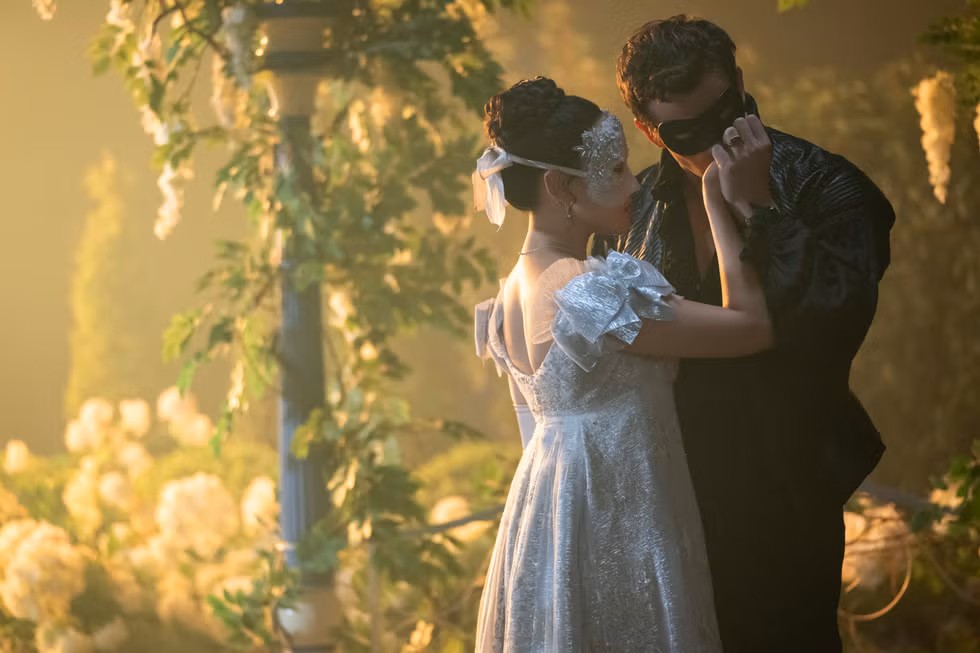
Yerin Ha and Luke Thompson as Sophie and Benedict. Image: Liam Daniels/Netflix
Inter-class relationships:
The focus of season four’s romantic plot is the second Bridgerton brother, Benedict, alongside his newly introduced love interest, Sophie Baek (the adapted version of the book’s Sophie Beckett), played by the incredibly talented Yerin Ha. Rhimes keeps the main plot of Benedict’s book, An Offer from a Gentleman (2001), and Sophie is introduced sneaking into Violet Bridgerton’s masquerade ball. As their romance grows, Benedict wishes to make Sophie his mistress (a status she repeatedly rejects). As the illegitimate daughter of the Earl of Penwood and a maid, she does not wish to subject a child she may have to the same fate. This inter-class relationship is much more dramatic than what is commonly featured in Romantic novels, but the trope echoes plots of Jane Austen. Austen features couples of various levels of wealth and status, though none so dramatic as what is portrayed in Bridgerton.
The marriage of Elizabeth Bennet and Mr Darcy of Pride and Prejudice (1813) is famously objected to by Lady Catherine de Bourgh, who claims such a match will cause ‘the shades of Pemberley to be thus polluted’. Unfortunately, Sophie has no Lizzie Bennet retort (‘He is a gentleman; I am a gentleman’s daughter; so far we are equal!’) to justify her relationship with Benedict, until Violet, Benedict’s mother, comes to the rescue and persuades Sophie’s stepmother agree to the lie that Sophie was actually a distant legitimate relative of the late Lord Penwood. Of course, then Sophie becomes Mrs Bridgerton and so all is well, like Lizzie becomes Mrs Darcy, despite the great protesting of Darcy’s aunt. Sophie’s story also has echoes of Austen’s Emma (1815). She most resembles Harriet Smith, who is introduced as ‘the natural daughter of somebody’. Harriet’s background similar to Sophie’s, though Harriet does not get so lucky as to marry a sexy Bridgerton brother.
The Lake Scene (or, Benedict as Byronic hero):
Benedict Bridgerton is the second-oldest brother, therefore the spare to the Viscount Bridgerton title, and a man who wishes to reject the norms of the ‘ton’. Benedict fits into the archetype of the Byronic hero. A key Romantic literary trope, D. Michael Jones defines the Byronic hero as having ‘an internal classlessness that is deepened by his exile from any recognisable domestic life’ and that ‘his class status […] is both haughtily aristocratic and sentimentally middle class’. Benedict, most notably, is torn between his duty and status as a member of the ‘ton’ and his allegiance to the Bridgerton family, and the freedom he wishes he had.
Benedict’s arc before series four has been exploring his persona as an artist who cannot commit to anything – or anyone. True to this nature, before he devotes himself to Sophie, Benedict sleeps around, constantly. Often with two or three lovers in his bed at a time. (It was a pleasant relief to me tha season four did not erase Benedict’s previously established bi/pansexuality, and a bigger relief still that Sophie unquestionably accepts Benedict’s coming out to her.)
Tying Benedict to a more modern iteration of Romanticism, he has a call-back to the infamous Mr Darcy lake scene of the 1995 Pride and Prejudice. Benedict, however, is completely naked – which for me further cements his status as a Byronic figure. Though Benedict is never truly exiled, as often Byronic heroes are, he seriously considers moving to the countryside with Sophie in order to have a relationship with her; the couple would have faced exile from polite society.
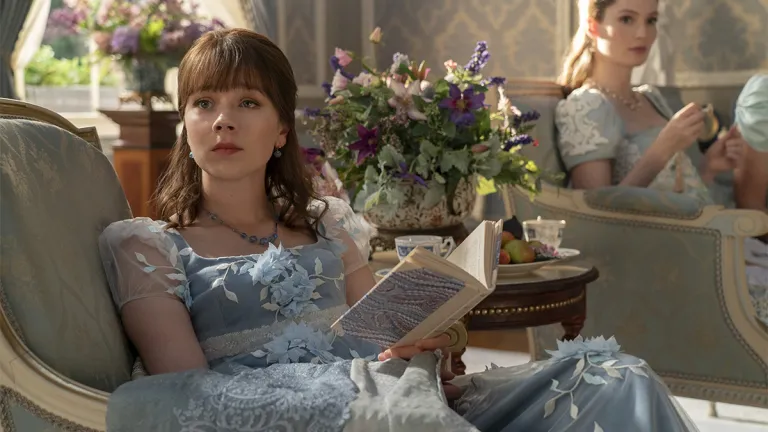
Claudia Jessie as Eloise Bridgerton. Image: Liam Daniel/Netflix
Eloise as Proto-Feminist:
In season three, Eloise Bridgerton is given a ‘silly novel’ to read by her brother Colin: Austen’s Emma. Bridgerton, it seems, is quite self-aware. Season four, however, features another Romantic reference, side character Cressida Cowper, informing Eloise that she has been reading Mary Wollstonecraft. Indeed, Cressida says that Elosie ‘would not stop talking about her’. Wollstonecraft’s Vindication of the Rights of Woman (1792) definitely seems like something that Eloise would enjoy and corresponds with the (proto)feminist views that the character exhibits.
If the rumours are true, and Eloise’s book will be the focus of the next season of Bridgerton, I look forward to seeing how her story unfolds with her relationship to such seminal texts of Romantic female empowerment, as well as what other Romantic connections the series will develop in the future.
Emma Butler is a PhD researcher in English Literature at Edge Hill University. Her thesis ‘From Health to Leisure: The Seaside Resort in the Nineteenth-Century Literary Imagination’ studies the representation of the coast as a liminal space in nineteenth-century literature in relation to literary depictions health/sickness, the working class, and the Gothic. Emma’s research interest spans the long nineteenth century, with a focus on the novels of Jane Austen and the medical humanities. She was recently the BARS Visiting Fellow at Chawton House for 2025, researching obscure Romantic period seaside-based novels and continuations of Austen’s Sanditon.
Chloe WilcoxComments Off on Call for Papers: 2026 Wordsworth Summer Conference
The 2026 Wordsworth Summer Conference at elegant Rydal Hall will be the 55th since Richard Wordsworth’s inaugural conference gathering in 1970. This year we continue the format pioneered by Richard, mingling lectures, papers and lively academic debate with fell walking, picturesque rambles, and bus excursions to places of Wordsworthian and Romantic interest.
Call for Papers
2026 marks the centenary of Ernest de Selincourt’s publication of the parallel texts of the 1805 and 1850 Prelude, a landmark volume that shaped Wordsworth studies during the twentieth century and continues to do so today. 2026 is also 150 years since the publication of Wordsworth’s Prose Works of William Wordsworth, a three-volume set edited by the Scottish scholar A. B. Grosart. In view of these Wordsworth anniversaries, we invite papers that will explore ‘Wordsworth Texts’ broadly considered, to embrace the poet’s manuscript and printed texts in verse and prose, versions and editions up to the present. Papers may consider texts produced by the wider Wordsworth family (e.g. Mary Wordsworth, Dorothy Wordsworth, Dora Wordsworth, Edward Quillinan) as well as critical, biographical, scholarly, and editorial commentaries from Wordsworth’s time up to the present.
In addition to these topics, we also welcome proposals on any aspect of Wordsworth and his circle, and the Romantic period more broadly, including its influences and legacies.
For more information, including bursaries, please see the PDF attached to this email.
All proposals for papers, bursary applications (and references, if applicable) should be emailed by 15 May 2026 to proposal.wsc@gmail.com.
Chloe WilcoxComments Off on Study Day: Ann Radcliffe’s ‘St Alban’s Abbey’ at 200
St Alban’s Cathedral welcomes Dr. Elizabeth Bobbitt, Professor Dale Townshend, and award-winning writer Rosie Garland for a study day to mark the 200th anniversary of Radcliffe’s poem ‘St Alban’s Abbey; A Metrical Romance’. Get your tickets here.
About the event
Follow in the footsteps of Romantic-era poet and Gothic novelist Ann Radcliffe (1764–1823), whose St Alban’s Abbey; A Metrical Romance (1826) brings to life the opening battle of the Wars of the Roses at St Albans in 1455. Join Dr Elizabeth Bobbitt, Professor Dale Townshend and award-winning writer Rosie Garland (Fellow of the Royal Society of Literature) for a special study day marking the 200th anniversary of the poem and looking ahead to its forthcoming Cambridge University Press scholarly edition. The programme features short talks and readings, a literary tour of the cathedral, and a creative writing workshop led by Rosie Garland.
Study Day Itinerary
10 – 10.30am: Registration over tea and coffee
10.30am: Welcome and Introduction to Ann Radcliffe and St Alban’s Abbey: A Poetical Romance.
11.30am – 12.30pm: Mapping Radcliffe’s St Alban’s Abbey: A Guided Tour of St Alban’s Cathedral and Surrounding Abbey Ruins
12.30 – 1.30pm: Lunch break
1.30 – 3.30pm: ‘Locating the Spirit of Ancient Days:’ Radcliffe as Literary Tourist – Creative Writing Workshop
3.30-4pm: Share your poetry!
4pm: Closing Remarks
Please note that this event will be held in-person only and will not be livestreamed or recorded.
About the organisers
Elizabeth Bobbitt is a research associate at the University of York. Her research focuses on Ann Radcliffe’s post-1797 texts which include Radcliffe’s last published novel, Gaston de Blondeville (1826) and her fascinating variety of narrative and lyrical verse. Her publications include “Negotiating Gothic Nationalisms in Ann Radcliffe’s Post-1797 Texts: Gaston de Blondeville and St Alban’s Abbey” in Women’s Authorship and the Early Gothic for University of Wales Press (2020) and “Ann Radcliffe’s Post-1797 Works: Edwy; a Poem, in Three Parts and the Topographical Gothic” in Essays in Romanticism for University of Liverpool Press (2022). She is thrilled to be co-editing Radcliffe’s posthumously-published works with Dale Townshend for Cambridge University Press.
Dale Townshend is Professor of Gothic Literature in the Manchester Centre for Gothic Studies at Manchester Metropolitan University. His most recent publications include Gothic Antiquity: History, Romance, and the Architectural Imagination, 1760–1840 (OUP, 2019); the three-volume The Cambridge History of the Gothic (co-edited with Angela Wright and Catherine Spooner; CUP, 2020–21); and Matthew Gregory Lewis: The Gothic and Romantic Literary Culture (UWP, 2024). With Elizabeth Bobbitt, he is editing Ann Radcliffe’s posthumous works for the Cambridge edition.
Rosie Garland has a passion for language nurtured by public libraries. She writes poetry, long and short fiction and sings with post-punk band The March Violets. She is the author of The Palace of Curiosities (which won the Mslexia Novel Competition and was longlisted for the Desmond Elliott Prize), Vixen and The Night Brother, which was described by The Times as “a delight…with shades of Angela Carter.” Her new novel, The Fates (Quercus) is a retelling of the Greek myth of the Fates. Her latest poetry collection, What Girls do in the Dark (Nine Arches Press), was shortlisted for the 2021 Polari Prize. Val McDermid has named her one of the most compelling LGBT+ writers in the UK today. In 2018-2019 she was inaugural Writer-in-Residence at The John Rylands Library, Manchester, and in 2023 was made a Fellow of The Royal Society of Literature. — Dr Rosie Whitcombe
Amy WilcocksonComments Off on Catherine Redford on poetry and the new collection The Way the Water Held Me
When my wife died at the age of 33, Mary Shelley was a natural companion in my journey through grief. Widowed two hundred years before me when Percy Shelley drowned in a boating accident, she, too, had been left with a young son to bring up alone. Not only that, but both of us were separated from family and friends at the time of our bereavements; my wife and I had moved to a new part of the country just six weeks before she died, while Mary had left her support network behind in London in order to follow Percy to Italy. Mary famously wrote the loneliness of her grief into her novel The Last Man (1826), in which Lionel Verney – a portrait of Mary herself – becomes the last surviving human on Earth after a deadly plague sweeps the globe. Two centuries later, I grieved through the lockdowns and social isolation of the COVID-19 pandemic.
After my wife’s death, I turned to creative writing as a means by which to work through my grief. Wanting to examine the complexities of bereavement, I wrote poems on memory and mourning, on the public rituals surrounding death and the ways in which individuals find coping strategies for their loss. Those poems turned into my debut collection, The Way the Water Held Me, which was published this month.
Lorem Ipsum has been the industry’s standard dummy text ever since the 1500s.
Incorporating Mary Shelley into my poetry provided a source of comfort, helping me to feel less alone as a young widow. Her presence also helped to legitimise my emotions and took some of the shame away from the messiness of my grief; I’d expected to be sad after my wife died, but I’d been unprepared for the fear, anger, desperation, and even resentment that I felt. Mary became a canvas onto which I could project these feelings, whether as teenage best friend, gothic heroine, or doppelgänger. In ‘I allow Mary Shelley to create another monster’, I depict Mary as ‘ripping the seams’ of my life and ‘restitching it as her own’, so that I become ‘A double / treading in her footsteps, her loss lived again / through me’.
I was also interested in exploring the complications of Mary’s own personal path through grief, given the less-than-ideal state of her marriage at the time of Percy’s death. In the depths of her bereavement, she was eager – perhaps even desperate – to depict their love as perfect, whereas Percy had complained to friends of her ‘coldness’ and had betrayed her with a number of other women. Although there is no evidence that an affair took place, Percy’s infatuation with Jane Williams is evident in some of his last poems. I wanted to create an imaginative space in which Mary is able to confront this humiliation. In ‘Mary Shelley and I survey the aftermath’, I depict a post-apocalyptic scene in which Mary and I view the ruins of their house on the coast; in the poem’s closing lines, I sense the words from Percy’s Jane Williams poems ‘scuttling / into the dark corners of her [Mary’s] mind’ as she acknowledges her late husband’s unkindness towards her.
Inspired by the closing chapters of The Last Man, post-apocalyptic imagery is a thread running throughout the collection. However, I didn’t want to tether my work solely to the nineteenth century; instead, I also allowed myself the freedom to depict this metaphor for grief from more modern perspectives, such as the detonation of a nuclear bomb. I play with such anachronisms throughout The Way the Water Held Me. Rather than having Mary simply visiting me in the present or me visiting her in the past, I create a mutual space that we can occupy through the layering of timeframes. We watch late-night TV together, then sit by the hearth. I visit her in her rooms in 1820s London, where she wipes my wife’s text messages from my mobile phone. In ‘Mary Shelley and I hold a séance’, I bring together the experiences of our respective youths, depicting us listening to Coleridge by candlelight before miming nineties indie songs into hairbrushes. The result is something both disorientating and universal in its atemporality.
I particularly enjoyed incorporating Mary’s own words into my poetry, quoting from her letters, journals, and novels. At times, I rework or subvert Mary’s original meaning: words from The Last Man are reordered to create poems about the Last Woman, lofty reflections on posterity and empire becoming a simple portrait of the suffering and demise of a lone female in a world that fails to acknowledge the loss of civilisation. ‘Mary Shelley writes to tell me that her husband has drowned’ is another collage poem, this time made from words used by Mary in her letter to Maria Gisbourne of 15 August 1822. In this letter, Mary describes how the final house in which she lived with Percy was ‘after his own heart’; in using these words in a new context, I was able to play with the idea of Mary keeping Percy’s physical heart (or some incinerated organ resembling it) in her desk. In doing so, I simultaneously acknowledge, participate in, and interrogate the myth-making that surrounds Percy’s death and Mary’s widowhood, from the hastily-abandoned volume of Keats in Percy’s pocket to the wreck of the boat that mysteriously survived. In turn, this informs my poetry about my own experiences of the fetishisation of death, from mourning rituals to the significance we assign to the possessions kept when a loved one dies.
‘Part elegy, part séance, part scream’ (Fiona Benson, winner of the Forward Prize for Poetry)
‘A beautiful, heartbreaking book’ (Liz Berry, winner of the Forward Prize for First Collection)
Dr Catherine Redford is a writer, researcher, and editor. She has published widely on Romantic and Victorian literature, with a particular focus on Mary Shelley, the Last Man theme, and the Gothic. Her poetry – which has featured in journals and anthologies including Magma, Under the Radar, and Lighthouse – embraces the crossover between the creative and the critical. Catherine has previously held positions as both a lecturer and a Career Development Fellow at the University of Oxford.
Amy WilcocksonComments Off on ‘Romantic Retrospection’ BARS Conference Update
Notice from the Conference Organisers: This is just a quick note to remind BARS Conference delegates that the deadline for bursary applications is 16th March (next Monday). Please see your acceptance email for further details of how to apply. Applicants will hear back by the start of April.
We are also excited to announce that registration for the conference will open at the end of March – please look out for further emails/information regarding registration.
Chloe WilcoxComments Off on Elizabeth Montagu Correspondence Online: Summer Internship Programme 2026
Paid opportunity for PhD students and Early Career Researchers
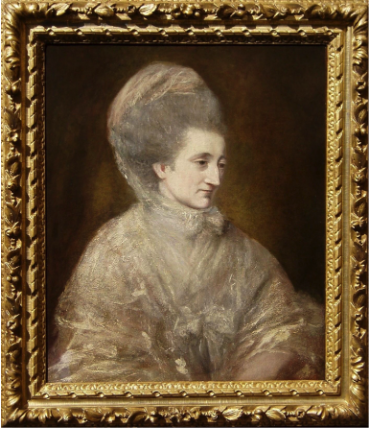
Portrait of Elizabeth Montagu by Frances Reynolds. Private Collection.
An exciting opportunity for a PhD student or Early Career Researcher to work as a research intern for the Elizabeth Montagu Correspondence Online (EMCO).
The EMCO internship programme focuses on transcribing the letters written by Montagu to her friend, Elizabeth Carter, and preparing these transcriptions for digital publication on our Edition website. This involves marking up the letters in XML (TEI) and ensuring accurate database records.
Our internship programme has been running since 2021. We have welcomed a number PhD students and early career researchers, and uploaded around 400 letters from Montagu to Carter as a result, many of whom have gone on to work with the project beyond the initial internship. You can find out more about the programme here: https://emco.swansea.ac.uk/project/intern-programme/.
— Further Details: After the success of last year, we will be running our internship as a summer programme again. We will complete mandatory induction and training during the summer term (May-June 2026) with the rest of the summer planned for you to complete the transcription and digital markup (xml) of 30 letters. Work will be completed by 31 August 2026. The candidates will be on a probation period for the first two months. The payment will be provided in 3 instalments (£200 each), after the probation period, and the timely completion of each of the 2 assigned work packages. The total renumeration will be £600. You will also be credited on the Edition website for your work.
As well as practical experience working on a digital project, there will be opportunities for you to attend EMCO team meetings and learn more about project management.
The internship is remote. Full training and software will be provided.
— About You: o You will have achieved or be working towards a PhD in eighteenth-century studies (or a related field). o You will have working knowledge of eighteenth-century epistolary culture and/or digital humanities. o You will be prepared to learn new skills and work with the wider EMCO team (from senior scholars to fellow interns).
—
About EMCO: Elizabeth Montagu (1718-1800), author and Bluestocking salonnière, was a leading woman of letters and artistic patron of her day. Her correspondence is considered ‘among the most important surviving collections from the eighteenth century’ (ODNB). She corresponded extensively with leaders of the British Enlightenment, such as Edmund Burke, Gilbert West, David Garrick and Horace Walpole, as well as the Bluestocking inner circle – Elizabeth Carter, Sarah Scott, Hannah More, Hester Thrale Piozzi, Frances Burney, Anna Laetitia Barbauld, Elizabeth Vesey, and Frances Boscawen. Her letters discuss politics, business, and family affairs, as well as observations on literature and society. Our goal is to offer digital unification of Montagu’s extant correspondence of around 4,000 letters, which is held in at least 34 libraries, archives, and private collections worldwide,
— Application Details: If you would like more information, please contact Dr Katie Crowther (kc1200@york.ac.uk). Please send a CV and a supporting statement to Professor Nicole Pohl (emco-nicole@outlook.com) together with a confirmation from your supervisors that this work will not interrupt research progress – please ask them to email to confirm their support of your application by the deadline. Deadline for applications: 1 April 2026 Online interviews expected to take place: w/b 15 April. There will be a transcription assessment as part of the interview process. There will be further opportunities for working with EMCO in the future, so please apply now only if you are able to work on the project from May-August 2026.
Speakers Serena Baiesi, Will Bowers, Greg Kucich, Diego Saglia, Maria Schoina, and Alessia Testori will discuss their research on and editing of the Romantic-era periodical The Liberal. You can read the new digital edition and learn more about the project at https://www.theliberal.unifi.it/
Amy WilcocksonComments Off on Event and Book Launch: Finding Elizabeth Hitchener (1783–1821)
We are excited to announce the launch event of Finding Elizabeth Hitchener(1783–1821) (Cambridge: Cambridge University Press, 2026). Hosted by the Keough-Naughton Institute for Irish Studies and Notre Dame London, the launch is taking place on Wednesday 18 March 2026, 5:45pm-7:30pm at Notre Dame London, 1–4 Suffolk Street.
This event will tell the story of Percy Bysshe Shelley’s friendship with Hitchener, in which Ireland held profound significance as a place of personal refuge and political experiment, as well as introducing Finding Elizabeth Hitchener and the life and work it uncovers. Authors Will Bowers (QMUL), Oliver Clarkson (Oxford), and Andrew Hodgson (Birmingham) will each give short talks, followed by comments from Fiona Stafford (Oxford). The program will be chaired by Elisa Cozzi (Notre Dame).
A reception will follow the speaking program, and books will be available for purchase and signing.
Finding Elizabeth Hitchener (1783–1821) by Will Bowers, Oliver Clarkson, and Andrew Hodgson, is the first critical study of a neglected Romantic-period schoolmistress and poet. Drawing on newly uncovered archival evidence and a fresh examination of Hitchener’s writings, the book presents an account of Hitchener’s rich personal, intellectual, and literary life. It demonstrates her achievements as a celebrated teacher, an enterprising letter writer, and a distinctive poet of place. Hitchener is best known to literary history for her formative intellectual influence on Percy Bysshe Shelley.
———
The Letters of Percy Bysshe Shelley editorial team.
Amy WilcocksonComments Off on Call for Papers: Placing the Nineteenth Century: A PGR/ECR Conference
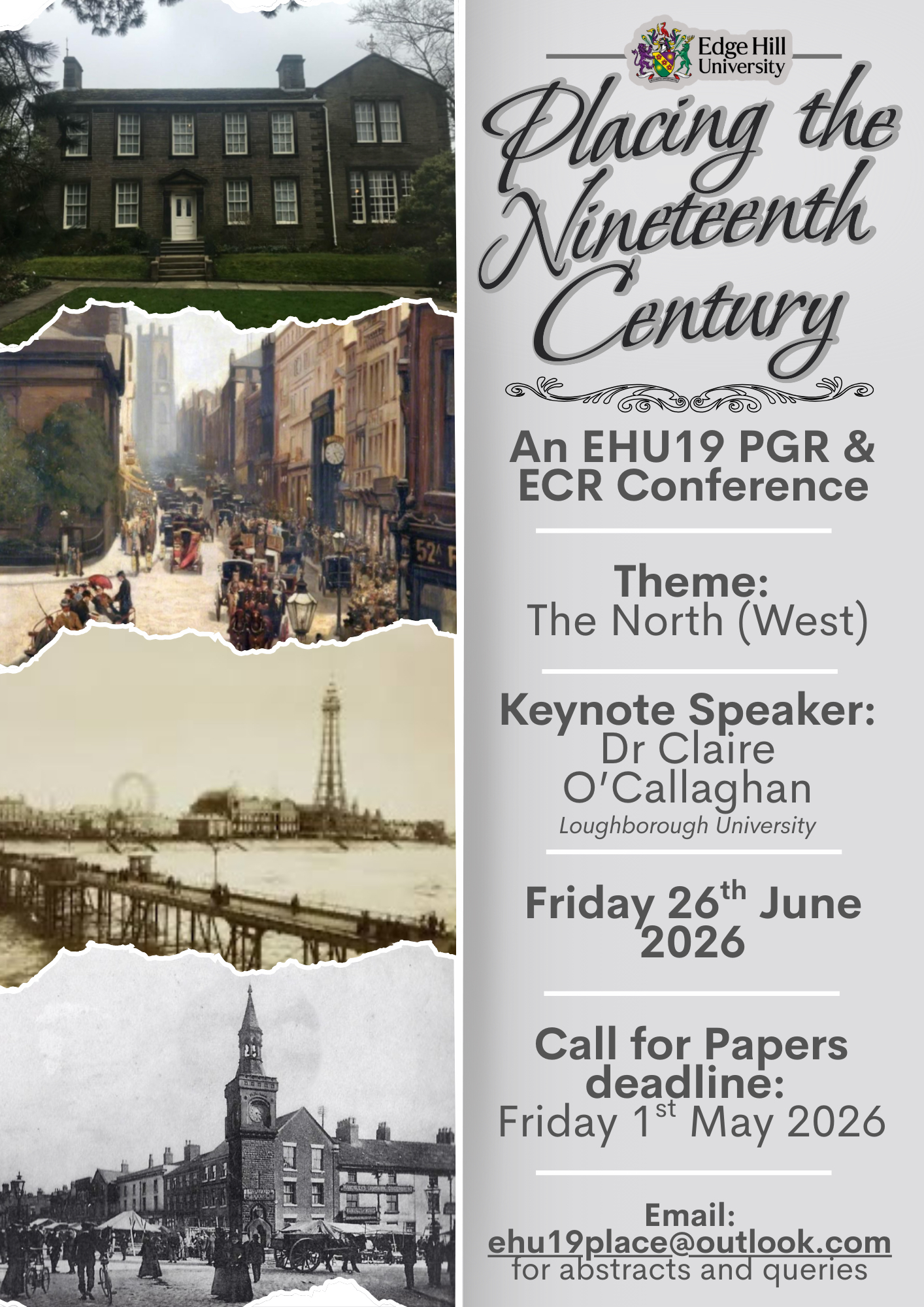
Friday 26th June 2026 Edge Hill University
Edge Hill Nineteen research centre is excited to invite you to ‘Placing the Nineteenth Century’, a PGR/ECR conference focused on the North (West) of England in nineteenth-century literature and history. London and the South have often been the heart of discussion about the nineteenth century. However, development in industry during the period brought popularity to cities such as Liverpool and Manchester, which led to a boom of industrial growth in the north of England. In the nineteenth century, the north of England developed like never before, both within cities and in more rural areas.
Following a recent EHU19 research symposium, PhD students from literature and history came together to discuss their emerging research and found a common theme – place. More specifically, the North (and North West) of England was a uniting thread, and so the idea for such a conference was born.
We invite proposals that engage with ‘place’ in the long nineteenth century, with particular attention to the North (West), broadly conceived. Papers may approach place as material, imagined, represented, contested, remembered, or speculative. We welcome MA/MRes students, PhD students, and Early Career Researchers whose research interests focus on the North (West) of England in nineteenth-century literary studies, history, art history and related disciplines, with suggested (but not limited to) topics such as:
Fictional/fantastical representations of the North (West)
The legacy of space in the North (West)
Transnational and postcolonial links to the North (West): colonial, imperial, and transatlantic contexts (e.g, Liverpool as a global port)
Museums, archives, and collections: regional museums and the afterlives of nineteenth-century places
Gendered, racialised, and marginalised spaces: who belongs, who is excluded, and how space is policed
Landscape across disciplines: historical, literary, artistic, and creative engagements with the natural and industrial landscapes of the North (West) in the long nineteenth century
The North (West) in popular culture, periodicals, visual culture, and performance
Queer histories and queer readings of place, including non-normative identities & relationships
Please send abstracts of approximately 250 words (including title) for 10–15 minute papers, along with a short biography to ehu19place@outlook.com by 1st May 2026, including name, preferred pronouns, and academic institution.
We are excited to have Dr Claire O’Callaghan giving a keynote address on Top Withens, Wuthering Heights and the impact of literary scholarship. As Dr O’Callagham is also the Editor-in-Chief of the Brontë Studies journal, she has kindly agreed to also run a workshop on publishing in an academic journal.
Given the conference’s emphasis on ‘place’, we are excited to offer an in-person conference gathering in the North West and warmly welcome participants to join us here. However, we are also committed to accessibility needs and widening participation, so please indicate if you would prefer to present online in your application. Please also do let us know about any other access needs or adjustments that can make your experience easier.