Romantic Reimaginings: Adaptation and Convergence in Poe (Part 2 of 3)

      Comments Off on Romantic Reimaginings: Adaptation and Convergence in Poe (Part 2 of 3)

Romantic Reimaginings is a BARS blog series which seeks to explore the ways in which texts of the Romantic era continue to resonate. The blog is curated by Eleanor Bryan. If you would like to publish an article in the series, please email ebryan@lincoln.ac.uk.

Today on the blog our article is Part 2 in a 3 part series in which Jeff L. Wright (University of Arkansas) discusses adaptations of the works of Edgar Allen Poe. His first article (link below) examined Poe’s The Raven in the context of Halloween. Parts 2 and 3 examine Richard Corben’s comic book adaptations of Poe, tracing the evolution of these adaptations from the cultural ‘memeplex’ to the individual ‘selfplex’.

Part 1: bars.ac.uk/blog/?p=2721

Part 2:

My childhood fascination with horror comics would eventually come full circle as I conducted my research in grad school where, amongst many other interdisciplinary interests, the Dawkins/Bartolotti/Hutcheon evolutionary concepts of memes became a prime ingredient in most of my research. In terms of Romantic Reimaginings, I would like to take a look at the ways in which the bio-evolutionary theory of memes and adaptation work using adaptations of Edgar Allen Poe’s “The Raven”, in the comic books of Richard Corben.

Once upon a midnight dreary, while I pondered, weak and weary/Over many a quaint and curious volume of forgotten lore… tapping… on my tablet I came across some contemporary horror comics I had been meaning to get around to reading. There has always been a place in comics for good ole fashioned worm-and-guts horror, and famed underground comic book artist, Richard Corben, is probably one of the most creative Eisner Inductees to ever put pen to paper in this genre. In the days of Marvel’s “adult” label, Max, Corben penned several issues for the Haunt of Horror series that adapted stories and poems to great effect. Haunt of Horror: Edgar Allen Poe #1 (2006) featured one of Corben’s earlier adaptations of “The Raven” and “The Conqueror Worm,” both of which are re-imagined again by Corben in later works.

In my work, I prefer Susan Blackmore’s terms from The Meme Machine in referring to the world where art and literature live in our culture (memes) as the memeplex, and when those memes enter our minds it is entering the selfplex. The concept is simple. Memes from the memeplex, such as the poem “The Raven”, are absorbed into the mind/selfplex, via visual transmission of signs and images that represent the thoughts contained in the brain cells of someone else. Once absorbed into our brains, those signs are interpreted and become transmissions between our own brain cells, and if we deem it worthy, or if it is just too memorable to forget, or too forgettable to remember, it may get stored in our own selfplex/brain as memory. Following this bio-evolutionary model of memes, the meme/thoughts, can either stay relatively fidelitous to the original meme or it can mutate, either by accident because human memory is very fallible, or because we consciously mutate it. The meme is then regurgitated back into the memeplex where it will undergo a sort of survival of the fittest test, being accepted or rejected by the culture as a whole, or some degree in between, where it can then go through the whole process again as it enters and is regurgitated by numerous other selfplexes. This is an evolutionary process that can take place in a matter of seconds, rather than hundreds of thousands of years of biological evolution.

As someone focused on visual rhetoric/theories in adaptation studies and convergence culture, I am always either enamored or repulsed by another person’s idea of what a character looks like. It used to drive me bonkers the way an artist would render Frodo to look like a cherub with pants or made Strider look too clean-cut in the Tolkien calendars. In visual adaptations of “The Raven”, we often see a Poe-like caricature portraying the narrator, who we are never given any description of by Poe whatsoever. I think this is partly to blame for why so many people think Poe himself was an alcoholic and drug addict. We know the character is tired and lonely and that’s about it. So, any visual elements added to this poetic story are going to be coming mostly from the mind of the artist.
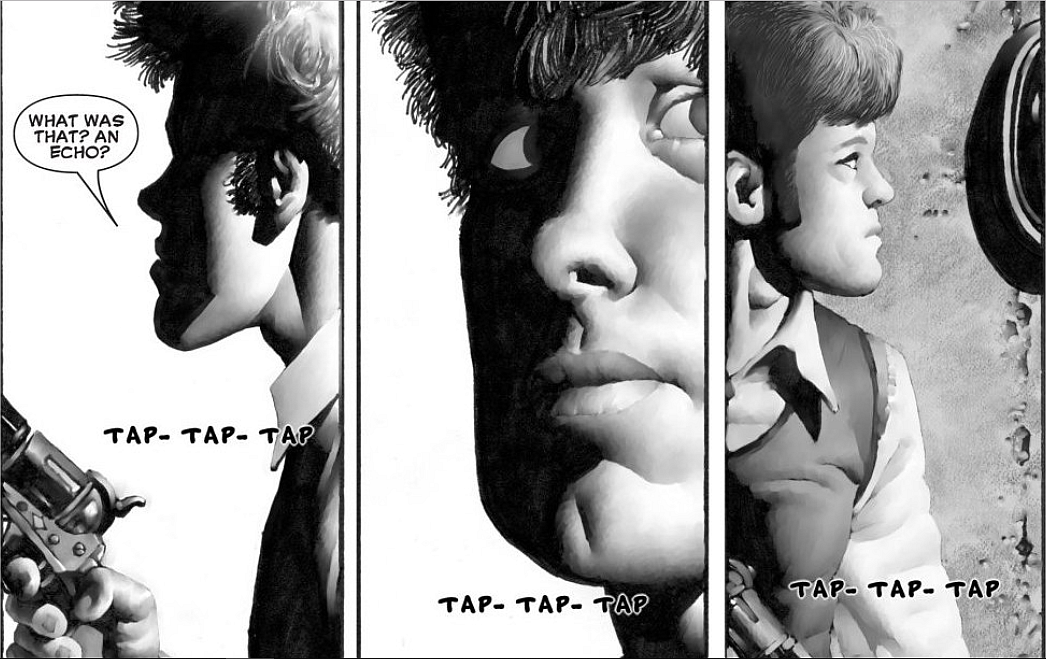
Figure 1

In this case, Corben is taking the poem from the memeplex, rolling it around in his own brain, Corben’s selfplex, and then he draws the comic book and puts it back out into the memeplex as a new adaptation, which is also a prime example of aspects of Convergence Culture phenomenon. We get to see a visual representation of his thoughts manifested into a material reality.

Corben’s artwork in this story is painterly, using what appears to be ink-and-paper in a more watercolor-styled fashion. You can see that the protagonist is fairly generic, while details abound in material objects like the revolver the character carries (fig. 1). It’s almost as if Corben doesn’t want to give too much detail to the character, instead creating the impression of the character, while the room around him and material objects are detailed. There is really only one controversial element of this poem’s imagery; what does the guy look like? We’re less likely to get hung up on what the room and objects should look like. Even an artistic expression of a raven would still be relatively fidelitous so long as we recognize it as the raven. But the protagonist’s appearance is the only element our minds are likely to find debatable. If you try to substitute a Pomeranian for a St. Bernard in Cujo, our minds are going to reject it. But changing the car in that story from a Ford Pinto to a Ford Fiesta; they are almost the same economy car, so who cares.

From a Convergence Culture standpoint, analysis such as this becomes a useful tool in looking at the adaptation process. Richard Corben’s work is a great piece of data, because as I mentioned before, he creates other renditions of this and other Poe stories, so one could analyze his visual adaptations of Poe on a specific textual meme in the same way art critics have analyzed Monet’s numerous water lily paintings. In Part 3, I will continue discussing Corben with one of his more recent adaptations of “The Raven”, where we see a shift in his visual style and color, as well as how he is approaching the written adaptations of Poe, specifically what elements are being added to this otherwise sparse story from one of Poe’s most famous poems.

Jeff L. Wright is currently working on PhD in Cultural Studies and as a writing instructor at the University of Arkansas. He has a BA and MA in interdisciplinary studies in the fields of Anthropology, Rhetoric-Composition, Gender Studies, Film Studies, and Theatre. Jeff’s writing ranges from academic research to playwrighting, and he is currently working as one of the official bloggers for the Sam Walton College of Business. His current research is focused on “Bitch-Rhetoric” in comic books and tattoos.


Romantic Reimaginings: Adaptation and Convergence in Poe (Part 1 of 3)

      Comments Off on Romantic Reimaginings: Adaptation and Convergence in Poe (Part 1 of 3)

Romantic Reimaginings is a BARS blog series which seeks to explore the ways in which texts of the Romantic era continue to resonate. The blog is curated by Eleanor Bryan. If you would like to publish an article in the series, please email ebryan@lincoln.ac.uk.

Today on the blog, in the inaugural article of a three part series, Jeff L. Wright (University of Arkansas) discusses adaptations of the works of Edgar Allen Poe. His first article examines Poe’s The Raven in the context of Halloween. Parts 2 and 3 examine Richard Corben’s comic book adaptations of Poe, tracing the evolution of these adaptations from the cultural ‘memeplex’ to the individual ‘selfplex’.

Part 1

Growing up in the woods of Sherwood may seem like some sort of magical childhood full of secret gardens and talking lions, but in reality, Sherwood, Arkansas was your typical run-of-the-mill suburban, U.S. town in the “South.” Every year there were fireworks on the 4th of July, pastel suits and Easter egg hunting, and of course lights and parades to celebrate Thanksgiving and Christmas. The holidays were always a lot of fun; they broke up the monotony of school with guaranteed days off and the hope of material goods in the form of presents. But of course, we always had to dress up in our “Sunday clothes” to eat what was otherwise an ordinary meal with the same people you ate with yesterday, or in the case of the 4th, you had to plan to weather what was usually a 36 degree day by slathering on tons of sunscreen and bug repellent to fend off the pinky sized mosquitoes coming out of the nearby creek. Of all the holidays to dress up for, though, Halloween was always my favorite. Costume planning went from weeks before to a full year of prep time by the time I was nearing the end of my Trick-or-Treating days (I think somewhere around the age of 40).

As Halloween approached again this year, I was reflecting upon my early school days when we were allowed to wear our costumes to school and we would all have a parade of classes, and Suzy was lying about getting to see Alien (1979), and the teachers and staff would hand out candy, and there was that one year that Johnny’s single, low-income mom “forgot” it was costume day and Johnny tore rips in his school clothes and said he was “a punker” and the teacher chastised him in front of everybody for it, and… well, there are always a lot of tangled memories tied up in childhood. But, the one thing that always stood out in my mind was when they would take large groups of costumed students to the library where the school librarian would be dressed up looking exactly like the Wicked Witch from The Wizard of Oz (1939), which wickedly scared the pants off the really little kids. Scaredy-cat babies! There was more candy and we always got to watch the Bing Crosby narrated The Legend of Sleep Hollow (1949), which in the days before VCRs was a big deal to get to see a Disney cartoon in the library.

But before that, every time, we had to sit through a reading of Edgar Allen Poe’s The Raven. It was like they had to get it out of the way first. Teachers would scurry around hushing and shushing the fidgety ones while the Wicked Witch read the poem out loud to us… from a book that didn’t even have any pictures in it! Why oh why would anybody think that little kids would be fascinated by this poem is beyond me. We whispered to each other, pulled our neighbors cape, popped the elastic string on the back of a mask; fidgeters every last one of us! Getting to watch cartoons and eat candy was fun, having to listen to someone drone on and on about a stupid raven tapping on a window sill??? “More like crapping on the window sill!” The wit and wisdom of the juvenile mind.

As a result, I was conditioned at an early age to be weary of “one of the U.S.’s greatest authors,” and like those awful, bottom-of-the-bag, all-that’s-left Halloween licorices or star mints, it put a bad taste in my mouth whenever it came to Poe for years afterwards. One of our few “canonical” U.S. authors, a good ole’ red blooded patriotic ‘Merican for crying out loud, and we were taught as schoolchildren to hate him, or at least note him to be the most boring aspect of Halloween, which to a kid is pretty much the same as saying “you’re the old lady coffee candy someone fished out of their old lady purse and put it in your Trick-or-Treat bag.” Realistically, in the eyes of a 7 or 8yo child, how was some ancient poet ever going to compete with It’s the Great Pumpkin, Charlie Brown (1966). And even though it was a long time ago in a galaxy far, far away, it was still an era in which the Universal Monster Movies were considered “G-rated” and family friendly. So, a poem that harkens back to middle-English about a dead girlfriend and a raven were about as scary or creepy to me then as when my little sister went as the Looney Toon, Tweety Bird, for Halloween. I’ll pit The Creature from the Black Lagoon (1954) against any Poe antagonist any day, any time.

In truth, looking back, I realized this was my first foray into the controversy of canonical literature. “Why do they get to say who we read?!” And as the Wicked Witch read the poem out loud, I remember a girl, maybe a grade lower than me, interrupting with “Who’s Lenore?” Unfortunately, I do not recall the witch’s response, but it had to be something to the effect of “Well, that’s his dead wife and the man is sad about it.” Which you can just imagine the slew of questions that is going to follow that: “Why’s she dead? How do you know he’s sad? Why do people drink when someone dies? Can you make my mommy stop drinking? Will a raven come and peck my eyes out?” What the hell were those educators thinking?

It’s an example of how easily we can (please tell me it was inadvertently) warp the minds of young readers and turn them away from authors by trying to introduce them at too early an age. In all fairness, it was also the same public school district that taught us that Frankenstein was about “not playing God because it’s a sin.” Unfortunately, it would not be until years later that my opinion of Poe would change. At this point, Edgar Allen Poe’s, The Raven, still stands out in my mind as one of the worst aspects of Halloween and those witchly open-mic readings were an epic fail.

Jeff L. Wright is currently working on PhD in Cultural Studies and as a writing instructor at the University of Arkansas. He has a BA and MA in interdisciplinary studies in the fields of Anthropology, Rhetoric-Composition, Gender Studies, Film Studies, and Theatre. Jeff’s writing ranges from academic research to playwrighting, and he is currently working as one of the official bloggers for the Sam Walton College of Business. His current research is focused on “Bitch-Rhetoric” in comic books and tattoos.

The Maureen Crisp Young Scholars Fund – Byron Conference Bursaries

      Comments Off on The Maureen Crisp Young Scholars Fund – Byron Conference Bursaries

The Maureen Crisp Young Scholars Fund invites applications for funding from  post-graduate scholars intending to present an academic paper at an approved Byron conference or a paper mainly on Byron at any other approved conference in or outside the United Kingdom.

The student (irrespective of nationality) should be studying at a University in the United Kingdom. Applications may be submitted at any time and should include a CV and the names of one, preferably two referees. An abstract of the paper to be read will be required, and details of the conference including its approximate total costs.

The candidate will be notified as soon as possible whether they will  be granted a fund or otherwise but actual funding will only be provided once there is confirmation that the candidate’s paper has been accepted.

In the event of the scholar being unable to attend the conference for whatever reason after a grant has be made, then the grant will be repayable in full forthwith to the Maureen Crisp Young Scholars Fund.        An application for funding to the trustees does not mean a grant will automatically be given

In the first instance please contact: www.newsteadabbeybyronsociety.org/contact

The Censorship of British Theatre, 1737-1843

      Comments Off on The Censorship of British Theatre, 1737-1843

New web resource on theatre censorship: https://tobeomitted.tcd.ie 

The website explores the topic of theatre censorship in Britain 1737-1843. It hosts 40 carefully selected play manuscripts submitted to the Examiner of Plays who had the primary responsibility of safeguarding the morals of theatre audiences after the passage of the Stage Licensing Act of 1737.

The manuscripts are drawn from the Larpent Collection (Huntington Library, Los Angeles) and the Lord Chamberlain’s Plays (British Library, London) and have been carefully selected to show the variety of reasons a play might be deemed inappropriate through the eighteenth and nineteenth centuries. Each manuscript is accompanied by an author bio, plot synopsis, reception history, and commentary on the censorship. The editorial apparatus amounts to 95,000 words in total.


The Meeting: Reading and Writing through John Clare

      Comments Off on The Meeting: Reading and Writing through John Clare

As part of an Arts Council England- & John Clare Society-funded outreach and inclusion project, Simon Kövesi has edited a short collection of readings of John Clare poems and prose by celebrated actor Toby Jones, now online at Oxford Brookes University. The readings are available via standard browsers, and via Spotify and iTunes as free podcast-style subscriptions. Reading texts are also provided on the project website. The hope is that Toby’s readings will support the study and enjoyment of Clare, at any level of interest.

Toby will perform as Clare, in the project’s final musical stage show, in Oxford in February, and in London in April, by way of celebrating 200 years since the publication of Clare’s first collection, Poems Descriptive of Rural Life and Scenery. More details soon.

Project website: https://www.brookes.ac.uk/the-meeting/

Toby Jones readings: https://www.brookes.ac.uk/the-meeting/toby-jones-reads-john-clare/

CFP: Writing Health from the 18th Century to the 21st

      Comments Off on CFP: Writing Health from the 18th Century to the 21st

3-5 June 2020,

Northumbria University, Newcastle upon Tyne, UK

Northumbria University, in connection with a three-year Leverhulme Trust-funded major project, is organising a two-day conference focusing on writing by and about doctors and other health practitioners, encompassing everything from physicians, apothecaries and botanists to midwives and cunning women. The aim of the conference is to give scholars the opportunity to explore the phenomenon of writing doctors and its wide social effects, whether it be representations of medical practitioners in literature and art, or creative works written by medical people. The interdisciplinary nature of the subject invites work on cultural, economic and gender history, as well as literary, visual and performing arts.

Plenary Speakers

Michelle Faubert, Associate Professor of English, University of Manitoba and Visiting Fellow, Northumbria University; Pratik Chakrabarti, Professor in the History of Science, Technology and Medicine, University of Manchester; Tita Chico, Professor of English, University of Maryland.

The movement of medical writing from Latin to English in the Early Modern era opened up knowledge previously monopolised by an elite readership. Medical practitioners of both genders recognised the potential to build up their brand by catering to a burgeoning market of eager new readers. Publishers and booksellers capitalised on increased literary rates and greater purchasing powers amongst the public to produce ever-growing quantities of scientific texts – further fuelling public fascination with health and wellbeing, especially that of women. Practitioners, in entering this marketplace, were laid increasingly open to public ownership, as a personality behind the prose, either for better or worse. The full social, economic and political implications of this radical shift in the dissemination of information in the medical field have only just begun to be uncovered by scholars. This conference aims to open up discussion regarding all elements of this topic ca. 1660 to the present day.

Topics might include, but are not limited to:

  • Representation of, and writing by, medical practitioners in literary, visual and performing arts
  • Medical self-fashioning.
  • The role of gender in medicine (e.g. female apothecaries, midwives, cunning women, etc.)
  • Definitions of medical writing and the role of genre
  • European, Trans-Atlantic, Asian, and colonial medicine Satire – in all its forms – directed at medical practice, both lay and professional, including by medical people themselves
  • Discourse and correspondence between practitioners, and practitioners and their patients.
  • The nature of medical publishing

We welcome proposals from researchers across a range of disciplines and stages of career, including early career and student scholars. Please send proposals of no more than 300 words, accompanied by a short biography, to writingdocs18@gmail.com by Friday 15th November 2019. Papers will be invited on a wide variety of relevant topics from within the period. A selection of revised papers is expected to be published as part of the project outputs.

Conference Rates: £130 full delegates, £65 Concessions (PGR and Unwaged)

The Conference is organised by: Clark Lawlor; Ashleigh Blackwood; Allan Ingram; Leigh Wetherall-Dickson; Helen Williams and Laurence Sullivan (The Writing Doctors Team).

Romantic Studies and Environmental Criticism: A Symposium

      Comments Off on Romantic Studies and Environmental Criticism: A Symposium

University of Leeds, 7–8 April 2020

Call for Participants

Deadline 13 December 2019

What is the current state of environmental criticism in British Romantic studies? And what is its future?

This symposium will bring together scholars working on literature, culture and the nonhuman around 1800. It aims to enable conversation between postgraduate students, early career researchers and leading thinkers in the field. We will take the measure of existing research on texts and ecologies in Romantic-period Britain, and ask what comes next.

We will also consider professional issues. How can we work towards a flourishing community of researchers in the field? How can scholarship inform and be informed by life outside the academy?

The symposium will consist of dialogues and round table discussions, with readings circulated in advance, but no formal lectures. Lead participants will include Professors Donna Landry (Kent), Ralph Pite (Bristol) and Kate Rigby (Bath Spa). It should be of interest to Romanticists working on environmental/ecological themes of all kinds, including but not limited to animal studies; climatology and meteorology; colonial environment-making; ecopoetics and formalist ecocriticism; gender and ecology; ‘green Romanticism’ and the genealogies of environmentalism; industrial change; natural philosophy; place, landscape and geography; and rural, urban and agrarian cultures.

The symposium will take place in Leeds from midday on Tuesday 7 to late afternoon on Wednesday 8 April. Participation is free but places are limited.

Five £150 bursaries are available to support postgraduate, early career and precariously employed researchers who will be participating in the whole event.

To take part, please email Jeremy Davies (j.g.h.davies@leeds.ac.uk) with a short description – max. 300 words – of your research interests in the field by 13 December 2019. To request one of the five bursaries, please also include a summary of your current career circumstances.

The event is funded by the AHRC, and hosted by the Leeds Environmental Humanities Research Group and the Leeds Arts and Humanities Research Institute.

Romantic Reimaginings: Adapting Mary Shelley’s Female Monster

      Comments Off on Romantic Reimaginings: Adapting Mary Shelley’s Female Monster

Romantic Reimaginings is a BARS blog series which seeks to explore the ways in which texts of the Romantic era continue to resonate. The blog is curated by Eleanor Bryan. If you would like to publish an article in the series, please email ebryan@lincoln.ac.uk.

Today on the blog, Gracie Bain discusses the adaptive history of Mary Shelley’s Female Monster.

In Mary Shelley’s Frankenstein (1818), the female creature Frankenstein creates for his monstrous son is assembled but not animated. In a fit of regret and concern for humanity, Frankenstein rips her body apart—creating what is arguably the most explicitly violent scene in the novel. He suspects that she may become rational, or worse yet, willful: “She, in who in all probability, was to become a thinking and reasoning animal” (129). In the film, Bride of Frankenstein (1935), directed by James Whale, she is animated but destroyed by the male monster when she refuses him. Though she is the title character, the Bride’s only dialogue is her scream of terror/horror. I, like many others, was unhappy with the female monster’s portrayal. What happens when the Bride desires and wills? What exactly is it about the female body that provokes violence? It is my argument that in each of these texts, she is destroyed because she either has the potential to will or she does actually enact her own will.

The Bride’s scream in Bride of Frankenstein

Elizabeth Hand’s novel, The Bride of Frankenstein: Pandora’s Bride (2007), embodies the cultural fascination with Frankenstein’s female monster as an adaptation of an adaptation. In the novel, the Bride survives the fire intended to kill her in Bride of Frankenstein. She teams up with Dr. Pretorius and escapes to Berlin—followed by both the Frankensteins and the male monster. Eventually, Elizabeth Frankenstein kills her husband, reanimates him, and attempts to convince the Bride to join her in what is essentially an all-woman murder squad. The Bride refuses and kills Elizabeth. If we look at Frankenstein as her origin, Bride of Frankenstein as her animation, and Pandora’s Bride as the enactment of her will and desire, we can read the character’s progression as reflective of the power of monstrous bodies—specifically female ones. If adaptations function as a place of critical analysis, then Whale’s film and, perhaps more interestingly, Hand’s novel, allow our culture to work through what exactly happens when female monstrosity is paired with a monstrous will. What exactly is monstrous about the female will and body?

In Willful Subjects, Sara Ahmed argues we name someone willful when “they are not willing to be means” (42). To be willful is to refuse the “right” kinds of authority. It is to “‘snap the bond,’…understood as snapping the affective tie of the family as well as the bond reproduction, understood as fate, or even fatality” (Willful Subjects 113). In Shelley’s novel, it seems that it is the potential for the Bride to enact those reproductive bonds in the wrong way that gets her destroyed. Frankenstein rationalizes that she may want to destroy humanity—that she might not will the right way. She could potentially destroy humanity by accepting the male monster as her mate or by refusing him. In Bride of Frankenstein, she does snap the familial bond between her, the monster, and Frankenstein when she screams in terror at the male monster. In Pandora’s Bride, Pandora refuses to go with Henry Frankenstein peacefully. Instead, she defeats the evil Frankenstein and his wife, Elizabeth, who eventually turns her husband into an animated monster himself. One could read the Bride’s will in Whale’s film and Hand’s novel as simply doing the right thing. It would be morally wrong to create “a race of devils” as Victor puts it in Frankenstein (129). I am more interested in the ways that her willful refusal is read as being willfully hopeful. Reading the Bride’s refusal as a decision of morality is undercutting the potential for the action of willing.

Cover of The Bride of Frankenstein: Pandora’s Bride by Elizabeth Hand

In Hand’s novel, when her will is fully realized, there is a repetition of mind language: “I already knew my own mind…. you will recall that I did actually possess a mind” (Hand 11-12). She chooses her own name after refusing the one suggested by Pretorius—Lilith, the fallen woman— because she does not see herself as a fallen woman. When Donna Haraway argues in “A Cyborg Manifesto” that unlike Frankenstein’s monster, the cyborg is not looking for a father or a creator, she forgets the Frankenstein’s monstrous daughter. While Haraway argues for a being without myth, the female monster is the creature and creator of her own myth. She chooses the name of Pandora: “That should be my name…. Dr. Pretorius said that someday a woman will write of the New Eve. So I will be the New Pandora. I will not be any man’s bride or any man’s toy. Whatever strengths I possess, whatever I have hidden inside of me, whatever I unleash upon men, I will do so knowingly” (32). She refuses to be a bride, to be an Eve, instead, she chooses to open the box and find hope: “I thought of the legend from which I had drawn my name….one moral to be drawn from it—Woman as the cause of Humanity’s misfortune–was cruel and egregious. Yet there was solace…to be drawn from its other conclusion…hope survives” (198). The development of reason that urges the male monster to reconnect with his creator urges the female monster to be willfully hopeful in herself. To be willfully hopeful is to ignore that which makes us avoid Pandora’s box.

Mary Shelley’s text may give us an unsatisfactory ending for the female creature, but it does provide a springboard to explore the themes of willfulness and desire that are more subtly represented in her novel. Contemporary adaptations that engage Shelley’s female monster explore the complicated relationship between desire, willfulness, and hope.

Works Cited:
Ahmed, Sara. Willful Subjects. Duke University Press, 2014.
Bride of Frankenstein. Directed by James Whale, performances by Colin Clive, Boris Karloff, and Elsa Lanchester, Universal Pictures, 1935.
Hand, Elizabeth. The Bride of Frankenstein: Pandora’s Bride. Dark Horse Books, 2007.
Shelley, Mary Wollstonecraft. Frankenstein. Edited by Susan J. Wolfson. 2nd edition. Pearson, 2007.

Gracie Bain is a first-year PhD student at the University of Arkansas. Her research looks at the intersections of Victorian popular literature, affect theory, and crime literature.


BARS Treasurer, BARS Membership Secretary: Invitation for Expressions of Interest

      Comments Off on BARS Treasurer, BARS Membership Secretary: Invitation for Expressions of Interest
The following message is from Anthony Mandal, BARS President.
     Dear BARS Members,
As announced at the BARS 2019 conference in Nottingham, our Treasurer & Membership Secretary, Dr Jane Moore, is stepping down at the end of this year. Since her election in 2013, she has worked tirelessly over six years marked by a growing membership, an expanding range of funding opportunities and new partnerships with external organisations. On behalf of BARS, the Executive would like to reiterate its thanks to Jane for her diligence and commitment over these years. It has been a pleasure working with her and she will be missed.
The Executive would also like to extend its gratitude to Dr Nicola Lloyd, who has assisted Jane over these years in preparing budgets, updating accounts and monitoring membership records.
In the context of BARS’ continuing expansion and diversification, it has become apparent that the role of Treasurer & Membership Secretary is now an extensive and demanding one. In light of this, the Executive wish to split the role into two separate posts. Such a decoupling would also align BARS with the practices of fellow societies such as BSECS, BAVS and BAMS. Additionally, This new arrangement would provide scope for the elected Officers to develop these roles in new and exciting ways.
Please find attached role descriptions for the Membership Secretary and Treasurer, detailing duties and anticipated activities. 
According to the BARS Constitution, a change of this nature would normally need to be passed at the July BGM with a two-thirds majority vote of Members present. However, circumstances didn’t allow for this at Nottingham this summer, although the proposed changes were announced. In light of this, Members who wish to lodge dissenting views of the proposed change or offer feedback on the decoupled roles should write to the President, Anthony Mandal (mandal@cardiff.ac.uk) by 14 November 2019.
The Executive wish to invite expressions of interest for the posts of Treasurer and Membership Secretary by 21 November 2019. Informal enquiries about the role should be directed to the outgoing Membership Secretary and Treasurer, Jane Moore (MooreJV@cardiff.ac.uk). Applications should be sent to the Secretary, Jennifer Orr (Jennifer.Orr@newcastle.ac.uk), and should comprise an up-to-date CV and a personal statement (up to 500 words) detailing the applicant’s qualifications for the role.

Please click here to view the document containing role descriptions.

If you have any issues accessing the PDF, please contact BARS Communications Officer Anna Mercer (mercerannam@gmail.com).

Techne Collaborative Doctoral Award 2020

      Comments Off on Techne Collaborative Doctoral Award 2020

The Keats House Collections: Constructing Romantic Lives and Afterlives

Applications are invited for a fully-funded, three-year PhD to be hosted jointly by Keats House and the Centre for Research in Romanticism at the University of Roehampton, London, UK. The PhD will begin in October 2020. This is an exciting opportunity to work with an internationally famous museum which celebrates the life and works of one of Britain’s greatest poets. Situated in Hampstead, London, Keats House contains many precious artefacts including correspondence, books and portraits. Its non-displayed collections are cared for by London Metropolitan Archives, who work with the House to provide access for researchers and anyone with an interest in Keats and his circle.

The aim of this project is to investigate the ways that a writer’s house and its collections can actively contribute to the cultural memory, reputation and appreciation of a canonical author. The exact topic of the PhD will be decided by the student in conjunction with supervisors, but we expect the development of the collections to provide an outstanding opportunity to put new research insights into practice through actual and virtual curation of the collections. The project provides excellent career opportunities and will provide relevant training in archives, heritage work and digitization. The student will contribute to ‘Keats200’ and the future plans of Keats House and the Keats Foundation.

The supervisory team will be Professor Ian Haywood and Dr. Dustin Frazier Wood (Roehampton) and Rob Shakespeare (Director, Keats House). Further expertise will be available from London Metropolitan Archives and the Keats House team.

Expressions of interest and any other queries: please contact Professor Ian Haywood no later than 1 December 2019: I.Haywood@roehampton.ac.uk.

FULL JOB ADVERT: https://www.jobs.ac.uk/job/BWH513/techne-collaborative-doctoral-award-2020-the-keats-house-collections-constructing-romantic-lives-and-afterlives