Byron Society 2020-2021 PhD Bursary

      Comments Off on Byron Society 2020-2021 PhD Bursary

The Byron Society invites applications for a PhD bursary of £3,000 for 2020-2021.

Applications are open to new and existing full-time PhD students enrolled at a UK university and working on a thesis addressing any aspect of the life, work and /or influence of the poet Lord Byron. Applications are also welcomed from those studying multiple poets or authors, including Byron.

Each bursary covers just one year, however multiple applications can be made and postgraduates whose research focuses solely on Byron can receive up to three annual bursaries. (Those who study Byron alongside other poets and authors can only be awarded one bursary).

Applications can be made by students with additional sources of funding, but please list these in your application. The applications should also include a summary of the applicant’s academic record, an outline of his / her proposed research and the names of two referees who may be contacted. Please also state what year of study you are in.

For more details about this award and past recipients, and to submit your application, click here.

Call for Expressions of Interest: BARS 2023 INTERNATIONAL BIENNIAL CONFERENCE

      Comments Off on Call for Expressions of Interest: BARS 2023 INTERNATIONAL BIENNIAL CONFERENCE

Deadline: 23 February 2020

Send your EoI to Jennifer Orr (Jennifer.Orr@newcastle.ac.uk)

THE BRITISH ASSOCIATION FOR ROMANTIC STUDIES is pleased to invite Expressions of Interest for the 2023 International Biennial Conference. The last two BARS conferences (York 2017 and Nottingham 2019) were very successful, and we will be co-hosting a large conference with the North American Society for the Study of Romanticism at Edge Hill University in Summer 2021.

Since 2015, attendance at BARS conferences has grown to around 250 and delegate feedback has been very positive. We are very much looking forward to working with institutions in continuing to build on and to diversify the successful BARS model. Please consult the programmes for Cardiff, York and Nottingham as guides for your proposal.

A decision will be made by the BARS Executive at its next meeting in March 2020 and the successful applicants will be invited to submit a report for the following Executive meeting, which will be held electronically in July 2020. The successful applicants will also be expected to make a presentation at the next conference, Edge Hill 2021.

Host institutions are expected to take account of the following in preparing their Expressions of Interest:

Venue location, capacity and accessibility

We expect numbers could range between 250 to 275 delegates: please bear this figure in mind when bidding. You will need a plenary lecture hall large enough to accommodate these numbers, plus a sufficient number of breakout rooms and catering facilities (BARS conferences can normally have around ten parallel sessions). For North American colleagues in particular, the distance from a major airport and transport links will be an important factor, so please bear this in mind.

We expect organizers to offer a range of accommodation from traditional student-type lodgings through to hotel-level facilities. Sufficient cheaper accommodation to allow postgraduate participation is desirable: such accommodation should be within reasonable walking distance of the conference venue or the organizers should make suitable travel arrangements to take delegates to and from the venue.

The venue is expected to meet the usual requirements for facilities in academic meetings, including Wi-Fi and PowerPoint/projection facilities in all rooms. It is desirable that the meeting rooms are in reasonably close proximity to each other and that there is a communal meeting area or foyer, preferably with refreshment facilities so that delegates can socialize and browse publisher stands.

In order to comply with BARS’s commitment to equality, diversity and inclusion, conference organizers should ensure that the venue, accommodation and transportation are fully accessible.

Conference theme

This should be of sufficient scope and significance to allow the Association’s members to take part. Recent themes have been ‘Romantic Imprints’, ‘Romantic Improvement’, ‘Romantic Facts and Fantasies’ and ‘New Romantics’. The full list of previous conferences can be found on the BARS website.

Timetable

The conference has typically run from Thursday to Sunday in the second half of July, with the conference commencing on the afternoon of the first day and finishing on Sunday afternoon. However, this is a flexible schedule and proposers are encouraged to deviate from this model, for instance proposing a Monday-to-Thursday event (indeed, BARS 2021 will be running from Tuesday to Friday).

The BARS Executive normally meet on the evening before the conference begins: organizers will need to arrange a suitable venue for this (two-hour) meeting. The meeting typically concludes with a short tour of the conference venue for the Executive members in attendance. In fixing on a date, it is especially important organizers should check which conferences are already scheduled for what is often a busy time in the calendar and liaise with conference and society chairs in order to avoid clashes wherever possible and facilitate attendance at all events. Conferences which run during summers and are likely to be attended by BARS delegates include those hosted by the British Association for Victorian Studies, the International Conference on Romanticism, the International Gothic Association, the International Society for Eighteenth-Century Studies and the North American Society for the Study of Romanticism.

The CFP is usually circulated by October of the preceding year (2022) and the outcome of the refereeing process confirming speakers is usually made by the middle of January.

Vetting of papers

It is usual for members of the BARS Executive to serve on the panel which referees the proposals for panel papers, though the local organizers have the final right of veto. (It is desirable that papers are refereed not only for the integrity of the event, but also to help delegates secure financial support from funding bodies and institutions.)

Programme

The programme usually takes the form of parallel sessions consisting of panels where delegates deliver 20-minute papers. BARS welcomes convened and themed panels that reflect cutting-edge projects and collaborative research, and other formats such as roundtables and workshops. In addition, there are usually four or five plenary lectures, one of which is designated the Stephen Copley Lecture and another the Marilyn Butler lecture in memory of BARS’s founding members and much-loved scholars. Plenaries are chosen by the local organizing committee, though BARS expects this to reflect a gender balance and a mixture of national and international scholars. In the arrangements of the panel sessions and the timing of the plenary lectures the organizers are asked to consider seriously the responsibility of offering all speakers a reasonable size of audience (it is now standard practice to end the conference on the final day with a keynote). BARS expects panels to incorporate postgraduate and early career researchers opportunities alongside more established academics. The programme should also include specific sessions targeted at professional development for ECRs.

Reception, Book Prize, Banquet, PGR/ECR reception

The BARS conference includes a reception (normally on the first night), a slot for the BARS First Book Prize awards (this can be done at the reception or can be separate), and a banquet on the third night. It has increasingly been the case that informal meals are offered on the second night, although this depends on local factors such as whether the conference venue is campus-based or near a well-provisioned civic centre. Payment for the banquet is optional and can be purchased during registration. There should also be an evening slot for a reception aimed specifically at postgraduate and early career researchers: this typically takes the form of informal drinks and/or dinner, and often runs on the second night but should not be scheduled against the Banquet, in case PGRs/ECRs wish to attend.

Refreshments and lunches 

BARS expects the conference registration fee to include refreshments (before the first sessions each day and regular 30-minute coffee breaks), buffet food for the reception, and lunches on Days 2 to 4 (one of these can be a brown bag lunch on the excursion day). Please build this into your costs.

Conference excursion

It is usual to arrange an excursion or choice of excursions with laid-on transport within the schedule, to take place usually on the Saturday (i.e. Day 3) afternoon, and to a ‘Romantic’ venue with general relevance to the conference e.g. a museum, estate, birthplace, gallery. We are keen to explore offering the excursion on another day (e.g. the final day of the conference, or before the main activity of the conference commences), for reasons of inclusivity. The excursion is always an optional extra in terms of costings and can be purchased during registration.

Biennial General Meeting

The conference organizers are required to find a central time (at least one hour, which can be the lunch hour) within the schedule to host the BARS BGM. Key aspects of the BGM are: presentation of reports from the Executive to Membership; election of the new BARS Executive for 2023–2025; presentations on the PGR/ECR conference in 2024 and BARS 2025.

Cost

Organizers are asked to keep costs as low as possible without compromising the quality of the event. Please provide as much information as you can about the predicted registration fee, including a day rate and discounted rates for PGRs, ECRs, retired and unwaged, as well as whether you propose to include discounted ‘early bird’ rates. In order to maximize inclusion, day rates must feature as part of the package offered to delegates.

BARS is willing to provide an appropriate level of support to its international conference; any profits are expected to be shared 50/50 with BARS. 

The selection committee strongly encourages proposers to include indicative budgets with projected income and costings, in order to confirm the event’s viability and affordability for delegates.

Liaison

Organizers will maintain contact with the BARS Executive throughout the planning process. This is usually managed by the co-option of a local organizer onto the BARS Executive for a period of two or more years. A delegation from BARS will also make a site visit in 2021 or 2022 to check through logistics, run through the programme and offer general advice. The BARS Executive will also approve the final programme.

CFP – Pacific Paratexts

      Comments Off on CFP – Pacific Paratexts

An interdisciplinary symposium exploring paratexts in writing from and about the Pacific

Plenary lectures: Rod Edmond (University of Kent); Anna Johnston (University of Queensland)

Meiji University, Tokyo, Japan, November 7-8 2020

This two-day interdisciplinary symposium investigates the role and status of paratexts in the mediation and representation of Pacific cultures, geography and history. “Paratext” is the label coined by theorist Gerald Genette to describe those threshold devices that help shape a text’s reception, including annotations, blurbs, cover design, epigraphs, fonts, format, front and back covers, glossaries, illustrations, indices, introductions, maps, prologues and epilogues and titles.

Paratexts have been a frequent presence in Western literary representations of the Pacific. Consider, for example, the “Preface”, annotations and glossary that accompanies Louis Antione de Bougainville’s Voyage Autour du Monde (1771); John Hawkesworth’s paratexts for his edition of Captain Cook’s An Account of the Voyages (1773); the famous marginal gloss that accompanies Samuel Taylor Coleridge’s 1817 version of “The Rime of the Ancient Mariner”; Edgar Allan Poe’s deconstructive “Preface” and footnotes for The Narrative of Arthur Gordon Pym of Nantucket (1838); Pierre Loti’s epigraphs, notes and parallel transcriptions of Tahitian and French for The Marriage of Loti (1880); and Robert Louis Stevenson’s ethnographic annotations for his Polynesian Ballads (1890). In
translations, travel writings, missionary accounts and ethnographic studies, paratexts have provided a crucial site for the mediation of Pacific cultures and the establishment of scholarly authority. Pacific writers such as José García Villa and Albert Wendt have used paratexts to create a space for their voice and assert their identities in conditions that suppress and exclude indigenous and hybridic voices. On the other hand, Patricia Grace has argued that writers from “small population cultures” should not have to “other” their languages and cultures by providing glossaries and other explanatory information in footnotes for readers.

This symposium will explore how paratexts facilitate the juxtaposition of different writings, the crossing of generic and cultural boundaries, the collision of different languages and intersections between the factual and the fictional, the creative and the imaginary and the historical and ethnographic. These devices can operate legalistically to provide documentary evidence of economic, historical, legal and political claims asserted in the core text. They can be deployed to make manageable the foreignness of a text by either domesticating it or intensifying those aspects that are considered foreign via exoticization. In some cases, paratexts are utilized to assert dominant racist paradigms and contain indigenous voices within boundaries considered acceptable. In others, they provide a surreptitious means of authenticating and archiving indigenous perspectives. Multiple paratexts also offer a means of staging contestatory and contradictory views of the Pacific and the position of the speaker in relation to it.

This symposium examines the various ways in which paratexts are used to mediate the Pacific in literary and non-literary writing in different languages. Questions for exploration include:

  • How do writers use paratexts to construct authorial identities? Why use paratexts for this purpose?
  • Are paratexts a generic expectation? If so, how did they become so? How do paratexts enable writers to place their writings in relation to other forms of writing—anthropology, ethnography, history, literature and so on?
  • How have paratexts affirmed and undermined the distinction between factual and fictional representations of the Pacific? What does it mean to assert the factual status of a cultural artefact?
  • How do paratexts differ in versions of the same text produced for different audiences?
  • What kind of threshold does the paratext offer for agents, creative and scholarly collaborators, editors, participant-observers, publishers and translators?
  • What do shifts in paratextual practices show us about changing cultural and political ideologies?
  • How are paratexts utilized to support and contest Eurocentricism and the flow of knowledge from Pacific to Western metropolitan centres?
  • How are paratexts used to create audiences for indigenous voices? When does mediation become appropriation? What hidden contributors do paratexts reveal and efface? How do cultural differences shape paratextual practice? Does it make sense to use the term “paratext” in a non-Western context? What other terms might be more useful (for instance from parergon or frame theory)?
  • Epeli Hau’ofa asserted that “our histories are essentially narratives, told in the footnotes of the histories of empires”.2 Likewise, Stevenson famously entitled his polemic against American, British and German involvement in the First Samoan Civil War (1886–94) A Footnote to History (1892). What does it mean to use paratexts as metaphors for the historical situation of the Pacific? How do paratexts situate the Pacific in relation to ideas of World geography, World history and World literature?
  • When does extratextual material—letters, interviews, book reviews, commentary on the text—fulfill a paratextual function, and how does this complicate Genette’s model? To what extent can non-written material such as conversations, correspondence, records, journals and interviews be considered paratextual?
  • How do paratexts operate in non-literary texts: comics and manga? ethnographic literature? the frame of the picture and the title of the art-work? music? News, translation and subtitles? Philosophy? Political writing? Religious texts? Travel writing? How does the shift to digital, transmedia storytelling and e-reading devices complicate our understanding of the paratext in the Pacific context?

Research that is still speculative is welcome alongside completed pieces. Please include five keywords in all proposals. The deadline for all proposals is 1 May 2020 with decisions on submissions to be circulated by 30 May 2020. Please send all submissions and queries to pacificparatexts@gmail.com.

Meiji University is located in central Tokyo, with easy access to Tokyo Haneda and Tokyo Narita airport. A list of recommended hotels of different price ranges will be provided nearer the time.

Recipients of the BARS/Wordsworth Trust Early Career Fellowship 2020

      Comments Off on Recipients of the BARS/Wordsworth Trust Early Career Fellowship 2020

BARS and The Wordsworth Trust are delighted to announce that two fellowships have been awarded for 2020.

We received a number of excellent applications, and the two Early Career Researchers taking up the fellowships in 2020 are:

Dr Alexis Wolf

Dr Francesca Mackenney

Congratulations to Alexis and Francesca, and on behalf of everyone at BARS and the Wordsworth Trust, thank you to all those who applied.

The Fellowship invites ECRs to work with Jeff Cowton (Curator and Head of Learning) during one of the most exciting and transformative times in the Wordsworth Trust’s history. The major HLF-funded project ‘Reimagining Wordsworth’ is due for completion in time to celebrate Wordsworth’s 250th birthday on 7 April 2020. The Wordsworth Trust is committed to embracing the Creative Case for Diversity and believe that by welcoming a wide range of influences, practices and perspectives, we can better understand the collection in Grasmere and the stories it can tell, thereby enriching public programmes. The purpose of this Fellowship is to help the Trust to achieve just that – to examine the collection from a different perspective, and to use that perspective and knowledge to help audiences better understand and engage with Wordsworth’s life and work.

Read more about the fellowships here.

We look forward to hearing the outcomes of the fellowships undertaken by Alexis and Francesca. Reports from both successful applicants will be posted on the BARS Blog.

– Anna Mercer (Communications Officer)


New Content – Romantic Circles Reviews & Receptions

      Comments Off on New Content – Romantic Circles Reviews & Receptions

Romantic Circles Reviews & Receptions invites you to check out the exciting new content we have published recently:

  • We are pleased to announce a new section of its site dedicated to conference panel reviews. Just up are reviews of panels from the 2019 NASSR Chicago conference Romantic Elements by Ben Blackman, Sharon Choe, and Elizabeth Giardina, and a collective effort from Alexandra Milsom, Brian Rejack, and Shavera Seneviratne. We also have reviews of panels from the 2019 ICR Manchester conference Romanticism Now and Then by Hannah McAuliffe and Lucia Scigliano and a review of Anne-Lise François’s keynote lecture by Ross Wilson.
  • Recently published book reviews include Richard C. Sha’s Imagination and Science in Romanticism by Bysshe Inigo Coffey, Dahlia Porter’s Science, Form, and the Problem of Induction in British Romanticism by Jeanne Britton, Jonathan Sachs’s The Poetics of Decline in British Romanticism by Carmen Faye Mathes, and Manu Samriti Chander’s Brown Romantics: Poetry and Nationalism in the Global Nineteenth Century by Nikki Hessell, Alexander Regier’s Exorbitant Enlightenment: Blake, Hamann and Anglo-German Constellations by David Simpson, among others.
  • Jim Rovira has curated music playlists for his two recent collections Rock and Romanticism: Blake, Wordsworth, and Rock from Dylan to U2 and Rock and Romanticism: Post-Punk, Goth, and Metal as Dark Romanticisms, both of which can be streamed through iTunes or Spotify.
  • Our section on “Romanticism and Popular Culture” continues to document both old and new references to Romantic texts and figures in, for example, HBO’s mini series Watchmen, runway shows at New York fashion week, and Mel Brooks’s Blazing Saddles. Have you seen any Romanticism in the wilds of pop culture lately? If so, please submit your examples here.

We are also happy to welcome two new Associate Editors Alex Gatten and Lenora Hanson. If you have ideas for reviews of books, conferences, or digital scholarship resources, or for bookchats or booklists, then please get in touch with a member of the editorial collective here.

Associate Editors: Suzanne L. Barnett, Alex Gatten, Lenora Hanson, and Ross Wilson

General Editors: Orrin Wang and Paul Youngquist

Romantic Reimaginings: On William Wordsworth’s “Nutting” – A Journal Excerpt Followed By A Reflection

      Comments Off on Romantic Reimaginings: On William Wordsworth’s “Nutting” – A Journal Excerpt Followed By A Reflection

Romantic Reimaginings is a BARS blog series which seeks to explore the ways in which texts of the Romantic era continue to resonate. The blog is curated by Eleanor Bryan. If you would like to publish an article in the series, please email ebryan@lincoln.ac.uk.

Today on the blog, Sean Wojtczak provides an introspective analysis of William Wordsworth’s ‘Nutting’ through a journal excerpt followed by a reflective piece of writing.

The older I grow, the more a sense of dread sinks into my heart during these long winter months. The barren scenes beyond my window, distorted by the darkening, deepening hues of night bring only melancholy to my mind, and I find myself longing with an increasing intensity for but one glimpse of life. It would be enough to hear the bursts of a squirrel’s chatter, or to spy the elegant step of a deer; but what I truly crave in these lonely hours is for another soul to sit next to me across from this dying fire.

The emotional hardships of Winter certainly come from the season’s longevity, but I would also argue that the true difficulty comes from the fact that the true climax of Winter’s majesty arrives within the first few hours of the first snowfall, and then it is gone until one more year can turn such sights entirely unfamiliar to our eyes.  While other seasons may gradually make themselves known to us (Spring, for example, must arrive slowly through a veil of muddy, melted snow) Winter simply appears one day. And yet, though it is true that this climax is fleeting, the beauty it holds must still be recognized.

This year, as I stepped into that wintry debut, I was at first overwhelmed by the absolute silence of the scene. Yes, the bare trees would occasionally creak in the wind, and the clumps of snow would fall from their branches, but these sounds seemed to harmonize with the silence rather than disturb it. The stillness was so suffocating that I felt at once minute against the scale of the sprawling dell and yet so boldly out of place within the uniformly frozen backdrop. And then that first icy wind greeted me. It burned my exposed throat and whipped my face, but my lungs rejoiced in the crispness of the air. Everything felt so fresh, and I was reminded of younger years when I would sprint across the hot sands before diving into the freezing waters of Lake Michigan. The shock of the cold, the jolt of energy, the grasp of the murky bottom against my toes, and then the rising, the kicking to the surface, and then finally, the surfacing and the tremendous gasp for air. It was always impossible not to scream with both joy and surprise when first diving into those waters. Now, the chilly air of this November morning felt equally refreshing, and I could not help but feel as if I was wading through thick waters as I trudged onward through the woods.

The landscape before me, blanketed in a mirror-glaze of snow, inspired in me that transcendent sense of discovery one tends to lose as they grow older and their imagination fades. Here was a well-known scene, and yet, in this newfound state, I felt as if I were the first to traverse it, for it was only my footprints which littered the ground, and only my breathing which upturned the tranquility. It was this errant spirit which caused my heart to turn inward as I witnessed the well-versed become unfamiliar, and I found myself walking slower and slower until I stopped completely in the morning light.

There, standing in that sublime atmosphere, it was impossible to not be influenced, to not let my ears play tricks on me. It was then that I first thought I heard his laughter again. Of course this was impossible, but there I stood, certain that I was hearing him laugh again. And as I remained there, listening, I grew almost certain that if I were to just turn around I would see him there, much younger than he was last, once more wearing his gray snow gear, once more trying to look up at me through his downturned hat, his eyes squinting in the sunlight once more…
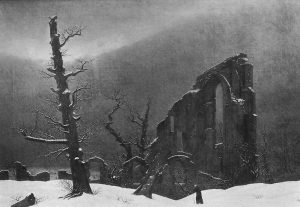
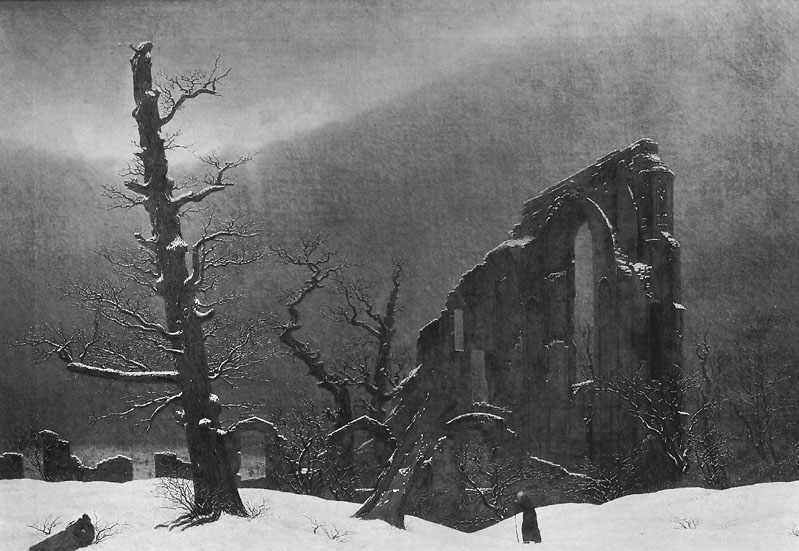
Caspar David Friedrich, ‘Monk in the Snow’ or ‘Der Winter’, 1808.

It is here that I lift my pen from the page, as I have so often before, and lean away from the pile of nearly-blank pages before me. Next to this stack sits a glass of wine, a cup of coffee brewed in indecision, and an anthology of English Romantic poetry. I’m in the process of writing a piece which is supposed to serve as both a memoir and a eulogy for a dear friend. It’s an attempt at expressing the disconcerting harmony between loss and nostalgia that has been plaguing my heart these last few months, but no matter how hard I try to reframe these memories, I just can’t seem to express what came before this period of grief. Each attempt I make at materializing his essence upon the page only manifests my sorrow more, for these recollections are now enveloped in nothing but pain. I have always relied on the written word to serve as an emotional outlet and a source of solace, but lately it seems to only hurt me.

It is with these frustrations that I lift the volume of poetry from my desk and flip to one of my favorite poems from Lyrical Ballads, William Wordsworth’s “Nutting.” Like so many other of his great works, “Nutting,” can be understood in a variety of ways. To name just a few, it can be interpreted as the narrative of a loss-of-innocence, as a possible reworking of Adam and Eve, as a conservationist’s thesis, or as something entirely more abstract based on the abundance of sexual imagery. For me, however, the true power of this poem has always come from the dual-meaning which is found within the poem’s conclusion. As a memoirist in both prose and poetry, I have always been haunted by this poem and have returned to it again and again whenever I am struggling with writing. This is because it offers such a profound investigation into what we choose to write about and from where we should draw our inspirations.

In order to fully access this space for reflection, however, one must first understand the meta-narrative that is at work within the production of the poem. To briefly summarize the narrative of this poem, it is about a young boy who ventures into the woods to gather nuts. Along his campaign, he discovers “one dear nook unvisited,” and there he takes great pleasure in the tranquility of the space and the “banquet” that is offered to the senses. However, in a moment of impulsivity, he uses his crook to yank nuts off of a tree branch, which ultimately disturbs the scene and ruins the magic he had found within it. He regrets this action almost immediately and the poem ends with the young boy, now a grown man, warning his “dearest Maiden,” to “move along these shades / in gentleness of heart; with gentle hand / touch—for there is a spirit in the woods.”

The conclusion of this poem, however, is complicated by the observation that Wordsworth, as the speaker and composer of the poem, has once more taken from this nook, this time not with a crook, but with a pen. This is where the meta-narrative comes into play, and it begs the question: has this act of literary-harvesting damaged the nook in a similar way? Why or why not? What precisely is lost in this transaction, and what is gained? It is obvious that the nook is not physically damaged by Wordsworth’s penning of the poem, and yet, I still wonder what sort of abstract, sacred essence may have been lost or altered in the act. Wordsworth certainly lost something in the production of this poem, for the moment that someone else read it, the little secluded spot was no longer Wordsworth’s alone.

This loss in the transaction became truly significant for me, however, when I started to think about how it could apply to more intangible properties like dreams, emotions, and memories. In these scenarios, we play the role of the maiden and the spirit-in-the-woods, because, as we traverse our own planes of interiority in search of writing material, we still remain like the spirit which can easily be harmed by the transgressions. Whatever we take, and whatever is lost, is taken and lost from and by us. As writers, we must constantly interrogate ourselves to evaluate what we are willing to sacrifice for a piece of writing, and what we are truly willing to not just share, but give to others.

Another difficult matter that this reflection introduces is the question of what we should decide to do when writing about painful topics. How do we know that the very act of writing about these topics won’t hurt us? What boundaries should we set for ourselves when writing about emotionally intense topics? Where do we draw the line on what we should or shouldn’t write about when it comes to how it may affect us? These questions are important because, once more, when we write about these things, we are not only playing the role of the young boy yanking at the tree branches, but we are also the tree branches being influenced (and potentially damaged) by the process. So how far are we willing to sacrifice ourselves for craft?

Ultimately, I think that it is important that we do not have a collective set of answers to these questions, or some easy formula through which we may find the answers. It is an integral step in the creation of any piece of artwork to investigate what our intentions are in creating it, and whether the production of the work will do more harm than good. As writers, we must discover our own personal boundaries when it comes to sharing our personal lives and tackling difficult topics. The majority of William Wordsworth’s work is heavily based in memory, and I think that he knew just how frequently writers can tend to wander through the forests of their interiors. I would argue, then, that “Nutting” serves as a warning that we must always be vigilant as to which branches we choose to pull from. However, I also want to note that in this cautionary poem, Wordsworth never tells the audience to entirely avoid the woods. In terms of writing, Wordsworth actively encouraged people to delve into their interiors and reflect on what they might find. In fact, this is one of the core theses of his Romantic ideology.  Therefore, similarly, we should not avoid our own searches for material through introspection. However, as Wordsworth advises, we should act with a “gentleness of heart,” when we do so.

I cannot personally say at this point whether my own creative projects which deal with my friend are harmful or not. I know that they are genuine, and that when I finally do finish them I will never share them with anyone else. This is because they have always been for me and me alone. I also know that I most likely need more time before I can properly tackle these themes of loss, just as I know that the reason grief still pervades my writing so ceaselessly is because I am still in mourning. I do have faith, however, that one day writing can heal even this.

Sean Wojtczak is a twenty-two-year-old graduate of the University of Iowa. His work has been published in multiple journals and magazines, including the Keats-Shelley Association of America Blog. He currently resides in Iowa City where he works as a paralegal.
Twitter: @seanwojtczak

Cardiff Romanticism and Eighteenth-Century Seminar – 2020 Spring Programme

      Comments Off on Cardiff Romanticism and Eighteenth-Century Seminar – 2020 Spring Programme

All are welcome to attend the following events at Cardiff University in early 2020.

All events are free, and start at 6pm in room 2.47, John Percival Building, Cardiff University, CF10 3EG.

18 Feb Dr Lizzy Spencer (University of York) ‘Women, accounting, and intertextuality in England c.1680-1830’

9 Mar Prof Tim Webb (University of Bristol) ‘Leigh Hunt and Romantic Imprisonment’

16 Mar Prof David Duff (Queen Mary, University of London) ‘Coleridge as Prospectus-Writer’

20 Apr Prof Nick Roe (St Andrews) ‘The Rise of Biography in the Eighteenth Century’

Talks are 45-50 minutes followed by questions. Refreshments are provided.

Please direct any enquiries to Anna Mercer (Mercera1@cardiff.ac.uk), and visit the CRECS Blog for updates.

CfP: NASSR 2020 Conference at the University of Toronto

      Comments Off on CfP: NASSR 2020 Conference at the University of Toronto

A notice about NASSR 2020 from Terry F. Robinson

Dear BARS Colleagues:

Greetings! You are invited to submit a proposal for the 28th Annual Conference of the North American Society for the Study of Romanticism (NASSR). The NASSR conference, which will bring together 300-400 scholars to discuss literature, philosophy, art, and culture c. 1770-1840, will take place at the University of Toronto, Ontario on August 6-9, 2020.

CONFERENCE WEBSITE

Keynote Speakers:
Elizabeth Maddock Dillon (Northeastern University)
Martin Myrone (Tate Britain)

Topics may include (but are not limited to):

  • Re-envisioning Romanticism: looking back and looking forward
  • Visions and the visionary: perception, prognostication, projection, speculation, the speculative
  • Ways of looking: reading, conceptualizing, observing, peeping, gazing, categorizing, examining, recognizing and misrecognizing
  • Visual culture, philosophy, and aesthetics: objects of sight, spectacle, the spectacular, the sublime and the beautiful
  • Reading methods and histories: careful, close, distant, surface; plagiarism, copyright law
  • Print culture in its social, theoretical, and physical aspects (e.g. text, design, structure, layout); manuscripts, letters, journals, scrapbooks, books, journals, newspapers
  • The seen and the unseen: noumena, phenomena, the spirit world, apparitions and appearances
  • Romantic iconoclasm and anti-representationalism; ocularcentrism and “the tyranny of the eye”
  • Visual communication: text, numbers, notation (e.g. musical), images, sign language, placards, banners, flags, gestures, hieroglyphs, emblems, insignia
  • Questions of form and representation
  • Fashionable looking: costume, hair, makeup, manner, style, taste, places to see and be seen
  • Visualizing gender and sexuality: identity, performance, politics
  • Visual and scenic arts: sculpture, painting, illustration, graphic satire, print shops, pornography, broadsheets, dioramas, panoramas, architectural and landscape design
  • Theatre and performing arts: set design, lighting, visual effects, costume, body movement, dance, pantomime, attitudes, tableaux vivants
  • Art collection and assessment: museums and curation, connoisseurship, formal and evaluative concerns (e.g. light, color, pattern, shape, scale, proportion)
  • Visualizing class: social hierarchies and signifiers (e.g. clothing, heraldry, pageantry), occupational and economic segregation
  • Instruments of looking: lenses, spectacles, quizzing glasses, spy glasses, Claude glasses, prisms, mirrors, telescopes, microscopes, orreries, windows
  • Forms of illumination and darkness: lightning, electricity, candlelight, lamps, gas light, spotlights, limelight, torches, fireworks; shade, shadow, twilight, gloom, obscurity
  • Religious vision(s): prophecy, revelation, enthusiasm, sermons and hymns, public and private devotion, natural and revealed religion
  • The science of the eye: vision, optics, visual anatomy, medicine, pathology, disability, blindness
  • Data visualization (e.g. land, economy, population studies): mapping, cartography, geography, geolocation, charts, diagrams, categorization, numerical and pictorial statistics
  • Visualizing race: slavery, racism, racialization, minoritization
  • Vision and ecopoetics: seeing nature (vistas, prospects, the picturesque); noticing and reading features of land, water, and sky; watching weather and recognizing climate; the animal gaze
  • Envisioning space and place: the local and the global, home and abroad, the peripheral and transperipheral
  • Envisioning (the ends of) empire: imperialism, colonialism, sites and sights of war; decolonization, indigenization
  • Political and military forecasting, strategy, optics, campaigns, battlegrounds, political theatre
  • Imagining the future of Romanticism; strategizing its work in the humanities, in the university, and in society

EMAIL CONTACT: nassr2020vision@gmail.com

**The deadline for general submissions is 24 January 2020.**

We look forward to receiving your proposals!

Sincerely Yours,
Terry F. Robinson (and on behalf of John Savarese and the NASSR 2020 conference committee)


New BARS Treasurer and New BARS Membership Secretary

      Comments Off on New BARS Treasurer and New BARS Membership Secretary

An announcement from the BARS Secretary, Dr Jennifer Orr, below.

Dear BARS members,

As you will know, our current Treasurer is stepping down after many years of service to the organisation. We have divided the role to create two new Executive posts of Membership Secretary and Treasurer and I am delighted to announce that Dr Tess Somervell and Dr Cassie Ulph will be taking up these posts, respectively.

As the new membership year will soon be upon us, please note Tess’s details below for any cheques and membership correspondence:

Dr Tess Somervell
Email: t.e.s.somervell@leeds.ac.uk
Tel: +44 (0)113 343 1690
Address: School of English, University of Leeds, LS2 9JT

On behalf of the BARS Executive, I would like to extend our warmest thanks to outgoing Treasurer Dr Jane Moore for her service to BARS over the years.

Wishing you all a Merry Christmas,

Jennifer

Welcome to the team, Dr Cassie Ulph and Dr Tess Somervell! Thank you again, Dr Jane Moore, for your wonderful work with BARS.

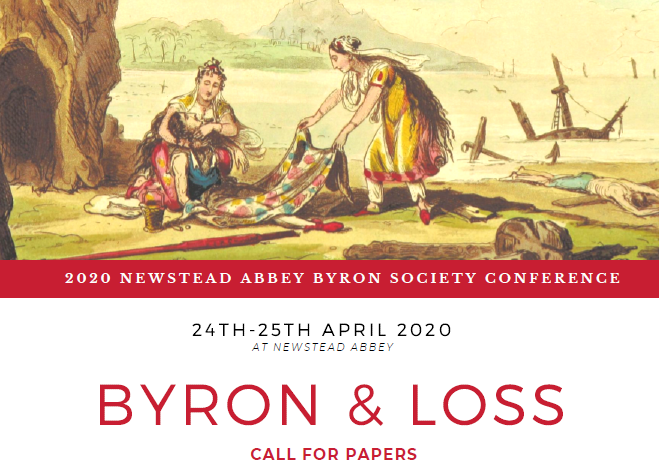
Call for Papers: Byron and Loss

      Comments Off on Call for Papers: Byron and Loss

2020 Newstead Abbey Byron Conference

24th-25th April, Newstead Abbey

2020 marks the bicentenary of a troubling year. George III had lost his life and the new king George IV was
rapidly losing what little shreds remained of his dignity, lost what little shreds remained of his dignity, pursuing
his errant wife with hypocritical vengeance during the so-called Queen Caroline Affair. The government had lost
the trust of the people, and many politicians would have lost their lives had the Cato Street Conspiracy
succeeded. Meanwhile Byron, now in the fourth year of his self-imposed exile, was rapidly losing his hair, teeth,
famous good looks, and – some might argue – his own dignity. It is against this backdrop that he became
interested in Italian politics, or rather the loss of political authority and national autonomy.


To mark the year of 1820, we welcome papers considering the theme of Byron and loss. Topics could include, but are not limited to:

  • Grief, familial loss and suicide
  • Melancholy, weltschmerz, Romantic melancholia
  • Material and aesthetic losses
  • Appetite and diet
  • Loss of status, land, and national autonomy
  • Loss of love, lovers, and spouses
  • Religious convictions and anxieties
  • Idealism and political convictions
  • Anxieties about poetic reputation and legacy
  • Writer’s block and poetic inspiration
  • Financial losses, economic instability and usury
  • Ruins and degeneration

Submissions by 1st February 2020. Send to Conference Organisers, Dr Emily Paterson-Morgan and Dr Charlotte May, email: newsteadbyronconference@gmail.com