
Here we have the latest report from Yu-Hung Tien, the most recent winner of the Stephen Copley Research Awards, for more information about how to apply, please see here.
I’d firstly like to take this opportunity to express my deep gratitude to BARS for offering their Stephen Copley Research Awards in support of the continuation and celebration of Romanticism and its ever-evolving legacies. I used the funding to conduct two research trips, which included one to Rome in March and the other to London in May. Through these experiences, I as a first-year PhD student gained more solid contextual knowledge about the doctoral project that I am now working on, and developed a much clearer picture of its future direction.
My project looks at the literary afterlives of John Keats through a less explored transatlantic lens, particularly in Emily Dickinson, Wallace Stevens, and F. Scott Fitzgerald. I was initially fascinated with the ways in which the notions of mortality and immortality are interwoven by Keats. I then started to ponder whether or not Keats might have expected to ‘immortalise’ himself through his words. I was thereafter drawn to his last surviving letter written in Rome, dated 30 November, 1820, to Charles Brown. In this letter, Keats confesses with poignancy if not with a great ambition, ‘I am leading a posthumous existence’. My interests in probing his ‘posthumous existence’ were thereby forged—I have ever since then been keen to explore the ways in which Keats might have been kept ‘alive’ in other writers’ words.
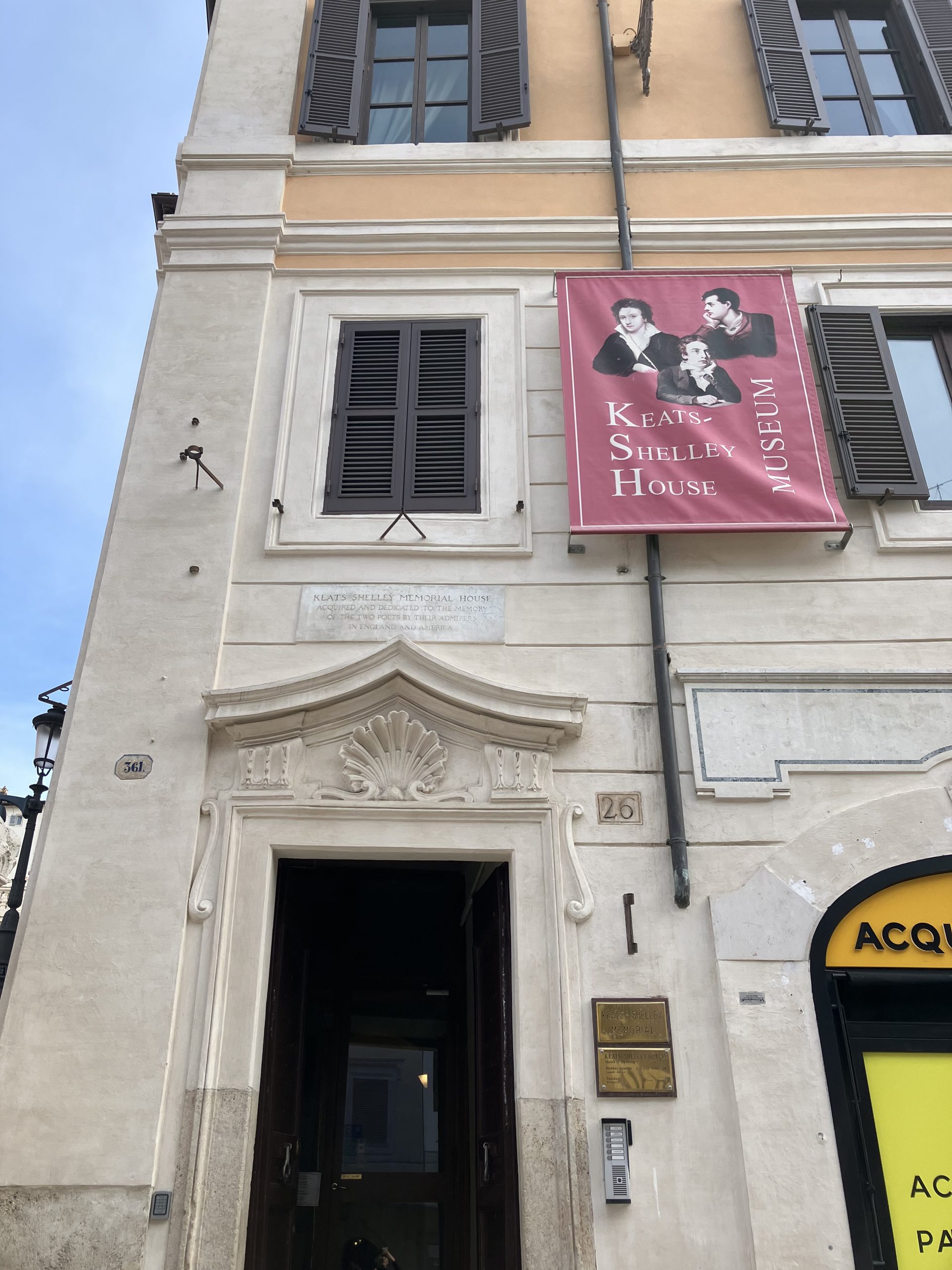
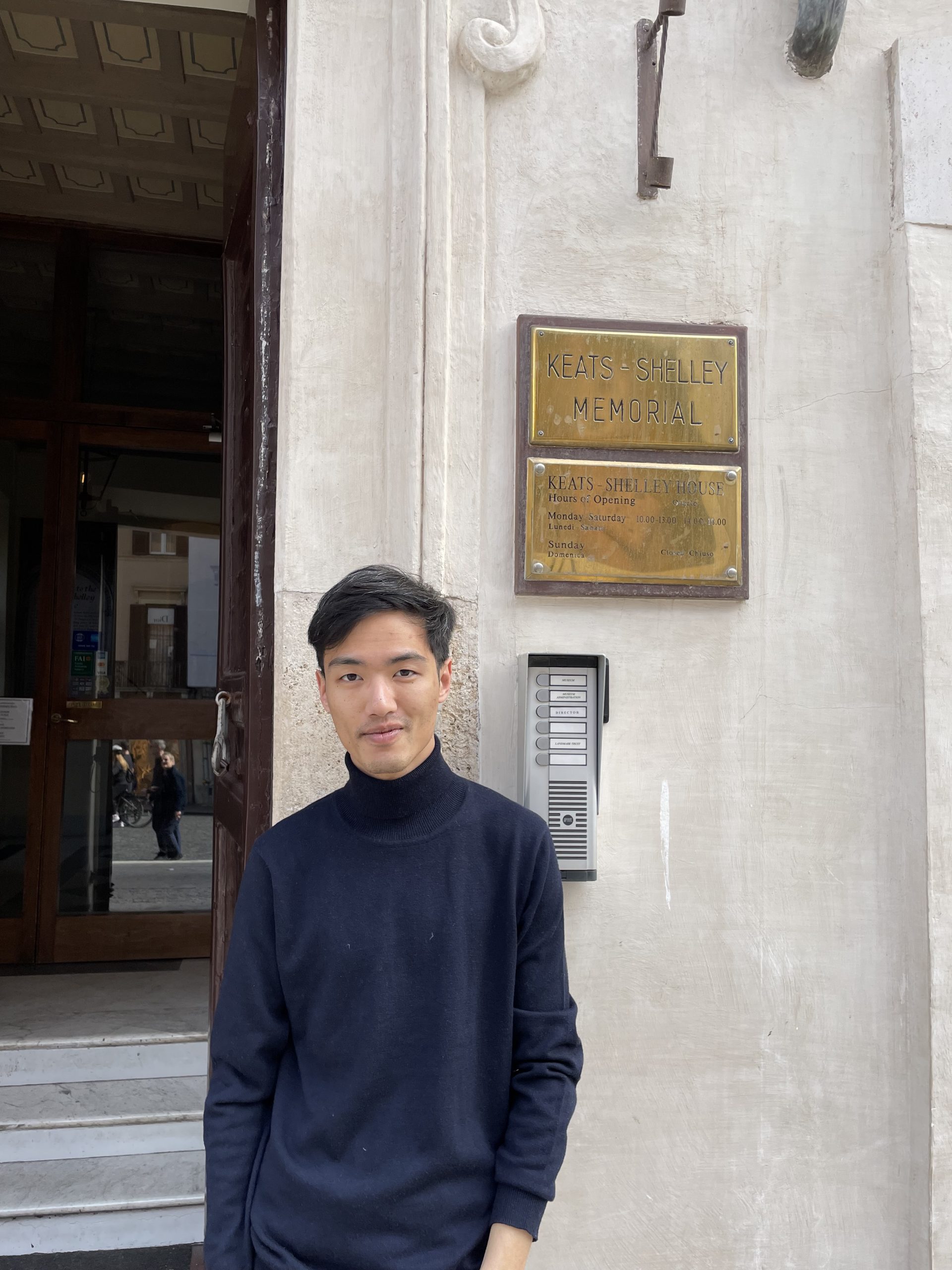
Whereas my thesis’s approach is to look at Keats’s transatlantic legacies—an approach that is less adopted in the existing ‘Keats Reception Studies’—at its preliminary stage, I decided to retrace the ways in which his afterlife started to take shape, which is expected to help lay a solid foundation for my succeeding argument. I thus made up my mind to dedicate my first research trip to Rome, particularly to the Keats-Shelley House, the place where Keats embarked on his path to reach the state of immortality, and now, to review it in hindsight, a starting point from which my research journey departs to immortalise Keats.
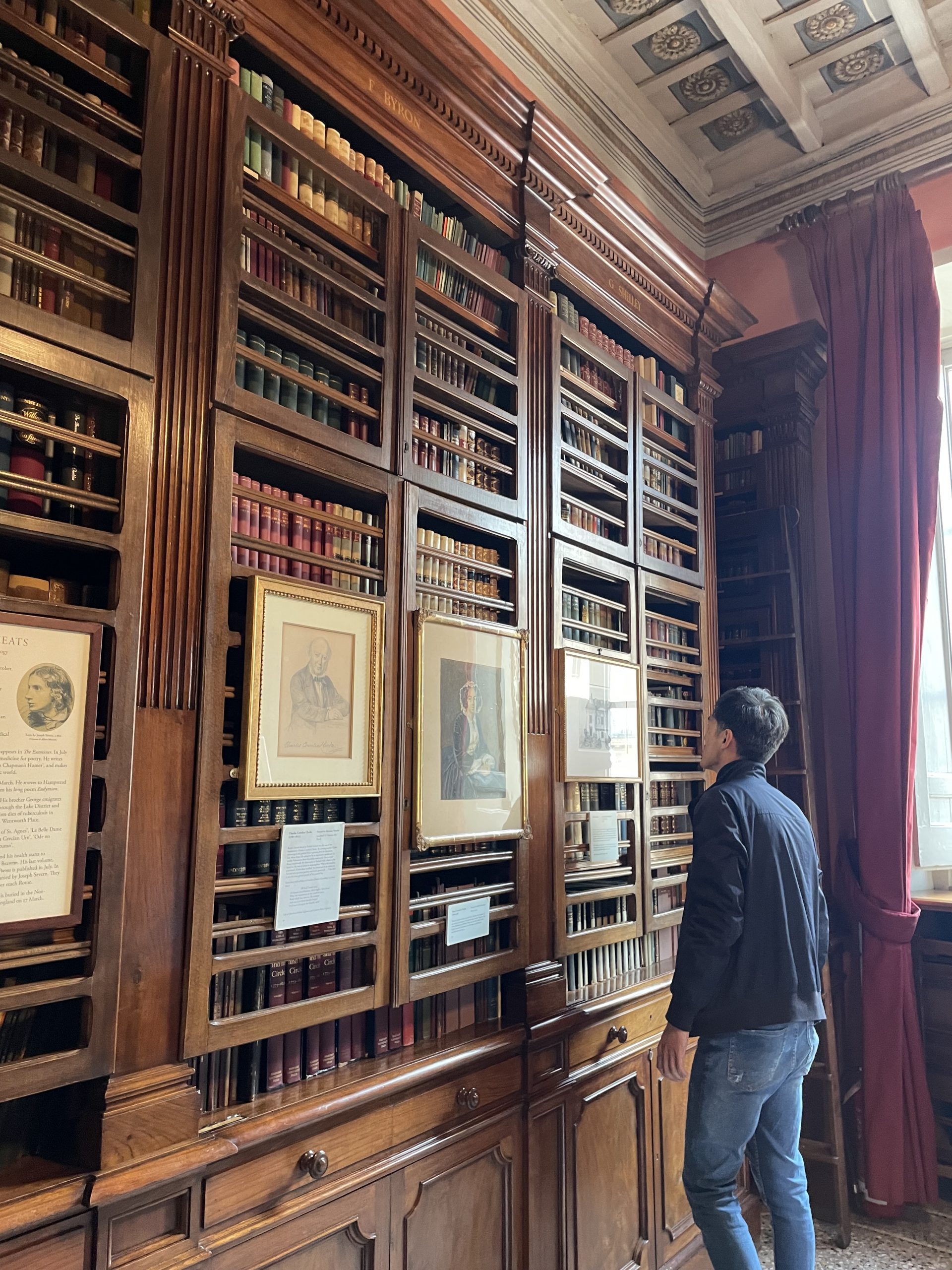
My admiration for Keats’s life and writing was indeed amplified by all the public collections at the Keats-Shelley House. What inspired me the most, however, was an invaluable opportunity with which the Keats-Shelley House granted me to consult a few works stored in their library. All of them are extremely beneficial to my current project. For example, The Poetical Works of John Keats: With a Life (1863) published by Little, Brown and company in Boston that I consulted reshaped my perception of how Keats might have been received in the US in the late nineteenth century. I was particularly drawn to the chapter ‘The Life of Keats’ written by J. H. L., through which I developed a renewed insight into how readers on the other side of the Atlantic might have perceived the ways in which Keats’s ‘intellect was satisfied and absorbed by his art, his books, and his friends’ (19). Another book that I consulted, John Keats: The Principle of Beauty (1948) by Lord Gorell refreshed my approach to Keats’s aesthetics, which will play an important role in some of my close readings.
My second research trip to London was primarily dedicated to my visit to the British Library. Among all the materials that I consulted, I was particularly inspired by A Critical Dictionary of English Literature and British and American Authors from the Earliest Accounts to the Later Half of the Nineteenth Century, Vol. II (1870) by S. Austin Allibone, and the Index of English Literary Manuscripts, Vol. IV 1800-1900, Part 2 Hardy – Lamb (1990) by Barbara Rosenbaum. The former informed me of the critical reviews that Keats received in the long nineteenth century—of which I was not aware—that shape the portrayals and (re)presentations of his reception. Through the latter, I was impressed to see how Keats’s autographs and manuscripts are kept on both sides of the Atlantic. This discovery, on the one hand, enlightened me with an insight suggesting the transatlantic journey that Keats’s poetry has undertaken as not just on a figurative but also on a physical level. It also on the other hand hinted at some future research trips for me to take on the other side of the Atlantic, which would assist me in rebuilding the poet’s transatlantic afterlives in a more comprehensive manner.
As Keats writes in the beginning of his Endymion, ‘A thing of beauty is a joy for ever: / Its loveliness increases; it will never / Pass into nothingness’. To end with my report, I’d like to again express my deep gratitude to BARS for offering this research award. With its support, I gained a clearer idea of the potential pathways for me to undertake in the near future to help complete my current project. More fundamentally speaking, I was inspired by the materials which I consulted during the research trips outlined above. Through them, I developed a refreshing insight into Keats’s poetry. I started to approach it as such ‘a thing of beauty’ bringing me endless joy and inspiration, whose ‘loveliness increases’ and hopefully through my own research ‘will never / Pass into nothingness.’
Yu-Hung Tien is a PhD student at the University of Edinburgh, UK. His research interests lie in Romanticism and its transcultural legacies. His current project explores the afterlives of John Keats from a transatlantic perspective, with a particular focus on the poet’s literary survival in Emily Dickinson, Wallace Stevens and F. Scott Fitzgerald. Yu-Hung has recently published an article in the Symbiosis journal. He is also a Communications Fellow for the Keats-Shelley Association of America (K-SAA).