
This Stephen Copley Research Award could not have come at a better time. Having completed most of the chapters of my doctoral thesis, I now faced the challenge of a new phase in my research: extensive archival work. I study the early evangelical novel and its subtle sociopolitical leanings, so until this point, my research had centred on readily accessible primary sources from the long eighteenth century. Having pored over texts from three diverse disciplines – literature, political philosophy, and theology – I was now left with the task of following up my research on these novels with an exploration of their contemporary reception. For this, I knew I needed to consult specific archives. In June 2026, I was honoured and thrilled to receive a BARS Stephen Copley Research Award to do just that.

| The Firestone Library at Princeton University, where I consulted extensive collections of American and British periodicals of the long eighteenth century. |
My archival journey started a bit earlier, over velvety pages carefully housed in Oxford’s Bodleian and the British Library. During that time, I began developing a framework for the British reception of these evangelical novels, all written by and for women. It became evident that many contemporaries noted – as I did – the subtle radical ideals within them. Being an American, I began to wonder if this response was shared beyond Britain, specifically within a republican print culture.
This led me to my current project: the transatlantic sociopolitical reception of British early evangelical novels. These novels, first published between 1790 and 1820, are primarily didactic in purpose and adhere to the main tenets of evangelical theology. While modern scholarship has largely characterised them as conservative, my tri-disciplinary analysis reveals that the novels address questions of agency, authority, and societal intervention in ways that complicate this assumption, largely as a result of their specifically evangelical tenets. My project examines a number of once best-selling evangelical novels, including Mary Brunton’s Self-Control (1811) and Discipline (1814), Harriet Corp’s An Antidote to the Miseries of Human Life (1807) and its Sequel (1809), and Hannah More’s Coelebs in Search of a Wife (1808).[1] While reception of these novels is most commonly found in British journals, such as The Monthly Review and The Critical Review, the novels were also quickly reprinted and circulated in the United States; thus, reception extended beyond the British marketplace to the American marketplace. My hope is that this research will provide a better understanding of how women’s religious fiction was received transatlantically, across distinct political cultures, and how it engaged with sociopolitical ideals through the nineteenth century.
I soon discovered that the best places to access early American editions of these novels, along with the periodicals that reviewed them, were the Kislak Center for Special Collections, Rare Books, and Manuscripts at the University of Pennsylvania and the Firestone Library and its Special Collections at Princeton University. Penn holds various early American editions of my project’s novels, published mostly in Philadelphia and Boston, while Princeton offers extensive American and British periodical holdings, particularly in eighteenth- and early nineteenth-century materials. Also, conducting research at the Kislak Center would – and, happily, did – provide me with the opportunity to consult complementary print materials and newspapers at the nearby Library Company of Philadelphia, the American Philosophical Society, the Historical Society of Pennsylvania, and the Athenaeum of Philadelphia, which are likewise rich in resources.
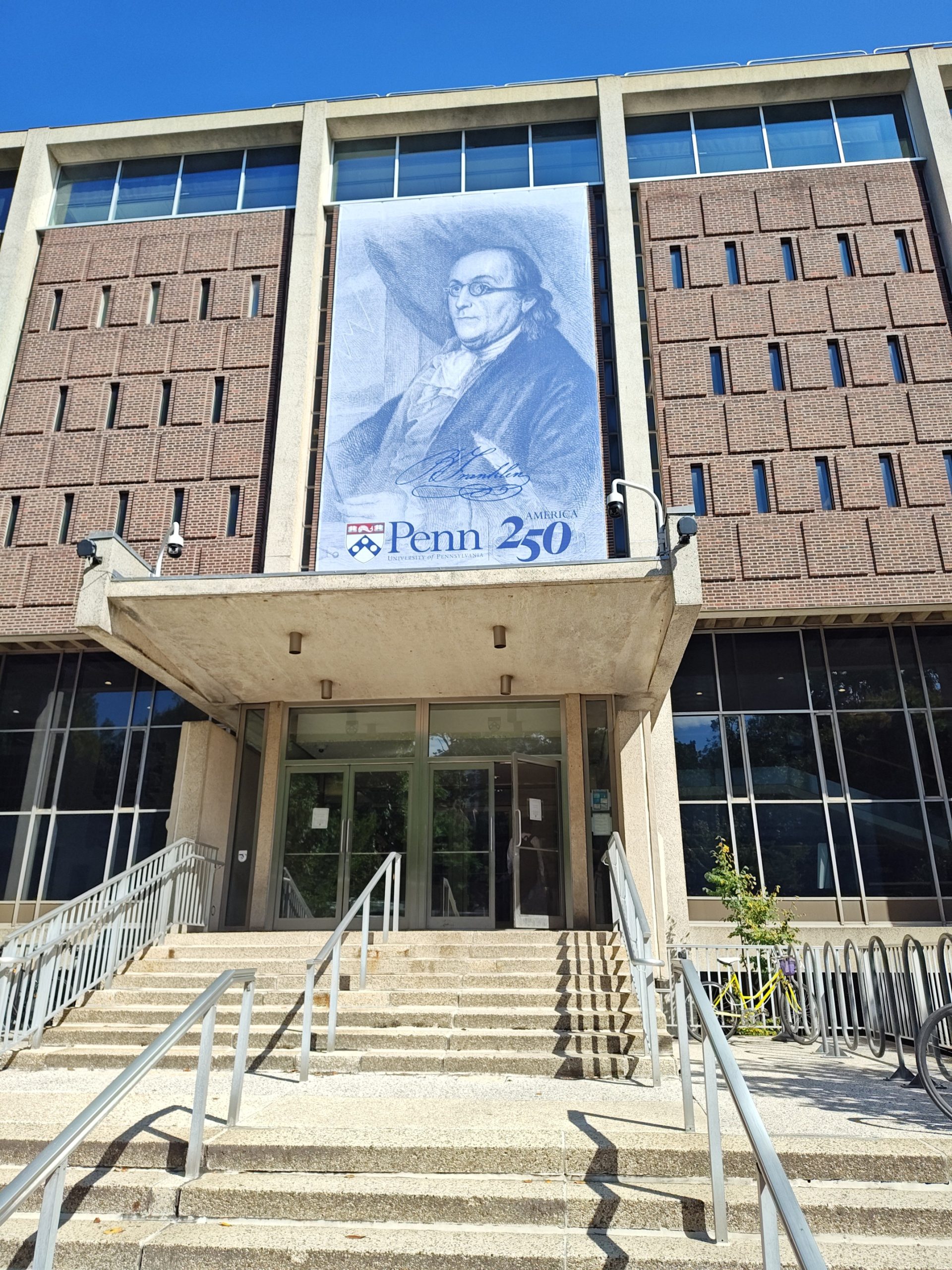
| The Kislak Center for Special Collections, Rare Books, and Manuscripts at the University of Pennsylvania, where I consulted early American editions of British evangelical novels. |
Finally, the time arrived to take my trip. It was a beautiful week in mid-September – not quite autumn – but the air already held the familiar scent of vibrant fallen leaves. Walking through the streets of Princeton and Philadelphia and up the steps of long-loved libraries, I sat among various American volumes, editions, and imprints of British evangelical novels. It is always a privilege to hold something so old, especially when it is housed in a building steeped in its own history. As I moved from one archive to the next and ran my fingers over the carefully penned owner inscriptions, I thought of the many before me who must have scoured and treasured the very pages of these books.
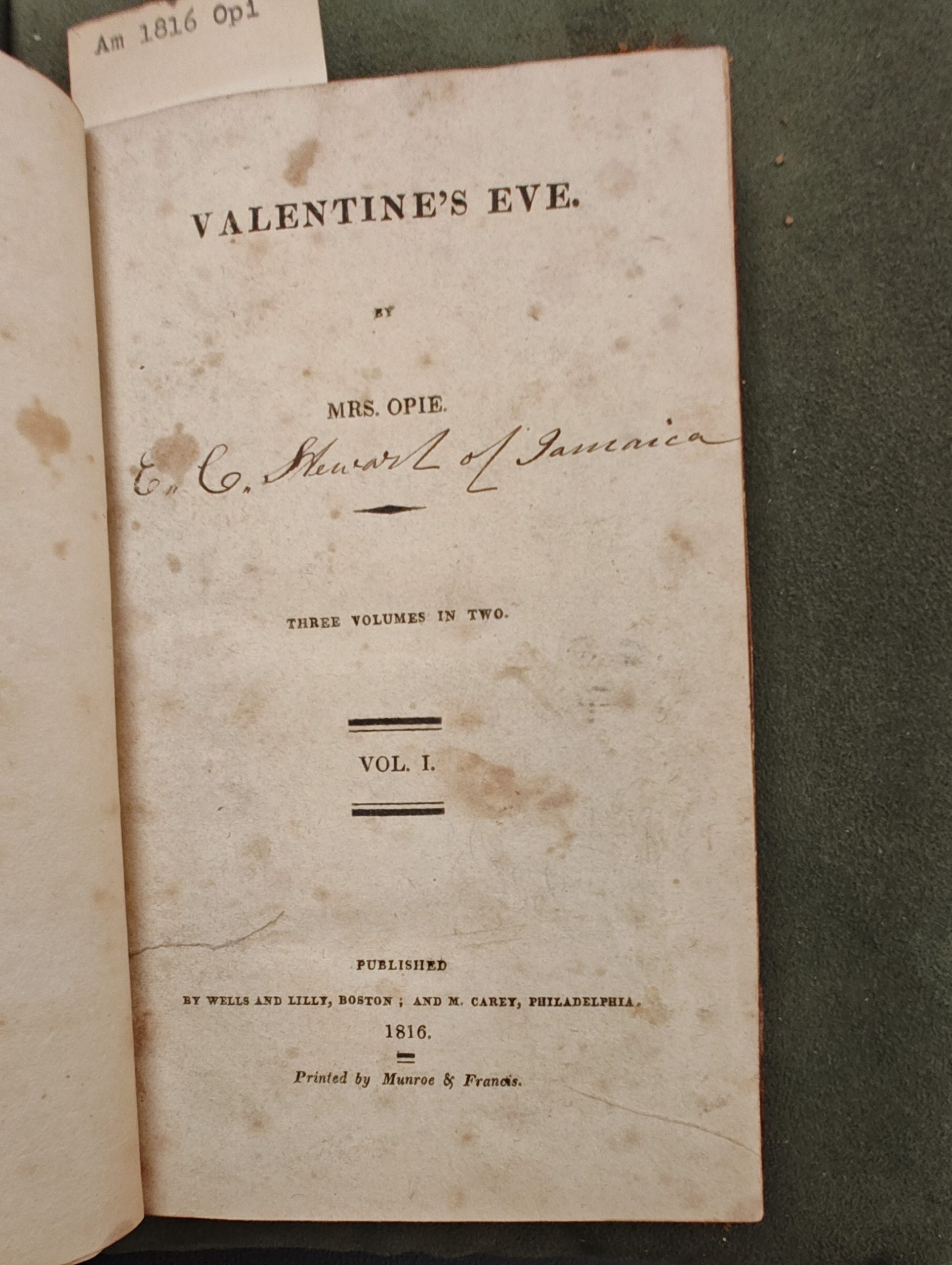
| The title page of Amelia Opie’s evangelical novel Valentine’s Eve (1816), published in Boston and Philadelphia, featuring a handwritten ownership inscription apparently reading “E. C. Heward of Jamaica.” Held at the Library Company of Philadelphia. |
Archival research yielded some fascinating results and revealed the various ways in which American reviewers engaged with the sociopolitical implications of British evangelical novels. In New York’s Christian Inquirer, a reviewer suggests that More’s Coelebs is morally admirable but intellectually limited because, unlike America and its “republican equality,” Britain lacks a social conscience, specifically due to its disregard for female education and its continued attachment to traditional social hierarchies.[2] Consequently, the review uses More’s novel to criticise traditional British social systems and practices. In Greater Boston’s General Repository and Review, the reviewer of Self-Control notes: “We cannot but approve the intention of the author to recommend habits of self-government,” thus indicating that evangelical moral discourse and republican political ideals, such as individual autonomy, could converge in American reception.[3] Interestingly, some reviews identify aspects of these novels as excessively radical. In Philadelphia’s Port Folio, the reviewer condemns Ellen’s behaviour in Discipline as shockingly “manly”: “A young lady of seventeen, driving a pair of spirited horses, ‘Jehu like,’ may, possibly, excite no surprise on the other side of the Atlantic; but, in our less adulterated land, it would be an invasion of the ‘rights of man,’ not less ridiculous than disgusting.”[4] Here, the reviewer questions unconventional female agency in Britain, justifying his criticism by invoking the “rights of man”; in doing so, this review illustrates how the language of republican liberty could ironically reinforce, as opposed to challenge, conventional gender boundaries.
These discoveries have given me much to consider about the ways in which British evangelical novels were understood, received, and even reinterpreted across the Atlantic, particularly within the distinct political culture of the early American republic. While there is yet more work to be done on this fascinating topic, I am deeply grateful to BARS for allowing me to continue in that work through this generous award. I am also grateful to the many helpful librarians and archivists whose care of these invaluable primary materials provides a space for both questions and answers to take form.
Rachel Xhemajli is a doctoral candidate at the University of Oxford. Her DPhil research examines the early evangelical novel in Britain, its political implications, and its cultural impact in the long eighteenth century. Her broader research interests centre on how classic literature shapes contemporary thought and public discourse. She is an English lecturer at Alvernia University.
Photos courtesy of Rachel Xhemajli.
[1] The above titles have been shortened. The full titles are as follows: Brunton’s Self-Control: A Novel (1811) and Discipline: A Novel (1814), Corp’s An Antidote to the Miseries of Human Life, In the History of the Widow Placid, and Her Daughter Rachel (1807) along with her A Sequel to the Antidote to the Miseries of Human Life, Containing a Further Account of Mrs. Placid and Her Daughter Rachel (1809), and More’s Coelebs in Search of a Wife: Comprehending Observations on Domestic Habits and Manners, Religion and Morals (1808).
[2] “Miss Hannah More’s Works – Coelebs in Search of a Wife; Tales and Allegories,” Christian Inquirer 11, no. 50 (1857), 1.
[3] “Article 4. Self-Control: A Novel,” General Repository and Review 1 (1812), 200.
[4] “Discipline: A Novel,” The Port Folio 1, no. 5 (1816), 416.