CFP – Tales of Terror conference

      Comments Off on CFP – Tales of Terror conference

FIRESIDE TALES OF TERROR: The Gothic and Winter

University of Warwick, 15-16th December 2022 

“Horrors belong as naturally to the fireside, as fireside belongs to Christmas” declares the narrator of the
piece “Fireside Horrors for Christmas” in the December 1847 issue of Dublin University Magazine. This
image of “popular fireside stories or winter’s tales” exchanged in communal settings had, as the late
Catherine Belsey explained, a “long vernacular tradition” (2010). Furthermore, it was, she argues, a
practice that often-challenged orthodox institutional discourse about, for example, the “true meaning” of
Christmas or the origins of ghosts and tapped into secular and “pagan” rituals and practices. The later
transference of this hearth-side image into textual and visual print, not only as content, but as collective
reading activities has helped immortalise Winter and/or Christmas and the Gothic as ideal bedfellows, not
only in Western cultures but in the wider global imagination. Periodicals of the nineteenth-century such
as Household Words, Belgravia, and The Strand capitalised on the wider Christmas market and the desire
for ghost stories in their specific Christmas Numbers including accompanying illustrations, while an
increasing number of collections and anthologies began to emerge and have remained extremely popular
gifts, from collections of Dickens’s Christmas ghost stories, to Edward Wagenknecht’s 1947 anthology
The Fireside Book of Ghost Stories, to the recent British Library Tales of the Weird anthologies Chill
Tidings: Dark Tales of the Christmas Season and Spirits of the Season: Christmas Hauntings.
Televisual/cinematic and radio adaptations of traditional tales have transformed the communal experience
of terror at Christmas and utilise the oral and the visual in different ways: such as the BBC’s televisual
series “Ghost Stories for Christmas”, TV Christmas specials such as Inside No. 9: The Devil of Christmas
and podcasts such as “Ghost Tales by the Fireside – True Ghost Stories Podcast”. The Gothic-Horror
film has twisted and co-opted the form of the fireside tale of terror and its seasonal trappings to bring us
horrifying delights such as Black Christmas (1974); Krampus (2015) and its sequels; apocalyptic Christmas
comedy Silent Night (2021), and many more. Even the seemingly twee Christmas film can send chills and
invite horror – Home Alone, anyone?


So too, the collective-experience, not in the home but amongst strangers in public forums are offered
with watching the aforementioned in the cinema, or attending theatre shows such a Robert Lloyd Parry’s
“The M.R. James Project” which use the allure of a one-man show set by a fireside as a story-teller in a
wing-backed armchair recites some old favourites, or The Theatre of Dark Encounters who incorporate
ghost walks as well as shows in-theatre to seasonal delights. The horror of the life-sized Mouse King in the
traditional Nutcracker ballet based on E.T.A Hoffman’s story or the Cute Gothic of Matthew Bourne’s
ballet adaptation of Edward Scissorhands also offer interesting perspectives on what Gothic is and how it
is expressed. The mash-up of Winter/Christmas and Gothic can be further enjoyed in media and
ephemera such as board games – a staple component of the Christmas season – like Christmas Murder
Mystery and Clue: Nightmare Before Christmas Edition, while vintage postcards of children being
terrorised by the Krampus blend nostalgia and dark humour, and gothic-Christmas decorations (such as
the lights Will Byers communicates with from the Upside Down), all revel, like Jack Skellington, in the
fusion of Halloween and Christmas.


Julia Briggs writes that ‘The telling of tales around the fireside makes explicit a particular aspect of
the ghost story which depends upon a tension between the cosy familiar world of life (associated with Heim
and heimisch – home and the domestic) and the mysterious and unknowable world of death (unheimlich,
or uncanny)’ (180-1), inviting us to think about the spaces and places of Winter Gothic; often juxtaposed against the chilling and deadly atmosphere and dark nights of the “outside” which the narrator of the
“Fireside Horrors” piece insists make the conjunction of tale of terror and the winter period so ideal. In
fact, many other Gothic works use that setting of snow, ice, and long shadowy nights outside of the
Christmas period as they explore the horrors hidden in isolated arctic landscapes from Mary Shelley’s
Frankenstein (1818), Dan Simmons’ 2007 novel The Terror which was adapted to television and released
in 2018 and based on a real failed expedition, Michelle Paver’s speculative ghost fiction Dark Matter
(2010), and the various stories collected in the forthcoming British Library Tales of the Weird anthology,
Polar Horrors. So too, do works such as vampire horror film 30 Days of Night (2007) which play on
meteorological phenomena such as Polar Night. Yet, what happens to, and what does Winter/Christmas
Gothic mean, in a global context and in regions where that season is hot and dry? And so, we also invite
pieces that challenge the traditional connections.

Topics that may include:
❖ Oral tales, folklore, travel writing.
❖ The “Ghost Story” and Christmas – tradition and new innovations.
❖ The space of the fireside or the campfire, or the use of candlelight (blackouts etc) in Winter Gothic
representation etc.
❖ Arctic/polar regions and terror.
❖ Specific authors, rediscovered authors as pioneers, frequenters, or unusual contributors.
❖ Anthologies, Periodicals, Magazines and other print cultures.
❖ Illustrated Winter Gothic/Christmas Gothic stories.
❖ Collaborations, serials, short-story cycles and collections.
❖ The Gothic and Religious festivals; Paganism and Winter.
❖ In global regions and nations where it falls in with hot, dry seasons.
❖ Horror/Gothic films or Television shows set at/about Christmas; Christmas specials.
❖ Adaptations of or original works of Winter / Christmas Gothic across graphic novels, radio plays,
film, television, theatre, ballet etc.
❖ Gothic Tourism such as ghost walks.
❖ Board games, video games, RPG, postcards and ephemera.
❖ Global literatures, translations, de-canonisation.
❖ Children’s literature and media.
❖ Papers which blend the creative and the critical are welcomed.
❖ Pre-formed panels are also invited.

Please send the following information to Jen Baker and Sandie Mills at talesofterrorconference@gmail.com no later than Monday 17th October 2022:
• Email subject: “Fireside Tales of Terror Abstract”;
• Abstracts of no more than 250 words;
• Brief biography (c.150 words) of the speaker(s);
• 5-8 key words.
• Whilst we hope this will predominantly be an in-person conference, we intend to offer hybrid
options for a more inclusive environment and so please indicate if you would most likely attend inperson or would prefer/need to present remotely.
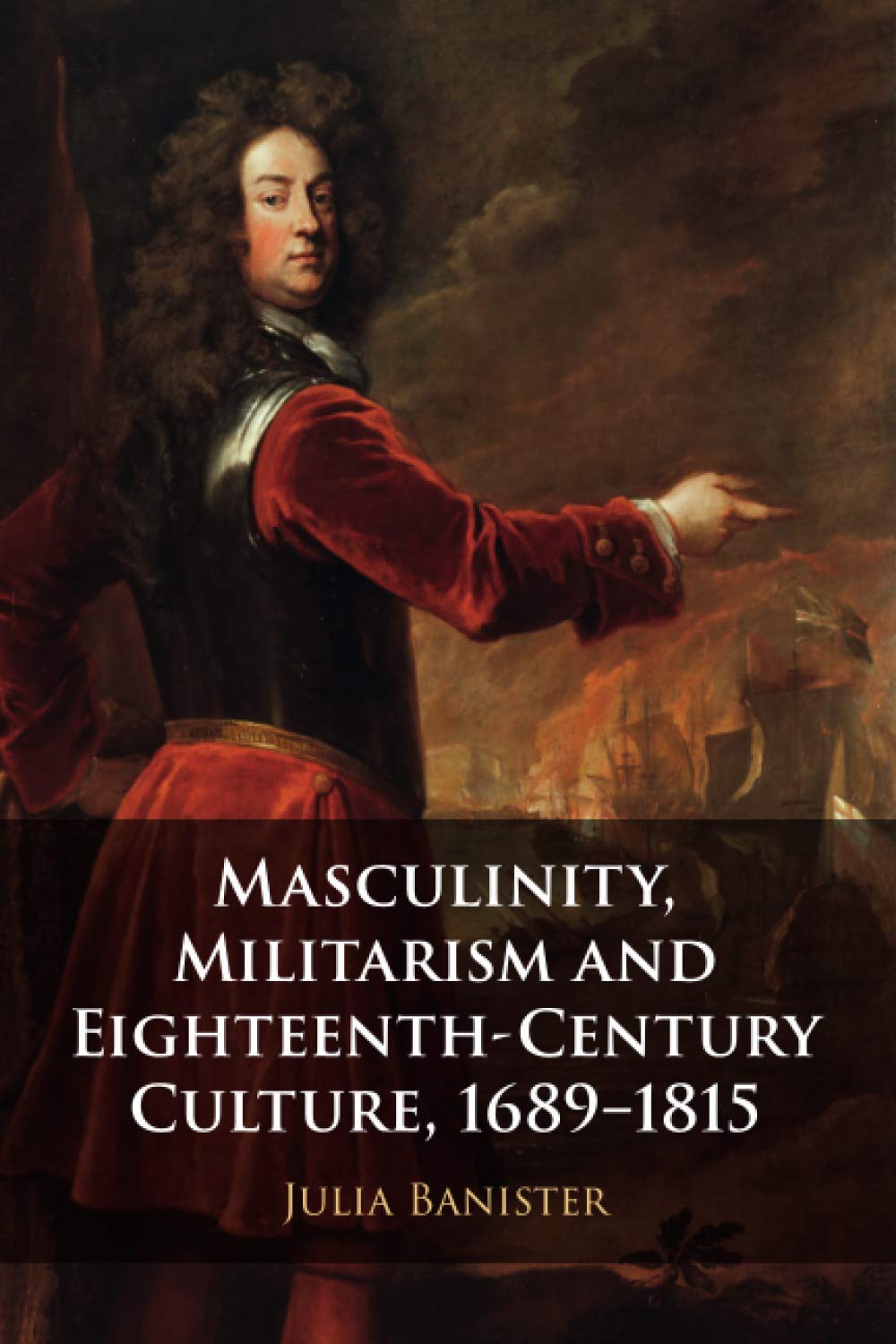
Five Questions: Julia Banister on Masculinity, Militarism and Eighteenth-Century Culture

      Comments Off on Five Questions: Julia Banister on Masculinity, Militarism and Eighteenth-Century Culture

Julia Banister is a Senior Lecturer in English Literature at Leeds Beckett University. She is an interdisciplinary literary scholar with particular interests in bringing literary texts together with other forms of writing and in exploring the relationship between texts and historical contexts. Her research specialisms include gender and the body; war and military service; disability studies; and travel writing. She has published on authors including William Falconer, Laurence Sterne and Jane Austen. Her monograph Masculinity, Militarism and Eighteenth-Century Culture, 1689–1815, which we discuss below, was published by Cambridge University Press in 2018.

1) How did you first become interested in military masculinities?

My interest began with the study of masculinity, which I can trace to studying women’s writing when I was an undergraduate. When I started my doctoral research, I turned to the study of masculinity, which was then a comparatively new field. It might seem odd now, but early scholars of masculinity (many of whom were sociologists) worried about turning the critical spotlight to men, or rather, turning it back to men: what might that mean for gender studies more broadly? Would the new focus on men undermine efforts by feminist scholars to bring to light women’s gendered experiences? The study of masculinity has since shown that we can’t really get to grips with, for example, the social performance of gender or lived experience of gender inequality, without acknowledging that masculinity is as much a construct as femininity. In my study of ‘military’ masculinity, I examine a particular construction of masculinity that is hidden in plain sight.

2) Your book covers a period stretching from the Glorious Revolution to the Battle of Waterloo.  What do you consider to be the main changes in how military men were seen over the course of this span?

We all know the cliché that the Romantic period was a time of great change, but this well-worn idea is as useful a starting point for understanding military service in the eighteenth century as it is for understanding, say, the consumer or industrial revolutions. Military historians employ the term ‘military revolution’ to describe the process of change in the way wars were fought which occurred, roughly, between 1500 and 1800. By the early eighteenth century, it was apparent to many commentators that theirs was an age of ‘modern’ warfare; the vassals of the medieval world, like the heroes of the ancient world, could be said to have put down their weapons and picked up their ploughshares as circumstances demanded, but modern wars required modern military forces. In my book, I contrast the decline of ‘old’ notions of military service as the exercise of aggression and bravery, selflessness and patriotism, with the emergence of a ‘new’, professional military man, who calculates risk, acts in accordance with (externally imposed) codes of discipline, and hopes for financial reward. It is not the case that old ideals were simply replaced by new ones, however. After all, the tussle between old and new ideas of military service was also a tussle between old and new ideas about the (physical) matter and meaning of masculinity. In other words, the stakes for the debate were much higher than they might seem.

3) Your chapters move between considerations of major debates and trials and discussions of Augustan attitudes, the Gothic, the Culture of Sensibility and nascent Romanticism.  How did you come to choose these points of focus, and how important to your design was combining perspectives from different modes, genres and social forms?

My ‘home’ discipline is literary studies, so when I started working on military masculinity I thought a lot about methodological issues for gender history, such as how gender ideals relate to lived experience, which is hard for historians to access. By studying the records of five trials of naval officers accused of wrongdoing in active service, I hoped to hear from at least some individuals about their lives and experiences. That said, the questions posed by the naval courts—about what should be expected of a senior military man—were also questions that concerned society more broadly. In my chapters, I aim to show that the answers given to those questions in a wide range of printed texts are inflected by the values and commitments which characterise phases or periods, such as the culture of sensibility.

4) What do you think that a renewed attention to military contexts might help us see in Romantic-period literature?

The study of military matters has traditionally been the preserve of military historians, but in the last two decades literature scholars have really taken on war and militarism as subjects. Romanticists have been at the forefront of this, and so it is right to be asking ‘what next’. The close connection between the core decades of the Romantic period and two decades of conspicuous, wide-spread warfare means that scholars of Romantic-period literature are particularly well placed when it comes to uncovering new connections between war and culture. In addition, the complexity of the wars in this period means that we should keep looking at texts we know well. For example, in my book, I write about Jane Austen’s Persuasion. Captain Wentworth is not just a generically ‘military’ character; as a sailor in the Napoleonic Wars, he has had particular military experiences, which reinforce his particular understanding of his military role, notably his interest in financial reward. Looked at in this way, Persuasion is not simply ‘about’ the military; rather, the novel intervenes in debates about the military that were current in the period.

5) What new projects are you currently working on?

I’m sticking with the military. My interests in masculinity, gender and the body remain important to me, but my current work is focused on the relationship between the military and one of the most characteristic, and controversial, literary genres of the eighteenth century and Romantic period: the gothic. Like my first book, my new project on military gothic covers the long eighteenth century, but the new project has a narrower, or rather deeper, focus on traditionally ‘literary’ texts. It may sound contradictory, but I think there’s a direct relationship between my enthusiasm for interdisciplinary study and my turn to literary genre. To think about this new project in terms of the broader context, it is hard for those of us working in universities in the UK not to be aware that the value of the humanities is, increasingly, a matter of politicised public debate, and so it also seems to me that this is a very good time to celebrate our discipline.

Applications invited: The Pforzheimer Grants

      Comments Off on Applications invited: The Pforzheimer Grants

The Pforzheimer Grants are awarded each year to support research in Romantic-era literature and culture. The awards honor Carl H. Pforzheimer, Jr. (1907-1996), past president, vigorous advocate, and most generous benefactor of our Association. An investment banker and philanthropist, he also served as head of The Carl and Lily Pforzheimer Foundation, established by his parents. The Foundation has long been distinguished for funding scholarship in early nineteenth-century English literature.

The Keats-Shelley Association awarded the first Pforzheimer Grants in 2000. Past winners have used the award to fund research travel to work with archives in Ghana, Jamaica, Spain, and the UK.

Preference is given to projects involving subjects featured in The Keats-Shelley Journal, the Association’s annual publication, including projects engaging race, empire, gender, class, and global Romanticisms. Advanced graduate students, untenured faculty, and independent scholars working outside the academy are eligible.

Each grant is worth $3,000.
The deadline for 2023 awards is November 1, 2022.

Eligibility: 
Advanced graduate students, independent scholars, and untenured faculty.

Purpose: 
To provide funding for research expenses related to scholarship in Romantic-era literature and culture. Projects need not be author-based nor focus on Keats or the Shelleys. K-SAA invites research that expands traditional definitions of the field and its futures, such as projects engaging race, empire, gender, class, and global Romanticisms approached through diverse methodological and theoretical frameworks. The grants do not support time off for writing or for travel to conferences.

Application Procedures

A complete application must include:
> Application Form.
> Curriculum vitae.
> Description of the project, not to exceed three pages. This brief narrative  should clearly describe your project, its contribution to the field, and your plan for use of the money.
> A one-page bibliography of publications that treat the topic.
> Two letters of reference from people who know your work well and can judge its value. These letters should be sent directly by your referees to the Chair of the Grants Committee before the application deadline.

Please email complete applications as a single PDF file to the Chair of the Grants Committee, Professor Olivia Loksing Moy at: KSAA.Pforzheimer@gmail.com

Report to the Association: 
The Keats-Shelley Association expects awardees to file project reports by the following December describing how the grants furthered their research.

Download the application form and read about past winners here.

Five Questions: Jennie Batchelor on the Lady’s Magazine

      Comments Off on Five Questions: Jennie Batchelor on the Lady’s Magazine

Jennie Batchelor is Professor of Eighteenth-Century Studies at the University of Kent. Her research interests include women’s writing; authorship and anonymity; periodicals and women’s magazines; representations of gender; the politics and practices of work; sexuality and the body; book history; material culture studies; and the eighteenth-century charity movement. Her books include Women’s Periodicals and Print Culture in Britain, 1690s-1820s (co-edited with Manushag N. Powell; Edinburgh University Press, 2018), Women’s Work: Labour, Gender and Authorship (Manchester University Press, 2010) and Jane Austen Embroidery: Authentic Embroidery Projects for Modern Stitchers (Pavillion, 2020). She recently gave the Marilyn Butler Memorial Lecture at BARS/NASSR 2022; her excellent talk drew on the research that fed into her newest monograph, The Lady’s Magazine (1770-1832) and the Making of Literary History (Edinburgh University Press, 2022 – freely available via open access), which we discuss below.

1) How did you first become interested in the Lady’s Magazine?

My fascination with the Lady’s Magazine began in 1998 when I was in the early stages of my PhD dissertation on dress and the female body in eighteenth-century literature and culture. One of the chapters was about the periodical press, and I knew that the Lady’s Magazine included fashion reports and plates and carried essays on dress, too. So, I went to the British Library to consult the copies that had survived the aerial bombing that destroyed much of the collection in the 1940s and naively thought I would spend a couple of weeks consulting everything the magazine printed on the subject in those volumes. Three months later, I came up for air. I became completely immersed in the magazine in all its unapologetic miscellaneity. And while I tried to be disciplined and stick only to articles and images that specifically addressed matters of dress and appearance (and there are more than enough of those), I could not help but be drawn in by the advice columns, recipes, trial reports, travel writing, biographies and essays on science, geography, history and philosophy it contained. In short, I was hooked.

2) What were the major challenges you faced in getting to grips with a run of issues covering over fifty years and containing millions of words?

I am so glad you inserted the word ‘major’ into this question to prevent me from having to recount all of them. Suffice it to say, there were a lot. The first was access. No copyright library has a full run of the periodical, a fact that is surely in part to blame for the scholarly neglect of the publication. That challenge was resolved when I approached Adam Matthew Digital to enquire if they would be interested in digitising the periodical and, to my eternal gratitude, they said yes. The result was published as Eighteenth-Century Journals V in 2013. But other challenges remained. The magazine is a glorious miscellany, with articles in every genre you can imagine and covering almost every topic you can conceive. Some of the articles (particularly those on science) lay far beyond my expertise. My GSCE French and A-Level German were also not up to the challenge of the periodical’s multilingual content.  

As your question implies, though, the biggest problem was the size of the run. I wanted to read it all and I wanted to read it chronologically. (When I say ‘read it all’ I have to admit that I skim read lots of articles in the interests of time.) Reading consecutive issues chronologically was the only way that made sense to me to read the magazine, but at the same time I realised this was actually a completely nonsensical approach. We know from recent work by the likes of Eve Tavor Bannet, Christina Lupton and Abigail Williams that readers in this period often read discontinuously, and magazines, of course, are not and never have been designed to be read from cover to cover. I like to think that putting the book together and organising material in it around the issues that structure each chapter allowed me to read it discontinuously after the fact. 

3) How does the Lady’s Magazine serve to challenge default assumptions about Romantic-period authorship and literary history?

When I first read the magazine in the 1990s, I simply couldn’t fathom why it was all but invisible in literary historical scholarship. While this oversight could be explained by some of the challenges I have mentioned above, when I delved into the matter further, I was confronted by a range of prejudices against the magazine, its contributors and readers that simply did not align with my experience of reading it. The Lady’s Magazine, I learned, was ephemeral, trivial and fashion obsessed. It amounted to little more than a training guide in the arts of womanhood. It envisaged readers as consumers rather than readers. Worst of all, given that most of its original copy was provided gratis for the much of the magazine’s history by volunteer reader-contributors, its encouraged literary amateurism. As a cultural document, the magazine might be interesting, but as ‘Literature’, I was assured, it was lacking. Only a very partial account of the magazine, I concluded, can prop up such arguments.

In the book, I track the process by which the periodical was systematically written out of literary history from the mid-nineteenth century onwards. I argue also that that it is precisely the magazine’s failure (and sometimes its active refusal) to conform to what would become normative categories of literary analysis that makes it so important. There are so many narratives we have told ourselves about Romantic literary history that simply don’t hold up after reading this incredibly popular magazine. Narratives about the rise and fall of particular genres like the sonnet, oriental tale or epistolary novel, to take just a few examples, come under strain. So too does our sense of who was being read at specific moments in time. The Lady’s Magazine, I contend, understood itself as an agent in literary history and the writers and figures (women and men) they acknowledged, published, reprinted or commemorated present a very different canon to any taught in classrooms today.

Uncovering the identities and reconstructing career biographies for the periodical’s contributors also offers a very different sense of what it means to be an author in this period. In the book, I reconstruct career biographies for several of the magazine’s most interesting and important contributors. None are amateurs in the pejorative sense of the term, even if some or all of their work for the magazine was unpaid. (Unpaid does not equal amateur.) Writers like the prolific translator, poet and essayist Radagunda Roberts, Mary Pilkington, George Crabbe, Thomas Chatterton and Catherine Day Haynes (later Golland) – all of whom published in the magazine and elsewhere – were determinedly professional writers, albeit ones whose lives as authors were characterised by precarity. At the same time, it is worth noting also that these writers achieved audiences that many of the more famous writers of the day could have only dreamed of achieving through volume publication alone. With an estimated monthly circulation of around 15,000 copies a month at its height, more people would likely have been reading and talking about the wonderful fiction of Elizabeth Yeames of Norwich in 1811 than an anonymous novel called Sense and Sensibility printed in a standard run of 750 copies. I could go on, but it is all in the book. I might just add that Jane Austen read the Lady’s Magazine, too.

4) How much did the Lady’s Magazine change over the course of its run, and what were the most important turning points?

The magazine changed quite a lot over time, but the majority of these changes happened in the second half of its 62-year run. In its first two years – during which time there were two versions of the magazine – a lot of thought was given to working out the right formula for the magazine’s audience. Once settled, that formula stayed relatively steady until 1800, when the magazine introduced its first price hike from 6d to 1s, to accommodate regular hand-coloured fashion plates to allow it to compete with rival, The Lady’s Monthly Museum (1798–1828). A second set of changes followed in the run up to the launch of the magazine’s new series in 1820, when it was under the editorship of its long-time printer, Samuel Hamilton. Lengthy, illustrated reviews were introduced for the first time, and reader-authored content was marginalised. Those authors who did write for the magazine (like Mary Russell Mitford, Barbara Hofland and Thomas Noon Talfourd) were now paid. The illustrations and production values improved under the subsequent editorship of Charles Heath and the magazine started forming alliances with other periodical forms, such as the fashion journal and the newly devised annuals. By the end of its run, the magazine was a very different proposition again. It was less miscellaneous and more conservative. Nevertheless, it was an important bridge to the women’s magazines that followed, many of whose editors harked back to Lady’s Magazine’s earlier issues (to its popular serial fictions, advice columns, reader dialogue and needlework patterns) when fashioning their own titles.

5) What new projects are you currently working on?

I am currently working on a few projects. I have a longstanding interest in women’s labour and its devaluation. One of the ways that this interest connects with my work on the Lady’s Magazine is via the needlework patterns for ornamenting clothes and household objects that it issued monthly from 1770 to the end of 1819. For many years, I have been building up a collection of these patterns (most of which were disbound from monthly issues of the magazine and have been scattered to the winds) and, in addition to making these available to the public via a searchable website, I am writing a journal article on the patterns, women’s needlework and the circulation of craft knowledge. This, in turn, relates to a longer project I am currently working on about the craft of writing, which looks at eighteenth-century women writers who were also makers and the intersections between writing and other forms of creative making practice. I have some tentative ideas about further work on Romantic periodicals and magazines that I would dearly like to do some day, but having spent so much of the last decade immersed in those millions of words in the Lady’s Magazine, I may leave that for a little while.

Gothic Women: Gothic Histories

      Comments Off on Gothic Women: Gothic Histories

Monday 12 September, 5pm – Online

“The writer of romance is to be considered as the writer of real history” (William Godwin)

From the eighteenth century onwards, the genres of the Gothic novel and the historical novel have been intertwined. Indeed, the Gothic has been described as “a mode of history” (Punter) – a way of exploring “the peculiar unwillingness of the past to go away” (Sage and Smith). In Gothic texts, tales that have been forgotten or suppressed re-emerge, as power struggles centre on accounts of the past: whose stories we hear, and who shapes them. Women’s fiction has often deployed these themes to interrogate dominant narratives, imagining new approaches to the ghosts of the past. The anniversary seminar of the Gothic Women Project will celebrate this lineage, exploring the rich relationship between the Gothic and the historical novel from the early days of the genre through to the turbulent interwar years of the twentieth century.

Speakers:

Professor Jim Watt (University of York): Clara Reeve (title tbc)

Dr Kaley Kramer (Sheffield Hallam University): Falling through the gaps: Sophia Lee’s ruined histories

Tickets and further details here

Wordsworth Grasmere: Romanticism webinars in August and September

      Comments Off on Wordsworth Grasmere: Romanticism webinars in August and September

The Wordsworths and Gardening

25 August, 7.30pm, Online

Dr Jeremy Davies and Dr Jane Roberts join Principal Curator Jeff Cowton to discuss their work, including a project to return the Garden-Orchard at Dove Cottage to the character and spirit in which the Wordsworths knew it. They will also share some of William and Dorothy’s writing on plants, as well as look at manuscripts and books from the Wordsworth Trust’s collection including the Wordsworths’ copy of William Withering’s An arrangement of British plants. This event accompanies ‘Experiments in Land and Society, 1793–1833’, an Arts and Humanities Research Council project that is supporting new research into the garden and historically informed enhancements to the outdoor spaces at Dove Cottage.

Tickets and details here.

Refuge from the Ravens: Wordsworth rewritten by homeless Britain
8 September, 7.30pm, Online

In 1798, Lyrical Ballads by William Wordsworth and Samuel Taylor Coleridge sparked a literary revolution. Poems in everyday language told of people on the margins of society. Our new exhibition, Refuge from the Ravens: Wordsworth rewritten by homeless Britain, is a twenty-first century remix — new Lyrical Ballads made by people with experience of homelessness, and other vulnerable people, in poetry, art and song. In this online launch event Phil Davenport and Julia Grime, the project directors, will explain how the exhibition came about and share stories and creative work from the project. Professor Fiona Stafford will also introduce the original Lyrical Ballads and their historical context. There will be live poetry readings, and we will also take a detailed look at objects and manuscripts from the Wordsworth Trust’s collection.

Tickets and details here.

BARS Digital Events 2022/23: Call for Proposals – Deadline Friday 16th September

      Comments Off on BARS Digital Events 2022/23: Call for Proposals – Deadline Friday 16th September

The British Association for Romantic Studies Digital Events Committee are glad to invite proposals for our 2022/23 series.  We’ll be looking to run fewer events this session (four or five), but we’re keen to keep the series going.

As before, we invite proposals for curated roundtable sessions; these usually consist of four or five speakers, at least one of whom must be a doctoral student or early career scholar.  Events last for 90 minutes and will generally take place via Zoom at 5pm UK time on a weekday.  The usual format is a series of talks of between 7 and 12 minutes in length, then a discussion among the speakers, then a Q&A session.  Events are free and open to all; they will be recorded and shared on the BARS YouTube channel.

Indicative topics include (but are not limited to) the following:

  • Ecocritical and environmental studies
  • Romanticism and disability studies
  • Bicentenary celebrations and discussions
  • Romanticism and pedagogy
  • Romanticism and gender studies 
  • Digital Romanticism and online collections and resources 
  • Special editions and editing
  • Romanticism and race
  • Author studies
  • Romanticism in the 21st century
  • Romanticism and mobility
  • The relationship between academia, heritage sites, museums, and libraries. 

We recognise that this application process favours scholars applying as a team or group.  If you would like to participate but are unsure how to reach out to scholars working on a similar topic in our field, please get in touch with the BARS Digital Events Team via the email address below – we’d be happy to make suggestions.  If possible, please specify your area of research, include a brief biography, and explain the topic and scope of your proposed paper/roundtable idea.

The 2022/23 deadline for proposals is Friday 16 September 2022.

How to Apply

Please send your proposal to BARS.DigitalEvents@gmail.com by 16 September 2022. 

We expect proposers to be members of BARS – please find more information about the benefits of being a member and how to apply here.

A proposal for a roundtable should be around 500 words and should include the names and email addresses of all speakers (we recommend four to five).  Chairs can be nominated as part of the proposal or provided by the Committee.  If you wish for BARS to provide a chair, please state this in your proposal.  Talks should be connected by a core subject for discussion and/or a central question for the panel to address.  If you have not attended any previous Digital Events, please familiarise yourself with the format and past topics by viewing previous recordings of events on our YouTube or by looking at the Digital Events category on the BARS Blog before submitting a proposal.

If you would like to propose an alternative format, or if you have other questions, please feel free to contact us by email.

BARS Digital Events Committee 2022/23

  • Francesca Killoran
  • Cleo O’Callaghan Yeoman
  • Matthew Sangster
  • Yu-hung Tien
  • Cassie Ulph
  • Amy Wilcockson

The BARS Executive would like to extend special thanks to outgoing Digital Events Committee members Amanda Blake Davis and Colette Davies and our chair for the first two seasons, Anna Mercer, for all the time and trouble they’ve taken helping to make the programme so successful.

Contact: BARS.DigitalEvents@gmail.com
Twitter: @BARS_DigiEvents

Five Questions: Laura Kirkley on Mary Wollstonecraft: Cosmopolitan

      Comments Off on Five Questions: Laura Kirkley on Mary Wollstonecraft: Cosmopolitan

Laura Kirkley is a Senior Lecturer in Eighteenth-Century Literature at Newcastle University. Her research interests include cross-cultural exchange and women’s writing in the eighteenth century and Romantic period, as well as editing and the digital humanities. Her publications examine subjects including Mary Wollstonecraft’s translations and translational afterlife, Wollstonecraft and Jean-Jacques Rousseau, and transnational literary networks, particularly in the context of women’s writing. Her edition of Thomas Holcroft’s translation of Isabelle de Montolieu’s Caroline of Lichtfield (discussed here) was published in hardback in 2013 and reissued in paperback in 2016. She is also one of the team behind The Gothic Women Project. Mary Wollstonecraft: Cosmopolitan, her new monograph, which we discuss below, has just been published by Edinburgh University Press.

1) How did you first encounter Mary Wollstonecraft?

I was supposed to be writing an essay about Austen in my second year as an undergraduate at Exeter College Oxford, and I got distracted by references to A Vindication of the Rights of Woman in Marilyn Butler’s Jane Austen and the War of Ideas. Marilyn was my tutor and she was very encouraging when I went down a Wollstonecraft rabbit-hole in my Austen essay. I didn’t know at the time that she’d worked with Janet Todd to put Wollstonecraft’s collected works back in print in the 1989 Pickering and Chatto edition, so I didn’t fully appreciate my good fortune until Marilyn ended up supervising my final-year dissertation on Wollstonecraft and Rousseau. I’ve been a Wollstonecraft obsessive ever since.

2) How does your previous work on translation inform your monograph’s focus on Wollstonecraft’s cosmopolitanism?

I define Wollstonecraft as a cosmopolitan partly because she spent so much of her career as a translator of European literature and a reviewer of foreign works for the Analytical Review. I’ve previously published on French and German translations of her works, but those translations were directly influenced by the transnational networks she established through Joseph Johnson’s publishing house, which had strong links with Continental Europe and America. It’s clear from her surviving letters that she tried to make contact with the French and German authors she translated. For instance, when she translated Christian Gotthilf Salzmann’s Moralisches Elementarbuch (1782; extended edition 1785), the overlap between their educational philosophies resulted in Salzmann and his son-in-law translating and editing some of Wollstonecraft’s works for their German readership. In her advertisements, Wollstonecraft also makes it clear that she is a creative translator whose naturalised English versions constitute critical commentaries on her source texts as well as attempts to convey their moral and cultural importance to her British audience. In short, Wollstonecraft’s translations inform and contribute to her engagement with other cultures. They tend to reflect her cosmopolitan belief that there are broadly universal values which are best instilled with sensitivity to local contexts and practices, and they often mount a subtle challenge to the misconceptions that divide people across false barriers of race, class, religion, and nation.

3) Which authors, events and experiences do you see as most strongly influencing Wollstonecraft’s thinking on cosmopolitanism?

Wollstonecraft was driven by British anti-Jacobinism and legally sanctioned misogyny to prefer Revolutionary France to her mother country. Having said that, I don’t define her as a cosmopolitan simply because she rejected blinkered national allegiances. I define her as a cosmopolitan because she espoused an ethical model of patriotism that incorporated world citizenship, and because her works are shaped by transnational literary exchanges as well as her experiences of travel and expatriation. I show that she was influenced by several Continental European writers, including the French educationalist Stéphanie-Félicité de Genlis, the German pedagogue Christian Gotthilf Salzmann, and the French Revolutionary orator Honoré Gabriel Riqueti, comte de Mirabeau. But the book puts two figures centre-stage: Wollstonecraft’s Newington Green mentor, Dr Richard Price, and Jean-Jacques Rousseau. Price was a rationalist theologian who supported the American and French Revolutions and, in his Discourse on the Love of Our Country (1789), he put forward a model of patriotism that incorporated world citizenship. Rousseau might seem a surprising choice: most people know that she attacks his gender politics in A Vindication of the Rights of Woman, and he’s also often considered a proto-nationalist philosopher, the quintessential anti-cosmopolitan. But Wollstonecraft read every work of Rousseau she could get her hands on, and she once confessed that she had ‘always been half in love with him’. I argue that she drew on his philosophy to showcase her dilemma about how best to refine private affects into a cosmopolitan love of humankind, and that she was inspired by his work to foreground subjective responses with potential philosophical significance.

Equally important, though, are Wollstonecraft’s life experiences. As part of cosmopolitan circles in radical London and Revolutionary Paris, she rubbed shoulders with writers like Tom Paine and Helen Maria Williams, whose support for the Revolution stemmed from their embrace of world citizenship over national loyalties. She never made it out of Europe (despite plans to go to America) but even so, her travels confronted her with different political systems, social mores and literary traditions. She was often out of her comfort zone and forced – with varying success – to confront and revise her prejudices. With every border crossing and culture shock, she re-examined her cosmopolitan ethic, and, in Scandinavia particularly, she developed an anti-imperialist preference for cultural authenticity and diversity. I suggest that she struggled towards the end of her life to square that preference with her philosophical universalism.

4) Which works by Wollstonecraft do you think make the most distinctive contributions to advancing or interrogating cosmopolitan discourses?

Wollstonecraft expresses a universalist cosmopolitan ethic in her first published work, Thoughts on the Education of Daughters, which came out in 1787. This is clearest when she advocates philanthropy – in the sense of charitable giving but also in the root sense of ‘love of humankind’. Other early works such as Original Stories from Real Life and Mary, A Fiction appropriate and transform foreign-language source material, reiterate the emphasis on philanthropy, and express a cosmopolitan belief in the underlying commonality of human nature. Having said that, from 1790, Wollstonecraft’s response to the French Revolution amplifies the cosmopolitanism of her early works. I argue that, in both Vindications, she promotes an ethical form of patriotism compatible with world citizenship. She also considers what nurtures public-spirited virtues within the bounds of a nation, and how national loyalties can further or frustrate the claims of justice and philanthropy. I devote two chapters to the much-neglected An Historical and Moral View of the French Revolution, and I argue that, for Wollstonecraft, political justice depends on channelling the human instinct for compassion towards a principled commitment to universal benevolence. This means wrestling with the paradox that human sympathies are both essential to benevolence and liable to corrupt it. In Letters Written During a Short Residence in Sweden, Norway and Denmark, Wollstonecraft tries to resolve that paradox. She does this by identifying her personal suffering with the suffering of female outsiders from unfamiliar cultures. In this way, she constructs an epistolary voice that is compassionate, solidaristic, and distinctively gendered, embodying an ‘ethic of caring’ that distinguishes her from the detached, elitist Grand Tourist. Crucially, Wollstonecraft’s ethic of caring entails a philanthropic commitment to the well-being of others that grows out of her feelings for her lovers and her daughter. In the spectacular natural world of the Scandinavian fjords, her erotic and maternal sentiments inspire imaginative connections with a pantheistic nature as well as intense compassion for a boundless community of strangers whose pain she longs to relieve. I therefore argue that her epistolary persona enacts a cosmopolitan ethic of caring which is driven by heartfelt sentiments but which can also be reconciled with the principles of justice.

5) What new projects are you currently working on?

I’m currently editing Wollstonecraft’s translations for the Oxford University Press scholarly edition of The Collected Works of Mary Wollstonecraft, which is contracted under the General Editorship of E. J. Clery. As part of the team behind the Gothic Women Project, which runs monthly online seminars on underappreciated works by Gothic women writers, I’m also researching connections between Wollstonecraft’s cosmopolitanism and the works of Mary Shelley. Others have remarked on Shelley’s transnational outlook, but I’m especially interested in her examination of cosmopolitan and republican modes of thought in the contexts of war and trenchant nationalism, and in connections between her works and those of Germaine de Staël and Sydney Owenson. 

Victorian Literary Languages, 25 & 26 August 2022.

      Comments Off on Victorian Literary Languages, 25 & 26 August 2022.

The second workshop of the “Victorian Literary Languages” research network, co-organised by Gregory Tate (St Andrews) and Karin Koehler (Bangor), will be taking place in Trinity College Dublin on Thursday 25th and Friday 26th of August.

The aims of the network are to study the multilingualism of literature written in Victorian Britain and Ireland, and to explore the connections between the literary and linguistic histories of the four nations in the nineteenth century.

The programme for the Trinity College Dublin workshop can be viewed here:

Please email viclitlang@gmail.com if you would like to attend part or all of the workshop online or if you have any questions about the network. Deadline 19th August.

Anti-Racist Pedagogies Teach-in

      Comments Off on Anti-Racist Pedagogies Teach-in

Refusals, Redactions and Divestments

Anti-Racist Pedagogies Teach-in 

1 September 2022 10am -3pm EST

Join here by Zoom

The Woman of Colour Facebook Group, UTSA English, the K-SAA and Colby College

In this Teach-in we will explore dynamics and refusals at work in anti-racist pedagogies in traditionally white disciplines of Eighteenth-Century Studies, Romanticism, and Nineteenth-Century Studies. 

v What are persisting points of obscurity in praxis aiming to be fully anti-racist and how might these be addressed?

v What is in danger of being ‘redacted’ (Christina Sharpe) as white fields incorporate Black, Indigenous, Latinx, Asian and decolonial studies? 

v What must be continually divested in anti-racist pedagogical praxis?

10am-12pm Plenary talks and Discussion  

v Global Literatures & Cultures in the Romantic Period Editorial Collective

v Middle Eastern North Africa Mariam Wassif (Carnegie-Mellon University)

v Queer Studies and Intersectionality Jeremy Chow (Bucknell University)

1pm-3pm Workshops and Discussion

1.     J. Ereck Jarvis: Black Redactions

2.     Mariam Wassif: Middle Eastern/North Africa Diaspora in the period

3.     Jeremy Chow: Queer Intersectionalities

4.     Kristina Huang: Dedicated session on The Woman of Colour (1808)

5.     Shelby Johnson: Indigenous Sexuality and Gender Studies

6.     Sam Plasencia: Designing Anti-Racist Assignments