William Blake at BARS

      Comments Off on William Blake at BARS

Today on the Blog is a post from Jodie Marley (University of Nottingham). This is the third in a series of reports from the International BARS conference that took place in July 2019. You can also see pictures from the event if you search #BARS2019 on Twitter. She is part of the committee running UoN Romanticism with Amy Wilcockson and Ruby Hawley-Sibbett, at the University of Nottingham. This is a Romanticism reading group who run monthly sessions with invited guest speakers. This Nottingham-based group has members and attendees who from across the UK, and organise a field trip every term to a local Romantic area of interest. For more details – follow @UoNRomanticism or email uonromanticism@nottingham.ac.uk

As I specialise in Blake, it was an absolute delight to experience four Blake panels unfold at BARS 2019. We had one Blake panel per day, which was, to quote Jason Whittaker (University of Lincoln) , ‘utter bliss’.

I presented my paper on day one’s Blake panel on ‘The Fantastical Reception of William Blake’. I spoke on the reception of Blake’s esoteric thought by W. B. Yeats. Jason Whittaker’s paper on Blake discussed Ray Nelson’s Blake’s Progress and Angela Carter’s The Passion of New Eve, and Luke Walker’s (Roehampton University) paper outlined connections between Blake, Dead Man and mid-twentieth-century psychedelia’s interpretations of Romanticism. This panel’s consideration of the expansion of Romanticism’s influence beyond 1790-1830 was particularly useful in broadening Romantic studies’ traditional scope.

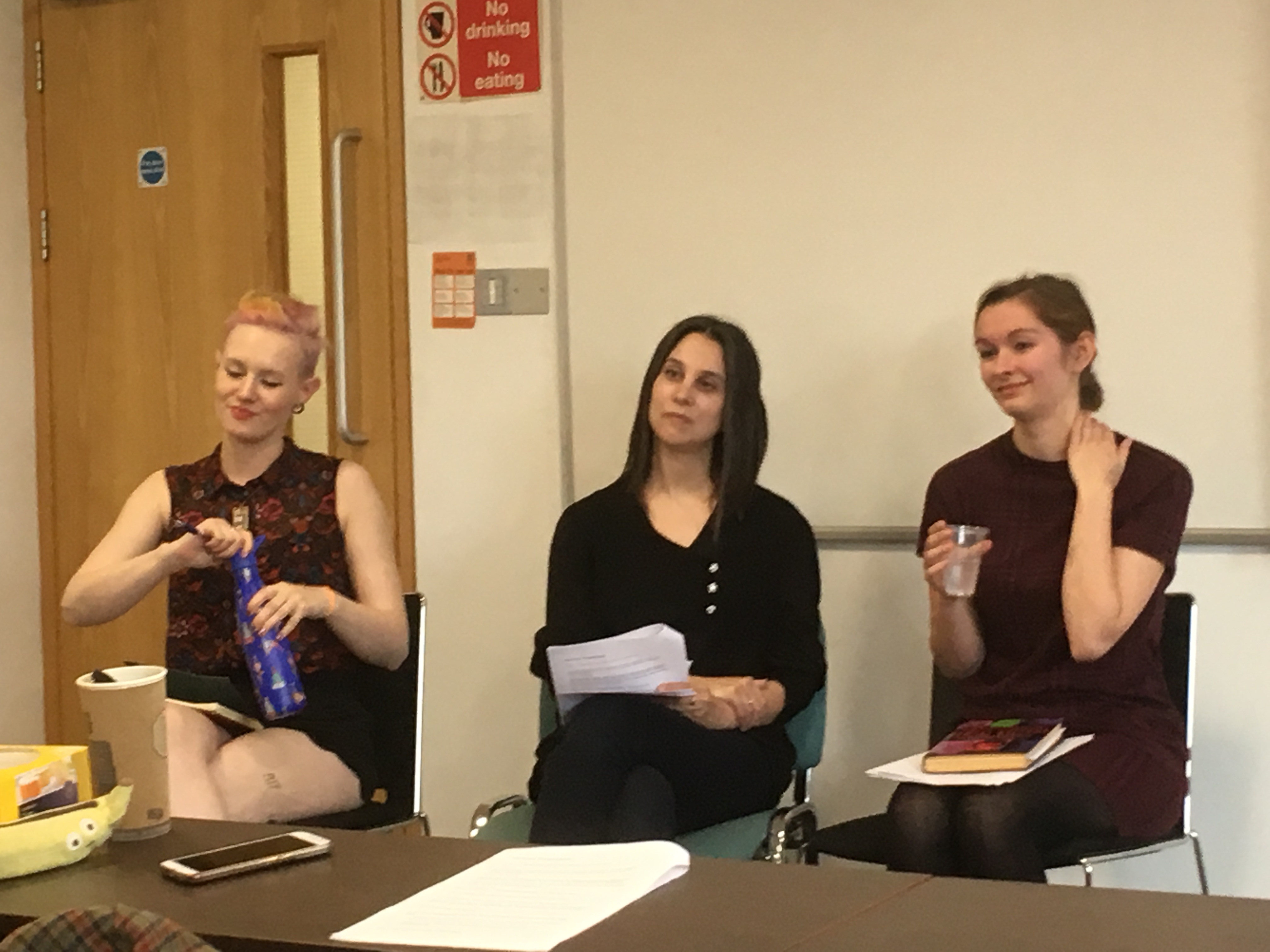
Day two’s Blake panel focused on Blake’ art and illustration. Clémence Ardin’s (University of Kent) paper compared Blake’s illustrations of fallen women and angels in the Book of Enoch with Alfred de Vigny’s Eloa ou la soeur des anges. Sharon Choe’s (University of York) paper centred around a close-reading images on the The Book of Urizen plates to discuss Blake’s representations of darkness, the void, creation and destruction. Elli Karampela’s (University of Sheffield) paper discussed ‘The Ghost of a flea’, Blake’s ‘Visionary Heads’ and how we might conceptualise them as Gothic bodies.

Clémence Ardin, Sharon Choe and Elli Karampela on the ‘Fantasising Blake’ panel

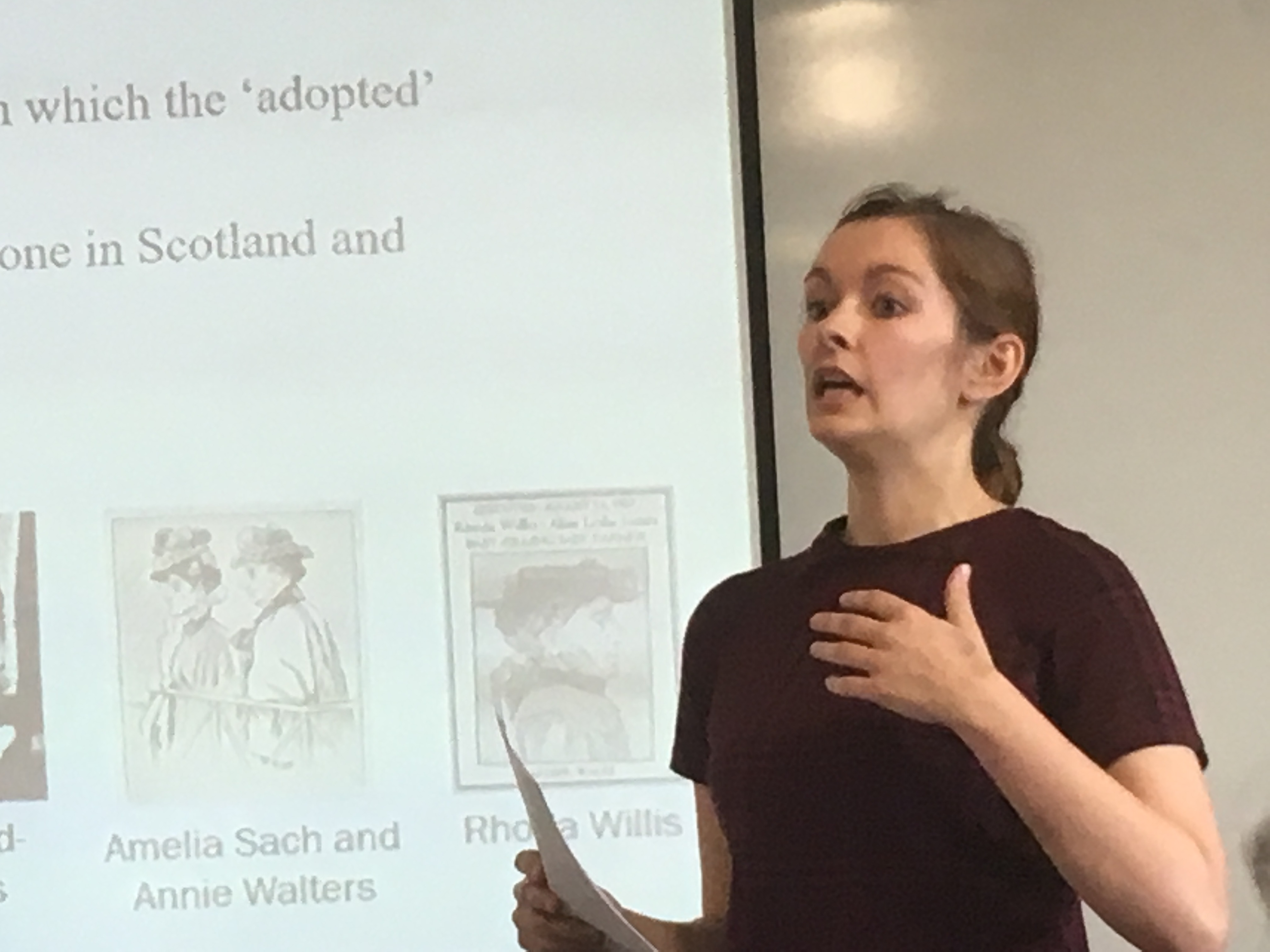
Day three’s Blake panel, ‘William Blake’s Hand’, began with Mark Crosby (Kansas State University) and his paper on Blake’s letters and how they illustrated Blake’s (often difficult) journey through the patronage system. Elizabeth Potter’s (University of York) paper, gave an innovative reassessment of approaching Blake’s marginalia, and helped me reassess and realign my current use of Blake’s marginalia. Both Potter and I quoted the same aphorism of Lavater’s (number 532) in our respective papers, an eerie coincidence. The final paper for this panel was Josephine McQuail’s (Tennessee Tech University) on eroticism in the Vala illustrations, and its reception in Blake criticism over the centuries. As in the second Blake panel, there was an emphasis in McQuail’s paper on the importance, the necessity of considering Blake’s images alongside his works, which I find increasingly important as I form my own research about Blake.

Elizabeth Potter giving her paper

I chaired day four’s Blake panel, ‘Blake’s Visionary Imagination’. Tara Lee’s (University of Oxford) spoke on the intersection of the natural and the mechanical in Blake’s particular form of epic. Joshua Schouten de Jel (Plymouth University) discussed selfhood and psychoanalysis in The Book of Thel and Visions of the Daughters of Albion. Finally, with perhaps one of my favourite papers of the conference, Camille Adnot (Paris-Diderot University) spoke on Blake’s Four Zoas, the influence of medieval mappae mundi on Blake’s illustrations, and the question of mapping dreamscapes in Blake’s works.

Camille Adnot presenting her paper

BARS 2019 was fascinating from start to finish. Although the end of the conference left me feeling deflated that four days of exciting conversations had to come to an end, I am, ultimately, excited for the future of my research area and the connections I’ve made within it.

Jodie Marley, University of Nottingham

16th August 2019
Conference Report: Reading Nineteenth-Century Periodicals, Manchester Metropolitan University

      Comments Off on Conference Report: Reading Nineteenth-Century Periodicals, Manchester Metropolitan University

Today on the BARS Blog is a report from  ‘Reading Nineteenth-Century Periodicals’, a special event in Manchester earlier this year. This event was part-sponsored by BARS. The report is by Dr Emma Liggins, Senior Lecturer in English Literature. You can follow English at Manchester Met on Twitter here

Find out how to apply for sponsorship from BARS here

Reading Nineteenth-Century Periodicals, North West Long Nineteenth Century Seminar, 17 July 2019

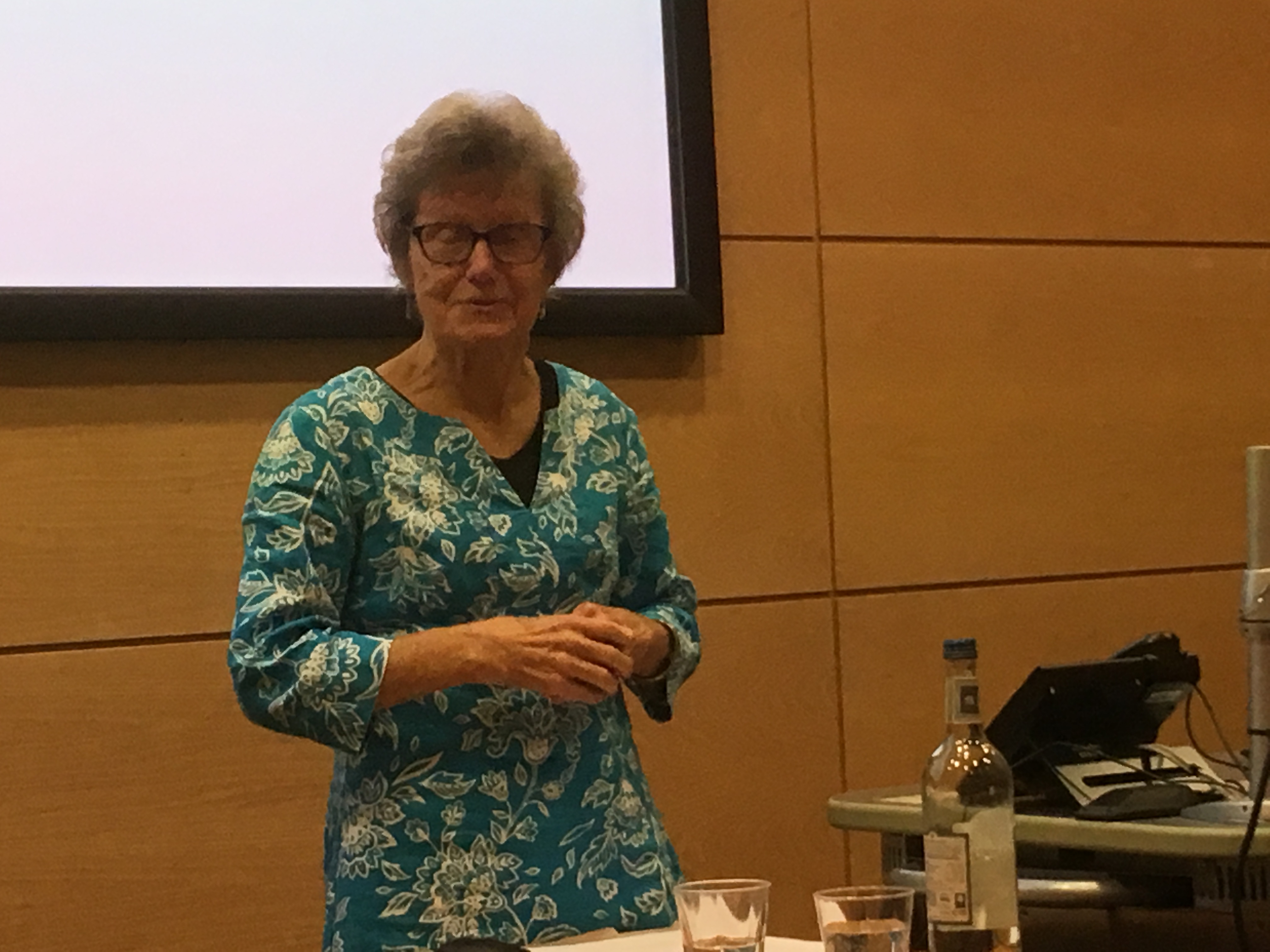
The celebratory event ‘Reading Nineteenth-Century Periodicals, with thanks to Margaret Beetham’, was held at Manchester Metropolitan University in July 2019, as the summer event of the North West Long Nineteenth Century Seminar. It was co-organised by Emma Liggins (Manchester Metropolitan University), Annemarie McAllister (University of Central Lancashire) and Andrew Hobbs (University of Central Lancashire) to mark Margaret’s 80thbirthday. We celebrated Margaret’s outstanding contribution to feminist and periodical research and her ongoing influence on our ways of reading and working with periodicals, cookbooks and women’s writing in the long nineteenth century. Her pioneering book A Magazine of her Own: Domesticity and Desire in the Woman’s Magazine, 1800-1914 (1996), and her work on servants’ reading, cookbooks and class, have been hugely influential in the field. The event brought together independent researchers, students, and scholars at different stages of their careers. Many members of the audience knew Margaret’s work well and had worked with her in the past, but it was also an opportunity to bring her work to the attention of a new generation of researchers. In a tribute to Isabella Beeton, the famous cookbook author and editor of The Englishwoman’s Domestic Magazine brought to light in Margaret’s research, we enjoyed home-made cakes in the coffee and lunch-breaks –the Bakewell tart was a triumph!

The first session focussed on late nineteenth and early twentieth-century periodicals and their readers. Solveig Robinson opened the day with an examination of the mediation of notions of motherhood and domestic management in the scientific mother’s magazine Baby. Gemma Outen responded to Margaret’s claim that there was a ‘dearth of specific information’ about readers to think about the imagined readership of the temperance journal Wings, drawing on census returns to plot the characteristics of the ‘average reader’. Margaret’s own paper ‘Situated Knowledges’: or the Back Door’ drew on Donna Harraway’s work to offer a history of developments in cultural theory she had witnessed in her sixty-year career and the ‘back-door knowledge’ scholars need to draw on in order to ‘open some windows in the house of Victorian studies’. She also reflected on coming through the ‘back door’ to literary studies where she would question the canonical texts being taught and draw on her involvement with the Women’s Movement in her teaching and research. This led to an ongoing discussion throughout the day about the implications of the ‘demise’ of Women’s Studies, the changing face of feminist scholarship and reinventing the curriculum.

Tributes by a range of scholars who had worked with, and/or been taught by, Margaret, emphasised her generosity with early career researchers and research students, her encouragement of collaboration and the ways in which conversations always lead to a greater understanding of the complexities of texts. Brian Maidment spoke about the importance of her early work on class and (as co-conspirator) her challenging of the establishment. Kay Boardman highlighted the excitement of collaborating with Margaret on the Victorian women’s magazines anthology, remembering the assemblage of a new taxonomy from the piles of paper and magazines on an office floor in the days before digitization. Angelica Michelis celebrated Margaret’s support for her female colleagues at Manchester Metropolitan University and her important contribution to food studies, particularly the complexities of cook-books and consumption. Finally, Ginette Carpenter spoke of the way in which Margaret had given her the confidence as a research student to develop her own independent thinking and to grapple with the complexities of reading and the woman reader.

The final postgraduate panel on ‘The Challenges of Archival Research’, which was funded by BARS, was also a chance to think about new directions in periodical studies.  Transnational and transatlantic exchanges, as well as the need for more work on readers of colour, were mentioned several times. Margaret’s most recent work on missionary journals in the twentieth century, set alongside exciting recent work by Caroline Bressey and Deborah Logan, is indicative of the need to keep thinking about the legacies of empire and globalisation. Victoria Clarke (University of Leeds) talked about the readership community of the Chartist newspaper, The Northern Star and the challenges of using corpus linguistics methods to analyse the uses of the words ‘manly’ and ‘womanly’ in its articles. Her approach demonstrated the uses of digitisation to advance ways of thinking about Chartism, gender and protest. The different uses of the language of interrogation in the proceedings presented in the Old Bailey online and press coverage of events from the 1760s were the subject of a fascinating presentation by Tamara Kaminsky (University of Exeter). Finally, Catherine Elkin (Manchester Metropolitan University) gave an entertaining account of her unsuccessful search for advertisements for baby-farmers in the late-nineteenth-century Manchester press. This was revealing of the difficulties of finding the right search terms; adverts about nurses rather than coded adverts for baby-farmers seemed to be more plentiful. Paying attention to the ways in which contentious constructions of motherhood are mediated in periodical culture linked back to Solveig Robinson’s discussion of baby science.

In the Q and A participants talked about European and American readers of British periodicals, the regional appeal of branch reports organised by location in newspapers of political organisations, the placing of journalism about Northern cities and choices about case studies in the attempt to avoid the limitations of being ‘London-centric’.  Issues of locality and regionality were also identified as an ongoing concern. This final discussion showed how a new generation of scholars were making effective use of data from digital archives to develop knowledge of readerships, periodical communities and linguistic variation in newspapers. It also foregrounded both the frustrations and the possibilities of trying to predict results and coming up with either something vastly different or nothing at all. This acknowledgement of the complexities of periodical research and the diversity and heterogeneity of nineteenth-century periodicals is a crucial aspect of Margaret Beetham’s legacy.

A selection of the papers given at the seminar, as well as a roundtable on Margaret’s work, will appear in a future edition of Victorian Periodicals Review, edited by Andrew Hobbs and Gemma Outen.

– Emma Liggins (Manchester Metropolitan University), August 2019


BARS 2019 Report

      Comments Off on BARS 2019 Report

Today on the Blog is a post from Johnny Cammish (University of Nottingham). This is the second in a series of reports from the International BARS conference that took place in July 2019. You can also see pictures from the event if you search #BARS2019 on Twitter. 

The run up to BARS was a busy time for us, as the postgraduate helpers. It was a lot of work that, thankfully, all seems to have come together in the end. Or, at least, that was the impression I got from various grateful delegates who consistently offered thanks and praise throughout the conference.

It was an intense first day; opening with the fantastic plenary by Professor Laura Mandell about some of the digital approaches she’s been working on were an exciting indication of things to come. The first panel I attended was equally fantastic, though of a far more sombre tone. Featuring discussions of ageing, lateness and dementia being wonderfully thought provoking and, with such heavy topics, inevitably very moving. However, the brief quotation of James Montgomery, my own interest, may have somewhat biased me in celebration of this panel.

Montgomery did crop up again later in the day; although this time when I gave my own paper after a somewhat complicated but well-handled panel shift, with the Romantic Radicalism and Romantic Life-writing panels being combined synergistically in a new beast that worked remarkably well. I’ve not had much experience giving papers, but I found the energy and interest in the room genuinely inspiring; questions and comments I’ve received have given me a long list of additional areas for me to investigate, which I am grateful for!

Me presenting my paper

Unsurprisingly, considering my own paper on Montgomery’s radicalism and imprisonment, many of my personal highlights were the papers of a political nature – Olivia Murphy’s discussion of the bizarre difficulties of the Birmingham mob to burn ‘Dr Phlogiston’ was fascinating, and Ian Packer’s paper on Wat Tyler reminded me that I really need to read more on how the older Southey dealt with his more radical youth. That’s not to say that I neglected other panels; I thoroughly enjoyed viewing Scottish Romanticism and Percy Shelley Panels, despite how they demonstrated my own near-criminal neglect of Romantic Drama.

I could, of course, talk about the panels ad infinitum, but I cannot fail to mention the other plenaries. Professor Diego Saglia’s discussion of (potentially) Byron’s skin was fascinating and wonderfully macabre; something I had never even thought of considering before. Professor Jane Stabler’s comparison of Byron to The Office (US)’s Dwight Schrute is forever etched on my brain, Dr Robert Poole’s wonderful discussion of Peterloo highlighted the role of women, and clarified the state of Manchester in 1819 – dispelling a lot of my own misunderstandings. Finally, Professor Sharon Ruston’s discussion of Humphry Davy and his rejection of poetry in favour of science felt like a fitting microcosm of the Humanities side-lining to the Sciences.

The excursion to Newstead was also wonderful; I visit it regularly as I work there part-time, but seeing it full of scholars who know and appreciate Byron and his history was wonderful; and I was pleased with how much enthusiasm everyone had for the Abbey, both as postgraduate helper and as part-time Visitor Assistant. In short, the conference was wonderful, and there is far more to be said than could fit in 500 words. I am glad that many seemed to enjoy it as much as I.

The next BARS conference will be the BARS PG/ECR Conference in 2020. The conference will be held at Keats House, Hampstead, from 12th-13th June. Further details and CfP to follow – for now, save the date!

Johnny Cammish, University of Nottingham

16th August 2019
BARS 2019: Factually a Fantastic Conference!

      Comments Off on BARS 2019: Factually a Fantastic Conference!

Today on the Blog is a post from Colette Davies (University of Nottingham). She reports from the International BARS conference that took place in July 2019. This is the first of a series of reports from the conference. You can also see pictures from the event if you search #BARS2019 on Twitter. 

Please forgive the cheesy title. The 16th International British Association for Romantic Studies (BARS) conference, themed ‘Romantic Facts and Fantasies’ (now you can see my title’s inspiration!), has just been hosted by the University of Nottingham’s School of English. Spanning a period of four days, Nottingham welcomed over 200 delegates from all around the world to this conference. Numerous parallel panels, exemplary plenaries, ECR and PGR workshops, excursions, conference banquets, wine receptions, wonderful catering, and frequent tea and coffee breaks meant that these four days sped by.

Despite time flying, the planning and organisation of this conference has been years in the planning. Bids for hosting the 2019 conference were placed just after the 2015 BARS conference at Cardiff University. As a current PhD student at the University of Nottingham, I joined the planning team over a year ago and, as Twitter reminded me today, I set up the Twitter account 365 days ago. Thankfully, the hard work by a team of more than ten people over the past four years most certainly paid off.

On the first day (and the hottest day of the year so far), delegates were welcomed by the organisers, Professor Lynda Pratt and Professor Máire Ní Fhlathúin. The conference was then officially opened by Professor Jeremy Gregory, Pro-Vice Chancellor for the Faculty of Arts at the University of Nottingham. Professor Laura Mandell, of Texas A&M University, gave the first plenary in which she focussed on ‘Re-inventing Gender: the Feminist Controversy in England, 1788-1810’. Her plenary discussed the data project she is currently working on, in which writing styles are annotated and grouped to indicate difference of styles that surpass the M/F binary. Lunch followed, during which there was a highly informative PGR and ECR workshop on ‘Heritage Careers’ given by Dr. Gillian Dow and Dr. Anna Mercer. The afternoon was a succession of three parallel panels; over 60 individuals presented on the first day! The evening began with the Welcome Reception and Book Prize followed by an informal dinner.

BARS Book Prize announced by Dr. Jane Moore

Friday quickly flew by with four parallel panels along with two plenaries, a BBQ for dinner and a PGR and ECR wine reception. Professor Diego Saglia gave the second plenary of the conference, in which he focussed on Byron’s links to and life in Ravenna in a lecture entitled, ‘Byron’s Words and Things: Bodies, Bullets and a Box’. His presentation included some of the items relating to Byron which were collected by the Countess Teresa Gamba – one of them being flakes of Byron’s skin! The third plenary was delivered by Professor Jane Stabler. Also focussing on Byron, Jane Stabler discussed the anecdotal evidence and annotations on Byron’s text. Friday closed with a vibrant PGR and ECR wine reception at the Orchards Hotel, allowing PGR and ECR students to meet and mingle.

The Conference Banquet

Saturday was Excursion Day! In the morning, delegates attended one parallel panel before enjoying the plenary on ‘Peterloo: The English Uprising’ by Dr. Robert Poole. This was also the public Byron lecture, hosted annually by the School of English. Poole showed the audience images and text from the new graphic novel he has collaboratively worked on and which tells the story of Peterloo through using cartoons, as well as evidence and quotations from letters and records of Peterloo in its narrative. Specifically, Poole concentrated on the representation of women in archival documents and contemporary caricatures of Peterloo and used them to illuminate the role women played in this uprising. On Saturday afternoon, delegates could choose one of three excursions: trips were planned to Newstead Abbey, Wollaton Hall and Park, and the Lakeside Arts Museum which currently houses the conference’s exhibition on Romantic Facts and Fantasies. The Conference Banquet on Saturday evening was enjoyed by all who attended. We were treated to performances of Peterloo songs, collated and introduced by Dr. Alison Morgan of Warwick University and performed by folk trio, the Thrup’nny Bits.

Performance by the Thrup’nny Bits

The last day, Sunday, had the final parallel panels and a second ECR and PGR workshop, this time focussing on publishing. Delivered by Professor Ian Haywood and Dr Richard Gaunt, they tackled some of the facts and fantasies of publishing monographs and articles and REF. Professor Sharon Ruston gave the final plenary on Sunday afternoon; her talk on Humphry Davy’s notebooks demonstrated how he discussed both poetry and science, using concepts of Romanticism to define scientific practices and work. The conference closed with the new incoming President of BARS, Anthony Mandal, praising the conference organising team and all those who gave papers, asked questions, and attended panels and workshops. Colette Davies and Amanda Blake Davis then introduced the BARS ECR and PGR conference, to be held in June 2020 at Keats House, before Dr Andrew McInnes advertised and outlined the 2021 BARS/NASSR joint conference, which will be hosted at Edge Hill University. Hands sore from many rounds of applause, delegates bade farewell to Nottingham. Many headed home, but many were also heading for the International Conference of Romanticism (ICR) in Manchester or the Frances Burney conference, both of which took place the week after BARS.

Conferences require a lot of energy, both from delegates and organisers. Yet, they enable people to share their research with each other, forge connections with scholars working in similar areas and, most importantly, allow individuals to develop their research and practice. I am always nervous before presenting a conference paper but the discussions afterwards are so rewarding. I have never been to a conference yet where I haven’t come away with new texts to include in my research or a new approach to a work or an author. BARS 2019 didn’t disappoint. Established and new scholars alike are keen to talk to each other and it was wonderful to mix with scholars at different stages of their careers. It was really rewarding to be part of the organising team for this conference. Thank you to everyone who came and thanked us for our work towards.

The next BARS conference will be the BARS PG/ECR Conference in 2020. The conference will be held at Keats House, Hampstead, from 12th-13th June. Further details and CfP to follow – for now, save the date!

Colette Davies, University of Nottingham

14 August 2019

The Scottish Romanticism Research Award 2019

      Comments Off on The Scottish Romanticism Research Award 2019

The executive committees of the British Association for Romantic Studies (BARS) and the Universities Committee for Scottish Literature (UCSL) are delighted to announce the winner of the third annual Scottish Romanticism Research Award: Amy Wilcockson, a PhD Candidate in the English Department at the University of Nottingham. During her research trip, she will visit the University of Glasgow Library and the Mitchell Library in order to study materials relating to her research on the Scottish poet Thomas Campbell.

BARS and UCSL have established the annual award for postgraduates and early career scholars to help fund expenses incurred through travel to Scottish libraries and archives, including universities other than the applicant’s own, up to a maximum of £300. A postgraduate may be a current or recent Master’s student (within two years of graduation) or a PhD candidate; a postdoctoral scholar is defined as someone who holds a PhD but does not hold a permanent academic post. If appropriate, UCSL will endeavour to assign the awardee an academic liaison at one of its partner universities in Scotland.

Recipients are asked to submit a short report to the BARS Executive Committee, for publication on its website, and to acknowledge BARS and UCSL in their doctoral thesis and/or any publication arising from the research trip. Please join us in congratulating Amy on her award. We look forward to welcoming her to Scotland.

Dr Daniel Cook, University of Dundee

12 August 2019

Call for Papers. Don Juan: Conception, Reception, Imitation

      Comments Off on Call for Papers. Don Juan: Conception, Reception, Imitation


DON JUAN: CONCEPTION, RECEPTION, IMITATION


ONE-DAY CONFERENCE, SATURDAY 7TH DECEMBER 2019

BICENTENNIAL COMMEMORATION OF DON JUAN CANTOS I & II

ANTENNA MEDIA CENTRE (NOTTINGHAM TRENT UNIVERSITY), NOTTINGHAM


SPONSORED BY BARS & ROMANTIC BICENTENNIALS


Keynote speaker Professor Jerome McGann (University of Virginia).

Professor McGann, one of the world’s leading Byron scholars for over thirty years, is not only editor of Byron’s Complete Poetical Works, but has also written a huge range of critical essays and books on Byron and his poems.

The Byron Society invite proposals for 20-minute papers on Don Juan.

Published anonymously in the summer of 1819, the first two cantos of Byron’s ‘satirical epic’ Don Juan provided the reading public with a work which self-consciously raised and challenged received ideas about fame, originality, and literary merit and was admired and reviled in almost equal measure. The first two cantos became an overnight sensation, inspiring countless attacks against their sexual and religious infidelities, the bitingly acerbic social and political commentaries, the horrifying burlesquing of scenes of death and destruction, and the generalised irreverence. While some were shuddering with outrage, others saw the significant commercial opportunities offered by Byron’s ‘Donny Jonny’, with parodies, musical adaptations, and ‘new’ Cantos flooding the market alongside the numerous pirated copies.

Submissions relating to any aspect of Don Juan are welcome, however papers connected with the first two cantos are of particular interest. Suggested topics include but are not limited to:


  • Byron’s sources, influences and inspirations for Don Juan
  • Techniques, conventions and tropes used in Don Juan
  • The contemporary reception of Don Juan (critical reception popular and
  • working-class reception, male vs female reception, metropolitan vs rural
  • reception, reception in Britain and other countries) and Byron’s responses
  • Later critical and creative responses to Don Juan
  • Imitations and adaptations of the poem
  • Questions of ownership, piracy and anonymous publication
  • The poem’s place in Byron’s oeuvre with an especial emphasis on its continuing
  • value in the modern era.


Proposals of no more than 300 words should be submitted by email no later than Friday 30th August to byrondonjuan2019@gmail.com.

We welcome 10 and 20-minute proposals from PGs and ECRs for a special panel and round table.

We hope to collect selected papers for a special edition of The Byron Journal.


Lord Byron (c) Newstead Abbey; Supplied by The Public Catalogue Foundatio


Conference fees:

  • Students – £20.00
  • Speakers – £40.00
  • Byron Society Members – £40.00
  • Non-Members – £60.00

Conference fees include lunch and a champagne reception.

There will be an optional conference dinner on the evening of the 7th, and an optional trip to Newstead Abbey on the Sunday.


Applications Open! Nineteenth-Century Matters Fellowship: University of Surrey 2019-20

      Comments Off on Applications Open! Nineteenth-Century Matters Fellowship: University of Surrey 2019-20


Nineteenth-Century Matters is an initiative jointly run by the British Association for Romantic Studies and the British Association for Victorian Studies. Now in its fourth year, it is aimed at postdoctoral researchers who have completed their PhD, but are not currently employed in a full-time academic post. Nineteenth-Century Matters offers unaffiliated early career researchers a platform from which to organise professionalization workshops and research seminars on a theme related to nineteenth-century studies, and relevant to the host institution’s specialisms. The focus should be on the nineteenth century, rather than on Romanticism or Victorianism.

For the coming academic year Nineteenth-Century Matters will provide the successful applicant with affiliation in the form of a Visiting Fellowship at the University of Surrey. The fellowship will run from 23 September 2019- 1 September 2020.

The successful fellow will particularly benefit from and contribute towards the University’s expertise in nineteenth-century literature, Neo-Victorian literature, theatre, mobility studies, and the visual arts. They will also be encouraged to become involved in the activities of the Victoriographies research group, a collection of researchers in the School of Literature and Languages and curators at Watts Gallery whose research focuses on the nineteenth century. Fellows will also benefit from the University’s close connections with Watts Gallery, that houses an impressive collection of nineteenth-century paintings and sculptures produced by the artist G.F. Watts and his wife, the designer and artist, Mary Watts.

This fellowship includes a University of Surrey e-mail address, and access to its library and electronic resources for the full academic year. There is no requirement to live in the Surrey area during this time. The primary purpose of the fellowship is to enable the successful applicant to continue with an affiliation and remain part of the academic community. It is a non-stipendiary post, and the fellow will need to support themselves financially during the academic year. The fellowship will, however, include up to three week’s accommodation at the University over the summer, where the fellow will be free to develop their research and make the most of Surrey’s archives and special collections. The fellow will also be financially supported by BAVS and BARS with the organising of a research and professionalization event on a theme relevant to Surrey’s collections and/or research interests. It is expected that the fellow will acknowledge BARS, BAVS, and the University of Surrey in any publications that arise from their position.

Application Process

Applicants should submit a CV with a two-page proposal of their research topic and event, and explain why they would benefit from the fellowship. These should be sent to Briony Wickes (briony.wickes@kcl.ac.uk) and Paul Stephens (paul.stephens@lincoln.ox.ac.uk).

The deadline for applications is Thursday August 22nd 2019 (23:59 GMT). Applicants will be notified of the committee’s decision by Thursday August 29th 2019.

Past fellows are listed here.

Call for Papers: Nineteenth-Century Contexts Special Issue

      Comments Off on Call for Papers: Nineteenth-Century Contexts Special Issue

Nineteenth-Century Contexts

Special Issue on Ecologies of the Atlantic Archipelago

May 2021

Guest Editors:

Seán Hewitt & Anna Pilz

Ellen Hutchins, Fucus ovalis, collected on Whiddy Island, 1805, Trinity College Dublin


Studies of the intertwined histories of Great Britain, Ireland, and their associated islands have given rise to the notion of ‘archipelagic studies’. As in John Kerrigan’s seminal work Archipelagic English, the cover of which shows the familiar image of Great Britain and Ireland on a map tilted, reaching out from mainland Europe and into the Atlantic, this involves a new perspective on geography, identity, and the relations between nations. Central to this field of criticism are concerns regarding land and the natural world.

Nineteenth-century developments resulted in dramatic shifts within the archipelago, with attending drastically-altered human-environment relationships. There were numerous instances of famine, subsistence crises, demographic change, and altered pressures on land and systems of tenure. Connective technologies of the modern world spread to sparsely populated regions, complicating notions of centre and periphery as well as tradition and modernity. Unprecedented infrastructural developments via roads and railway networks connected rural and urban geographies, resulting in increased tourist traffic; the expansion of ports further enhanced trading networks with Europe and beyond; and the spread of the colonial project led to various productions of knowledge of the natural world.

Alongside the British project, various nationalisms looked to the natural world as a way of arguing for racial, cultural and geographical distinction. Islands and coastlines, the ‘untouched’ places, were loaded with radical potential. The folk revivals, and the attention paid to local cultures, had political as well as ecological consequences. A pan-Celtic cultural movement sought to offer new visions of the natural world which might alter, supplement or correct Anglo-Saxon narratives. Thus, nature became a temporal category within the imperial project.

Within the archipelago, the ‘Celtic’ nations contributed both to the larger British scientific project and to individual, national attempts to consolidate a vision of cultural and geographical identity through nature. While civic science and natural history bloomed alongside folklore collection, the boundary between scientific and literary writing remained productively porous. Networks of knowledge exchange proliferated.

In ecocritical studies which respond to the notion of the Anthropocene, an emphasis has been placed on the transnational capacity of environmental crisis to break down, and spill over, national borders. Likewise, ways of seeing the world which were posited as outmoded, belated, or ‘primitive’ by the rationalising project of nineteenth-century Europe are being re-examined and explored as beneficial to reconsidering human/non-human relations in the twenty-first century. Thus, animism, pantheism and vitalism have all recently been posited as radical correctives to Western thought.

This issue aims to bring into focus interconnection, idiosyncrasy, and the ways in which national boundaries were simultaneously made porous and more distinct by writers and artists who sought to engage with the new visions of nature which the nineteenth-century offered. How does ecological disaster prompt shifts in artistic production? How were ecological relationships linked with colonialism and its legacies withinthe archipelago? How does contested religious thought and identity affect relationships with the natural world? How are natural histories and national histories bound and interlinked? Literary considerations of the archipelagic environment, and archipelagic ecological relationships, are varied and multitudinous.

To focus on nineteenth-century contexts of archipelagic ecologies enables the tracing of connections and the identification of shifts in perception that might not easily align with literary periodisation of Romantic, Victorian and early Modernist writing. New developments in ecocriticism, from new materialisms to notions of the Anthropocene, shed light on the innovations of nineteenth-century cultural responses to environmental shifts and scientific work.

ARTICLES MIGHT FOCUS ON (BUT ARE NOT LIMITED TO):

  • gendered environments
  • urban environments and their cultural productions
  • folk revival and ‘local’ literature
  • discoveries of archipelagic environments
  • environments in children’s literature
  • natural history and education
  • human-animal relations
  • writing natural history
  • nature and regional languages / dialects
  • writing environmental catastrophe
  • nature, environment, and genre
  • poetics of place
  • nature writing and regional environments
  • literary geographies and environment
  • travel writing and environment
  • nature as a museum of the past
  • nature and its regenerative potentials
  • colonial networks within and outside the archipelago
  • periodical culture, agricultural reform, and environmentalism

We invite 600-800-word abstracts for a 31 January 2020 deadline. The commissioned articles (of no longer than 9,000 words, inclusive of footnotes) will be due on 31 August 2020. All article submissions will undergo peer review and may include illustrations with copyright to be secured by the author (colour for online publication and black and white for print).

Abstracts should be submitted to both Dr Seán Hewitt (seanedwardhewitt@gmail.com) and Dr Anna Pilz (a.pilz@outlook.com).

Stephen Copley Research Report: Hiroki Iwamoto on Benjamin Robert Haydon

      Comments Off on Stephen Copley Research Report: Hiroki Iwamoto on Benjamin Robert Haydon

Stephen Copley Research Award Report:

Benjamin Robert Haydon Manuscripts at Houghton Library and Christ’s Triumphant Entry into Jerusalem at the Athenaeum of Ohio / Mount St. Mary’s Seminary

This June, thanks to a BARS Stephen Copley Research Award, I was able to visit the United States to access the collection of Houghton Library at Harvard University. My PhD thesis concerns the historical painter Benjamin Robert Haydon’s influence on the poetry and poetics of John Keats, and I devoted my time at Harvard mostly to consulting the painter’s (unpublished) materials that are specifically related to the poet’s life and writings.


Houghton Library, Harvard University (author’s photograph)


Among the rare materials that I accessed at Harvard, I was particularly pleased to be able to consult Haydon’s unpublished original draft for his Autobiography. Haydon started this draft, which he called ‘Vita’, sometime around 1815 and is assumed to have abandoned it after 1825. Resumed as late as 1839, his Autobiography was published posthumously in Tom Taylor’s Life of Benjamin Robert Haydon (1853). That is, Haydon worked on the ‘Vita’ while many of the Romantic writers were still alive. Somewhat disordered and even incomplete as it is, this voluminous manuscript (which counts more than 250 pages) not only bespeaks the vigour with which Haydon composed it, but also provides us with a version of his literary self-portrait, drawn from a perspective quite significantly different from that in the published Autobiography. Keats scholarship has previously paid very little attention to the ‘Vita’, but I believe that a close examination of this manuscript will shed new light on our understanding of the literary and artistic milieu of the Romantic period, especially in the Keats circle.

At Harvard, I was also pleased to be able to consult Haydon’s transcriptions of Keats’s letters. Most of them are addressed to Haydon himself, the rest to Keats’s brother Tom. Since all of these letters have been already published, Haydon’s transcriptions themselves are not that remarkable. Yet what makes this material singular is that Haydon ‘annotated’ some of the letters. Judging from its content, it is most plausible that Haydon sent them to Richard Monckton Milnes (later Lord Houghton) to assist him in preparing for his first biography of Keats. In fact, Milnes’s 1848 biography of the poet does seem to rely on some of Haydon’s annotations. Yet Milnes’s book does not reproduce all of Haydon’s commentary, including that on Wordsworth’s (in)famous comment on Keats’s recitation of Endymion as a ‘pretty piece of Paganism’. It now turns out that, along with the ‘Vita’, Haydon’s annotated transcriptions of Keats’s letters will indeed be indispensable for exploring their relationship in my thesis.


The Athenaeum of Ohio / Mount St. Mary’s Seminary (author’s photograph)


Leaving Boston (Harvard), my research trip in the US ended by seeing Haydon’s large painting Christ’s Triumphant Entry into Jerusalem at the Athenaeum of Ohio / Mount St. Mary’s Seminary, Cincinnati. This Catholic seminary is located a long way from the airport, and it took more than an hour by bus even from the city centre to get there. But it was a rewarding experience for me to come Cincinnati to see this painting. Visitors to this seminary can now see Haydon’s painting hung awe-inspiringly in its darksome atrium. Christ’s Entry is grand both in its scale (size) and in its conception (subject). An often vainglorious artist, Haydon modelled the face of Christ on his own, and surrounded the figure with his own contemporaries including Keats, Wordsworth, and Lamb; and the painted scene served him, virtually, as a symposium of the geniuses that gathered to commemorate his own imminent ‘entry’ into the history of English art. After all, he was then about to—but failed to—gain far-flung fame as a great historical painter. However neglected Haydon is nowadays, Christ’s Entry is still, I believe, his masterpiece. And those nearly life-sized figures in the canvas also seemed to induce me to feel as if I were a part of the picture, and to envisage further in my mind the animated scene when those luminaries—Keats, Wordsworth, Lamb, and others—enjoyed ‘the immortal dinner’ in front of this picture in late December 1817.


Benjamin Robert Haydon, Christ’s Triumphant Entry into Jerusalem (1820; photo provided by: The Athenaeum of Ohio / Mount St. Mary’s Seminary of the West in Cincinnati, Ohio U.S.A.)


I am greatly indebted to BARS for awarding me the research grant, without which this archival trip would not have been possible. And I am also very grateful to the librarians and staff at Houghton Library and the Athenaeum of Ohio / Mount St. Mary’s Seminary for their permission to allow me to take a close look at the rare materials in their collections. Thanks to all those concerned, my research trip went very well, and will undoubtedly contribute significantly to the development of my thesis.

—Hiroki Iwamoto (University of Bristol)

Find out how to apply for a BARS Stephen Copley Research Award here.

Introducing Project ERIN: Thomas Moore in Europe

      Comments Off on Introducing Project ERIN: Thomas Moore in Europe

Erin%20Logo%20JPG

ERIN documents two of Thomas Moore’s song series – the Irish Melodies (1808-1834) and National Airs (1818-1827) – as well as music inspired by his ‘oriental romance’ Lalla Rookh (1817). ERIN enables the user to track the production and dissemination of these works in Europe, from their respective dates of creation through to 1880. Any contributors to this process (composers, arrangers, editors, illustrators, engravers, publishers, etc.) are indexed or tagged as part of the project. All of ERIN’s resources are now available at www.erin.qub.ac.uk. This website unites the previously available blog and OMEKA resources (images) with some new features, including podcasts and a catalogue that unites the collections of eight European repositories. ERIN was co-produced by Dr Tríona O’Hanlon (Dublin) and Dr Sarah McCleave (Queen’s University Belfast) and was supported by the Horizon 2020 Framework of the European Union and Queen’s University Belfast.

To complement ERIN’s launch, the exhibition, ‘Discovering Thomas Moore: Ireland in nineteenth-century Europe’ is on display at the Royal Irish Academy, Dublin from 17 June to 23 December 2019. ‘Discovering Thomas Moore’ is curated by Dr Sarah McCleave (Queen’s University Belfast). For further information about this exhibition and a series of complementary lectures on Thomas Moore, see this link.