The BARS Review, No. 52 (Autumn 2018)

      Comments Off on The BARS Review, No. 52 (Autumn 2018)

We are delighted to announce the publication of the most recent issue of The BARS Review (No 52, Autumn 2018).  The issue contains a total (including a double review) of nineteen reviews of recent scholarly work within the field of Romanticism, broadly conceived.  Five of the nineteen reviews compromise a ‘spotlight’ section on ‘Romanticism, the Landscape, and the Environment’.

This issue of The BARS Review is dedicated to the memory of Professor Michael O’Neill (1953-2018) and includes his review of John Barnard’s 21st-Century Oxford Authors: John Keats.

If you have comments on the new number, or on the Review in general, we’d be very grateful for any feedback that would allow us to improve the site or the content.  Mark Sandy would also be very happy to hear from people who would like to review for BARS.

Editor: Mark Sandy (Durham University)
General Editors: Ian Haywood (University of Roehampton), Susan Oliver (University of Essex) & Nicola J. Watson (Open University)
Technical Editor: Matthew Sangster (University of Glasgow)

Table of Contents

Dedication

To Michael O’Neill (1953-2018)
Mark Sandy

Reviews

John Regan, Poetry and the Idea of Progress, 1760-1790
Fiona Milne
Roger Maioli, Empiricism and the Early Theory of the Novel
Gillian Skinner
Diego Saglia, European Literatures in Britain, 1815-1832
Gillian Dow
Jonathan Crimmins, The Romantic Historicism to Come
Francesco Marchionni
G. A. Rosso, The Religion of Empire: Political Theology in Blake’s Prophetic Symbolism and Chris Bundock and Elizabeth Effinger, eds., William Blake’s Gothic Imagination: Bodies of Horror
Sibylle Erle
Heidi Thomson, Coleridge and the Romantic Newspaper: The Morning Post and the Road to ‘Dejection’
Charles W. Mahoney
Madeleine Callaghan, Shelley’s Living Artistry: Poems, Letters, Plays
Christopher Stokes
O. Bradley Bassler, Kant, Shelley and the Visionary Critique of Metaphysics
Merrilees Roberts
Roger Whitson, Steampunk and Nineteenth-Century Digital Humanities: Literary Retrofuturisms, Media Archaeologies, Alternate Histories
Kostas Boyiopoulos
Bo Earle, Post-Personal Romanticism: Democratic Terror, Prosthetic Poetics, and the Comedy of Modern Ethical Life
Paul Hamilton
Jane Austen, The Beautifull Cassandra: A Novel in Twelve Chapters. Afterword by Claudia L. Johnson. Artwork by Leon Steinmetz.
Megan Quinn
Ainsley McIntosh, ed., Marmion: a Tale of Flodden Field. The Edinburgh Edition of Walter Scott’s Poetry.
Anna Fancett
John Barnard, ed., 21st-Century Oxford Authors: John Keats
Michael O’Neill

Spotlight: Romanticism, Landscape, and the Environment

Julia M. Wright, Representing the National Landscape in Irish Romanticism
Finola O’Kane
Thomas H. Ford, Wordsworth and the Poetics of Air: Atmospheric Romanticism in a Time of Climate Change
Yimon Lo
David Higgins, British Romanticism, Climate Change, and the Anthropocene – Writing Tambora
Thomas Bristow
Tom Furniss, Discovering the Footsteps of Time: Geological Travel Writing about Scotland, 1700-1820
Gerard Lee McKeever
Paige Tovey, The Transatlantic Eco-Romanticism of Gary Snyder
Antonia Spencer

Whole Number

The BARS Review, No. 52 (Autumn 2018) – review compilation
The BARS Review Editors

Stephen Copley Research Report: Katie Snow at the Gillray Collection

      Comments Off on Stephen Copley Research Report: Katie Snow at the Gillray Collection

For more information on how to apply for a BARS Stephen Copley Research Award, visit the BARS website.

Stephen Copley Research Report by Katie Snow

House of Lords Library: The Gillray Collection

This May, I visited the Parliamentary Archives in Westminster, London. Thanks to the generous support of BARS, I was able to undertake some key research for my PhD thesis, which explores representations of the breast in eighteenth-century visual satire. As a massive satirical print enthusiast, I’ve had my eye on the House of Lords Gillray collection for a while. Bequeathed to the library in 1899, this beautiful compilation of caricatures belonged to Sir William Augustus Fraser (1826-1898). Excitingly, some of the prints within the eleven volumes do not appear in the British Museum’s catalogue of prints and drawings – the go-to source for scholars of visual satire. The House of Lords Gillray collection is precious, and I’m grateful to the library for granting me access.

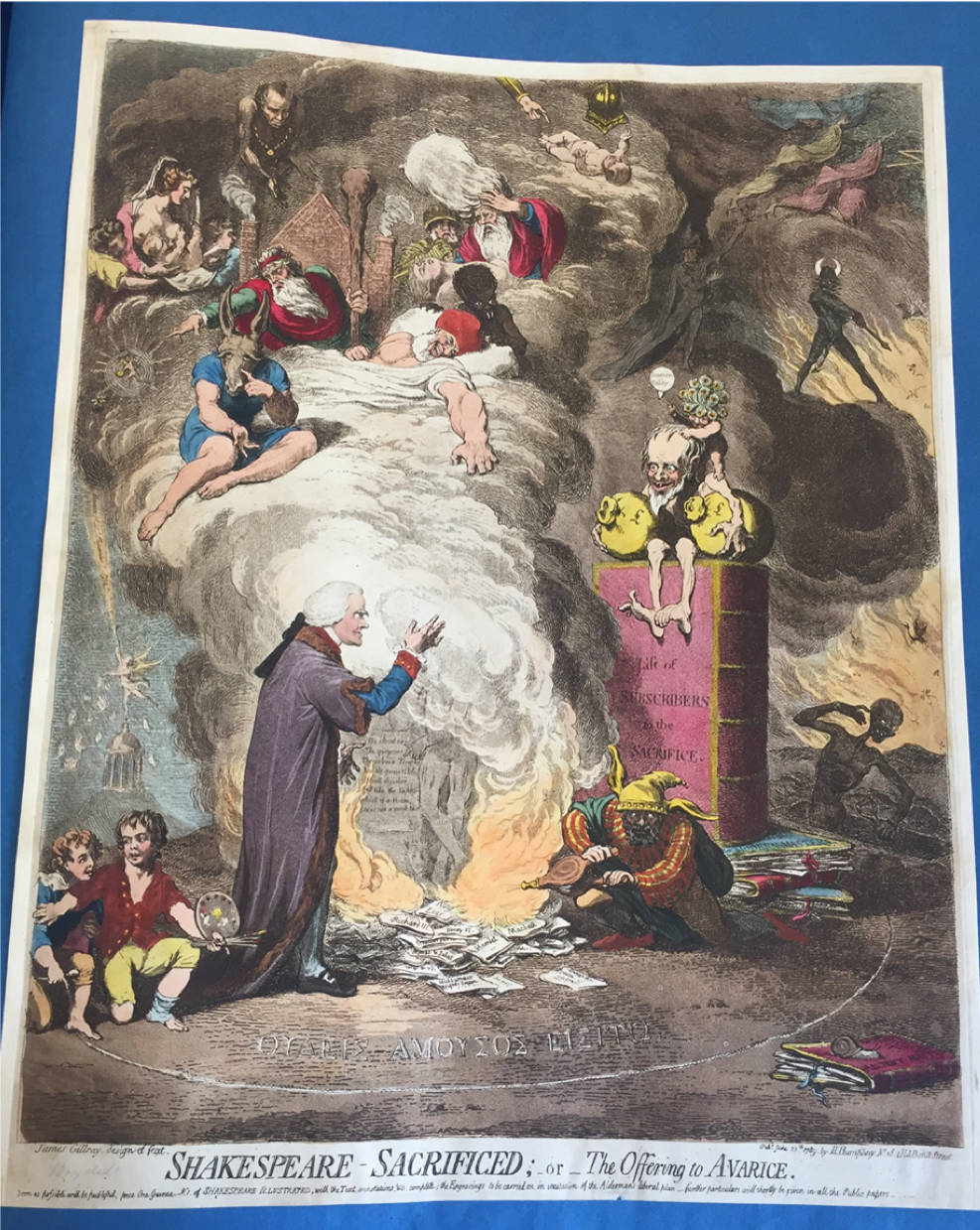
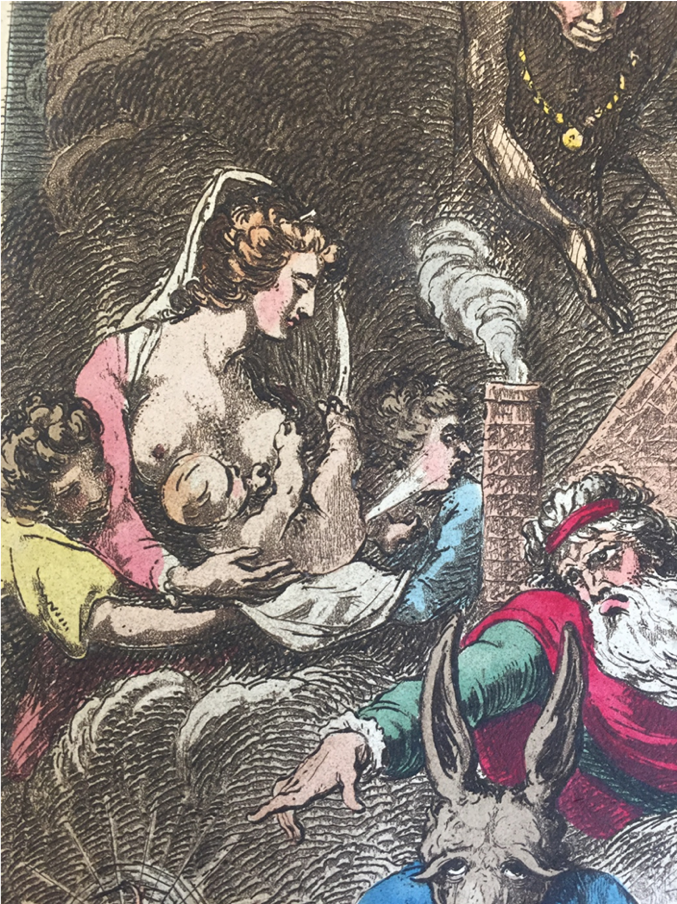
The intention of my PhD project is to progress understanding of the way in which ideological narratives of femininity, and especially motherhood, were (and still are), forged around the breast. Previous scholarship has overlooked the significance of the breast within visual satire, and my research seeks to rectify that. As expected, a lot of the prints within the eleven volumes feature bared breasts, and I collected numerous new sources. Viewing the satires in person also allowed me to notice previously missed details within familiar digitised prints. For example, a mother with an infant to her breast appears in the top left hand corner of Gillray’s famed Shakespeare Sacrificed;-or-The Offering to Avarice(1789) – an important feature that’s passed me by until now.


James Gillray, Shakespeare Sacrificed; – or – The Offering to Avarice, published by Hannah Humphrey, 1789


Detail of Shakespeare Sacrificed 


The image depicts a woman seated upon a cloud, cradling an infant. Her right breast is exposed, and the baby grasps her left nipple as she glances down. Two other figures huddle close, and the baby either urinates or passes wind into the disgusted face of the figure in blue. Every detail included in a satirical prints is significant, and I’m looking forward to digging deeper into the social, political and cultural inferences behind this representation.

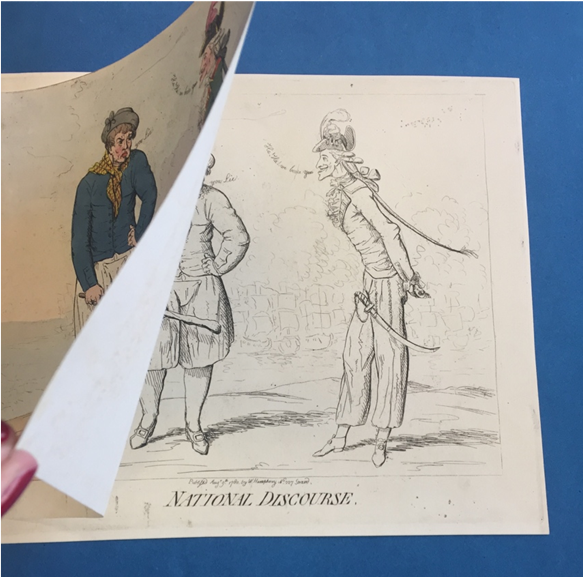
Fraser was a meticulous collector, and his (huge and very heavy) volumes are almost perfectly preserved. Pasted upon blue paper with gold gilding, the prints are vivid in colour. The hobbyist habits of Fraser are interesting; he arranged his prints chronologically, inserted markers to indicate the prints that he was unable to secure, and most often devoted a double page to each print, presumably to prevent the colours rubbing off on each other. There are also occasions where Fraser has pasted in a black and white copy of a print and later added its colour equivalent, as below. This implies a preference for coloured satires, and/or for the latest version/all versions of a single print.


James Gillray, National Discourse. Published by Hannah Humphrey, 1780.


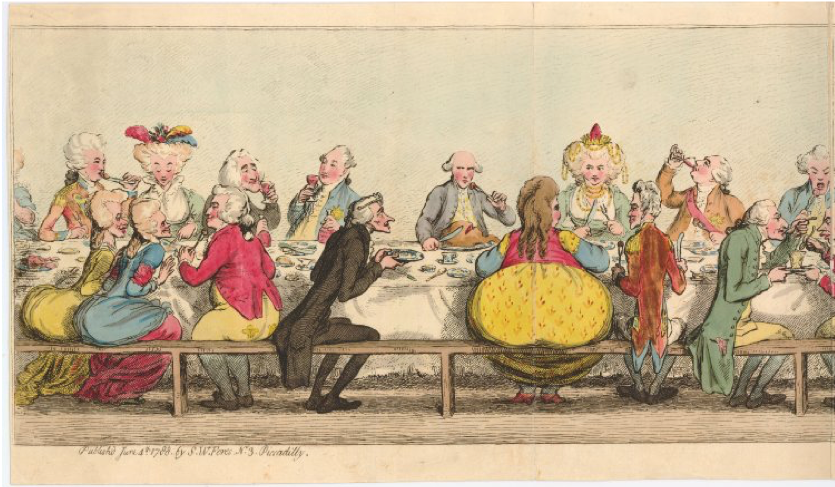
One of the highlights of the visit was the stunning print below. The Installation Supper (1788) unfolded like a concertina and stretched across the room, eliciting low whistles of appreciation from fellow reading room comrades. Depicting a dinner party given by the Knights of Bath on the 19 May 1788, The Installation-Suppercaricatures key social and political players including the Prince of Wales, Edmund Burke, and Maria Fitzherbert.[1]


James Gillray, The Installation-Supper, as given at the Pantheon, by the Knights of the Bath on the 26th of May, 1788. Published by S. W. Fores, 1788


Detail from print. The British Museum, BM Satires 7330.


Additionally, I was able to spend some of my time in London at the British Library. Here, I found sources for an upcoming chapter about the breast and discourses of social corruption, damage and disorder.

I would like to extend my gratitude to BARS for the generous Stephen Copley bursary, which supported an inspiring and productive visit to London. Further thanks are owed to the archival staff at the Parliamentary archives and the House of Lords librarians, who were most helpful, knowledgeable and kind.

[1] Further details of the guests within the print can be found in Mary Dorothy George’s description of the piece for the British Museum Catalogue. Mary Dorothy George, ‘Catalogue of Political and Personal Satires in the British Museum’, VI, 1938.

2019 BARS First Book Prize Shortlist Announced

      Comments Off on 2019 BARS First Book Prize Shortlist Announced

The judges for the 2019 BARS First Book prize, chaired by Professor Claire Connolly, are delighted to announce a shortlist of four exceptional books, drawn from a strong list of initial submissions:

Congratulations to all the shortlisted authors!

The winner of the prize will be announced at BARS’ 16th International Conference, ‘Romantic Facts and Fantasies’, at the University of Nottingham in late July.

‘Romantic Facts and Fantasies: Culture and Heritage of the Romantic Age, c. 1780-1840’ Exhibition Opening

      Comments Off on ‘Romantic Facts and Fantasies: Culture and Heritage of the Romantic Age, c. 1780-1840’ Exhibition Opening

‘Romantic Facts and Fantasies: Culture and Heritage of the Romantic Age, c. 1780-1840’ Exhibition Opening

by Amy Wilcockson 

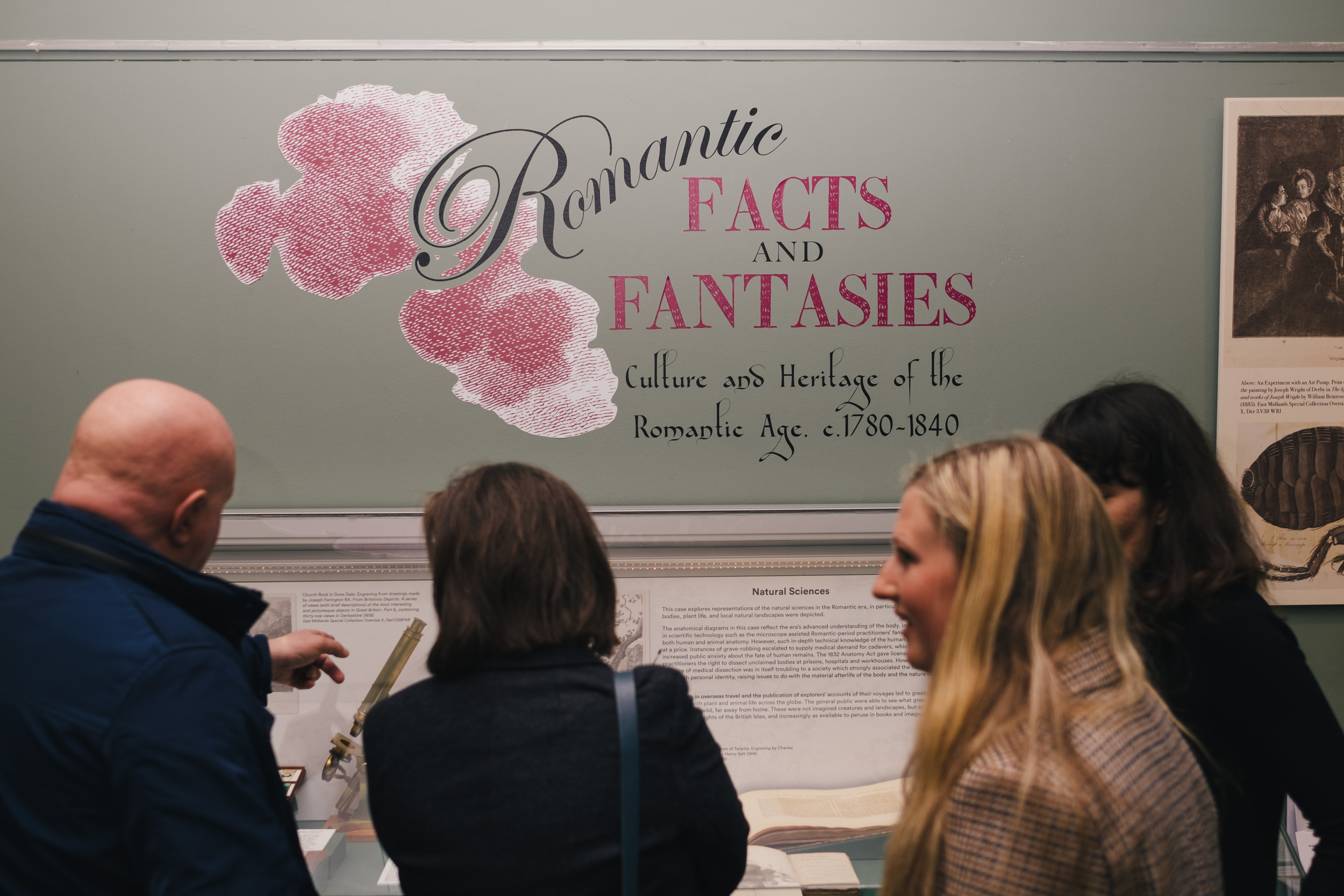
After months of hard work and sifting through the plentiful archives of Manuscripts and Special Collections at the University of Nottingham, Thursday 9 May 2019 saw the private view and official opening of the ‘Romantic Facts and Fantasies: Culture and Heritage of the Romantic Age, c. 1780-1840’ exhibition.

All image credits to Manuscripts and Special Collections, University of Nottingham

The exhibition centres on key themes including science, travel, industry, communication and exploration in the Romantic period, alongside focusing on a number of authors, poets and key figures irrevocably linked with the East Midlands.

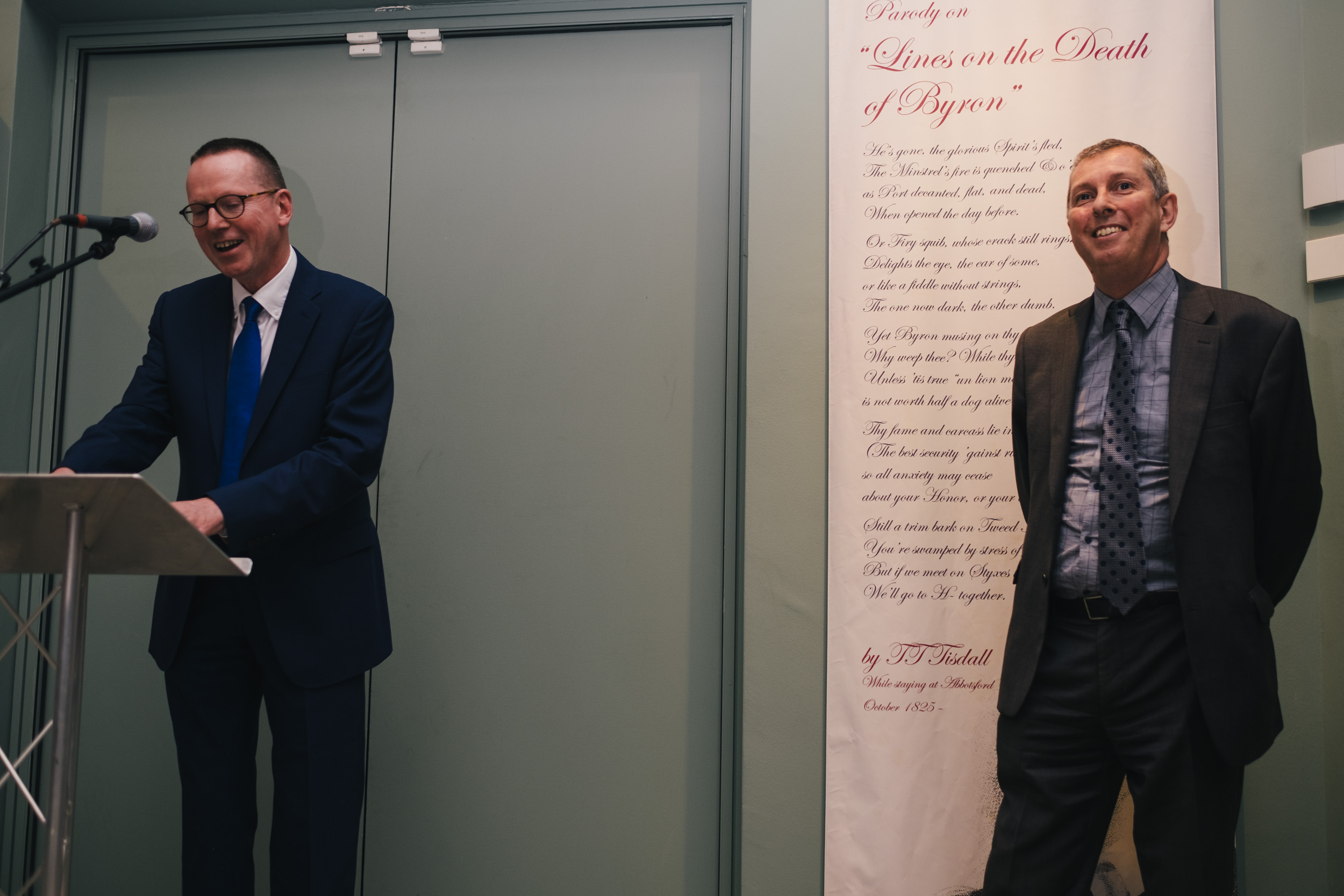
As part of the team co-curating this exhibition, it was astounding to see all the pieces of the jigsaw, so to speak, put together. From October 2018, the exhibition has been conceptualised, items chosen for inclusion, and then board texts, case backs and captions written, and then of course, loan items sourced from a variety of locations including Newstead Abbey and Derby Museums. To see it all in one place, and open to the public was an amazing feeling. The private view invited members of the BARS Executive Committee, local news outlets, University of Nottingham and other institutions’ staff and students, and enjoyed a large turnout, with over one hundred people hearing Professor Jeremy Gregory, Pro-Vice-Chancellor for the Faculty of Arts, and Professor Lynda Pratt, one of the exhibition’s academic leads, officially open ‘Romantic Facts and Fantasies’ to the public.

Key items on display include Joseph Wright of Derby’s ‘Cottage on Fire’, kindly loaned by Derby Museums, which evinces Wright’s innovative use of light and shadow, and a number of wonderful loans from Newstead Abbey, including Lord Byron’s calling card, and a copy of Thomas Phillips’ famous 1813 portrait of Byron.

Many of Manuscript and Special Collections’ items are on display to the public for the first time and include first and second editions of Lord Byron’s poetry and juvenilia, autograph copies of poetry written by Henry Kirke White, and a selection of letters from Amelia Opie, Robert Southey, Joanna Baillie, Maria Edgeworth, Sir Walter Scott, Mary Howitt and Percy Bysshe Shelley. Richard Arkwright, Derbyshire’s innovator and inventor is heavily featured, and visitors to the exhibition will also view anatomical drawings, scientific equipment and dinosaurs in an exploration of early nineteenth century science.

It is hard to choose a favourite item in the exhibition, and I am torn between a couple of items. The first are two locks of James Thomas Townley Tisdall’s hair, one taken aged four, and one upon his deathbed. As you can imagine, it was quite a surprise when we opened these little bundles and found what was within… Another favourite has to be the beautiful drawing of the ‘Crimson Cliffs’, an odd phenomenon witnessed by early Arctic explorer, Major John Ross and his crew, who initially believed that the red hue of the rock face was due to the droppings of seabirds (this isn’t the case!). ‘Romantic Facts and Fantasies:Culture and Heritage of the Romantic Age, c. 1780-1840’ is full of an array of wonderful curiosities like those featured, and well worth a visit.

Open in the Weston Gallery at the University of Nottingham’s Lakeside Arts Centre, the exhibition is running to coincide with the British Association of Romantic Studies’ 2019 Conference, ‘Romantic Facts and Fantasies’, held at the University of Nottingham in July 2019. The organisational team of the conference are also the co-curators of the exhibition, and we encourage all conference delegates to visit the exhibition and explore the University of Nottingham’s unique and varied manuscript collections on show.

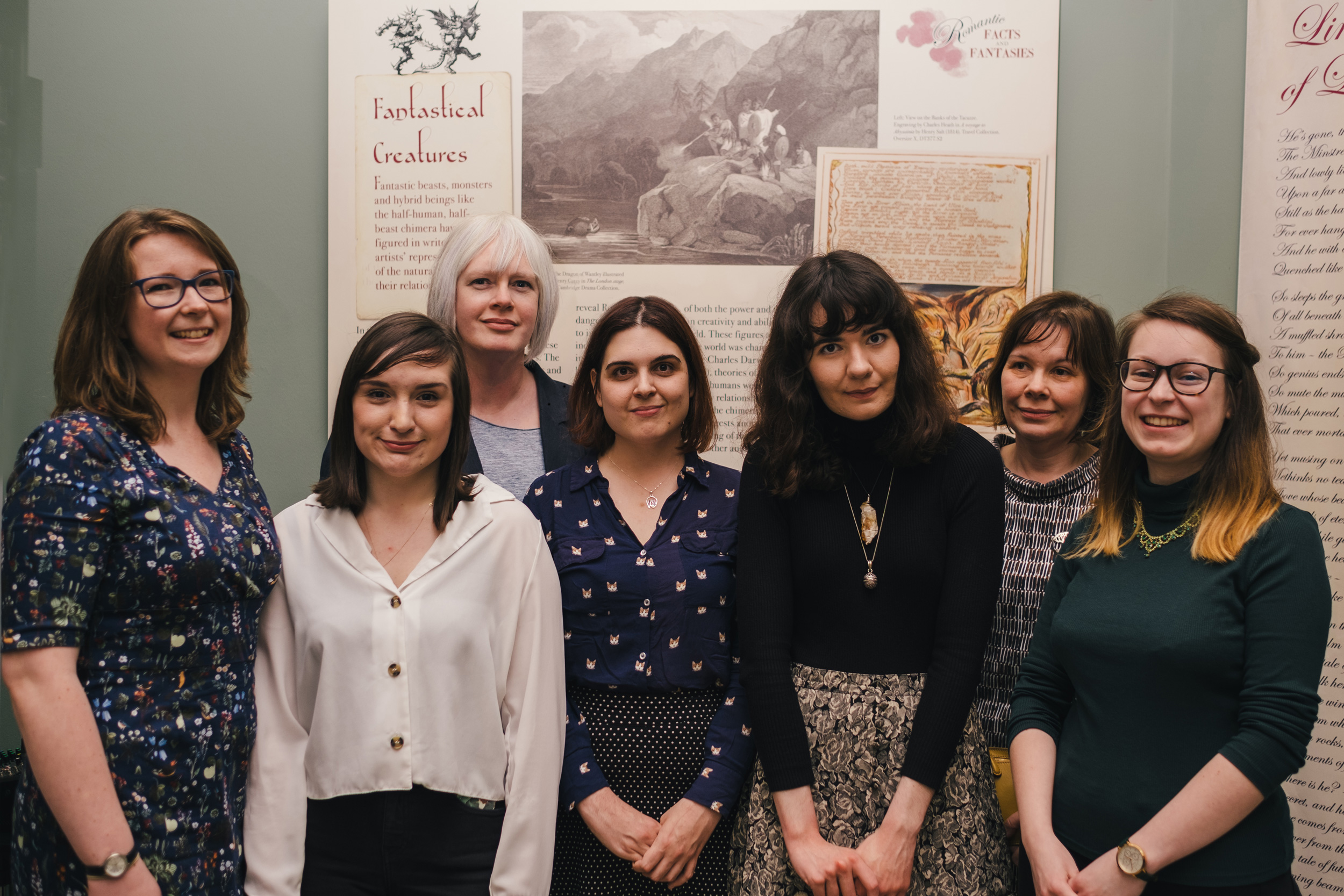
This exhibition has been jointly curated by a team from the School of English (Professor Lynda Pratt, Dr Máire ní Fhlathúin, Johnny Cammish, Colette Davies, Ruby Hawley-Sibbett, Jodie Marley, Amy Wilcockson and Dr Charlotte May) and Manuscripts and Special Collections, University of Nottingham. The exhibition continues until Sunday 25 August, and is open Tuesday-Friday, 11am-4pm, Saturday and Sunday, 12noon-4pm. Admission is free.


A series of wider engagement talks, gallery tours and film screenings are also available during the run of the exhibition which include –

Free Lunchtime Talks: Held in the Djanogly Theatre, Lakeside Arts Centre. All talks begin at 1pm and last for approximately one hour. Advance booking is recommended.

Gothic Haunting from the 1790s to the Present – Wednesday 5 June 2019.
The condition of haunting is central to the gothic mode. Dr Matt Green, Associate Professor in the School of English, University of Nottingham, explores haunting and being haunted, discussing creative artists and writers from William Blake to Alan Moore in a survey of texts and narratives of the gothic tradition from its hey-day in the 1790s into the 21stcentury.

Romantic Reputations: Angelic Austen and Beastly Byron? – Tuesday 2 July 2019.
Was Lord Byron really ‘mad, bad and dangerous to know’, and was Jane Austen ‘a narrow-gutted spinster’? As two of the most enduringly popular writers of the Romantic period, their lives have been scrutinised and their moral reputations polarised. University of Nottingham PhD Researchers Ruby Hawley-Sibbett and Amy Wilcockson ask whether their lives, loves and works have been misrepresented.

Paupers and Poetry: The Workhouse at Southwell – Friday 26 July 2019. [During the BARS Conference].
The early 19thcentury is often seen as a time of invention, creativity and technology. However, it also saw the development of an institution that shaped the lives of less fortunate members of society for decades to come – the Workhouse. This talk by Dr Charlotte May will focus on the Workhouse at Southwell, Nottinghamshire, whose founder was a close connection of the poet Lord Byron.

Romanticism, Caricature and Politics – Tuesday 20 August.
The years 1780-1840 are sometimes regarded as the ‘golden age of caricature’. In this illustrated talk, Dr Richard Gaunt, Associate Professor in the Department of History, considers the rough, boisterous sensibilities which caricaturists brought to their craft.


And:

Gallery Tours: Join the exhibition curators for a guided walk through of the exhibition and learn about the stories behind the items on display.
Weston Gallery, free, advance booking required.
Wednesday 5 June, 2.30-2.30pm
Tuesday 2 July, 2.30-3.30pm

Film Screening of Mary Shelley (2017) – Tuesday 25 June, 7pm.
Running time 2 hours. Held in the Djanogly Theatre. Tickets are £5 (£3 concessions).
A romance based on the relationship of Mary Wollstonecraft Godwin (Elle Fanning) and the poet Percy Bysshe Shelley (Douglas Booth). When the couple leave England with Mary’s step-sister Claire to stay at Lord Byron’s villa near Geneva, Mary is inspired to write one of the most important novels of the nineteenth century, Frankenstein. The film will be introduced by Dr Charlotte May.

Romanticism at The Royal Institution: 7 June 2019

      Comments Off on Romanticism at The Royal Institution: 7 June 2019

For those in or near London this summer…


Join fellow Romantic enthusiasts at The Royal Institution on 7th June for a FREE half-day symposium in association with the London-Paris Romanticism Seminar and the Fordham Romanticism Group, New York. Listen to talks by leading scholars who will restore the forgotten literary history of the Royal Institution and highlight its unique interdisciplinary contribution to British Romantic culture.

The event will conclude with a wine reception to celebrate the launch of Sarah Zimmerman’s new book The Romantic Literary Lecture in Britain (Oxford University Press).

Book here.

Call for Papers: Teaching (the) Romantic / Romantic Teaching

      Comments Off on Call for Papers: Teaching (the) Romantic / Romantic Teaching

Romantic Circles Pedagogy Commons seeks essays that address a wide range of topics, methods and themes related to the teaching of Romanticism. For the past several years we have published special volumes that speak to a specific issue within Romanticist pedagogy, such as ‘Romanticism and Technology’, ‘Teaching Global Romanticism’, or ‘Teaching the Romantic with the Contemporary’. For this volume we’d like to issue more broad and open call for essays that offer innovative approaches to teaching Romanticism. We are especially keen on approaches that consider Romanticism as methodology or practice and seek to reproduce it in the classroom.

‘Wanderer above the Sea of Fog’, Caspar David Friedrich (c.1818)


Possible topics include but should be in no way limited to:

Teaching specific Romantic-period authors through an engagement with their poetics or aesthetic practices

  • Teaching Romantic-era pedagogy, for example, Rousseau or the Edgeworths
  • Teaching Romanticism in the 21st-century classroom
  • Teaching Romanticism collaboratively
  • Teaching Romanticism as an act of resistance

Please submit 300-word abstracts to ruderman.4@osu.edu by June 30. If accepted, completed drafts would be due by September 30.

The Romantic Circles Pedagogy Commons is a peer-reviewed online journal dedicated to the presentation of essays about teaching that offer sample teaching materials as well, from printable handouts to ‘digital-born’ teaching materials.

Stephen Copley Research Report: Eleanor Bryan on Vampires

With thanks to Eleanor Bryan for this report. Want to apply for an award? Information can be found here.

The Stephen Copley Research Award allowed me to spend four days in London attending a conference and conducting archival research at the British Library. The Open Graves Open Minds (OGOM) conference was held at Keats House in Hampstead and was entitled ‘“Some Curious Disquiet”: Polidori, the Byronic vampire, and its Progeny’. The event was prompted by the bicentenary of The Vampyre and featured papers on topics ranging from contemporary adaptations to the vampire’s folkloric and Byronic roots.

My PhD thesis concerns dramatic adaptations of Gothic novels, namely Mary Shelley’s Frankenstein(1818) and Bram Stoker’s Dracula(1897): two iconic texts which are frequently paired together in adaptations. The repeated coupling of two narratives with such vastly disparate publication dates is intriguing, as the texts deal with very different cultural contexts and social concerns. My thesis attributes this in part to Lord Byron’s ghost story competition at the Villa Diodati in 1816, the ‘year without a summer’, from which both Frankenstein’s monster and the first literary vampire originate. Attending the OGOM Polidori conference allowed me to learn more about the literary history of the vampire pre-Dracula, while simultaneously updating myself on emerging scholarship within this area. The event itself was holistic in its approach and covered a wide range of themes which will serve to inform my future readings of vampiric texts and, subsequently, the next chapter of my thesis. Particular highlights included Sir Christopher Frayling’s keynote, Marcus Sedgwick’s discussion of the links between vampirism and tuberculosis, and a paper on the stage effects used in vampiric drama by Ivan Phillips.

Image via OGOM

The latter half of my trip was spent in the British Library reading rooms, in which I passed the first day reading Bram Stoker’s manuscript for Dracula: Or, The Un-dead – a 47-scene-long dramatic reading that was performed prior to the publication of Draculain order to secure dramatic copyright. This script consists of a mixture of Stoker’s own handwritten notes interspersed with cut and pasted extracts of the publisher’s proof copy. Having the opportunity to read this document not only gave me a fascinating insight into late-Victorian theatre, but also allowed me to explore how Stoker originally envisaged his eponymous Count for the stage.

I used my second day to examine early nineteenth-century playbills of dramatic adaptations of Frankenstein and The Vampyre. I was particularly interested in specific actors’ portrayals, as some individuals represented both monsters. This trend is seen in cinematic adaptations, with actors such as Bela Lugosi, Lon Chaney Jr., and later Christopher Lee playing both Frankenstein’s monster and Count Dracula throughout their careers, but is yet to be identified in early dramatizations. I had established that nineteenth-century adaptations had featured the same actor playing both monsters. However, through my scrutiny of early playbills, I have been able to determine that the two roles were not only played by the same actor, but also, for a short period of time, played by the same actor at the same time on alternate days of the week. This piece of information will serve to reinforce my application of theatrical theory to the two texts, and further establish links between Frankenstein’s monster and the vampire.

I’m extremely grateful to BARS for this award. Without their assistance, my visit – which has proved invaluable to the progression of my thesis – would not have been possible. I would also like to thank the OGOM team for organising such a fantastic conference, and the Reference Desk team at the British Library (especially John) for all of their helpful suggestions on how to use the library’s resources to their full potential.

– Eleanor Bryan (University of Lincoln)

Read more about the latest OGOM conference via their Twitter feed, here

Romanticism Celebrates 25 Years

      Comments Off on Romanticism Celebrates 25 Years

Written by Romanticism editor, Nicholas Roe.

The 25th publishing anniversary of Romanticism offers an opportunity to reflect on the origin of the journal three decades ago. In the mid-1990s there was no UK-based journal dedicated to publishing a broad range of essays, articles and reviews in the Romantic field. There were specialised journals, some of them of remarkable longevity such as the Keats-Shelley Memorial Bulletin and the Byron Journal. The Review of English Studies and Essays in Criticism published essays on Romantic literature from time to time alongside other material. In the US there were the Keats-Shelley Journal, Blake Quarterly, The Wordsworth Circle, and other author-focused publications, as well as the prestigious and long-established Studies in Romanticism. There seemed to be a gap for a new UK-based scholarly journal that would publish the most significant new critical and scholarly work in the field, with a reviews section dedicated to longer reviews of new work in the field.

Back cover of the first issue of Romanticism (1995).

The founding editors were myself, Drummond Bone, Jane Stabler, and Tim Webb. We met at Bow-of-Fife on a summer afternoon in 1994 and discussed how the journal might best be projected and published: we agreed that it should focus on the big picture, 1750-1850, that it should welcome critical, historical, textual and bibliographical essays prepared to the highest scholarly standards, and that it must seek to represent a full range of current methodological and theoretical debate. The immediate problem was how to find a publisher, and who to invite to join the board of Advisory Editors.

Vivian Bone was at that time Director of Edinburgh University Press, so there was, we hoped, a prestigious Scottish University publisher that would welcome the new journal and put it into successful production. The founding board of Advisory Editors comprised the following roster of distinguished scholars (with their 1995 affiliations):

John Barnard (Leeds University)
Anne Barton (Cambridge University)
Lilla Crisafulli Jones (University of Bologna)
John Donovan (University of York)
Kelvin Everest (Liverpool University)
David Fairer (Leeds University)
Neil Fraistat (University of Maryland)
Paul Hamilton (University of Southampton)
John Kerrigan (Cambridge University)
Greg Kucich (University of Notre Dame)
Nigel Leask (Cambridge University)
Grevel Lindop (Manchester University)
J. C. C. Mays (University College Dublin)
Vincent Newey (Leicester University)
Lucy Newlyn (Oxford University)
Michael O’Neill (Durham University)
David Punter (Stirling University)
Susan Wolfson (Princeton University)

The first issue of Romanticism was published by Edinburgh University Press in April 1995, with new work my Morton D. Paley, Jennifer Wallace, John Barnard, Philip Shaw, Simon Bainbridge, Jane Stabler, Timothy Clark and Mark Allen, Nick Havely, John Kerrigan and David Chandler.

Front cover of the first issue of Romanticism (1995).

Originally published twice a year, since 2006 Romanticism has been published triannually. Katie Garner at St Andrews University is now reviews editor, and the first of three 25th anniversary issues, a stimulating gathering of essays on ‘Transporting Romanticism’ has just been published. From bees to ballooning, ‘Jane Austen’s Mobility’, and Romantic and Victorian nonsense poetry Romanticism continues to show new directions of travel in Romantic studies. Some planned future issues will focus on ‘Romanticism and Ageing’, Thomas De Quincey, John Clare, and Jane Austen.

Find out more about Romanticism and read the latest issue, on ‘Transporting Romanticism’, here.

To celebrate, the editors have hand-selected 25 articles from the archive which are free to read! Read them here.

This blog has been reposted with kind permission from Prof Nicholas Roe. You can see the original post here.

BARS 2019: Romantic Facts and Fantasies – Registration Open

      Comments Off on BARS 2019: Romantic Facts and Fantasies – Registration Open

Please see below for a notice from the organisers of BARS 2019 giving more information about the fantastic range of activities they’ve arranged and providing details about registration, accommodation and bursaries.

BARS 2019: Romantic Facts and Fantasies

The BARS 2019 Conference Organising Committee are pleased to announce that registration for BARS 2019: Romantic Facts and Fantasies is now open. For more information and online registration please visit https://www.nottingham.ac.uk/conference/fac-arts/english/romantic-studies/index.aspx

The registration fee includes the opening evening reception and informal dinner on Thursday, a BBQ on Friday, and buffet lunch daily as well as unlimited refreshments available all day at the conference centre (tea, coffee, cappuccinos, lattes, mineral water, biscuits and fresh fruit). Free parking is available on site. Delegates will have free access to the state-of-the-art gym and 25m swimming pool at the University of Nottingham’s new David Ross Sports Village. Other facilities including a climbing wall and squash and badminton courts can also be pre-booked for a small charge.

The conference dinner on Saturday is optional and may be booked at the time of registration, together with a selection of optional excursions on Saturday afternoon (see below).

We hope to release a limited number of single-day tickets in due course, as numbers permit.

Accommodation

Choose from ensuite rooms in either Rutland Hall of Residence or The DeVeres Orchards Hotel.

Membership of BARS

To participate in BARS 2019, you must be a member of the British Association for Romantic Studies. If you are not already a member, please purchase your subscription via the online shop when you register for the conference.

Optional Excursions

·         Derby City Museum and Art Gallery & Pickfords House

·         Newstead Abbey

·         Kedleston Hall

·         Walk to Wollaton Park with tour of Natural History and Industrial Museums (FREE)

·         BARS Exhibition Lakeside Arts Romantic Facts and Fantasies: Culture and Heritage of the Romantic Age (FREE)

Bursaries

The Early Bird rate for PhD/unwaged delegates has been heavily subsidised by BARS and the School of English, University of Nottingham in order to support postgraduate and early career scholars to attend and present their work. We hope to offer some additional bursaries at a later date, depending on numbers and finances, but cannot guarantee that we will be in a position to do so. More information will be made available by 1 July 2019.

We are very much looking forward to seeing you at BARS 2019!

19th Century Matters: Digital Mapping Training Day, May 2019

      Comments Off on 19th Century Matters: Digital Mapping Training Day, May 2019

Are you an Early Career Researcher working on the long nineteenth century? Have you ever wondered why bother with digital mapping and what it could contribute to your research?

Registration is now open for a one day research and training event in digital mapping for Early Career Researchers, including current PhD students, in English and History, 29 May 2019, 10.30-16.30, at the Ruskin Library and Research Centre, Lancaster University. The day aims to support and inspire absolute beginners in considering using Geographic Information Systems (GIS) technology in their own research. The day will include two training sessions in using ArcGIS Online, a keynote speaker and two researcher talks that will showcase successful research projects which use GIS to study historical and literary texts. The event should appeal to Early Career Researchers in English and History whose research spans across the nineteenth century, from the early Romantics to the Victorians. 


Keynote Speaker:

Professor Ian N. Gregory (Lancaster University)


Speakers:

Dr Christopher Donaldson (Lancaster University)

Dr Patricia Murrieta-Flores (Lancaster University)


ArcGIS Online Training Sessions Facilitator:

Dr Joanna Taylor (University of Manchester)


The event is free, and limited to twenty places. If you are interested in attending the event please use this link to register. Please note, attendees will need to bring their own fully-charged laptop to participate in the two training sessions.

The training day is sponsored by the British Association for Romantic Studies and the British Association for Victorian Studies and is an outcome of their joint Nineteenth-Century Matters fellowship. There are eleven £50 travel grants available for ECRs living 30 miles or more from Lancaster; please find details of how to apply at the above link.