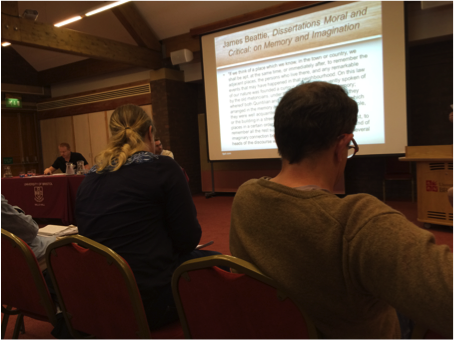
To whet your appetites for the programme, which the organisers are currently putting together from a large number of excellent abstracts, the poster for this year’s Early Career and Postgraduate conference. If you’d like to display this, a .pdf version can be downloaded using this link: BARS ECPG poster – Romantic Voices – pdf.
Five Questions: Amy Culley on British Women’s Life Writing
Amy Culley is a Senior Lecturer in the School of English and Journalism at the University of Lincoln. She has particular interests in life writing, women’s writing and editorial practice, and has co-edited essay collections on all of these topics either published or forthcoming. She has published articles and book chapters on topics including Sophia Baddeley, Elizabeth Fox, Lady Rachel Russell and court memoirs. Her first monograph, British Women’s Life Writing, 1760-1840: Friendship, Community, and Collaboration, which we discuss below, was published in 2014 by Palgrave Macmillan.
1) How did you come to realise that you wanted to write a monograph on women’s life writing around the turn of the nineteenth century?
I became interested in Romantic autobiographies by Rousseau, Wordsworth, De Quincey and others as an undergraduate, but it wasn’t until I began thinking about possible PhD topics that I first considered working on women’s life writing. The idea was sparked by browsing in indexes and bibliographies of women’s autobiographies during a visit to The Women’s Library. I was struck by just how many women had written about their lives in the Romantic period and how many of these writers I had never heard of. The book was based on the research of my PhD, during which time I discovered the pleasures of archival study, and the project expanded to include women’s lives written in manuscript as well as printed sources. I was fortunate that after the PhD I became involved in other activities that broadened my perspective: running a conference on life writing at Lincoln in 2009 (with Rebecca Styler), editing four volumes of Women’s Court and Society Memoirs for the Chawton House Library series, and co-editing a collection of essays (with Daniel Cook) Women’s Life Writing, 1700-1850: Gender, Genre and Authorship (Palgrave, 2012). These experiences returned me to the thesis with a greater awareness of its flaws and (more positively) with a renewed sense of enthusiasm for the book I was hoping to write. My original aim was to write a critical history of women’s life writing focusing on the importance of personal relationships, communal affiliations, and creative collaborations in these often hybrid and indeterminate texts, and these ideas remained central to the project. But stepping back and reading more widely in contemporary life writing theory and scholarship on female communities and family authorship in the eighteenth century and Romantic period enabled me to find new ways to approach these concerns.
2) Your book is divided into three parts, examining Methodists, courtesans and women writing during and about the French Revolution. How did the process of your research and reading lead you to choose these divisions?
This may seem an unlikely trio of ‘God, sex, and politics’, and at my viva we discussed how any one of these parts could have been the focus of a book-length study (a comment that has also been made by several of the book’s reviewers). But addressing these diverse (net)works enabled me to challenge the association of autobiography with single authorship and personal feeling and instead establish its importance as an articulation of relationships and communal identities and as a contribution to the history of a family, community, or nation.
I began with an archive of spiritual writing by Methodist women preachers whose journals and diaries, autobiographies, transcribed oral testimonies, and letters provided rare insights into friendship and spiritual fellowship and demonstrated the importance of collaboration, in contrast to the traditional association of spiritual autobiography with individualism. Writing about the self enabled these women to explore family relationships and spiritual belonging, as well as to challenge Methodist historiography by providing a collective history of women’s preaching for the nineteenth century. Next I addressed the life writing of courtesans whose literary experiments moved well beyond the scandalous memoir to explore themes of friendship, rivalry, maternity, marriage, and their complex identifications with the aristocratic woman of fashion. This section, in contrast to Part I, enabled me to discuss print culture and the influence of readers, publishers, and ghost-writers on these women’s self-representations. In the final part of the book I wanted to show how women’s life writing contributed to political and historical debates through attention to the life writing of British women travellers during the French Revolution, addressing both the writing of radical supporters of the Girondins and counterrevolutionary texts.
To create these divisions some parts of the original thesis were removed (the Quakers sadly didn’t make the cut) and some writers were added (which resulted in a very enjoyable summer in the company of courtesan Harriette Wilson). In grouping these authors I followed the self-identifications and priorities of their life writing, but I was also aware of the instabilities of these categories and the intriguing overlaps and potential distortions created by my approach. For instance, the courtesan Grace Dalrymple Elliott (discussed in Part III) shared lovers and column inches with Mary Robinson and Elizabeth Fox (discussed in Part II) and exploited the self-vindicatory strategies of the scandalous memoir, but in her Journal she defines herself exclusively in relation to events in revolutionary France. Conversely, Mary Robinson is an important respondent to the French Revolution and a member of the radical intelligentsia, but her Memoirs (discussed in Part II) provides few traces of these connections.
3) To what extent do you see the women you examine as seeking to carve out new kinds of life writing distinct from those produced by their male peers?
I focused on women writers in particular to demonstrate their rich contribution to the culture and practice of self-narration in the period and to offer new perspectives on female communities and collaborations through the lens of life writing. Gender shapes women’s relationships to autobiographical traditions and frames the reception of their works, but I make no claims for a distinct female tradition or poetics of life writing. The women I consider often wrote in relation to prominent male life writers, particularly John Wesley, James Boswell, Jean-Jacques Rousseau, and William Godwin and reading them in dialogue with these authors creates new webs of interpretation. For instance, the recovery of life writing by unfamiliar figures like Methodists Mary Fletcher, Sarah Ryan, and Mary Tooth places an established author like Wesley in new contexts, while Godwin’s Memoirs of the Author of a Vindication of the Rights of Woman is enriched by considering it alongside the life writing of Mary Hays and Mary Robinson. The spiritual autobiography and scandalous memoir are familiar categories of women’s life writing, but I wanted to show the diversity and hybridity of these forms and to consider auto/biographical contributions to political and historical writing as women used personal narratives to shape the collective memories of the age. I was also interested in connections in women’s life writing across traditional literary periods; how do experiments with semi-autobiographical fiction by Romantic women relate to the playful experiments with amatory fiction, secret histories, scandalous memoirs, and the sentimental novel of an earlier era, or uses of the roman à clef in the Regency? Many of these questions about gender and genre are in need of further investigation, particularly women writers’ contributions to biography and the place of manuscript culture and collaborative and collective authorship in histories of women’s life writing.
4) Of the writers your book examines, whose works would you particularly recommend to scholars seeking to increase their knowledge of the field, and which works do you think would provide the most opportunities for fruitful interchanges if included on undergraduate and/or postgraduate programs?
Studies of female authorship in the Romantic period are no longer dominated by the novel, poetry, and drama and, happily, women’s life writing has been receiving considerable attention of late. Mary Robinson’s Memoirs, Mary Wollstonecraft’s Letters Written in Sweden, Norway and Denmark, and Helen Maria Williams’ Letters Written in France (the most well known of the works I discussed) are now firmly established on English programs and I’ve greatly enjoyed teaching them. But access to affordable scholarly editions of life writing remains a significant challenge and quite a few of my sources were manuscript journals running to multiple volumes written over many years. That said, if an affordable edition was available, I would love to teach The Memoirs of Mrs. Sophia Baddeley (1787), the history of a friendship between the actress and courtesan Sophia Baddeley and her companion and biographer Elizabeth Steele that is punctuated by cross-dressing, bed swapping, and duels. It illuminates topics such as the lives of actresses, the literature of sentiment and satire, and the scandalous memoir, and it would provide an interesting counterpoint to Boswell’s Life of Johnson (published four years later) or Hester Thrale’s Anecdotes of the late Samuel Johnson (published the year before). Grace Dalrymple Elliott’s Journal of my Life during the French Revolution is another intriguing text which deserves to be better known, particularly by readers interested in women writers and the French Revolution, aristocratic authorship, and counterrevolutionary narratives. Elliott was courtesan to the pro-revolutionary Louis-Philippe, Duke of Orléans and sought to defend her reputation from the taint of regicide by writing a personal history of the French Revolution on her return to England around 1801.
5) What new projects are you currently working on?
I’m still very interested in life writing. Thanks to a British Academy/Leverhulme Small Grant I’m in archives working on women writers who lived from the mid-eighteenth century to the early Victorian period to see how they narrate experiences of old age in their journals and letters. I’m hoping that personal accounts of ageing and old age written by women in the early nineteenth century will be the topic of my next book. At the moment I’m focusing on the exchanges between Mary Berry and Joanna Baillie in late life for a collection on Romantic women’s literary networks. My earlier interests in textual editing have resulted in a co-edited volume (with Anna Fitzer) Editing Women’s Writing, 1670-1840 that will be out this year with Routledge and I’m really enjoying working collaboratively on this. When it’s done, I’ll be researching a book chapter on women writers’ contributions to early literary biography.
We are very pleased to welcome Eleanor Fitzsimons (winner of the 2013 Keats-Shelley Prize and author of Wilde’s Women) to the BARS blog. This post, part of the ‘On This Day’ series, presents Part I of her essay ‘Every Cloud: How Art and Literature Benefited from a Year Without Summer’. Eleanor’s essay looks at 1816 as the year of no summer and examines the impact that catastrophic weather patterns had on the work of writers and painters such as Turner, Austen and the Shelleys. Part II is to follow.
We think you’ll all agree that this is a great way to introduce 1816 in 2016, a year in which we will be celebrating the bicentenaries of many important Romantic events. If you want to contribute to the ‘On This Day’ series with a post on literary/historical events in 1816, please contact Anna Mercer (anna.mercer@york.ac.uk).
EVERY CLOUD: HOW ART AND LITERATURE BENEFITED FROM A YEAR WITHOUT SUMMER

JMW Turner. Weathercote Cave, near Ingleton, when half-filled with Water and the Entrance Impassable, a watercolour. British Museum
Often, an artist must go to great lengths to get the aspect he desires. In 1808, English Romantic landscape painter Joseph Mallord William Turner scrambled to the bottom of Weathercote Cave, a misnamed pothole situated close to the hamlet of Chapel-le-Dale in North Yorkshire. On reaching a plateau, thirty-three meters below ground level, he unpacked his kit and produced a characteristically vibrant watercolor that captured the wild torrent of water as it tumbled from a cavity situated two-thirds up before terminating in a violent whirlpool at the base of towering rocks. Barely discernible at the foot of the canvas is a tiny figure that appears to represent the artist himself. Turner’s somewhat dramatized representation, which he presented to his great friend and patron Walter Fawkes, is titled simply Weathercote Cave, Yorkshire and can be seen in Sheffield’s Millennium Gallery.
Turner loved to paint the Northern English landscape and experimented with dramatic light and weather effects in his compositions. In recognition of his deep appreciation for the untamed beauty of the region, Longman & Co. commissioned him to produce one-hundred-and-twenty watercolours for incorporation into an illustrated history of Yorkshire, the accompanying text to be supplied by the Reverend Dr. Thomas Dunham Whitaker, the highly respected author of a well-received series of scholarly histories. Although artist and author had worked together on Whitaker’s The History of Whalley (1801) and his The History of Craven (1812), this would be by far their most ambitious collaboration and Turner’s fee of three thousand guineas was the highest paid to a British artist at the time.
On July 12, 1816, Turner left London and travelled north to Farnley Hall near Otley, the home of Walter Fawkes, who was to accompany him on this lucrative tour. Regrettably, the undertaking proved to be far from pleasurable. Although the entire Fawkes family set out with the artist on a series of excursions to local beauty spots, the company disbanded at the end of a week of almost constant rain that culminated in a thorough soaking as they traversed the moors that led to the towering cliffs of Gordale Scar. In order to complete the sketches that would form the basis of his finished watercolours, Turner had no option but to negotiate his way around the vast county of Yorkshire, a distance of more than five hundred miles, alone on horseback in torrential rain. At some point, a capricious wind must have snatched his little sketchbook from his hands, since one page is coated in mud to this day. As he went, he recorded how his progress was hampered by the frightful weather that blighted the summer of 1816: ‘Weather miserably wet. I shall be web-footed like a drake…but I must proceed northwards. Adieu’, he lamented in a letter to watercolorist James Holworthy, dated July 31, 1816
Turner returned to Weathercote cave that summer with the intention of sketching it for inclusion in his book, but days of incessant rain had left it submerged and completely inaccessible; ‘Weathercote full’, he scribbled on the pencil study he made that day. His finished painting, the cumbersomely titled Weathercote Cave, near Ingleton, when half-filled with Water and the Entrance Impassable, a watercolour, is on view in the British Museum; this time the perspective is from above. Days later, the route Turner followed took him across the treacherous Lancaster Sands, a low tide shortcut that intersected Morecombe Bay and was particularly dangerous after heavy rainfall. As he went, he sketched a sodden band of horsemen huddling together in the lee of the Lancaster coach while ferocious rain crashed down from an angry sky. His dramatic Lancaster Sands is housed in the Birmingham Museum and Art Gallery.
After all his efforts, Turner must have been disappointed when spiralling costs ensured that the project was scaled down significantly and just one of the proposed seven volumes was published. He had been desperately unfortunate in his timing. The apocalyptic weather that blighted the summer of 1816 was truly exceptional and had its origins in an event that occurred fifteen months earlier and many thousands of miles from England. On the evening of April 10, 1815, the tiny island of Sumbawa in the Indonesian archipelago was rocked when Mount Tambora, the highest mountain in the region and a volcano that was long believed to be extinct, produced its largest eruption for ten thousand years. The outcome was catastrophic. Eyewitness accounts describe how the summit disintegrated, leaving behind a crater measuring three miles wide and half a mile deep. Horrified locals watched open-mouthed as three towering columns of rock-laden fire shot thirty miles skywards and a pyrocastic flow of incandescent ash surged down the mountainside at a speed of in excess of one hundred miles an hour, scouring everything in its path. On reaching the coast, twenty-five miles from its point of origin, this boiling mass cascaded into the sea, destroying aquatic life for miles and forming vast platforms of pumice that blockaded vital ports and inlets.
Ten times the quantity of debris that had buried Pompeii two millennia earlier rained down on Sumbawa and its neighboring islands during what remains to this day the largest recorded eruption in history. On Sumbawa, the cool air that was sucked into the vacuum left by the inexorable rise of superheated air formed a ferocious whirlwind that moved across the ravaged landscape, destroying everything before it. The tiny villages of Tambora and Sanggar, which had clung safely to the slopes of Mount Tambora for generations, were wiped out entirely and an estimated ten thousand people died in an instant. Fresh water sources were contaminated and crops withered in the fields, resulting in the death by starvation of a further eighty thousand inhabitants of the region. For days, the archipelago was battered by towering tsunamis and such was the extent of the devastation and loss of life that the indigenous Tambora language was eradicated forever.
On the northern shore of Eastern Java, three hundred miles away, residents of the city of Surabaya reported that the ground shook beneath their feet. On hearing a series of thunderous roars, startled inhabitants of the island of Sumatra, which lay one thousand miles northwest of Sumbawa, concluded that they had come under attack from some deadly enemy force, although they couldn’t be sure if it were human or supernatural. Within days, the entire region was enveloped in an ash cloud so fine that tiny particles suspended in the Earth’s atmosphere blocked adequate sunlight from filtering through. The entire East Indies, as the region was known, was plunged into an oppressive and unnatural darkness. Within three months an aerosol cloud of sulphide gas compounds had encircled the Earth from pole to pole. Volcanic dust entered the high stratosphere, supplementing debris deposited there by two earlier volcanic eruptions: La Soufrière on the Caribbean island of Saint Vincent in 1812, and Mount Mayon on the island of Luzon in the Philippines in 1814. Although he had not witnessed the spectacular eruption of La Soufrière, Turner had painted it, basing his vivid oil painting on a sketch made by Hugh Perry Keane, a barrister and sugar plantation owner who was present that day. Keane wrote an account of the eruption in his diary:
Thurs 30: … in the afternoon the roaring of the mountain increased & at 7 o’clock the Flames burst forth, and the dreadful Eruption began. All night watching it – between 2 & 5 o’clock in the morning, showers of Stones & Earthquakes threatened our immediate Destruction …Wed 6 May: … The Volcano again blazed away from 7 till ½ past 8. Thurs 7: Rose at 7. Drawing the eruption.
Turner’s painting, The Eruption of the Soufrière Mountains in the Island of St Vincent, 1815, can be viewed at the Victoria Gallery and Museum in Liverpool.

JMW Turner. The Eruption of the Soufrière Mountains in the Island of St Vincent, 1815. Victoria Gallery and Museum, Liverpool
All this volcanic activity had a disastrous impact on the weather, and nowhere on Earth escaped the consequences of this latest cataclysm. Across the globe, average temperatures plummeted by five degrees Fahrenheit as weather patterns were thrown into absolute chaos. In time, 1816 would be dubbed ‘the year without summer’. In Asia, unseasonably cold weather coupled with unprecedented early monsoons caused catastrophic floods that destroyed the rice crop and wiped out valuable livestock. Famine gripped China, killing many thousands of her citizens, while India was devastated by a cholera epidemic that swept through the subcontinent. In North America, accumulating snow was observed in the Catskill Mountains as late as June 1816, and it snowed on Independence Day in the southern state of Virginia.
Unprecedented quantities of weirdly-hued, ash-laden snow fell all over Europe and it was still snowing in London as late as July 1816. By the following September, the Thames had frozen and abnormally large hailstones were flattening the wheat and barley crops as they ripened in the fields. In neighboring Ireland, eight weeks of incessant rain resulted in the failure of both the potato crop and the corn harvest, triggering a widespread famine that provided a foretaste of what was to come three decades later. Starvation was followed inexorably by disease. Typhus erupted throughout the British Isles before fanning outwards across Europe and killing tens of thousands of her citizens.
(To be continued…)
About the author:
Eleanor Fitzsimons is a researcher, writer and journalist specialising in historical and current feminist issues. She has an MA in Women, Gender and Society from University College Dublin. In 2013, she won the Keats-Shelley Essay Prize with her essay ‘The Shelleys in Ireland’ and she is a contributor to the Romanticism Blog. Her work has been published in a range of newspapers and journals including The Irish Times, the Guardian, History Ireland and History Today. She is a regular radio and television contributor. Her book, Wilde’s Women: How Oscar Wilde Was Shaped by the Women He Knew was published by Duckworth Overlook on 16 October 2015. She tweets as @EleanorFitz.
CfP: Encountering Malta III: Literature and the Sea 1750-1850
Please see below for a Call for Papers for a nautically-focused conference happening in Malta this March. The deadline for submissions is a couple of weeks away (January 22nd).
—
Encountering Malta III
Literature and the Sea 1750-1850
An International Conference
hosted by the Department of English, University of Malta,
and the School of English, University of St Andrews
Valletta, Malta, Saturday 12 to Sunday 13 March 2016
Call for Papers
Located at the centre of the Mediterranean, Malta has been a destination for writers and travellers since ancient times and particularly so during the eighteenth and nineteenth centuries. Count Cagliostro visited Malta in 1762 and 1766, and, twenty years later, Goethe planned a visit. Sir Richard Colt Hoare, antiquarian and collector, was in Malta in 1790-1, Thorvaldsen, Danish sculptor, in 1796, and Napoleon arrived for a few days in 1798. Samuel Taylor Coleridge made Malta his home in 1804-6, Lord Byron called during 1809, followed by Lady Hester Stanhope in 1812. Gabriele Rossetti stayed for three years from 1821. John Hookham Frere, diplomat and author, settled in Malta in 1828 and was visited by Sir Walter Scott. Disraeli arrived in 1830, John Davy (brother of the famous chemist) followed, as did Lamartine in 1832, Newman in 1832-3, and Prosper Mérimée and Hans Christian Andersen in 1841.
Focusing on the period 1750-1850, Literature and the Sea will be held in the elegant buildings of the Old University in Valletta. Twenty-minute papers on any aspects of the conference theme will be welcome. Papers on writers who actually visited Malta are welcome, but this is not an exclusive requirement. Please e-mail a 200-word paper proposal to Dr Maria Frendo and Professor Nicholas Roe at encounteringmalta@gmail.com. Your paper proposal should be in the form of a Word file attached to an e-mail message. Please ensure that you include your name, professional affiliation and e-mail contact. Deadline for paper proposals is 22 January 2016; acceptances will be confirmed by 31 January at the latest.
Papers on literatures other than English are welcome, but must be delivered in English. It is hoped that some of the papers may be published.
Confirmed speakers to date include Ivan Callus, Maria Frendo, Michael Raiger, Nicholas Roe, Matthew Scott, Peter Vassallo.
The ‘early bird’ Conference registration fee is set at 115 euros until Monday 8 February 2016, payable in advance to the University of Malta. After 8 February 2016 the rate for registration will rise to 135 euros (registration closes on the 26 February). Accommodation has been arranged at local hotels, at special conference rates. For all conference information, including registration and accommodation, please go to our website at http://www.um.edu.mt/events/sea2016.
Travel: Air Malta, British Airways, Ryanair and Easy Jet fly to Malta all year round from various European locations. Lufthansa, Alitalia and KLM also route to Malta, and Emirates has a direct flight from Dubai.
Enquiries may be e-mailed to Dr Maria Frendo at the University of Malta at maria.frendo@um.edu.mt or to Professor Nicholas Roe, School of English, University of St Andrews at nhr@st-and.ac.uk. Paper proposals should be sent to encounteringmalta@gmail.com.
Conference coordinators are:
Professor Ivan Callus (University of Malta), Dr. James Corby (University of Malta), Dr. Maria Frendo (University of Malta), Professor Nicholas Roe (University of St Andrews), Professor Peter Vassallo (University of Malta).
—But the sea, Jack, the sea—
John Keats
On Christmas Day in 1815: Charles Lamb’s letter to Thomas Manning
Thankyou to Lucy Hodgetts (University of York) for this festive post which continues the ‘On This Day’ series. Her blog discusses Charles Lamb’s letter to Thomas Manning exactly 200 years ago on the 25th December 1815.
(If you’d like to contribute a post to this blog series next year please contact anna.mercer@york.ac.uk).
‘Dear Old Friend and Absentee’: Charles Lamb’s letter to Thomas Manning, 25th December, 1815.
by Lucy Hodgetts
Very few letters addressed to Charles Lamb still exist, apart from those written by the sinologist Thomas Manning. One of the first British scholars of Chinese language and culture, Manning was a friend and inspiration to Lamb throughout his writing life. Manning was the ‘friend M.’ from whom Elia professed to have received the translated Chinese manuscript which inspired ‘A Dissertation Upon Roast Pig’.
Manning was a gifted mathematician and was accepted to Gonville and Caius College, Cambridge in 1790 to study Maths, but sharing the Quaker antipathy towards oaths meant he never took a degree. He stayed in Cambridge studying medicine and teaching maths, and met Lamb in 1799. While at Cambridge, Manning became interested in the study of Chinese language and culture and in 1802 travelled to Paris to study Chinese under Dr Hagar at the Bibliothèque Nationale. Manning planned to travel to China and, in need of a useful trade, returned to England in 1805 to gain practical medical experience at Westminster Hospital. Manning was granted permission by the court directors of the East India Company to travel and live as a doctor in an English factory in Canton (Guangzhou), and left for China in May 1806. Unsuccessful in his attempts to travel into China’s interior, Manning stayed mainly in Canton until 1810 when he set out for the holy city of Lhasa (now the capital of Tibet), via Calcutta. Manning travelled without government permission, but arrived in Lhasa in December 1811. He was the first British traveller to reach the holy city and was even granted an audience with the Dalai Lama, then a seven-year-old boy. Manning left Lhasa in April 1812 and remained in Canton until 1816.
During Manning’s long absence abroad, Lamb wrote to his friend on Christmas Day, 1815, pondering upon the supposed impossibility of Christmas in Canton:
This is Christmas-day 1815 with us; what it may be with you I don’t know, the 12th of June next year perhaps; and if it should be the consecrated season with you, I don’t see how you can keep it. You have no turkeys; you would not desecrate the festival by offering up a withered Chinese bantam, instead of the savoury grand Norfolcian holocaust, that smokes all around my nostrils at this moment from a thousand firesides. Then what puddings have you? Where will you get holly to stick in your churches, or churches to stick your dried tea-leaves (that must be the substitute) in? What memorials you can have of the holy time, I see not.
– (C.L. to Manning, Dec. 25th, 1815. From The Letters of Charles and Mary Anne Lamb, vol 3: 1809-1817, ed. Edwin W. Marrs. Cornell University Press, 1978.)
In language prescient of De Quincey’s opium-eater, Lamb encourages his friend to take leave of the ‘Pagodas’, ‘idols’, and ‘wretched reliques’ of ‘Babylon’, enticing him with the nostalgic tastes and smells of home. For Lamb, it is the ‘faces fragrant with the mince-pies of half a century, that alone can authenticate the cheerful mystery’ of the Nativity. It is the domestic comforts and folk traditions of Christmas at home, rather than any religious doctrine, that represents the civilized ideal of England in this letter. In pitting the festive traditions of the ‘holy tide’ against those of the ‘unedified heathen’, Lamb elides a personal nostalgia for home with a patriotic pride in Western civilisation.
In an extended conceit, Lamb exaggerates the time Manning has spent abroad to imagine the future decay of his homeland. ‘And in sober sense what makes you so long from among us, Manning?’ asks Lamb. ‘You must not expect to see the same England again which you left.’ Lamb describes a near future in which England has altered radically in Manning’s absence: ‘empires have been overturned, crowns trodden into dust, the face of the western world quite changed’. London landmarks, icons of empire and progress, have decayed and vanished: ‘St. Paul’s Church is a heap of ruins; the Monument isn’t half so high as you knew it, […] the horse at Charing Cross is gone, no one knows whither’. Lamb joshes that in the time it has taken Manning to master the arcane minutiae of a foreign civilisation, he has missed the total downfall of his own: ‘and all this has taken place while you have been settling whether Ho-hing-tong should be spelt with a —- or a —-.’
In typical digressive style, Lamb’s reverie of the future shifts into a more personal key. ‘Poor Godwin!’ he laments. ‘I was passing his tomb the other day in Cripplegate churchyard. There are some verses upon it written by Miss Hayes [sic].’ Coleridge is ‘just dead, having lived just long enough to close the eyes of Wordsworth, who paid the debt to nature but a week or two before’. Godwin and Coleridge do not escape Lamb’s lampoon of academia either. While Godwin’s theories die with him, ‘ten feet deep in Cripplegate mould’, Coleridge has left behind ‘more than forty thousand treatises in criticism and metaphysics, but few of them in a state of completion. They are now destined, perhaps, to wrap up spices’. A light hearted warning to his friend on the ephemeral nature of cloistered scholarship, and on the cyclical rise and fall of empires, Lamb’s letter can also be read as a reproach on neglected friendships: ‘You see what mutations the busy hand of Time has produced, while you have consumed in foolish voluntary exile that time which might have gladdened your friends’.
Despite the decay of civilisation, and the mutability of its monuments and institutions, the precious friendship between Lamb and Manning endures. Lamb depicts a future in which the elderly friends will reminisce nostalgically for their Cambridge youth. In a touching conclusion, he implores the future Manning to ‘come to your old home. I will rub my eyes and try to recognise you. We will shake withered hands together, and talk of old things – of St. Mary’s Church and the barber’s opposite, where the young students in mathematics used to assemble’. Here, temporal distance emphasizes geographical division. Lamb’s intense and evocative yearning for a recent past is projected onto Manning’s physical remoteness. Lamb asks Manning to imagine a future in which their shared memories of a recent life will then be remembered as ‘old things’, perhaps with the aim of intensifying his friend’s twinges of homesickness. Lamb plays upon the precarious definitions of nostalgia and homesickness for emotive effect in this letter. Nostalgia is a Greek neologism, from ‘nostos’ meaning home, and ‘algos’ meaning a ‘painful longing’, and in the eighteenth century was regarded as an acute homesickness in those who travelled widely. Lamb’s letter demonstrates the transition of nostalgia from a form of homesickness for a physical place, to a longing for an idealised past or nationhood. Most of all, it shows how the pinning for idealised places or experiences often belies a powerful longing for an absent friend:
You like oysters and to open them yourself; I’ll get you some if you come in oyster time. [James] Marshall, Godwin’s old friend, is still alive, and talks of the faces you used to make.
Come as soon as you can.C. Lamb
Conference Report: ‘Marilyn Butler and the War of Ideas’
Many thanks to Grace Harvey (University of Lincoln) for contributing to the BARS Blog the report below, detailing her experience of the warm and welcoming ‘Marilyn Butler and the War of Ideas’ conference held at Chawton a couple of weeks ago. Further details of the conference can be found on the Chawton House Library site and via the Chawton House Library Facebook group.
‘Marilyn Butler and the War of Ideas: A Commemorative Conference’ was held on the 11th and 12th of December at Chawton House. Organised by Gillian Dow and Linda Bree, the two days featured unrivalled discussions and research that celebrated the life and work of Marilyn Butler.
The first day was opened by James Chandler (University of Chicago), whose keynote, ‘Edgeworth and Austen (and Butler)’, spoke warmly of his friendship with Butler and drew attention to the sheer extent of her career and influence. His consideration of slavery, money, and Butler’s discussions of Austen, Edgeworth and Smith, amongst others, effortlessly encapsulated the convivial and celebratory tone of the conference.
The first panel was an opening discussion that, like Chandler’s keynote, was peppered with personal remarks about Butler in addition to discussions of work inspired by and produced in response to Butler’s. Janet Todd (University of Cambridge) spoke of the male-authored memoirs of Jane Austen and Mary Wollstonecraft in her paper, ‘Male Memory, female subject: the case of Jane Austen and Mary Wollstonecraft’. Following this, Cora Kaplan (Queen Mary, University of London and Southampton) discussed how Butler’s work encourages readers to feature a wide variety of obscure and disparate individuals in her paper ‘War of Ideas: Butler and Feminism at two fin-de siècle’. Clara Tuite’s (University of Melbourne) ‘Austenian Badlands and the War of Ideas’ discussed the negotiation of politics and history through form, and Ros Ballaster (University of Oxford) concluded the opening discussion with a consideration of the place of the aesthetic in feminist recovery, in her paper ‘Passing Judgement: the place of the aesthetic in feminist literary history’.
Moving into the afternoon, the rest of the conference programme entailed the bittersweet demands of parallel panels, but the inevitable gaps in the following report have been filled by numerous scholars using the #MBWarofIdeas Twitter hashtag. The first session I attended was opened by Jacqueline Labbe’s (University of Sheffleld) ‘The Editor and Mrs Smith: Who is She?’. Here, Labbe queried how we might position Smith as a novelist and as a poet, as well as the complex relationship between author and narrator, and questioned the challenges this poses to readers. Following on from this, Amy Culley (University of Lincoln) and Anna Fitzer (University of Hull) spoke of their joint endeavours in editing women’s writing. In their paper ‘Editing Women’s Writing 1670-1840: Textual Editing and Women’s Literary History’, they presented the challenges and concerns editors face when approaching documentary evidence, giving a survey of the field drawing on their forthcoming co-edited collection on the subject.
After a quick tea break, the second parallel session commenced. Jane Spencer (University of Exeter) begun the panel I attended with, ‘Learned pigs: animal imagery in radical culture of the 1790s’. Spencer’s discussion of the politicised swine demonstrated how these symbols pertain to far-reaching implications. Mary Fairclough (University of York) started to query the lightning bolt moment we all so fondly associate with cinematic appropriations of Frankenstein in her paper ‘Frankenstein, Electricity and Chemistry’. Here, Fairclough traced references to science to surgeons William Lawrence and John Abernathy in order to insist that we should not reduce Shelley’s text to a “galvanic shockfest”. In the final paper of this panel, Michael Rossington (University of Newcastle) drew attention to Percy Shelley’s recently resurfaced poetry in his paper ‘Poetical Essay on the Existing State of Things: a newly recovered Shelley poem and its contents’. In addition to providing an overview of how we might position this within Shelley’s own literary works, Rossington was keen to consider how this text might suggest new ways in which we can illuminate Shelley’s personal and political positions.
Concluding the day’s celebrations, the final session was a warm reflection on Butler as editor and featured the launch of Mapping Mythologies, Butler’s last major work. Josie Dixon spoke of Marilyn’s legacy as series editor (for Cambridge University Press’s Studies in Romanticism) and more generally championed her commitment to providing rich and accessible tools for the aspiring scholar. Heather Glen shared her intimate and personal memories of Butler, and suggested how her character shaped her work as much as her ideas. She offered a unique insight into Butler’s writing processes and spoke of the processes that she herself undertook in editing Butler’s final work. David Butler closed the session with wit and affection, concluding the first day with as much warmth as that with which it opened.
Fuelled by both an excellent day of convivial discussion and a well-earned glass of wine, we were all promptly ushered into dinner where these conversations continued. Post-dinner entertainment was generously provided by undergraduate musicians from the University of Southampton, led by Professor David Owen Norris and featuring a fine Edgeworthian interlude from Gillian Dow.
Moving into the second day, Anthony Mandal (Cardiff University) opened the first of the parallel sessions with his thoughts on gender and authorship. In his paper ‘The Business of Ideas: Women’s Fiction and the Romantic Literary Marketplace’, Mandal drew attention to ‘Mrs Meeke’ and the Minerva Press to suggest how writers employed and exploited new markets for literature. Serena Baiesi (University of Bologna) continued to discuss how we might position Edgeworth’s fiction following Butler’s seminal editions in ‘Rewriting the Genre of ‘Romances of Real Life’: Maria Edgeworth and Jane Austen’. In the final paper of this session, ‘Illegitimacy and the Haunting of Jane Austen’s Novels’, Isobel Armstrong (Birkbeck, University of London) discussed the role of illegitimacy in the novels of Jane Austen and traced features of Emma back to King Lear.
Following a brief tea break, I now took my own position at the helm in the second session of the day. Following Chris Ewers’s (Independent) stimulating discussion of topography in the work of Jane Austen and Robert Bage, ‘”Anticipating” Austen: Hermsprong and the Geography, of “3 or 4 families in a Country Village”’, I gave my paper, ‘Man as He is Not: ReDefining and ReAligning Robert Bage’. Ian Haywood (University of Roehampton) rounded this session off with his thoughts on ‘Arts for the People in a Revolutionary Decade: Jacobinism and the Poet’s Gallery’. In the closing remarks of the panel, Haywood discussed the complex systems of visual culture, and alluded to the wider implications of these fascinating prints.
Moving into the final parallel session of the day, Fiona Price (University of Chichester) spoke passionately of the works of Jane West. In ‘Romantic Nationalism and the Sublime Church: Jane West’s Historical Fiction’, Price discussed how West inverts and subverts political affiliation in response to the 1790s’ radical politics. Michael Falk (University of Kent) discussed how readers might employ Butler to unique ends in his paper, ‘Butler’s Sociology’. Using the work of Amelia Opie as a ‘case-study’, Falk injected laughter and wit into his discussion of Butler’s legacy, and suggested how her appropriation of Bourdieu is a model for comparative work. Gary Farnell (University of Winchester) provided the final paper of this session and suggested how Butler’s work remains independent in schools of thoughts in his discussion of ‘Marilyn Butler’s Open Literary History’.
The two excellent days concluded in brief remarks in the closing discussion. First to the lectern was Mark Philp (University of Warwick), who in his paper ‘Intimate Friends in the 1790s’ called on William Godwin’s diary to open discussions of the prevalence, or indeed lack thereof, of women in intellectual and radical circles. Nigel Leask’s (University of Glasgow) brief discussion, ‘Marilyn Butler and Devolutionary Romanticism’, paid tribute to those areas of Butler’s work that considered diverse communities of writing. Deirdre Coleman (University of Melbourne) shared her experiences of receiving feedback from Butler throughout ‘Marilyn Butler and ‘the mind’s eye’ of the author’, and reminded all of Butler’s preference for Romanticism without Wordsworth. Jon Mee (University of York) rounded this final session off with his short paper ‘Transpennine Enlightenment: Power and Knowledge in the North’. During this brief discussion, Mee pointed to the north of England as a hothouse for improvement and cited the spreading literary and philosophical societies as examples of this, before offering concluding thoughts on women’s membership.
As with almost all of the previous sessions, these final remarks paid homage to Marilyn Butler’s personal and professional legacy, and this fabulous two-day conference was characterised by a warmth and intimacy that rarely features in academic conferences. Many thanks indeed to Gillian and Linda for organising such a wonderful celebration!
Baylor University Conference: The Uses of ‘Religion’ in 19th-Century Studies
BARS members who can make it to Texas in the spring are invited by the organisers to attend “The Uses of ‘Religion’ in 19th-Century Studies”, a conference at Baylor University, which will be held in the Armstrong Browning Library from March 16-19, 2016. A list of panels, speakers, and presentations can be seen here.
The conference features an international and interdisciplinary group of scholars who will participate in a variety of panels to examine how the category “religion” was constructed and deployed in nineteenth-century literature and culture, and to reflect self-critically on how scholarship invokes that category now. The conference will feature presentations by literary scholars, historians, art historians, and scholars of religion and theology that will extend our understanding of the uses of “religion” as a category and inform future academic conversation.
“The Uses of ‘Religion’ in 19th-Century Studies” conference, including a special concert on the Friday, is free to all who wish to attend. Registration is only required for those who are not on the program and plan to eat meals on Thursday and/or Friday (March 17 and/or March 18). The registration fees are $90 for meals on both days and $50 for meals on one day. Conference registration is now open.
Conference Report: ‘Difficult Women 1680-1830’
Thank you to Lucy Hodgetts and Marissa Bolin for the following reports from the interdisciplinary conference ‘Difficult Women 1680-1830’ held at the University of York on the 27th-28th November 2015.
To see the tweets from this conference please have a look at the Storify (day 1 and day 2). More information can also be found on the conference website.
Report by Lucy Hodgetts (PhD candidate, University of York)
‘Difficult Women’ was a two-day conference put together with the aim of uniting scholars working on representations and conceptions of women in literature, theatre, art, and science of the long eighteenth century. The term ‘difficult women’ encapsulates a plethora of figures that resisted accepted norms of femininity, and who challenged the expectations of their gender by innovative means. This interdisciplinary conference was a vibrant reflection of current research into the numerous ways in which women were considered to be ‘difficult’.
Shearer West’s keynote lecture, ‘What Do Difficult Women Look Like?’ set the tone for a truly interdisciplinary conference by exploring a range of artistic interpretations of femininity. West argued that over the long eighteenth century women became more ‘difficult’ as they became more visible, and thus more visualised. The central tension in these stylisations was between the interplay of particularity and generality. West used portraits of the Duchess of Devonshire to highlight the differences in individualisation in earlier and later representations, and claimed that in attempting to capture something singular in celebrity portraits, artists were actually producing innovative work.
On the second morning of the conference I was lucky enough to chair a panel of three rich and diverse papers, ‘Public, Private, and Class’. The first paper was delivered by Dr Victoria Owens and explored the relationship between the domestic and industrial spheres in the life, career, and marriages of Ann Henshall, a Staffordshire businesswoman. A recent MA graduate from the University of York, Laura Griffin, gave the second paper. Exploring a wealth of graphic caricatures of Princess Charlotte, Griffin’s talk was a fascinating examination of the misguided public-moralizing on female royalty and Britishness. The third paper was delivered by Cecilia Yu-Ting Yen on the relationship between propriety, property and the measuring of individual worth in Jane Austen’s Mansfield Park, and prompted a lively discussion on Austen’s heroines.
The panel ‘Modern and Contemporary Voices’ treated delegates to innovative re-readings of female writers. York PhD student Elizabeth Bobbitt gave a fascinating paper on the role of female antiquaries in Ann Radcliffe’s posthumous historical novels, and offered a refreshing perspective on the gendered role of the antiquary. Emilee Morrall’s paper on hunter/prey relationships in the fiction of Charlotte Smith utilized novel theoretical approaches to explore the role of female agency in Smith’s works. Finally, Professor Ros Ballaster’s paper, ‘Are we difficult enough yet? Feminist literary history and its futures’, argued for a qualitative rather than quantitative grounds for engaging with recovered women writers.
Perhaps my favourite paper of the conference was Kathleen Keown on ‘Difficulties of Influence in Martha Fouke’s amatory verse’. In an infectiously enthusiastic talk, Keown introduced us to the passionate verse of Martha Fouke, known affectionately as ‘Clio’ to her admirers. Keown discussed Fouke’s unique stylistic choices and why they were worth recovering, despite Eliza Haywood’s best efforts to brand Fouke as a libidinous amateur poet. It was a rare achievement to introduce such a historically obscured figure so comprehensively in a fifteen-minute paper, and I left the auditorium with a renewed interest in amatory writing, and a brand new interest in Fouke.
The conference concluded with Professor Harriet Guest’s lecture, ‘The Celebrated Mrs. Robinson’, which explored Mary Robinson’s complex self-representations in portraiture. The stark nature of George Dance’s profile portraits of Mary Robinson and Elizabeth Inchbald were possibly considered by contemporary critics to be unflattering in their attempt to reject popular celebrity and depict more ‘serious’ women of letters. Yet to the modern eye they seemed arresting and stunning in their crisp execution. Like most actresses depicted in character, Robinson’s portraits were considered as continuations of her dramatic performances. Although actresses used such depictions of their roles to mask their personal lives, Robinson’s celebrity resisted this identity switch in innovative ways. Circulated and proliferated strategically to shape her public identity, Robinson’s Warhol-esque image suggested not only a blurring of character and actress, but of public and private lives too.

Images from the contemporary art exhibit ‘(Difficult) Women’ curated by Arlene Leis at the Norman Rea Gallery (the venue for the conference wine receptions).
The breadth of papers read at ‘Difficult Women’ was testament to the richness and diversity of current research into women’s roles in eighteenth-century culture. This was a truly inclusive event in which professors, students, and professionals all rubbed shoulders in their discussions of women’s contributions to history, literature, politics, science, art, and material culture. The organisers should be congratulated and thanked for such a triumphant celebration of ‘difficult women’.
Report by Marissa Bolin (PhD candidate, University of York)
Originally intended as a one-day conference focused on the representations of independent and revolutionary women in the eighteenth century, the volume and quality of papers submitted to the University of York’s Centre for Eighteenth Century Studies (CECS) became the basis for a two-day event. The conference was supported through funding from CECS, the Royal Historical Society, the British Society for Eighteenth Century Studies, and the Humanities Research Centre.
Beginning with Professor Shearer West’s paper entitled “What Did Difficult Women Look Like?” we considered how the eighteenth century became an important period regarding the perception of “difficult women.” West argued that late eighteenth-century portraiture saw a change in the way in which women were presented. Progressing from flattened images of generic female figures, women began to be individualised in art and their images developed specialised identities.
The remainder of the first day’s panels focused on eighteenth-century material culture, women’s relationship with men, artistic representations of women, and female identities to explore the importance of the period in the development of “difficult” women. Alison Duncan’s analysis of Jane Innes, an influential aristocrat whose relationship with her brother forced her to become self sufficient, examined the ways in which unmarried women struggled to conform to social expectations. Dr. Rachel Turner and Heather Carroll, in contrast, investigated how women such as Kitty Fischer, Frances Abington, and Queen Charlotte fought purposefully against social norms, and the ways in which independent identity became visible through artistic representations of these important women.
The second day addressed the concept of extraordinary women and their embodiment of what it truly meant to be “difficult.” The day began with panels on the public and private spheres of women, women on stage, and the mental health of eighteenth century women. Lesley Thulin reflected on the presence of romantic melancholy in the lives of Dorothy Wordsworth and Maria von Herbert; Jack Orchard presented the juxtaposing identities of Catherine Talbot. In addition Eleanor Fitzsimmons’ analysis of Percy Shelley’s first wife Harriet, and Morag Allan Campbell’s look at the development of puerperal insanity, created intriguing perspectives of women of the period. The day also involved a very popular panel on the portrayals of prostitutes, criminals, and female sexuality with presentations by Dr. Drew Gray on the Kotzwarra v. Hill murder trial and by Dr. Ruth Scobie on the Henry Sullivan v. Cowden, Cutler, and Storer trial. Dr. Janice Turner examined the high percentage of women making a living by stealing, while Lizee Oliver analyzed the shocking presentation of women’s sexuality.
The conference concluded with a thought-provoking and in-depth analysis of the image of Mary Robinson by Prof. Harriet Guest, founder of CECS at York. Guest used the ways in which Robinson was presented in letters and in portraiture to argue that unlike the women that West discussed in her opening address, Robinson remained unique in her artistic portrayals. Unlike Siddons, Abington, and Inchbald, Robinson distanced herself from her theatrical roles in order to enhance her private identity.
The two-day conference was well attended and offered a wide range of interesting papers which stimulated discussion. Delegates contributed a fascinating range of perspectives to a deepening understanding of the ways in which “difficult women” shaped the eighteenth century.
CfP: The London Stage and the Nineteenth-Century World
Please see below for a Call for Papers for ‘The London Stage and the Nineteenth-Century World’, a conference which will take place next April in Oxford. The deadline is fairly soon (Friday December 11th), but there’s still time for those interested to submit abstracts.
—
Call for Papers
The London Stage and the Nineteenth-Century World
14-16 April 2016, New College, Oxford
new.ox.ac.uk/call-papers
DEADLINE: 11 December 2015
‘Plurality’ might be the most accurate description of the London stage in the nineteenth century: plurality of genre, of style, of theatre buildings. There were new dramatic forms, new technological advances, and new styles of management, not to mention new audiences and ways of attending the theatre.
We welcome contributions on all aspects and forms of drama and theatrical practice, from plays and operas to pantomime and puppetry. Subjects might include: theatrical resources, including collections; the constitution and history of theatrical genres; publishing and circulation; stage biography; music and musicians; scenography and spectacle; and theatrical spaces of all kinds. The ‘London stage’ should be interpreted as inclusively as possible, and we particularly seek papers on such topics as criticism, dance, the staging of the exotic, music hall entertainments, and international influences on London theatre. The meeting will provide an opportunity to take stock of the range of research currently being undertaken in the field as well as a chance to consider the place of London in the broader theatrical and political world.
All sessions will be held at New College, Oxford, with a keynote address by Daniel O’Quinn (University of Guelph) at the Bodleian Library’s new Weston Research Library. The conference is timed to lead up to the Bodleian Library’s exhibition ‘Staging History’, which will be held in the new Weston Research Library in October 2016.
Those wishing to give formal 20-minute papers should submit an abstract of no more than 200 words, and a biography of 100 words. However, we also encourage submissions for discussion panels, and are keen to receive proposals for other formats. The panel for paper selection will be Michael Burden, Jim Davis, Jonathan Hicks, David Francis Taylor, and Susan Valladares.
Proposals should be emailed to Jacqui.julier@new.ox.ac.uk; these should reach her by midnight on Friday December 11th. Other inquiries should be sent to the organisers, michael.burden@new.ox.ac.uk and jonathan.1.hicks@kcl.ac.uk.
On This Day in 1815: the Shelleys and ‘Mutability’
The ‘On This Day’ blog continues with a short piece by Anna Mercer on the winter of 1815, discussing P B Shelley’s ‘Mutability’ and the inclusion of this poem in Mary Shelley’s Frankenstein. To contribute to this blog series, please contact anna.mercer@york.ac.uk (we are currently seeking posts for next year that relate to literary/historical events in 1816).
We are as clouds that veil the midnight moon;
How restlessly they speed, and gleam, and quiver,
Streaking the darkness radiantly! – yet soon
Night closes round, and they are lost for ever:
Or like forgotten lyres, whose dissonant strings
Give various response to each varying blast,
To whose frail frame no second motion brings
One mood or modulation like the last.
We rest. —A dream has power to poison sleep;
We rise. —One wandering thought pollutes the day;
We feel, conceive or reason, laugh or weep;
Embrace fond woe, or cast our cares away:
It is the same! —For, be it joy or sorrow,
The path of its departure still is free:
Man’s yesterday may ne’er be like his morrow;
Nought may endure but Mutability.
P B Shelley’s ‘Mutability’ is an example of his extraordinary poetic talent; in particular these lines show his ability to weave together philosophical ideas and striking imagery within a short section of verse. In this way the poem is reminiscent of Shelley’s famous sonnets such as ‘Ozymandias’ and ‘England in 1819’. However, ‘Mutability’ was written before these other works, which were composed in 1817 and 1819 respectively. The exact date of composition for ‘Mutability’ is not known: the editors of the Longman edition of The Poems of Shelley assign it to ‘winter 1815-16 mainly on grounds of stylistic maturity’. However, the opening lines ‘suggest a late autumn or winter night, but this could have been equally well a night in 1814’.
The ‘On This Day’ blog series thus far has focused on the bicentenaries of events from 1815: if the most likely dating for ‘Mutability’ places its composition in the winter of 1815, the poem must have lingered in the mind of Mary Wollstonecraft Shelley, who would include lines from ‘Mutability’ in Chapter II, Vol II of Frankenstein (1818). Mary Shelley did not begin writing this novel (her first full-length work) until the summer of 1816, which she spent with Percy Shelley, Lord Byron, Claire Clairmont and John William Polidori in Geneva.

J. M. W. Turner, “Mont Blanc and the Glacier des Bossons from above Chamonix; Evening 1836″, Tate Britain.
It is interesting that we see Percy Shelley’s maturity emerging in ‘Mutability’, as the editors of the Longman Poems of Shelley establish. This maturity can be understood as Shelley’s fine-tuning of his philosophical expressions into a more coherent idealism. The poem’s almost universal application to any ‘man’ who lives on to the ‘morrow’ may be why Mary Shelley chose to place two stanzas (ll.9-16) in her first novel. They appear just before Victor Frankenstein reencounters his creation for the first time since its ‘birth’. He sets off on a precipitous mountain climb to the glaciers of Mont Blanc – alone – in an attempt to combat his anxiety and melancholy state of mind:
The sight of the awful and majestic in nature had indeed always the effect of solemnizing my mind, and causing me to forget the passing cares of life. I determined to go alone, for I was well acquainted with the path, and the presence of another would destroy the solitary grandeur of the scene.
Victor’s view of the valley, the ‘vast mists’, and the rain pouring from the dark sky, prompt him to lament the sensibility of human nature. As in P B Shelley’s ‘Mutability’, the narrator considers the inconstancy of the mind. This meditation presents a powerful contradiction that inspires both hope and hopelessness by reminding the reader that a potential for change is always present, whether fortunes be good or bad, whether the individual is positively or negatively affected by his/her surroundings. Either way, all might be completely altered over a short space of time as the human mind responds to external influences. Just as Percy Shelley writes ‘Man’s yesterday may ne’er be like his morrow; / Nought may endure but Mutability’, Mary Shelley’s protagonist considers how ‘If our impulses were confined to hunger, thirst, and desire, we might be nearly free; but now we are moved by every wind that blows, and a chance word or scene that that word may convey to us’. Lines 9-16 of Shelley’s poem are inserted in the novel after this sentence. Percy Shelley read and edited the draft of Mary’s Frankenstein, and Charles E. Robinson (editor of the Frankenstein manuscripts) has described the possibility of the Shelleys being ‘at work on the Notebooks at the same time, possibly sitting side by side and using the same pen and ink to draft the novel and at the same time to enter corrections’. The inclusion of the lines from ‘Mutability’ could even have been a joint decision.
Sir Walter Scott’s favourable review of Frankenstein from 1818 (when the novel was published anonymously) assumes this poetical insert to be the same authorial voice as its surrounding prose: ‘The following lines […] mark, we think, that the author possesses the same facility in expressing himself in verse as in prose.’ But instead, the implication is that Mary’s prose seamlessly leads into Percy Shelley’s verse, and illustrates the unity of their diction and their collaborative writing arrangement at this time.

A page from Mary Shelley’s journal (1814) showing both Mary and Percy’s hands. Bodleian Library, Oxford.
Mary Shelley’s journal shows that the Shelleys read S T Coleridge’s poems in 1815. Lines 5-8 of ‘Mutability’ indicate the possibility of a Coleridgean interest based on STC’s conversation poem ‘The Eolian Harp’. As Coleridge describes ‘the long sequacious notes’ which ‘Over delicious surges sink and rise’, Percy Shelley writes: ‘Or like forgotten lyres, whose dissonant strings / Give various response to each varying blast’. The Aeolian Harp or wind-harp (named after Eolus or Aeolus, classical god of the winds) is an image that reoccurs in Romantic poetry and prose. However it is significant that P B Shelley used it in common parlance with Mary, i.e. when writing letters. On 4 November 1814, he writes to her:
I am an harp [sic] responsive to every wind. The scented gale of summer can wake it to sweet melody, but rough cold blasts draw forth discordances & jarring sounds.
P B Shelley’s ‘Mutability’ can, in this way, promote discussion of the Shelleys’ creative collaboration. What we know of the Shelleys’ history provides evidence for their repeated intellectual interactions, as Mary Shelley’s journal shows an almost daily occurrence of shared reading, copying, writing and discussion. The Shelleys’ shared notebooks (not just the ones containing Frankenstein) also indicate that they would use the same paper to draft, redraft, correct and fair-copy their works. Beyond the Frankenstein notebooks, there are even instances of the Shelleys altering and/or influencing each other’s compositions in a reciprocal literary dialogue (something my work as a PhD candidate at the University of York is seeking to identify and explore in depth). If ‘Mutability’ was written in winter 1815 (or even earlier), maybe Mary Shelley looked over it, and kept it in mind in relation to her own creative writing – and therefore the poem found its way into her first novel. These details suggest that the Shelleys’ literary relationship was blossoming in the winter of 1815 (exactly 200 years ago), prior to their most significant collaboration on Frankenstein in 1816-1818.
References:
S. T. Coleridge, The Complete Poems ed. by William Keach (London: Penguin, 1997 repr. 2004) p. 87, 464.
Charles E. Robinson (ed.), ‘Introduction’ in Mary Shelley, The Frankenstein Notebooks Vol I (London: Garland, 1996), p. lxx.
Sir Walter Scott, ‘Remarks on Frankenstein’ in Mary Shelley: Bloom’s Classic Critical Views (New York: Bloom’s Literary Criticism, 2008) p. 93.
Mary Shelley, Frankenstein: A Norton Critical Edition ed. by J. Paul Hunter (London: 1996 repr. 2012) pp. 65-67.
Percy Bysshe Shelley, ‘Mutability’ in The Poems of Shelley Vol I ed. by Geoffrey Matthews and Kelvin Everest (London: Longman, 1989) pp. 456-7.