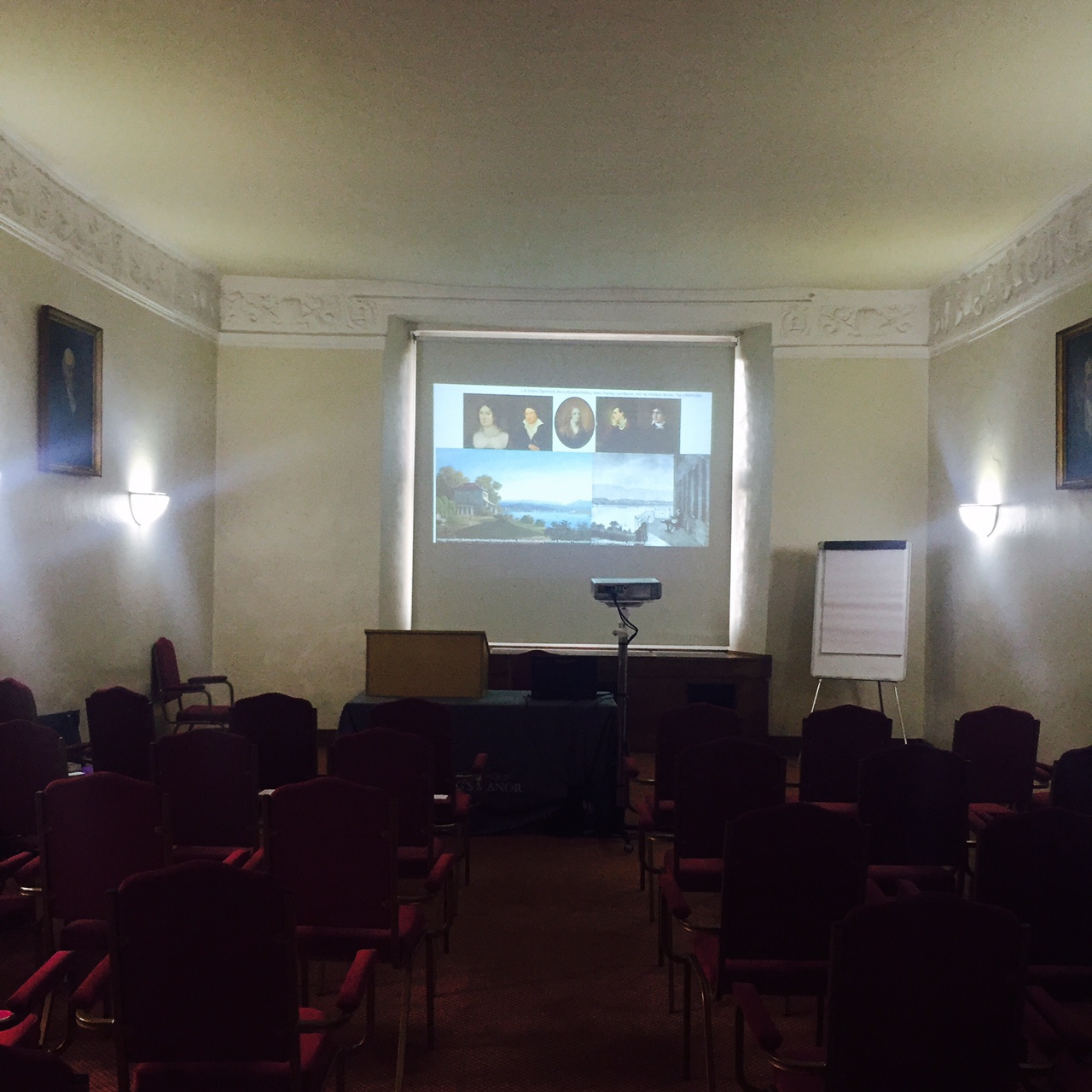
Five Questions: Oskar Cox Jensen on Napoleon and British Song

      Comments Off on Five Questions: Oskar Cox Jensen on Napoleon and British Song

Oskar Cox Jensen - Napoleon and British Song

Oskar Cox Jensen is currently a Research Fellow at King’s College London working on the Music in London 1800-1851 project.  His work focuses on the political, social and cultural histories of Britain and Europe in the long eighteenth century, with a particular focus on balladry, street music and mass culture.  Prior to taking up his post at King’s, he completed his doctorate at the University of Oxford, where he worked on the project that became his first monograph, Napoleon and British Song, 1797-1822, which was published in October by Palgrave Macmillan and which we discuss below.  As well as researching songs, Oskar is also a performer and recording artist; versions of many of the Napoleonic songs that his book examines can be heard on his Soundcloud.

1) How did you first become interested in the ways in which Napoleon was represented in popular song?

As an undergraduate historian, I was torn between two rather disparate interests: the Revolutionary and post-Revolutionary period (which is now so central to my thinking that I tend to forget to put ‘French’ before ‘Revolution’, just as ‘the ’90s’, to me, means the 1790s…) – and Viking-age Scandinavia.  Lacking the necessary six languages required for the latter, it became 1789 and beyond.  Song, meanwhile, has always mattered hugely to me, and I’ve been writing songs for more than a decade: drawn in by the thunder of the Marseillaise, I wondered if the two worlds might collide.

Of course, they did (for more of which, see question two!).  I needed a topic for my Master’s dissertation, ideally British, and while the 1790s seemed well covered, there was this immensely potent figure looming at the decade’s end that no one really had a handle on.  Stuart Semmel’s Napoleon and the British, the key work, focuses on London society and the press, rather than the people.  Folk musicologist Vic Gammon had published on the puzzling fact that later British songs of Napoleon seemed to idolise him.  There was clearly a story here.  I began with 15,000 words on 1814–16 and, encouraged by Mark Philp and David Hopkin, didn’t look back.

2) In your introduction, you assert that popular song was ‘the most widespread and influential form of literary expression of the day’, but remark that it has thus far received very little scholarly attention. What do you see as being the main benefits of recovering the importance of popular song?

The great attraction here, and the great danger, is the thought that we are recovering ‘lost voices’: that the silent, unlettered majority was actually making a lot of noise (or, rather, music).  In fact, many scholars from several disciplines have been drawn to the vast number of extant songs, often digitised, that we tend to label ‘broadside ballads’.  The issue is less, why has there been no work done, but rather, why has it proven so unproductive?  There remains a good deal of sober scepticism about what we can do with songs: they are ephemeral, and thus unquantifiable; they are usually anonymous; there is too little contextual material to bear their weight.  Their aesthetic worth, both musical and literary, has been seen as negligible.  The Romantic period was also a great age of propaganda, and many songs are polemical, didactic, seductive: with almost no evidence for their reception, how are we to draw any meaningful conclusions?

To claw back something more positive in answer to the question: song was the ubiquitous mass medium.  Generically, it was heterogeneous, assimilating elite poetry, theatrical hamminess, and street doggerel, just as it assimilated sacred, dance, or military music.  It simultaneously united and divided society both geographically and along class lines.  Its perceived potency was such that political and moral activists of every stripe made use of it.  Subject matter ranged from the same day’s news to medieval romance.  More people consumed canonical poetry as song than as verse; singing and listening, even in an age dominated by print, was simply what people did.  If we can get to grips with this, then we recover a living culture.  For how we might attempt this, see question three…

3) In composing your monograph, how did you seek to deal with the problems implicit in what you describe as ‘the fractured and contradictory incoherence of popular culture’?

I’m beginning to go off ‘popular’ as a useful label (maybe twenty years too late), preferring, if anything, to use ‘common’, especially for song.  But in this book, yes, I was specifically concerned with addressing plebeian experience and perception, which is a massive mess.  But there are some basic propositions that help shape things.  That quotation comes from a discussion of E.P. Thompson’s point that popular culture embodied a tradition of rebelliousness – a rather pleasing paradox.  And this is central to the book: we find a quite old fashioned top-down/bottom-up struggle, whereby various actors are trying to impose a set of values upon the people by cultural means that these actors do not quite understand.  Whilst being incoherent, especially in terms of party politics and a sense of identity, popular culture had its idioms and conventions, especially in song, and these conventions were cultural rather than political.

That is to say, for example, that it’s no good advancing the cause of temperance by publishing mass editions of teetotal songs, because these songs will not be fit for purpose: their lyrics will be sermonising, unsuitable to sing, and their functionality will be minimal: when would you sing them?  It is this idea of the fitness of songs that proved to be my way through the mess.  Were the words sympathetic?  Was the choice of tune, in particular, appropriate, and could the words be sung to it in the first place?  In the end, it was only by turning to contemporary aesthetic and performative considerations that I could evaluate this mass of material, and advance theories about its reception.  Thus the book begins with a contextual analysis of song as a practice, considering its writing, publication, performance and reception by real people in specific times and spaces, as a necessary precondition of any close readings.

4) To what extent might musical responses to Napoleon be systematised in chronological or class-based manners?

For convenience, I’ll take ‘musical’ to mean ‘song’ here, as the book does not look at instrumental music.  It all depends on whose response we are looking for: do we mean what was produced, or what was consumed?  The former is achievable. 1797: the first responses, mostly admiring.  1798: Napoleon as the worthy adversary to Nelson.  1799: he becomes a heathenish, usurpatory butcher.  1801–3: ambivalence.  1803–5: the blustering Ogre.  1806–9: silence.  1810–12: domestic comedy.  1813–14: triumphalism.  1814 and after: the disappearance of anti-Napoleonic propaganda and the mass assertion of a sympathetic song tradition.  Underneath, it’s far more complicated, and that goes for class too.  Geography is also central.  If sweeping generalisations are permitted, then take England south of the M4, and Wales: staunchly loyal and anti-Napoleon.  Everything north of that, including Scotland and Ireland: far likelier to hold Bonapartist sympathies.  And there is an obvious narrative of elite disdain versus popular affinity.  But press too hard and it all falls down.  Look at Cobbett or Byron, and they change year by year.  Look at the contested performance of song in almost every major city and town.  Most importantly of all, look very hard at any individual song, the relation of words to music, and the multivalent interpretations that could be read into both: the same song in two mouths could carry two opposing messages, which might be heard as half a dozen more.  This is not a medium that encourages systematisation.  Indeed, this would be my central plea.  Just because there are thousands of songs, and just because most of them don’t appear to be any good, doesn’t mean we should turn them into big data.  In the first place, it doesn’t work, because what is extant is entirely unreliable as a sample of what circulated at the time.  And in turning songs exclusively into statistics (not that statistics can’t be great when done properly), we both belittle their value as cultural objects, and lose any sense of what they actually meant to audiences.

5) What new projects are you currently working on?

Music in London 1800–1851 is keeping me very busy.  I’d like to echo James Grande’s invitation in these pages to visit the website if you are interested in being involved.  Along with David Kennerley and Ian Newman, I am co-editor of a volume of essays, The Art of Miscellany: Charles Dibdin and Late Georgian Culture, which looks at the world of Charles Dibdin the Elder with the aim of suggesting a new model of thinking about cultural production in the period, one that spans all sorts of media and networks.  This book is currently with readers.  I am also writing my second monograph, The London Ballad-Singer, 1792–1864.  In writing the Napoleon book I moved from political to cultural history, and this is where I’ve come to: a belief that we can best understand society and its texts by looking at the lived experience of culture, in this case on the London streets.  The book focuses on the representation, politics, performances, and repertoire of street singers – and ends (tragically?) with their ultimate disappearance.  Which seems like a good place to finish.

Five Questions: Ina Ferris on Book-Men, Book Clubs, and the Romantic Literary Sphere

      Comments Off on Five Questions: Ina Ferris on Book-Men, Book Clubs, and the Romantic Literary Sphere

Ina Ferris - Book-Men, Book Clubs, and the Romantic Literary Sphere

Ina Ferris is Professor Emeritus in the Department of English at the University of Ottawa.   She has written a series of important and influential contributions to Romantic Studies, particularly in the fields of book history and the history of the novel, for which she has received numerous deserved plaudits, including, most recently, the Distinguished Scholar Award of the Keats-Shelley Association of America.  Her major works include the monographs The Achievement of Literary Authority: Gender, History, and the Waverley Novels (Ithaca: Cornell University Press, 1991) and The Romantic National Tale and the Question of Ireland (Cambridge: Cambridge University Press, 2002).  In recent years, her research has focused on the book cultures of the late eighteenth and early nineteenth centuries, resulting in works including an edited volume for the Romantic Circles Praxis series on Romantic Libraries and a collection on Bookish Histories co-edited with Paul Keen.  One of the culminating achievements of this interest is her latest monograph, Book-Men, Book Clubs, and the Romantic Literary Sphere, which we discuss below and which was published in August by Palgrave Macmillan.

1) How did you first become interested in the idea of the bookman?

I’d been interested for some time in the intense bookishness of the early nineteenth century and I’d started by looking at familiar essayists such as Hunt and Lamb who made books and reading a focal point in their writing.  But in thinking more generally about how print was incorporated in the period I became more and more interested in a form of bookishness that hadn’t received much attention and was represented by bookmen who joined together to insert themselves in the circuit of book production and distribution as an alternative to the commercial market.

What sparked this turn was my running across the Bannatyne Club, the antiquarian printing club founded by Walter Scott in 1823 to print historical documents (a forerunner of the later learned printing societies).  Two things struck me as I did the research.  First, the club was formed not to read, discuss or collect books, as we might have expected, but to sponsor and produce books.  Second, the Bannatyne books came under surprisingly vehement attack from periodical reviewers and other commentators who derided or dismissed them as regressive ‘rubbish’.  The question was why they were so agitated in the first place by an inoffensive circle of bookmen and minor publications with restricted circulation.  I became interested in how bookmen, especially when they formed associations, functioned as flash points in literary culture not just because of their perverse attachment to the material book but because, in involving themselves in the making of books, they put into play an understanding of literary and disciplinary categories at variance with those sustaining the literary sphere.

2) You characterise the bookman as an outlier in the literary field, invested more fully in books themselves than in reading or in notions of literariness.  How does the liminality of the bookmen you examine serve to inform and enrich their perspectives?

The original title of my book was in fact Bookish Outliers: On the Borders of Literary Culture.  I wanted to foreground their position as figures detached from the centre of the literary sphere but not entirely removed from the sphere itself.  In relation to the question of perspective what this position means is that the bookmen’s location on the border put them in contact with contiguous spheres, letting them establish connections and introduce protocols and practices from neighbouring areas.  In this sense, their perspective was informed by a broader matrix of book production and practice, and one of my aims in the book was to draw attention to how this led to a different configuration of book, author and readers than what was being promulgated in literary circles.

One of the most striking examples in the book is Thomas Frognall Dibdin, founder of the elite bibliomaniac Roxburghe Club but also involved in the workaday world of the printing trades.  As a book designer as well as an author, Dibdin produced hybrid bibliographic volumes that embody his understanding of the book as the product of the printing arts as much as the writing arts.  What’s most interesting about them from a conceptual point of view is the way this understanding led Dibdin to make visible in his books what the modern book sought to make invisible.  He put print itself on flamboyant display, for example, and played with the format of the page.  He also credited by name printers and other craftspeople who contributed to the production, so that authorship in Dibdin is situated rather differently from authorship in the novels of Austen or even (despite their bookishness) in Scott’s historical romances.

3) In your introduction, you describe book clubs as having ‘largely disappeared from critical view’, becoming ‘not so much absent as elided’.  What do you think critics can gain by thinking through and countering this elision?

Book clubs have been typically lined up with literary societies, subscription libraries, and reading societies in lists of organizations exemplifying the conversational culture of politeness and the historical narrative of improvement.  This is not wrong (the clubs are certainly related to these other literacy-based organizations) but it obscures the specificity of the clubs, lumping them in with associations dedicated to reading, discussion, lectures, and so forth.  Moreover, placing all these associations on the same plane implies a smooth passage from one term to the next, but the book clubs have a different genealogy and trajectory, and they don’t stand in the same relation to the model of improvement.  By restoring their specificity we open a window onto overlooked dimensions of the experience and uses of print in the period, and so bring into view a more uneven terrain of the book and a more tangled process of the absorption of print into the everyday.  This seems to me the first critical gain.  The second is that in order to counter an elision, we must first track the process of elision, and this move induces critical reflectiveness, drawing attention to the investments/assumptions that sustain central literary categories (not only in the Romantic period but in our own time).  The response to the book clubs seems to me particularly resonant, presenting from a different angle the way literary culture in the Romantic period carved out a place for itself within a dynamic book culture that pressed in on it in different ways.

4) How did you come to fix on your book’s final structure, which circles out from establishment bibliophilia and printing centres in the cities to provincial book clubs and circuits?

To spotlight the constitutive friction between book culture and literary culture that helped to entrench dominant literary categories in the period, I isolated issues of circulation, production and reception triggered by book clubs not primarily devoted to reading or discussion.  At the same time I also wanted to expand the spectrum of book practices and the geography of the book, and so decided to filter these issues through three case studies centred in different regions.  The book starts in London with the high-toned Roxburghe Club of wealthy rare book collectors, which garnered criticism for restricted circulation, then shifts to Edinburgh where the more middle-class Banntayne Club issued historical documents relating to the Scottish past, prompting debate about what should be moved out of the archive into publication.  The final section widens out to look at a type of book club rather than a specific club, concentrating on ‘circulating’ book clubs that proliferated in small towns and rural areas and did not fit readily into the notion of the reading public.  These different spaces of the book make for a kaleidoscopic structure, showing different configurations of the book club, but underlying this structure is a historical thread (or story) about a ‘bookish interim’ which opened up and then closed down over the course of the early decades of the nineteenth century.

5) Now that this project is complete, what new research are you planning to embark on?

One of the discoveries for me in researching Book-Men, Book Clubs, and the Romantic Literary Sphere was the world of printers and the degree of literary activity linked to the printing house, and I’ve now begun to work on a project building out this interest in the printing trades.  I’m looking at the notion of authorship through figures who were involved in some way in these trades and who took to publication in their own right.  I have in mind figures such as William Hutton, who ran a paper factory and wrote the first history of Birmingham, along with various other works; or Pierce Egan, who trained as a compositor and produced the enormously popular Life in London.  What I want to do is revisit Foucault’s famous question ‘What Is an Author?’ by thinking about what happens if you pose this question not from the theoretical perspective of the function of a system of discursive regulation but from the historical perspective of those entering publication via unconventional paths.  How did they encounter or understand authorship?  What might this tell us about a period increasingly invested in the ‘literary character’?

Conference Report: Community and its Limits

      Comments Off on Conference Report: Community and its Limits

Many thanks to Thomas Null (University of Edinburgh) for this comprehensive report on the ‘Community and its Limits, 1745-1832’ conference held at the beginning of September at the University of Leeds.  BARS provided financial support to assist with this conference.

Community and its Limits, 1745-1832‘ was held at the School of English, University of Leeds on the 4th and 5th of September. The conference was organised by Jeremy Davies, Richard De Ritter, David Higgins, and Robert Jones as members of Leeds’ Eighteenth-Century and Romantic Research Group, and over two days proved a rich and stimulating conversation exploring the terms of cultural community in the long eighteenth century.

The schedule was arranged in single sessions, allowing for an atmosphere that was both intimate and engaging. Participants attended five panel discussions, two plenary lectures, and conference roundtable together, gathering at intervals for conversation and refreshments in the striking nineteenth-century interiors of the School of English.

‘Matters of Principle’, the opening panel, began with a paper from Dr Tim Milnes (Edinburgh). In ‘Hume, social empiricism, and the limits of trust’, he considered Hume’s use of the essay as a response to questions of epistemology and British empiricist thought in the eighteenth century. As radical scepticism in Hume leads to a form of social empiricism, he argued, knowledge is increasingly seen to depend on trust, and thus on the performance of communicative acts. In the hands of Hume, the familiar essay as literary performance becomes an important means of reinforcing this social trust, moderating between the spheres of learning and polite conversation. And yet, Dr Milnes argued, Hume’s own moderation manifests itself as a form of detachment (ataraxia) or philosophical indifference that encodes specific and socially-inflected norms regarding the customs and habits that underlie trusting communication.

Rachel Sulich’s (Leeds) ‘Communal deviance: Charles Moore’s “modern race of suicides”’ considered the complex motivations for Moore’s moralising rhetoric regarding depictions of suicide in popular writings. In this, she explained, he posits a general social threat based in the subversion of ‘good culture’, a consequence of modern man’s effeminacy as expressed in bodily indulgence, weakness, and imaginary evils.

Dr Matthew Ward’s (St Andrews) paper ‘Laughter, ridicule, and the limits of sympathetic feeling’ examined the writings of James Beattie and others, including Frances Hutcheson, Adam Smith, and William Hazlitt. Beginning from Scottish Enlightenment developments, he compared various associations of laughter, from the implied possibility of identification with others to the ridicule of others’ vulnerabilities, moral defects or physical deformities. He also considered laughter’s social utility: its providing distance from false claims on sympathy, or facilitating proportionate performances of sympathy, with a tendency towards convention. As in Beattie’s essay the perception of incongruity in all things laughable alerts individuals to an awareness of social patterns and expectations, and positions humour in the realm of aesthetic (rather than moral) judgement, Dr Ward considered the significance of sympathy in this discourse, and its limits as an opportunity for communities to develop together from a basis in convention.

After a break for tea and coffee the second panel, ‘National Communities’, began with Dr Helen Stark (Newcastle). In her paper, ‘A “Charnel-Vault”? Dead bodies and national identities in Walter Scott’s Paul’s Letters to His Kinsfolk (1816)’, she discussed concepts of identity and stability in an analysis of Scott’s post-Waterloo impressions of the Continent, tracing his language in this series of imaginary letters composed from notes of his visit to the battlefield.

Dr Jane Hodson (Sheffield) then presented an analysis of representations of dialect in novels of the Romantic period, in her paper ‘“I hae been sae lang accustomed to the Scots”: Language, community and identity in novels 1800-1836’. She considered the connection between these representations and shifting contemporary associations of speech and identity in several works, including Mudie’s Glenfergus (1820), The Monthly Magazine (1821), and Lathom’s Young the Bull; or, Born Abroad and Bred at Home (1828).

Honor Rieley (Oxford) concluded the panel with an examination of popular conceptions of the emigrant figure in the first decades of the nineteenth century. ‘Imagining the emigrant reader, 1802-1832’ surveyed representations of the emigrant alongside the changing circumstances of motivation and opportunity that influenced emigration of British populations to North America during these decades. Her analysis presented significant transformations in the imagined emigrant figure as the availability of opportunity extended to a broader segment of society in an age of mechanisation.

This was my first visit to Leeds, and I found the theme of the occasion complemented by the dense history of the city, its energy and diversity. Perhaps the breadth of scholarship addressed to ideas of community stimulated my perception of this unfamiliar place, and oriented my attention as observations and hesitant speculations unfolded within the circumstances of my experience. At any rate, this correspondence was enhanced by events on the conference schedule, and after the day’s final panel we crossed the city centre from the Leeds campus for an evening at Britain’s oldest surviving subscription library.

The Leeds Library was arranged as the venue of the keynote public lecture, and following a brief history of the collection and the context of its local development from Andrew Morrison, Professor Murray Pittock (University of Glasgow) shared his research with an audience gathered in the library’s central circulation space. ‘Memory, Erasure, Community and Culture: The Battle of Culloden in Scotland and the British Empire, 1746-1846’ examined the Scottish battle’s position and significance in constructed narratives of imperial Britain. In a presentation enriched by historical and visual illustrations, his reading of Culloden’s prominent role in the formation of collective narratives engaged an audience that included a number of the library’s regular subscribers.

Following a wine reception – and some further exploration of the library’s shelves – we were easily persuaded to continue our conversations over dinner, and within a few minutes we were pleasantly assembled at a table that spanned the length of a nearby brasserie.

The second day began with the panel ‘Satire and Sympathy’. I presented the first paper, ‘Shelleyan poetics, Scottish Enlightenment sympathy, and the limits of convention’, which was followed by Anna Mercer’s (York) paper ‘Expanding perceptions of the Shelleys’ community’, read by David Higgins. Beginning from the position that ‘the Shelleys are their texts’, she considered love and irony in Epipsychidion and ‘The Bride of Modern Italy’ within the context of her research on the collaborative literary relationship of Percy Bysshe Shelley and Mary Shelley.

Professor Michael Bradshaw (Edge Hill) rounded off the panel with his paper ‘Loitering on the threshold: Thomas Hood’s comical communities’. In a reading of the ambivalence Hood expresses in his poem on the socialite reformer and Society of Friends minister Elizabeth Fry, he considered the poet’s commitment to a community of readers and his strong sense of their shared tastes or opinions as he actively constructed a market-based reading public.

Dr Joanna Wharton (Independent Scholar) presented the first paper of the fourth panel, ‘Places of Community, 1789-1802’. In ‘Material practice and “vital religion” in the Mendip school and clubs’ she considered Hannah More’s Mendip ‘feast’ and the utility of physical pleasure in luring children to religion. This curious event in the Mendip hills linked spiritual and physical nourishment in a ceremony of reward, the decorum of which kept children from active enjoyment of what quickly turned into a local spectacle. Dr Wharton further examined the nature of the relationships established through More’s provision of gifts to the children. Whether intended to obligate adherence to moral conventions, the exchange was additionally intriguing for More’s personal identification with the poor, in the performance of hand-knitting items of clothing for the children.

Dr Matthew Sangster’s (Birmingham) examination of ‘London existences and community boundaries’ considered how community was represented in the rapidly growing city of the turn of the century. Here, size became glorious, a mark of distinction, rather than alienating, a shift he illustrated in the enormity of a period map of London. Reminding us that neither Wordsworth’s Prelude vision of London nor Blake’s was available to the contemporary Romantic – and reading excerpts of each, in a voice that conjured an atmosphere out of time – Dr Sangster presented these as part of his work mapping poetic environments in urban space, a developing project that suggested a valuable contribution to the digital humanities.

The panel concluded with Anne Fleming’s (Leeds) ‘Wordsworth’s creative ecotone: Navigating community boundaries and tension in the Vagrant poems’, in which she engaged the etymology of the ecological term ‘ecotone’ to describe a concept of ‘fertility… dwelling at the edge of the tension between different people, beings, [and] landscapes’. In a close reading of Wordsworth’s encounter with an orphan girl in ‘Alice Fell’, she examined the demanding process of community represented in spaces of intermingling borders, and further considered the role of the postal service as a device of this unique space, here and in a scene of disrupted social hierarchy in Thomas De Quincey’s ‘The English Mail Coach’.

We gathered for the fifth and final panel after lunch. ‘Life-Writing’ began with Dr Laura Davies’s (Southampton) survey of unedited manuscript letters in a paper that considered ‘Ways of reading the spiritual “Lives” of early Methodist women’. As she closely examined the language these Methodist followers used in correspondence addressed to their reverend, the varying dynamics between individuals and ideas of belonging revealed the complicated nature of this community.

Freshly returned from an international symposium on the Burney family at Cardiff, Dr Cassie Ulph (York) presented her paper ‘Domestic community or professional network? Keeping company with the Burneys’ within its most current critical context. She discussed her research on the relationships and exchanges that influenced creative output in writings produced within the circle of this literary family.

Dr Claire Sheridan (Queen Mary) then examined Thomas Love Peacock’s nostalgia as the last surviving member of the Shelley circle and his reluctant relationship to the biographical endeavour. Particular emphasis was placed on his representation of this Romantic sociability in his Memoirs of Percy Bysshe Shelley, a series of periodical pieces published for the mid-Victorian audience of Fraser’s Magazine.

Tea, coffee, and cake was followed by the conference roundtable, ‘Community, Society, and Scholarship in Leeds, 1768-2015’. Bringing representatives of the city’s cultural organisations together, Professor Jon Mee (York) chaired a discussion of the roles and contributions of these institutions in local history. Eveleigh Bradford of the Thoresby Society, Janet Douglas of the Leeds Philosophical and Literary Society, Lynda Kitching of the Leeds Civic Trust, and Andrew Morrison of The Leeds Library each provided insight into issues of institutional stability and change in a dynamic urban context.

Dr Felicity James (University of Leicester) presented the closing lecture, ‘Voices of Dissent: Community, History and Difficulty in Rational Dissent’. Within the context of the history of Unitarianism she focused on the first Essex Street Chapel minister Theophilus Lindsey, and presented an autobiographical chapter as a new kind of rational conversion narrative. This, she demonstrated, attempts reconciliation with establishment positions while also invoking – to ambiguous effect – a darker, unsettling history in early Nonconformist accounts of overcoming persecution. Dr James compared this development, positioned ambivalently between affiliation and dissent at a time of improving religious tolerance in Britain, to the crisis of Mr Hale in Elizabeth Gaskell’s North and South. Here the author probably has Lindsey in mind, she suggested, as Gaskell represents shifts in ways of dealing with dissent, perhaps using frustrations with the Unitarian doctrine of unity and tolerance in order to address issues of individual uncertainty within a larger social picture.

With this plenary – yet another fascinating glimpse of new research – our programme concluded, and following some final remarks and reflections we dispersed for hotels, evening trains, and home. Thank you again to all organisers and participants of this convivial exchange of ideas on Romantic community!

Thomas Null, University of Edinburgh

CfP Reminder: Burney and Popular Entertainments

      Comments Off on CfP Reminder: Burney and Popular Entertainments

A reminder that the deadline for submitting abstracts for next year’s Burney Society conference is now three months away (January 31st).  The Call for Papers is below for reference.

Conference of the Burney Society

St Chad’s College, Durham University, 4-6 July 2016

Burney and Popular Entertainments: the business of pleasure in Late Georgian Britain

Proposals are invited for 20 minute papers on the subject of ‘Burney and Popular Entertainments: the business of pleasure in Late Georgian Britain’

Frances Burney grew up at the centre of a vibrant metropolitan cultural scene, and was part of a network of musicians, writers, actors and artists whose careers depended on a culture of consumption, both imaginative and material. This was the world she evoked in her novels, plays and journals and this conference builds on the movement in Burney scholarship toward greater contextualisation of her work. The conference centres around entertainment, with the conference programme itself featuring a range of entertainments, including an excursion to a site of local interest, and the world premiere of Burney’s play Love and Fashion, which will be performed by Durham Student Theatre. The conference’s keynote address will be given by Harriet Guest, Professor Emerita of Eighteenth-Century Literature at the University of York.

Papers should address the work of Burney and/or members of her circle, with potential topics including (but not limited to):

  • Burney and the Theatre
  • Public Spaces (such as parks, gardens, assembly rooms, the seaside)
  • Private Entertainments
  • Commercial Entertainments
  • Shopping/Consumer Culture/Fashion
  • Tourism
  • The Promenade
  • Curiosity/Spectacle

Abstracts of no more than 250 words should be sent as an email attachment in MS Word document format to Francesca Saggini (fsaggini@unitus.it) and burneysocietyuk@gmail.com. You should also include a 250-word biographical statement. Please use your surname as the document title. The abstract should be sent in the following format: (1) Title (2) Presenter(s) (3) Institutional affiliation (4) Email (5) Abstract (6) Biographical Statement.

The deadline for receipt of all proposals is January 31, 2016. We will attempt to notify all correspondents before February 28 regarding the status of their submission.

A small number of travel bursaries will be available for postgraduate students presenting at the conference. Applications are invited from research students registered on a programme of postgraduate study on the date of the conference. Please indicate at time of submission if you wish to be considered for one of these, stating your affiliation and level of study, and include a brief statement of how attendance at the conference would be of benefit to your research project.

BARS: Seeking Expressions of Interest in hosting the biennial International Conference in 2019

      Comments Off on BARS: Seeking Expressions of Interest in hosting the biennial International Conference in 2019

(From Ian Haywood, the President of BARS, and the Executive).

The Executive of the British Association for Romantic Studies is now calling for expressions of interest from universities in hosting the biennial international conference in 2019. The BARS International Conference has a long history of successful four-day events designed to showcase new work by both eminent and new Romanticists from Britain and abroad in the field of Romantic studies. Past conferences have included ‘Romantic Imprints’ (Cardiff, 2015), ‘Romantic Imports and Exports’ (Southampton, 2013), ‘Enlightenment, Romanticism & Nation’ (Glasgow, 2011), ‘Romantic Circulations’ (Roehampton, 2009), ‘Emancipation, Liberation, Freedom’ (held jointly with NASSR, Bristol, 2007), ‘Romanticism’s Debateable Lands’ (Newcastle, 2005), ‘Romantic Conflict’ (Warwick , 2003), ‘Sustaining Romanticism’ (Liverpool , 2001), ‘Romantic Revelations’ (Keele, 1999), and ‘Romantic Generations’ (Leeds, 1997). The 15th International Conference, ‘Romanticism and Improvement’, will be held at the University of York in 2017.

Informal expressions of interest can be directed in the first instance to Professor Ian Haywood: I.Haywood@roehampton.ac.uk. Formal bids should be sent by Friday 18 December to Helen Stark at Helen.Stark@newcastle.ac.uk. Applications will then be assessed by the Executive Committee and a decision announced in February 2016.

In preparing a bid, potential host institutions may find the desiderata below to be a useful resource. The very successful BARS 2015 conference in Cardiff may also be a helpful guide: http://bars2015.org/.

BARS International Biennial Conference Desiderata

Host institutions are expected to take account of the following in order to fulfill the requirements of the Association:

• Conference Topic
This should be of sufficient scope and significance to allow the majority of the Association’s members to take part (organizers will be catering for a group usually in excess of 100 and possibly exceeding 200). In the past, this has most often taken the form of a ‘catch-all’ topic such as ‘Romantic Generations’ (1997), ‘Romantic Revelations’ (1999), ‘Romantic Conflict’ (2003), ‘Romantic Circulations’ (2009), although other conjunctions or triangulations of topics such as ‘Emancipation, Liberation, Freedom’ (2007), and ‘Enlightenment, Romanticism and Nation’ (2011) are also possible.

• Timetable
The timetable for the conference is typically Thursday to Sunday in the second half of July, with the conference commencing on the afternoon of the first day and finishing at lunchtime or in the afternoon on the Sunday.

In fixing on a date, organizers should check which conferences are already scheduled for what is often a busy time in the calendar and liaise with conference and society chairs (such as NASSR, Wordsworth Conference etc) in order to avoid clashes wherever possible and facilitate attendance at all events.

The call for papers is usually made by October of the previous year (2018) and the outcome of the refereeing process confirming speakers is usually made by early in the conference year (2019).

• Vetting of Paper Proposals
It is usual for members of the BARS Executive to serve on the panel which referees the proposals for panel papers, though the Conference Committee usually reserves the final right of veto. (It is desirable that papers are refereed not only for the integrity of the event, but also to help delegates secure financial support from funding bodies and institutions.)

• Programme
We strongly encourage a structure based around themed and convened panels designed to showcase the best current work in Romanticism, though individual submissions are also welcomed. The programme usually comprises a series of parallel sessions consisting of panels where delegates deliver 20 minute papers. In addition, there are usually three or four plenary lectures, two of which are memorial lectures dedicated to Marilyn Butler and Stephen Copley. Plenaries are chosen by the organizing committee in consultation with the BARS Executive. Some British presence in the plenaries is considered desirable given that this is the national association, but the Association encourages a balance of male and female scholars both from within Britain and beyond. Sessions should also aim to provide opportunities for PGRS and Early Career Researchers by incorporating them on panels alongside more established academics. It is expected that the programme will also include workshops and specialist sessions aimed at PGRs and ECRs, as well as other research-related activities, readings, performances, exhibitions etc that reflect and enhance the conference theme and the host institution’s resources and facilities.

• Accommodation/Venue
We expect organizers to offer a range of accommodation from traditional student-type lodgings through to hotel level facilities. Sufficient cheaper accommodation to allow postgraduate participation is desirable.

The venue is expected to meet the usual requirements for facilities in academic meetings. It is desirable that the meeting rooms are in reasonably close proximity to each other and that there is a communal meeting area or foyer, preferably with refreshment facilities so that delegates can socialize and rendezvous. Catering should normally include lunch on Friday and Saturday, provision for dinner on Thursday and Friday, with the option of Sunday lunch depending on the programme.

• Banquet
It is customary to offer delegates the option of a banquet on the Saturday evening. Payment for this is in addition to the conference and other fees.

• Conference Excursion
It is usual to arrange an excursion with laid-on transport on the Saturday afternoon, to a venue with general relevance to the conference e.g. a museum, estate, birthplace, or gallery. This is usually an optional extra in terms of costings and a packed (brown-bag) lunch is provided for delegates.

• BARS General Meeting (BGM)
The conference organizers are required to find a central time (at least one hour) within the schedule to host the BGM.

• Cost
Organizers are asked to keep costs as low as possible without compromising the quality of the event. The Association is willing to support its international conference (subject to negotiation) but expects the event to at least break even; it is normal that any profits are shared equally between the host institution and BARS. Organisers are asked to provide a detailed budget ahead of the conference and a brief report afterwards.

• Liaison
Organizers need to maintain contact with the Association during the planning process. This is usually managed by the co-option of one of the Conference Committee onto the Executive. The host institution is expected to make a presentation at the 2017 conference at York.

Subversive Jane Austen: from the Critic to the Reader

      Comments Off on Subversive Jane Austen: from the Critic to the Reader

locandina

Many thanks to Serena Baiesi for news of an international conference entitled ‘Subversive Jane Austen’ coming up at the Inter-University Center for the Study of Romanticism (CISR), based at the University of Bologna.  This will take place on November 6th; there’s more information above and below, and the full programme can be downloaded by clicking here.

Subversive Jane Austen: from the Critic to the Reader

Inter-University Centre for the Study of Romanticism (CISR)
Gemma – Erasmus Mundus Master’s Degree in Women’s and Gender Studies
Dipartimento di Lingue, Letterature e Culture Moderne – University of Bologna

November 6, 2015

The Inter-University Centre for the Study of Romanticism (CISR) of the University of Bologna directed by Lilla Maria Crisafulli, has established itself as a major international teaching and research centre in the field of Romantic, women’s, and gender studies. Within the multifaceted research activity in this area a key role is played by the studies devoted to the work and critical reception of Jane Austen, on which two important conferences have been organised during the 2000s: Jane Austen, Now and Then (October 2002) and Unmasking Jane Austen. Gli studi austeniani oggi (March 2009). The CISR has also established an intense collaborative relationship with the Chawton House Library, the internationally renowned research center on women’s writing Women’s Writing in English 1600 to 1830 located in the historic residence of the Austen family. Our conference intends to promote the continuity and visibility of the tradition of Austen studies at the University of Bologna and to map the most recent and promising developments of this constantly developing research area. In particular, our one-day conference will focus on subversive critical readings, and on the popular reception of an author in Italy, who is at the same time a ‘classic’ of the English literary canon and an icon of post-modern mass culture.

The first section of the conference, coordinated by Serena Baiesi, will deal with Austen’s subversiveness as outlined by recent scholarship. The theme will be discussed by internationally renowned scholars such as Beatrice Battaglia (University of Bologna); Katie Halsey (University of Stirling), Gillian Dow (University of Southampton and Director of Chawton House Library), and Bharat Tandon (University of East Anglia).

The second section of the conference will focus on the Italian context, and during the afternoon we will be discussing the contribute that critics can give to the comprehension of the novelist’s cultural role in Italy with distinguished Italian Austen scholars such as Diego Saglia and Eleonora Capra (Parma), Marianna D’Ezio (Rome), and Massimiliano Morini (Urbino). New critical approaches require a revision of translation strategies, which have been so far inspired by an essentially conservative reading of Austen and are now encouraged to engage with the twofold and ambiguous language of a novelist who unmasks the hypocrisies of Georgian society with an ironic writing that is extremely difficult to translate and has been hidden to the Italian reading public for a long time. Moreover, this section will also reflect on the large work of re-mediation of Austen’s life and novels and on the dissemination of Jane Austen’s fame in popular culture, through an endless amount of adaptations, imitations, sequels, prequels, spin-offs, turning her into a global literary brand able to appeal to readers and spectators belonging to diverse social and cultural contexts. The discussion of the manifold ways in which Austen is constantly re-mediated and re-codified will involve scholars (Cristina Bragaglia), together with readers, bloggers and other Janeites in a concluding round-table coordinated by Carlotta Farese hosting, among others, the founders of the Jane Austen Society of Italy.

New number of The BARS Review

      Comments Off on New number of The BARS Review

We’ve just published the autumn number of The BARS Review, containing thirty-five containing thirty-five reviews covering forty-three recent publications in the field of Romantic Studies, with a ‘Spotlight’ feature focusing on recent work in the field of Romanticism and Science.  The table of contents below provides a direct link to each of the reviews in html format; all the reviews are also available as downloadable pdfs and the complete number can be downloaded with a table of contents here (large file).  We hope that you enjoy all the contributions to this number, but if you do have any feedback or suggestions as to how the Review can be improved, we’d be glad to hear these either in the comments here or by email to the Editor, Dr Susan Valladares.

The BARS Review, No. 46 (Autumn 2015)

Table of Contents

Reviews

John Bugg, Five Long Winters: The Trials of British Romanticism; Kenneth R. Johnston, Unusual Suspects; and Murray Pittock, Material Culture and Sedition, 1688–1760
   Elias Greig
David Simpson, Romanticism and the Question of the Stranger and Jane Stabler, The Artistry of Exile: Romantic and Victorian Writers in Italy
   Omar F. Miranda
Peter J. Kitson, Forging Romantic China: Sino-British Cultural Exchange 1760-1840 and David Vallins, Kaz Oishi and Seamus Perry, eds., Coleridge, Romanticism and the Orient: Cultural Negotiations
   Andrew Rudd
Elizabeth A. Bohls, Romantic Literature and Postcolonial Studies
   Kang-yen Chiu
Daniel E. White, From Little London to Little Bengal: Religion, Print and Modernity in Early British India
   Daniel S. Roberts
Cynthia Schoolar Williams, Hospitality and the Transatlantic Imagination, 1815-1835
   Evan Gottlieb
David Sergeant and Fiona Stafford, eds., Burns and Other Poets
   Vivien Estelle Williams
Evan Gottlieb, Walter Scott and Contemporary Theory
   Ainsley McIntosh
James Noggle, The Temporality of Taste in Eighteenth-Century British Writing and Ashley Chantler, Michael Davies and Philip Shaw, eds., Literature and Authenticity, 1780-1900
   Matthew Scott
Nancy Yousef, Romantic Intimacy
   Ashley Jenkins
Monika Class, Coleridge and Kantian Ideas in England, 1796-1817: Coleridge’s Responses to German Philosophy
   Philip Aherne
Lisa Feurzeig, Schubert’s Lieder and the Philosophy of Early German Romanticism
   Kristina Muxfeldt
Stephanie Kuduk Weiner, Clare’s Lyric: John Clare and Three Modern Poets
   Andrew Hodgson
Gavin Hopps, ed., Byron’s Ghosts: The Spectral, the Spiritual and the Supernatural
   Anna Camilleri
Mark Sandy, Romanticism, Memory, and Mourning
   Tim Chiou
Daniel Cook, Thomas Chatterton and Neglected Genius, 1760-1830
   Nick Groom
Jane Darcy, Melancholy and Literary Biography, 1640-1816
   Anita O’Connell
Michael Phillips, ed., William Blake. The Marriage of Heaven and Hell
   David Fuller
Martin Blocksidge, The Banker Poet: The Rise and Fall of Samuel Rogers
   Charlotte May
Rachel Schulkins, Keats, Modesty, and Masturbation
  James Najarian
Barbara K. Seeber, Jane Austen and Animals
   James Castell
Mary Brunton, Self-Control, ed. Anthony Mandal and Ingrid Tieken-Boon van Ostade, In Search of Jane Austen: The Language of the Letters
   Katie Halsey
John Wiltshire, The Hidden Jane Austen
   Anne-Claire Michoux
Angela Escott, ‘The Celebrated Hannah Cowley’: Experiments in Dramatic Genre
   Kathleen James-Cavan
Allan I. Macinnes and Douglas J. Hamilton, eds., Jacobitism, Enlightenment and Empire
   Bob Harris
Mark Philp, Reforming Ideas in Britain: Politics and Language in the Shadow of the French Revolution 1789-1815
   Amanda Goodrich
Marisa Linton, Choosing Terror: Virtue, Friendship and Authenticity in the French Revolution
   Joseph Clarke
Julia Swindells and David Francis Taylor, eds., The Oxford Handbook of the Georgian Theatre, 1737-1832
   David Kennerley
Patrick Spedding and Paul Watt, General eds.; Ed Cray, David Gregory and Derek B. Scott, Volume eds., Bawdy Songbooks of the Romantic Period
   Simon Kövesi

Spotlight: Romanticism and Science

Jon Klancher, Transfiguring the Arts and Sciences: Knowledge and Cultural Institutions in the Romantic Age and Roderick Tweedy, The God of the Left Hemisphere: Blake, Bolte Taylor, and the Myth of Creation
   Robert Mitchell
Martin Priestman, The Poetry of Erasmus Darwin: Enlightened Spaces, Romantic Times
   Trevor H. Levere
Warwick Mules, With Nature: Nature Philosophy as Poetics Through Schelling, Heidegger, Benjamin and Nancy
   Frederick Gregory
Robert Mitchell, Experimental Life: Vitalism in Romantic Science and Literature
   Jan Golinski
David Ward, Coleridge and the Nature of Imagination: Evolution, Engagement with the World, and Poetry
   Jessica Roberts
Sharon Ruston, Creating Romanticism: Case Studies in the Literature, Science and Medicine of the 1790s and Carmen Casaliggi and Paul March-Russell, eds., Legacies of Romanticism: Literature, Culture, Aesthetics
   Edward Larrissy

Whole Number

The BARS Review No. 46 (Autumn 2015) – review compilation (.pdf)
   The BARS Review Editors

Archive Spotlight: New William Godwin Discovery

Dr Evert Jan van Leeuwen, of Leiden University, has written the following report for us on a new discovery he’s made in the Abinger Collection at the Bodleian.  We’re very happy to publish short notes like this relating to discoveries that might be of interest to the Romantic Studies community – if you’d be interested in contributing a piece on archival findings, please get in touch.

— — — —

Unknown Manuscript Note Identified in the William Godwin Papers of the Abinger Collection, at the Bodleian Library

In consulting the online catalogue of the Abinger Collection at the Bodleian Library, on Thursday 15 October 2015, I was able to identify the source of a piece of manuscript in William Godwin’s papers catalogued as “unknown.”  It concerns the following item, the pages of which can be viewed online here and here:

• Shelfmark: MS. Abinger c. 39
• Former shelfmark: Dep. b. 229/4(a)
• Fol(s).: 90r (and 90v)
• Document type: copy, in the hand of William Godwin, and Mary Jane Godwin
• Contents: ?Extract from an unknown work, beginning ‘The head is a house built for reason…’

The “unknown work” is The Guls Horne-Booke (1609) by Thomas Dekker, which Godwin read on the 5th and 6th of February 1813, according to William Godwin’s Diary.

Dr. B.C. Barker-Benfield, of the Department for Special Collections & Western Manuscripts at the Bodleian Library, explains that “the leaf is transcribed in the hand of an amanuensis, probably Mary Jane Godwin, but with corrections certainly in William Godwin’s hand.”  It contains the extended “head is a house” metaphor from Chapter 3 of Dekker’s text (pp.14-15 of the 1609 text, available as a digital file via EEBO).  It is transcribed almost verbatim, with only minor differences in punctuation and a small phrase missing on fol. 90v that appears between “Frenchman” and “nor” in the 1609 text: “that pluckes up all by [y] rootes” (15).  Dr. Barker-Benfield points out that “the watermark of this leaf is the lower half of Britannia, a very common pattern, with no visible date.”

Dekker’s pamphlet is a burlesque of the conduct literature circulating in early seventeenth-century fashionable society.  One wonders what drew the aging philosopher to The Guls Horne-Booke.  Godwin’s young admirer Edward Bulwer Lytton would become famous for his satirical portraits of high-society beaux and belles; Godwin, by contrast, holds the reputation for being a serious (even gloomy) psychological and political novelist of purpose.

In 1817, Godwin published Mandeville, a Tale of the Seventeenth-Century in England.  Reading Dekker may have been part of his research towards writing this work of fiction.  What I am currently researching is to what extent Dekker’s extended “head is a house” metaphor functions as a governing literary motif in Mandeville.  The narrator-protagonist Charles Mandeville reflects at the outset that “it is…necessary that I should here describe the most remarkable features of [my uncle’s] residence” because “they insensibly incorporated themselves as it were with the substance of my mind; and my character, such as it was afterwards displayed, owed much of its peculiarity to the impressions I here received” (23).  Audley Mandeville’s coastal residence is a full-blown Gothic mansion “in a woful [sic] state of dilapidation” (24).  In the course of the novel, Charles Mandeville’s mind becomes as isolated and ruinous as his uncle’s home.  Godwin was clearly struck by Dekker’s extended “head is a house” metaphor and his appropriation of this figure of speech suggests that he was developing a Gothic motif that the American poet, critic and short-story writer Edgar Allan Poe (who read Mandeville) would perfect in “The Fall of the House of Usher” (1839).  In this tale, the house and the mind of its proprietor are indeed one; they fall down together.

I will present a working paper on this thesis at the January 2016 British Society for Eighteenth-Century Studies conference and plan to publish a finished essay in the course of the year.  I would like to thank Dr. Barker-Benfield for encouraging me to publish a note on the identification of Godwin’s transcription of Dekker’s text.  The online catalogue entry will shortly be corrected in the light of the identification.

Dr Evert Jan van Leeuwen
Leiden University, the Netherlands
e.j.van.leeuwen@hum.leidenuniv.nl

On This Day in 1815: Samuel Taylor Coleridge’s ‘Christabel’ and his letters to Lord Byron

      Comments Off on On This Day in 1815: Samuel Taylor Coleridge’s ‘Christabel’ and his letters to Lord Byron
S T Coleridge by George Dawe c.1811-1812 (Wordsworth Trust)

S T Coleridge by George Dawe c. 1811-1812 (Wordsworth Trust)

Exactly two hundred years ago today, on the 15th October 1815, Samuel Taylor Coleridge wrote to one of his sincere admirers. Coleridge was approaching his 43rd birthday, and had been through many personal trials and tribulations since the publication of Lyrical Ballads in 1798. The admirer was Lord Byron, who, following the success of Childe Harold’s Pilgrimage and his more recently published Eastern Tales (such as The Giaour and The Corsair) was securing his status as one of the eminent and respected poetic figures of his day.

This letter sparked the interchange that led to Byron expressing his admiration for Coleridge’s other-worldly and mysterious poem Christabel. With Byron’s support, the poem was eventually published in 1816. On the 15th October 1815 Coleridge writes of his dramatic compositions and his future ‘intentions of presenting three old plays adapted to the present stage’. This letter details his affection for Richard II (‘perhaps the most admirable of Shakespear’s historical plays’). He suggests that in his new rewritten version of the drama he will introduce a ‘new female character’, one of the faults of the original narrative being ‘the entire absence of female interest’. STC’s letter (which is characteristically rambling and yet charming) then goes on to muse on actors and actresses of the day, and he signs off: ‘Your Lordship’s obliged servant S. T. Coleridge’.

Byron’s reply on the 18th October instigates a discussion on Christabel, as yet unpublished, and still unfinished:

Last spring I saw Wr. Scott. He repeated to me a considerable portion of an unpublished poem of yours – the wildest and finest I ever heard in that kind of composition. The title he did not mention, but I think the heroine’s name was Geraldine. At all events, the ‘toothless mastiff bitch’ and the ‘witch Lady’, the description of the hall, the lamp suspended from the image, and more particularly of the girl herself as she went forth in the evening – all took a hold on my imagination which I never shall wish to shake off. I mention this, not for the sake of boring you with compliments, but as a prelude to the hope that this poem is or is to be in the volumes you are now about to publish. I do not know that even ‘Love’ or the ‘Antient Mariner’ [sic] are so impressive – and to me there are few things in our tongue beyond these two productions.

Coleridge replies:

            My Lord

The Christabel, which you have mentioned in so obliging a manner, was composed by me in the [year] 1797 – I should say, that the plan of the whole poem was formed and the first Book and half of the second were finished – and it was not till after my return from Germany in the year 1800 that I resumed it – and finished the second and a part of the third Book.

He then goes on to explain that ‘A Lady is now transcribing the Christabel’. The editor of Coleridge’s letters Earl Leslie Griggs has identified the lady as ‘probably Mrs. Morgan or Charlotte Brent’. However, the copy of Christabel sent to Byron was the one made by Sara Hutchinson, for whom Coleridge had expressed an unrequited love that caused pain and suffering for the poet and those close to him. Sara was the sister of Mary Hutchinson (Wordsworth’s wife). The idea of Coleridge sending off the transcript of the poem in her hand strikes me as a poignant recollection of Coleridge’s difficult personal life, at a time when Byron’s serious personal difficulties – including debt, scandal and a broken marriage – were just beginning. Coleridge goes on to mention Wordsworth (in 1808 Wordsworth had written a preface to the ‘White Doe’ acknowledging his indebtedness to Christabel) and muse on poetical form in this second letter.

Byron had not only praised Christabel but sent it to John Murray, asking him to publish it. Coleridge and Byron met in person on the 10th April 1816, where Byron again brought up the subject of Christabel and implored its author to publish it despite the work’s unfinished state. At this famous meeting Coleridge also recited ‘Kubla Khan’ to Lord Byron and another literary icon, Leigh Hunt, who was also present. Two days later Murray came to see Coleridge to arrange the publication of Christabel and ‘Kubla Khan’ along with ‘The Pains of Sleep’.

Christabel captured the imagination of those authors now known as the second-generation of Romantic poets: Byron and Percy Bysshe Shelley would read the poem aloud one stormy night later that year (18th July 1816) at the Villa Diodati on the shores of Lake Geneva. A crucial participant in this evening of ghost-tales and philosophical discussion was Mary Shelley, who within the same month would start to write the narrative that became Frankenstein.

…But the full story of that night is for another post, which may well feature on this blog in 2016!

From Christabel (Part I, lines 135-189)

So free from danger, free from fear,
They crossed the court: right glad they were.
And Christabel devoutly cried
To the lady by her side,
Praise we the Virgin all divine
Who hath rescued thee from thy distress!
Alas, alas! said Geraldine,
I cannot speak for weariness.
So free from danger, free from fear,
They crossed the court: right glad they were.

Outside her kennel, the mastiff old
Lay fast asleep, in moonshine cold.
The mastiff old did not awake,
Yet she an angry moan did make!
And what can ail the mastiff bitch?
Never till now she uttered yell
Beneath the eye of Christabel.
Perhaps it is the owlet’s scritch:
For what can ail the mastiff bitch?

They passed the hall, that echoes still,
Pass as lightly as you will!
The brands were flat, the brands were dying,
Amid their own white ashes lying;
But when the lady passed, there came
A tongue of light, a fit of flame;
And Christabel saw the lady’s eye,
And nothing else saw she thereby,
Save the boss of the shield of Sir Leoline tall,
Which hung in a murky old niche in the wall.
O softly tread, said Christabel,
My father seldom sleepeth well.

Sweet Christabel her feet doth bare,
And jealous of the listening air
They steal their way from stair to stair,
Now in glimmer, and now in gloom,
And now they pass the Baron’s room,
As still as death, with stifled breath!
And now have reached her chamber door;
And now doth Geraldine press down
The rushes of the chamber floor.

The moon shines dim in the open air,
And not a moonbeam enters here.
But they without its light can see
The chamber carved so curiously,
Carved with figures strange and sweet,
All made out of the carver’s brain,
For a lady’s chamber meet:
The lamp with twofold silver chain
Is fastened to an angel’s feet.

The silver lamp burns dead and dim;
But Christabel the lamp will trim.
She trimmed the lamp, and made it bright,
And left it swinging to and fro,
While Geraldine, in wretched plight,
Sank down upon the floor below.


Works Cited:

S T Coleridge, Collected Letters ed. by Earl Leslie Griggs Vol IV 1815-1819 (Oxford: Oxford University Press, 1959) pp. 596-607.

S T Coleridge, Christabel in Coleridge: Poetical Works ed. by Ernest Hartley Coleridge (Oxford: Oxford University Press, 1912 repr. 1974) pp. 220-222.