CTTR on ‘The Letters of Thomas De Quincey: ‘Ghosts of the Past in some Glimpses’’

      Comments Off on CTTR on ‘The Letters of Thomas De Quincey: ‘Ghosts of the Past in some Glimpses’’

On Wednesday, 20 March 2024 at 4.00-6.00PM, the Centre for Transnational & Transcultural Research (CTTR) will be hosting a talk by Professor Robert Morrison, British Academy Global Professor at Bath Spa University.

Professor Morrison is one of the world’s leading experts on the life and works of Thomas De Quincey and will be discussing manuscript research for his forthcoming edition of the De Quincey’s letters with Oxford University Press.

What venue?

IT systems for rooming are still down after the recent cyber event. If you plan to attend, contact ( I.Omari2@wlv.ac.uk ) to send you details when the venue has been confirmed.

Who is this for?

The information will be circulated internally and externally. However, you are best placed to know your PGRs, MA students and even undergraduates who might benefit from attending – please encourage them to come!

Who to contact?

For more information, please do not hesitate to contact  I.Omari2@wlv.ac.uk

Brief Biography

Robert Morrison is British Academy Global Professor at Bath Spa University. He is the author of The Regency Revolution (2019), which was shortlisted for the Historical Writers’ Association Crown Award for the best in nonfiction historical writing, and which was named by The Economist as one of its 2019 Books of the Year. His biography of Thomas De Quincey, The English Opium Eater (2009), was shortlisted for the James Tait Black Prize. Morrison edited De Quincey’s Selected Writings (2019) for Oxford University Press and Jane Austen’s Persuasion (2011) for Harvard University Press.

Studies in Romanticism: Job Opportunity

      Comments Off on Studies in Romanticism: Job Opportunity

Studies in Romanticism seeks applications for a Book Review Editor.

The role is anticipated to commence the beginning of May, with the position including a $1000/year stipend. 

To apply, please send a CV and a brief statement describing relevant experience and interest in the position to the journal’s Managing Editor at rommgr@bu.edu. The statement should be no more than 200 words.

Applications will be reviewed as they are received, with a deadline of March 25th.

Postdoctoral job to develop WISE (Women Poets Inspired by the Sciences since the Romantic Era)

      Comments Off on Postdoctoral job to develop WISE (Women Poets Inspired by the Sciences since the Romantic Era)

Postdoc Opportunity – Closing date 22 April 2024

Applications are invited for a postdoctoral position from 2nd September 2024 to develop the research project WISE (Women Poets Inspired by the Sciences since the Romantic Era), funded by the University of Lille’s “Initiative d’Excellence”.

  • Job Type: Postdoctoral Researcher
  • Contract type: Temporary
  • Academic Discipline: English Literature 
  • Employer: Université de Lille (https://international.univ-lille.fr/en/)
  • Location: Campus Pont de Bois, Villeneuve d’Acsq, France
  • Salary: Based on the salary scale of French universities: “brut salary” between 2360 € and 2834 € per month.
  • Hours: Full Time
  • Starting Date: 2 September 2024

The successful candidate will be appointed full-time for twelve months, renewable once, and will be affiliated to the CÉCILLE research centre (https://cecille.univ-lille.fr/). 

The closing date for applications is 22 April 2024. 

Candidates selected for interviews who do not reside in France may request online interviews. We anticipate that interviews will take place between 10 and 18 June 2024.

Please submit:

  1. A CV
  2. A cover letter in connection with the WISE project (3 pages max.) 
  3. A copy of your PhD degree
  4. A short example of individual written work (article, chapter, &c)

All documents must be sent in one PDF to the following addresses: sophie.musitelli@univ-lille.fr and bruno.legrand@univ-lille.fr

Required Qualifications: A PhD in English Studies

Required Skills

  1. Doctoral qualification in anglophone literature; applications are particularly encouraged from those whose work involves poetry and/or British literature. 
  2. Excellent written and spoken skills in English and in French.
  3. The ability to conduct field research (archives, interviews &c). 
  4. Experience in the digital processing of collected data, or willingness to train in this area. 

Description of the Project:

WISE explores the contact areas between poetic writing and scientific discourse through the perspectives of women, who were long deprived of a formal scientific education. It focuses on the intensely imaginative and creative engagement British women poets have had with the objects, methods and languages of the sciences, and with their philosophical and political implications. It ranges from late 18th-century poetesses to contemporary voices that perpetuate the questionings opened during the Romantic Era, an age of political, scientific and aesthetic revolutions when disciplinary boundaries were redrawn. The project takes Britain as its epicenter, but also aims to draw a series of comparisons with women poets from other anglophone countries, in order to examine the ways in which the aesthetic possibilities awakened by these revolutions rippled across the English-speaking world through complex filiations. It will develop along four lines: (1) the relationship to scientific authority and power, (2) the imagination of the gendered body in a creative and often subversive dialogue with the life sciences, (3) the material practices and technologies available to women, and (4) writing in the Anthropocene.

The successful applicant will be expected to work in collaboration with the project coordinator on the following aspects of the project: 

  1. Complement and stabilize the corpus of primary sources – in particular locate and digitalize some of the unpublished or unavailable material in the main corpus (poems) as well as additional primary sources (letters, journals, field notes…) – and conduct interviews with poetesses; NB. This will involve research trips for which the successful candidate will be allocated a research grant.  
  2. Review secondary sources; 
  3. Analyze the poems, the complementary material and the interviews. This will provide the basis for the creation of a database of digitized poems and additional resources (letters, field notes, diaries, etc.).
  4. Contribute to the organization of scientific events in connection with the project.

Stephen Copley Research Report: Jacqueline Kennard on Orkney Library and Class Identity, 1800-1842

      Comments Off on Stephen Copley Research Report: Jacqueline Kennard on Orkney Library and Class Identity, 1800-1842

I’ve just returned from the most wonderful week visiting Orkney Library and Archive in Kirkwall, during which I spent valuable time with books and manuscripts essential to my Masters dissertation about the social history of Orkney Library during the Romantic period. I’m immensely grateful for the Stephen Copley Research Award, which contributed to the costs of this trip. It enabled me to immerse myself in the rich history of Orkney and to explore as many resources in the archives as possible, leaving me well-equipped for planning and writing my dissertation this summer.

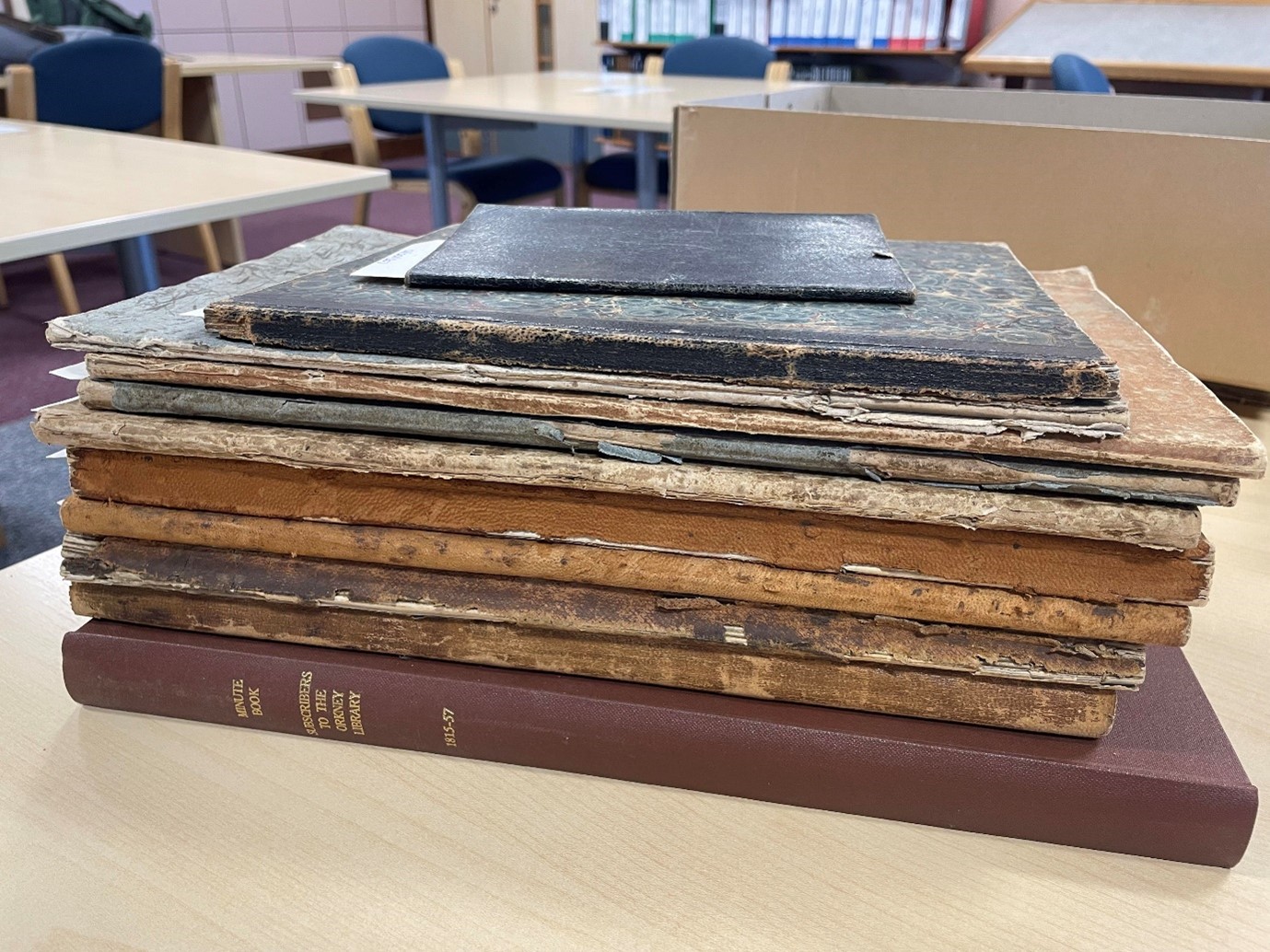
The Bibliotheck of Kirkwall – the collection of books bequeathed by William Baikie, Stronsay, in 1683, which founded Orkney Library – is known as the oldest public library in Scotland.[1] In 1815, this collection became part of a new subscription library alongside other donations of books by subscribers. Sadly, this iteration of the library is vastly understudied. J. B. Craven’s Descriptive Catalogue of the Bibliotheck of Kirkwall, a source which secondary scholars often look to, neglectfully summarises the library’s early nineteenth-century history in just one sentence: “The old Bibliotheck became afterwards incorporated with the ‘Orkney Library,’ which was instituted 23rd August 1815.”[2] This is despite plentiful surviving materials from the period, including borrowing registers, a minute book, a request book, subscriber lists, catalogues, and rules and regulations, which are housed in Orkney Library and Archives.[3]

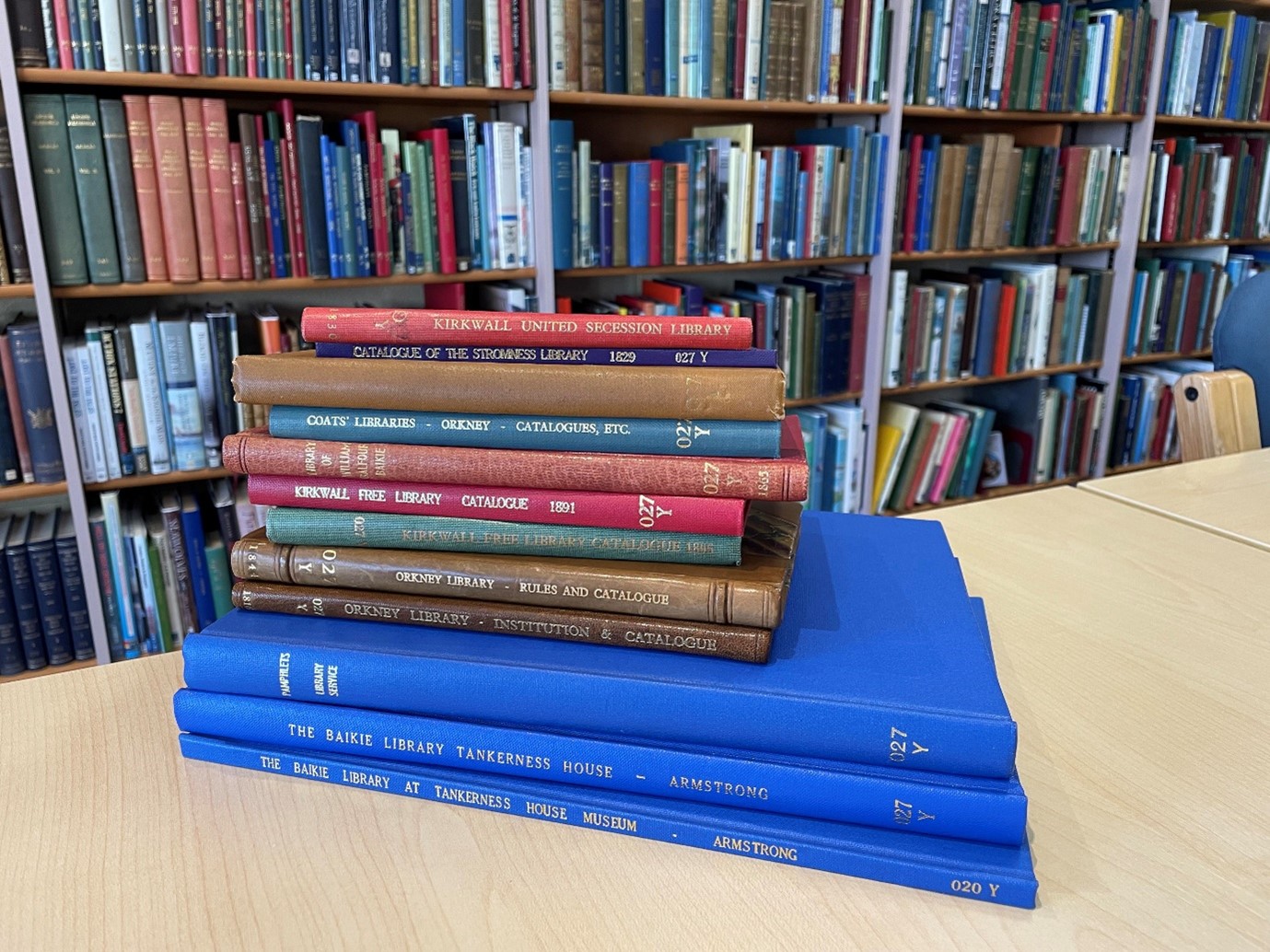
My dissertation is centred on the administration and use of Orkney Library in the Romantic period and so I spent much time with these crucial manuscripts. I also photographed electoral rolls, which I will use alongside online census and directory records to help build biographies about library borrowers. For a better understanding of nineteenth-century life on Orkney, I examined the Orkney and Zetland Chronicle and Orkney and Shetland Journal, the only two Orcadian newspapers from the period, as well as contemporary travel and guide books, including one written by Alexander Peterkin, a borrower of Orkney Library himself! I also endeavoured to photograph all library catalogues relating to Orkney Library and my time period, essential resources for tracking the changing collection of the library as well as considering other means through which borrowers might have accessed books.

A thanks must go to the staff in the archive for their enthusiasm about my project and recommendations. They were also kind enough to show me the first Bibliotheck catalogue, compiled in 1684. It’s funny to think that that piece of paper was the reason all of us were there – in the building that exists only because of Baikie’s bequest of the original 160 books over 300 years ago. I feel very fortunate to have seen it.

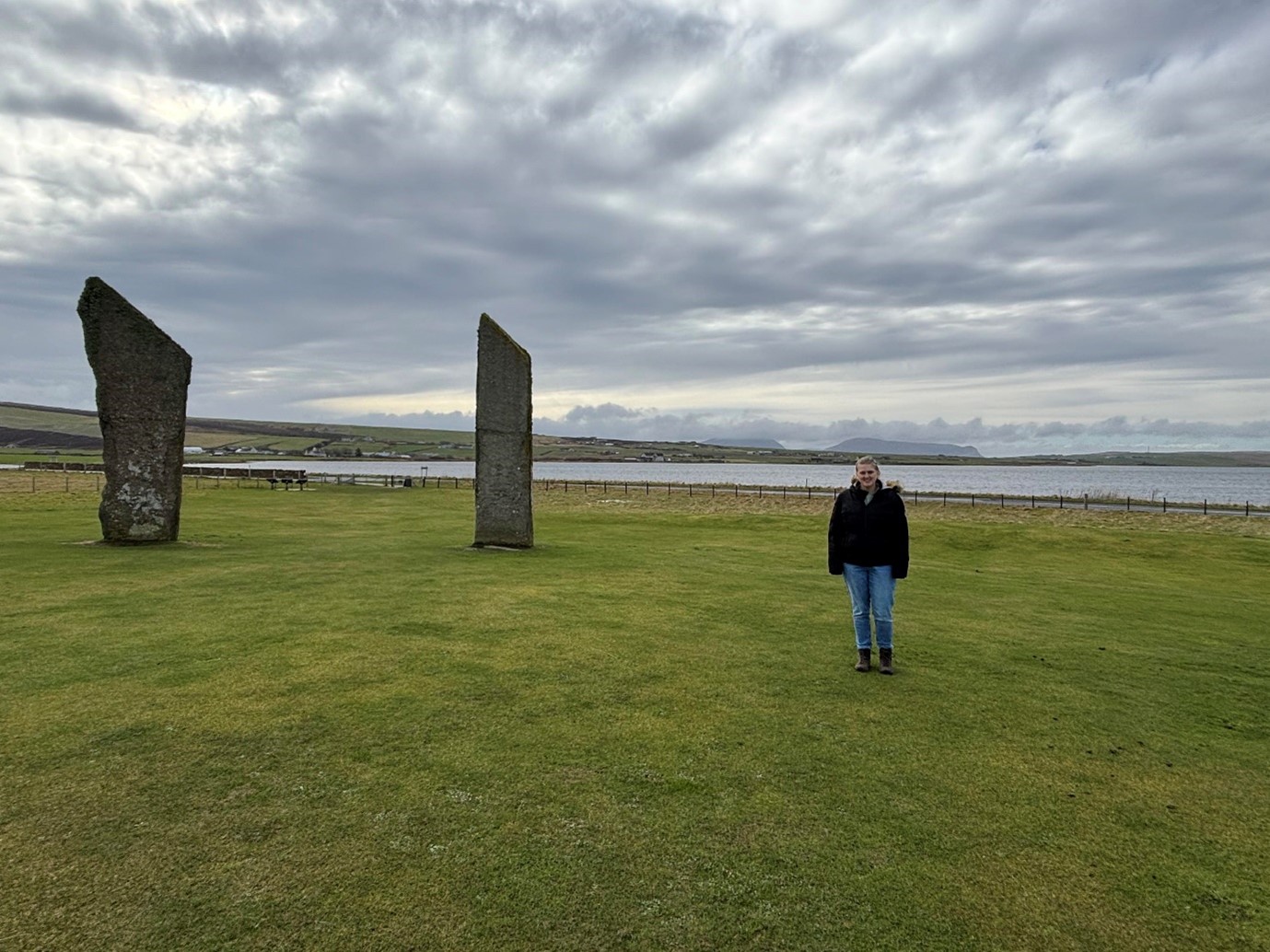
Although the archive was closed a couple of days during my trip, I made the most of my spare time. Most of it was spent reviewing and transcribing what I had seen so far in the archive, but one day was spent visiting the remains of some of Orkney’s neolithic structures – truly awe-inspiring! I started at Maeshowe, a tomb around 5000 years old which is covered in Norse runes from the Vikings’ time on Orkney, before visiting the Stones of Stenness and the Ring of Brodgar, and, finally, Skara Brae, the oldest village in Europe. Prior to my trip I had not realised how diverse and rich Orkney’s history is. I’m thrilled that I can contribute to this by researching another of its treasures – the oldest public library in Scotland.

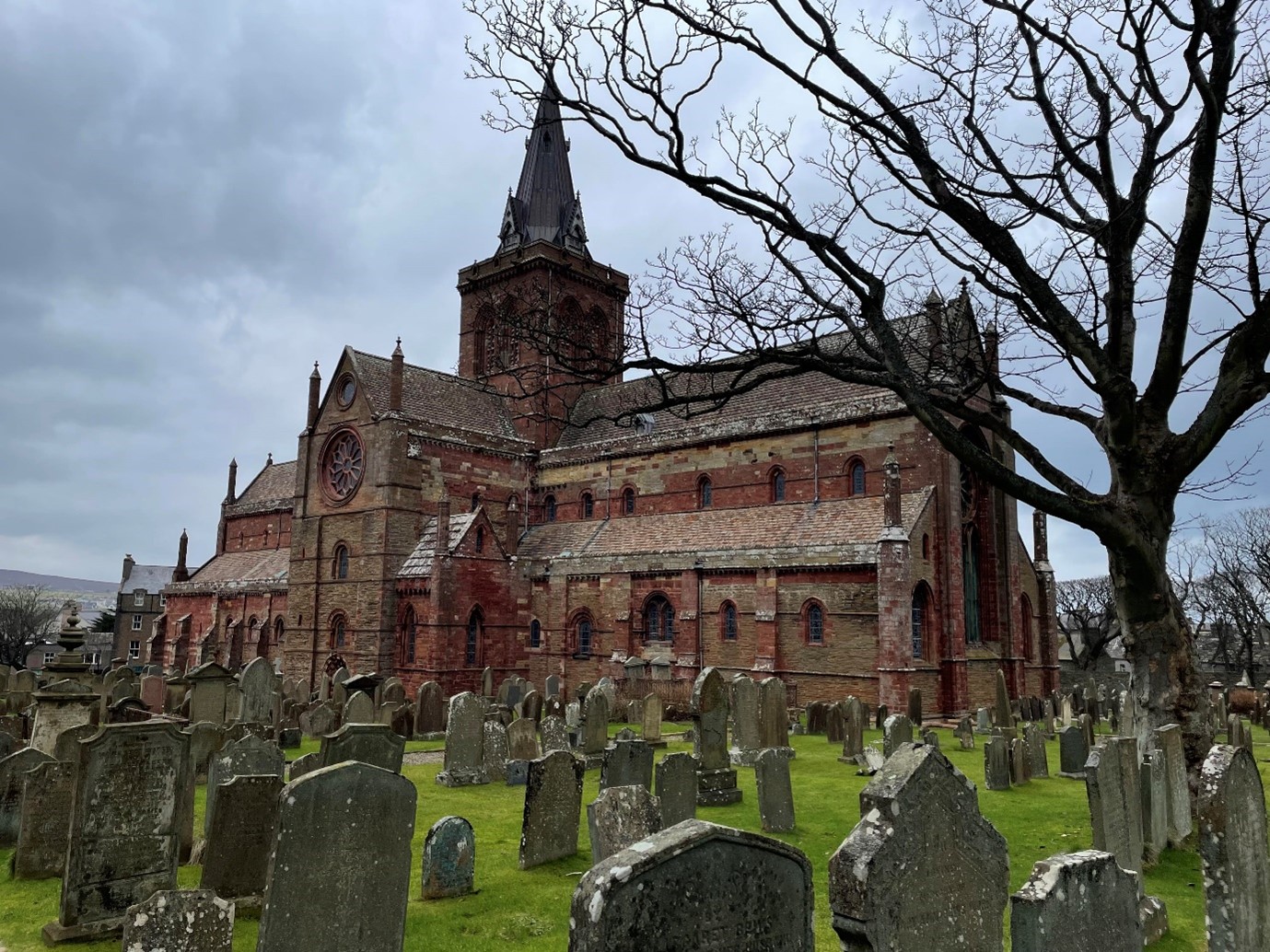
A lunch break from the archive was spent visiting St Magnus Cathedral, beautiful and worth a visit in itself but also the site of historical importance to the library, as the Bibliotheck was housed there for a time from 1689. Baikie’s body is also buried in the Cathedral, as is that of James Wallace, whom Baikie originally tasked with instituting the library and so can be termed the ‘first librarian’ of Orkney Library.

I feel incredibly privileged to have had the opportunity to visit Orkney and my research will be far better for it. I have a greater sense not only of Orkney life during the Romantic period, but also of how my research fits into its wider history, and I’m eager to revisit my photographs and continue transcribing the materials I viewed. Thanks must again go to BARS for offering me the Stephen Copley Research Award. I’m looking forward to sharing some of my findings from this trip at their ‘Romantic Making and Unmaking’ conference in July.

In the meantime, I shall leave you with this glorious sunset!


[1] https://orkneyarchive.blogspot.com/p/history.html

[2] J.B. Craven, Descriptive Catalogue of the Bibliotheck of Kirkwall (1683): with a Notice of the Founder, William Baikie, M.A. of Holland (Kirkwall: privately printed 1897), xi.

[3] Sadly there are two borrowing registers which are missing, covering the years 1824-1830 and 1835-1842. Helpfully, the minute book covers the entirety of my period of interest, which can reveal some of the library’s happenings during these gaps.

Biography

Jacqueline Kennard is a SGSSS-funded MSc Historical Research student at the University of Stirling. Her MSc dissertation is centred on the archive and borrowers of Orkney Library in Kirkwall. In October she’ll be beginning a PhD exploring nineteenth-century Scottish libraries and the role they play in establishing senses of class identity in their users. Follow her on Twitter/X here.

Conference Registration Open: ‘John Keats in 2024: Prospects and Retrospections’

      Comments Off on Conference Registration Open: ‘John Keats in 2024: Prospects and Retrospections’

This year’s conference, ‘John Keats in 2024: Prospects and Retrospections’, is to be held from 17 – 19 May at Keats House, Hampstead, London.

Those who wish to attend the conference dinner should complete registration by Friday 10 May 2024. No late requests will be entertained.

The regular fee for institutionally affiliated staff is £200 per person, which includes the administrative charges for letters of attendance and signed receipts for reimbursements.

Concessionary rates for undergraduate and postgraduate students, as well as unwaged participants will be £100.

These fees include the Conference dinner on Saturday 18 May.

Registration is on an individual basis per participant. The conference dinner comprises of a buffet with vegetarian options available, and includes a drink from the float at the bar. Further drinks are at your own cost. If you have any dietary requirements, please let us know by Saturday 4 May 2024.

Please visit https://keatsfoundation.com/conference/ to register.

Schedule


Friday 17 May 2024
2.00pm: REGISTRATION and WELCOME from the Keats Foundation team and Rob
Shakespeare, Principal Curator of Keats House, Hampstead at Keats House, The Nightingale
Room


2.30pm – 3.30pm: LECTURE 1: Andrew Bennett (University of Bristol)


3.30pm: Coffee / Tea


4.00pm – 4.50pm: PANEL 1: Keats’s Correspondence

  • Brian Rejack (Illinois State University): New Editorial Prospects for Keats’s Correspondence
  • Łukasz Mokrzycki (Adam Mickiewicz University, Poland): ‘I live in the eye…’ – John Keats and Giacomo Leopardi’s Views on Classical and Classicising Art. Evidence from the Letters

5.00pm – 5.50pm: PANEL 2: Keats and Editorial Practice

  • Peter Phillips (Independent Scholar): Poetry, Piety, Prudence, Profit: Keats’s dealingswith Publishers
  • Marie Michlova (Independent Scholar): Angel & Demons: Constructing Posthumous Image of John Keats


6pm WINE RECEPTION


Saturday 18 May: The Nightingale Room
9.30am – 11.00am: PANEL 3: Keats’s Soundscapes

  • Mina Gorji (Cambridge University): Fading out: Keats’ Sound Studies Carly Stevenson (University of Sheffield): ‘Strange sound’ in Isabella, or The Pot of Basil
  • Ernest Yuen (Chinese University of Hong Kong): Isabella, Soundscape, and the Industrial Revolution
  • Eric Eisner (George Mason University): ‘Hedge-crickets sing’: ‘Sounding Worlds’ and Reading Opacities in Keats and Robert Grenier


11.00am: Coffee / Tea


11.15am – 12.30pm: PANEL 4: Keats’s Poetic Form

  • Emily Rohrbach (Durham University): The snug study and the sonnet form
  • Rachel Kelley (Texas Tech University): Feel, Fair Creature of an Hour: The Petrarchan Pursuit of Time in Keats’s Sonnets
  • Eva Jenke (Humboldt-Universität, Berlin): Mirroring Shadows of Futurity


12.30pm: LUNCH


1.30pm – 2.30pm: LECTURE 2: Jonathan Mulrooney (College of the Holy Cross)


2.30 – 3.00pm: Coffee / Tea


3.00pm – 4.30pm: PANEL 5: Keats and Literary Criticism

  • Julie Camarda (College of the Holy Cross): Keats and the Biographical Method in Literary Criticism
  • Greta Perletti (University of Trento): ‘We blend, / Mingle, and so become a part of it’ – Towards an Ecocritical and New Materialist Reading of Keats’s Theory of Artistic Creation
  • Richard Marggraf-Turley (Aberystwyth University): Tales from the Infinite Loop: A Topological Perspective on Irony and Quotation in Keats, Hemans and Shelley
  • Merrilees Roberts (Independent Scholar): Keats and the eroticism of Hegel’s lyric objects


4.30pm: Coffee / Tea


4.45pm – 6.00pm: PANEL 6: Unravelling Keats

  • Meiko O’Halloran (Newcastle University): Keats’s ‘Shade of Memory’
  • Ou Li (Chinese University of Hong Kong): Keats between the Two Shields of Achilles
  • Enrico Brown (Independent Scholar): Keats’ Hidden World: Prospects of Uncovering It


7pm CONFERENCE DINNER at The Garden Gate


Sunday 19 May: The Nightingale Room


9.40am – 11.00am: PANEL 7: Keats and Aesthetic Theory

  • Małgorzata Łuczyńska-Hołdys (University of Warsaw): ‘Some ghostly Queen of Spades’: John Keats’s images of spectrality
  • Vivien Chan (Chinese University of Hong Kong): Keats, ‘Intermedial’ Pleasure, and Readerly Empathy
  • Ying-jie Chen (Cambridge University): Cute Keats?


11.00am: Coffee / Tea


11.15am: TALK FROM KEATS HOUSE INTERPRETATION OFFICER: Ken Page: Packet, Smack and Brig – a look at some of Keats’s ships.


11.30am – 12.30pm: LECTURE 3: Ella Kilgallon (Curator/Director, the Keats-Shelley
House, Rome)


12:30pm: LUNCH


2.00pm – 3.30pm: PANEL 8: Keats and his Contemporaries

  • Greg Kucich (University of Notre Dame): The Story of John Keats and Henry Kirke White – Episode Two: “We poor pilgrims in this dreary maze”
  • Angus Graham-Campbell (Eton College): Keats, Byron and Class
  • Kayleigh Williams (University of York): ‘Her hair was long, her foot was light, and her eyes were wild’: Elizabeth Siddal as a transmediator of Keats’s ‘La Belle Dame Sans Merci’
  • Sean Hughes (Imperial College London): Why did Oscar Wilde adulate John Keats?


3.30pm: Coffee / Tea


3.45pm – 4.30pm: PANEL 9: Keats’s Literary Legacy

  • Will Sherwood (University of Glasgow): Destabilising Temporality in the Fairy Poems of Keats and Tolkien
  • Michael Allen (Harvard University): ‘Pure coldness to our live imperfect eyes’: Keats’s Urn, Larkin’s Advertisements


4.45pm: CLOSING REMARKS


We will then take a walk to Leigh Hunt’s Vale of Health after the closing remarks. A final drink
at The Holly Bush pub on 22 Holly Mount is recommended, with dinner at everyone’s discretion.


The Keats Foundation is a UK registered charity, No. 114758

Stephen Copley Research Award Report: Vinita Singh on Children’s Sickness and Health in the Memoirs of the Long-Eighteenth Century

      Comments Off on Stephen Copley Research Award Report: Vinita Singh on Children’s Sickness and Health in the Memoirs of the Long-Eighteenth Century

The Stephen Copley Research Award helped me spend the last summer in Leeds, exploring valuable long-eighteenth-century archival resources located at the special collections in the Brotherton Library, University of Leeds. The primary research materials I consulted helped me develop my current postdoctoral project, which explores children’s perceptions of illness during the Romantic period in Britain.

As all projects mutate and develop throughout their research journeys, mine did, too. When I began exploring the resources held at the special collections, my goal was to locate primarily children’s letters from the period where subjects of their sickness and health were discussed however, as I progressed into my research, I was fascinated by the number of memoirs that were published during the long-eighteenth century about sicknesses and death of children. To my utter surprise, many of these memoirs were written abroad, often in the United States, and they were republished in Britain, often undergoing several reprints. Along with this, there were many memoirs originally published in Britain as well. Some publishers, for example, William Alexander, specialised in publishing memoirs of these kinds, with his advertisements placed in memoirs printed by other publishers too.

These memoirs about sick (and dead) children recorded not only the last phases of their sickness but also the whole journey, including the early onset of their illnesses and the slow progress over time. Many important stages in the development of diseases and their impact on children’s bodies were also recorded. For example, the memoir about Maria Mott’s sickness and death, titled A Short Account of the Last Sickness and Death of Maria Mott (1817), discussed how ‘the disease operated very severely, and being attended with distressing sickness of stomach for several days, soon reduced her strength so much that she was almost as helpless as an infant for a considerable time.’[1] Another memoir discussed an eleven-year-old child, Elizabeth Merritt, and her sickness and death stated that ‘between three and four years of age, she was visited with severe illness.’[2] Yet another memoir discussed a nine-year-old child, Jennett. B. Mott, and her sickness and death describes how ‘she was born a fine healthy child, and continued so till her third year, when, by an injury received on her back […] she began to complain of weakness and pain, which was increased in a distressing manner by the fever attending the hooping cough.’[3]

Along with this recording of the whole journey of a child’s ill health, the memoirs also discussed some remedies that parents employed in treating their children’s sicknesses. Maria Mott’s memoir, for instance, recollects how change of air benefited her recovery.[4] Similarly, Jennett. B. Mott’s memoir mentions how in order to tackle ‘the force of her disease’, she ‘was put under a strict diet, and had two blisters applied to her back every day, for six months’, and was given ‘nauseous medicine to take, many times a day for more than a year.’[5] Apart from providing details about symptoms of children’s diseases and how they progressed in specific cases, these memoirs also helped their readers see which remedies worked in actual instances and which proved futile. In this way, these memoirs can be considered to have helped their readers manage their children’s health by familiarising them with children’s diseases to some extent. This was more fascinating for me to know because my PhD project has explored that there was a surge in the number of popular health manuals written by university-trained physicians in the long-eighteenth century. In light of that knowledge, I also came to look at these memoirs as resisting modern medical opinion in some way.

Apart from the detailed picture of children’s symptoms, their sickness and the remedies employed, I found it striking that these memoirs consistently emphasise how patiently children bore their sickness and how this patience was more significant than that of other children and adults. For example, Maria Mott’s memoir mentions how ‘through the course of [her] long sickness, she showed a strength and firmness of mind not often met with, and during her confinement to her bed and chamber, (nearly two months) manifested much patient resignation.’[6] Similarly, Elizabeth Merrit’s memoir recollects her sickness ‘during which, her attendants observed her patience under suffering.’[7] Additionally, Jennett. B. Mott’s memoir mentions that ‘she bore [her sicknesses] with remarkable patience.’[8] If Maria Mott ‘was remarkably composed and sweet’ during her ill-health, Jennett. B. Mott ‘[manifested] great self-command and obedience’ when sick.[9] This consistent emphasis on children’s patience when sick and the transglobal fascination with such patient sick children’s memoirs (as evident in its reprints across the border) imply the cultural interest in seeing children suffering well. When childhood sickness and early death were rampant, there seemed to be a recognition of the fact that one must learn how to go through the whole experience, and that is where, I believe, the publication of these memoirs contributed: they instructed children and adult readers on how to be sick. Many memoirs clearly state the purpose of instruction behind them. Maria Mott’s memoir, for instance, states that it was ‘not originally designed for publication’, but since the story was ‘perused with much interest’ by [parents’] friends who also considered it ‘to be worthy of general circulation’, the text was published.[10] In the case of Elizabeth Merritt’s memoir too, the purpose of writing it is mentioned in the text, with parents exclaiming that it has been written ‘from a belief that some account of the life and last sickness of [their] daughter, Elizabeth Merritt, will prove instructive to the surviving part of the family, to her former associates, and perhaps to others of riper years’ which is why her parents were ‘induced to publish’ her memoir.[11] If contemporary popular health manuals written by university-trained physicians often taught their readers about the importance of restoring children’s health, these memoirs seem to have emphasised the value of undergoing sickness patiently when it strikes.

Apart from introducing their readers to the course of sickness a particular child experienced and asserting the instructional value of these stories of children’s sicknesses, these memoirs also tried to rebuild the early life of the deceased child. What I found very interesting is that most memoirs identify similar qualities in children’s nature to rebuild their past. For instance, most mention children’s interest in reading and spiritual subjects. For example, Elizabeth Merritt’s memoir stresses her inclination towards reading: ‘As she was particularly fond of learning, she soon began to read; her favourite companion then appeared to be her book, for the sake of which, she would frequently leave her little playmate.’[12] Similarly, Maria Mott’s memoir mentions that ‘being early taught to read, and furnished with books suited to her age, she soon acquired a taste for reading, delighted much in it, and was careful, as long as she lived, to devote suitable portions of time to this agreeable and useful employment.[13] Whether it is Elizabeth Merritt’s assurance to her anxious mother that ‘there is but one physician that can help [her]’ or Jennett. B. Mott’s exclamation to her grieving mother that ‘thou hast had many doctors to me, and they cann’t cure me, but the Lord can cure me, if he pleases’: most memoirs adopt a very similar format of writing.[14] These similarities in the reconstruction of children’s early lives suggest that these memoirs were possibly extremely popular in the period, with most people having read a few of them, leading to the adoption of a very similar format.

Children’s sickness in these memoirs is also depicted as a complex idea. Sick children are presented as more thoughtful beings from the beginning. For example, Maria Mott is described as having a capability to love ‘which [was] more than merely human’, suggesting some level of metahuman-ness in her personality before she got sick.[15] Similarly, Elizabeth Merritt’s memoir mentions her as ‘a child that early listened to the “voice of wisdom,” [and that] she was endued with a remarkable judgement in spiritual, as well as in temporary things.’[16] Additionally, in Jennett. B. Mott’s case, it is mentioned that ‘in all her discourse, there was a peculiar strength of mind observable, and a ripeness of judgement.’[17] ‘Her observations on the conduct of people, and on circumstances that had passed, bespoke a degree of reflection but rarely found in a child.’[18] This emphasis on how the deceased child was more mature than other children of their ages and even in comparison to adults around them convey the possibility that sickness perhaps was seen to have struck children who had something ‘more than merely human’ about them from the start.[19] This emphasis also implies that an early introduction to a life of sickness was considered to have made a child emotionally and spiritually more potent than others. Both meanings seem to be valid: sickness is presented to be affecting distinguished children, and it is also something that distinguishes them from other children of that age group.

Additionally, these memoirs present sickness as enabling children’s maturity and helping cultivate a fellow feeling in them. This was another way of looking at sickness beyond ideas of damage and destruction which popular health manuals of the period often presented. Maria Mott states that despite having ‘frequently thought of those people who traverse the deserts of Arabia, parching with thirst, but without water’, she had ‘have never until [she fell sick], been in a situation fully to sympathize with them’ and that during sickness her ‘tongue and throat [were then] in such a situation as to give [her] a pretty correct idea of the distress and suffering under which they must languish whose water [failed] in that burning clime.’[20] Similarly, Elizabeth’s Merritt’s memoir has her praying for the welfare of God ‘not on [her] alone, but on all thy afflicted children wherever they are’.[21] Additionally, when Jennett. B. Mott falls sick, she praises God to have blessed her with ‘a good bed […] when so many poor little children in New-York have not any to lay on!’[22] Sickness at an early stage familiarised children with the concept of suffering and ordeal and, in a way, improved their feelings for other sufferers. This approach to children’s sickness was more positive than the one offered by the health manuals of the period.

But unsurprisingly, as I found during my exploration, children’s painful voices lurk beneath these positive adult expectations of sick children. Jennett. B. Mott, for instance, is praised by her parents for her remarkable obedience and submission to God’s will. Nevertheless, the sickness ‘which she bore with remarkable patience’ has her often repeating to her mother: ‘I will try to be patient’; Dear mother! I will try to be patient’, indicating the effort that such patience required on her part.[23] Similarly, Elizabeth Merrit, who her parents describe as wholesomely patient and submissive throughout, grieves greatly the pain that slaughters her: ‘On third-day morning, being in great distress, she frequently said; that “her pain was greater than tongue could tell, and that if [her parents] knew how she felt, [they] [would] pity her,” while also requesting her mother to ‘supplicate [the] heavenly Father to relieve [her] from [her] pain.”’[24] Jennett. B. Mott’s statement to her mother that only ‘Lord can cure [her], if he pleases; and if it is not his will, [she was] willing to be sick to the day that [she] [dies],” bursting into tears, reflects her agony and pain, humanising these sick children more than the format of the memoir affords.[25] My research trip to the special collections was extremely fruitful, helping me to think of my postdoctoral project in more nuanced ways and I wholeheartedly am indebted to the financial help given by the Copley award to make this trip possible.

Biography:

Dr. Vinita Singh is a Postdoctoral research fellow at the Leeds Arts and Humanities Research Institute (LAHRI), University of Leeds. Her postdoctoral research project explores children’s letters written in the Romantic period about sickness, health, and wellbeing. She is a PhD graduate from the School of English, University of Leeds. Her doctoral dissertation, titled ‘Childhood Sickness and Health in British Romantic Writing’, was generously funded by the Leeds International Research Scholarship.


[1] Maria Mott’s memoir was originally published in New York along with its reprint in London in the same year. See Richard and Abigail Mott, A Short Account of the Last Sickness and Death of Maria Mott, Daughter of Richard and Abigail Mott of Mamaroneck, in the state of New-York (New York: Samuel Wood & Sons, 1817), p. 10.

[2] Elizabeth Merritt’s memoir was also published in both the United States and the United Kingdom in the same year, 1820. See John and Sarah Merritt, A Short Account of the Life, Sickness, and Death of Elizabeth Merritt: A Child Eleven Years of Age (London: William Darton, 1820), p. 4.

[3] Jennett B. Mott’s memoir was written by her mother and was yet again published both from the United States and the United Kingdom in the same year, 1815. See L. P. Mott, A Brief Account of The Life, Last Sickness, and Death, of Robert Mott, also of His Daughter, J. B. Mott (London: William Darton, 1815), p. 29.

[4] Maria Mott, p. 12.

[5] J. B. Mott, p. 30.

[6] Maria Mott, pp. 10-11.

[7] Elizabeth Merritt, p. 4.

[8] J. B. Mott, p. 30.

[9] Maria Mott, p. 19 and J.B.Mott, p. 30.

[10] Maria Mott, p. 2.

[11] Elizabeth Merritt, p. 3.

[12] Ibid., p. 4.

[13] Maria Mott, p. 8.

[14] Elizabeth Merritt, p. 8 and J. B. Mott, p. 36.

[15] Maria Mott, p. 6.

[16] Elizabeth Merritt, pp. 3-4.

[17] J. B. Mott, p. 31.

[18] Ibid.

[19] Maria Mott, p. 6.

[20] Ibid., p. 17.

[21] Elizabeth Merritt, p. 10.

[22] J. B. Mott, pp. 31-2.

[23] Ibid., p. 30.

[24] Elizabeth Merritt, p. 9.

[25] Ibid., p. 36.

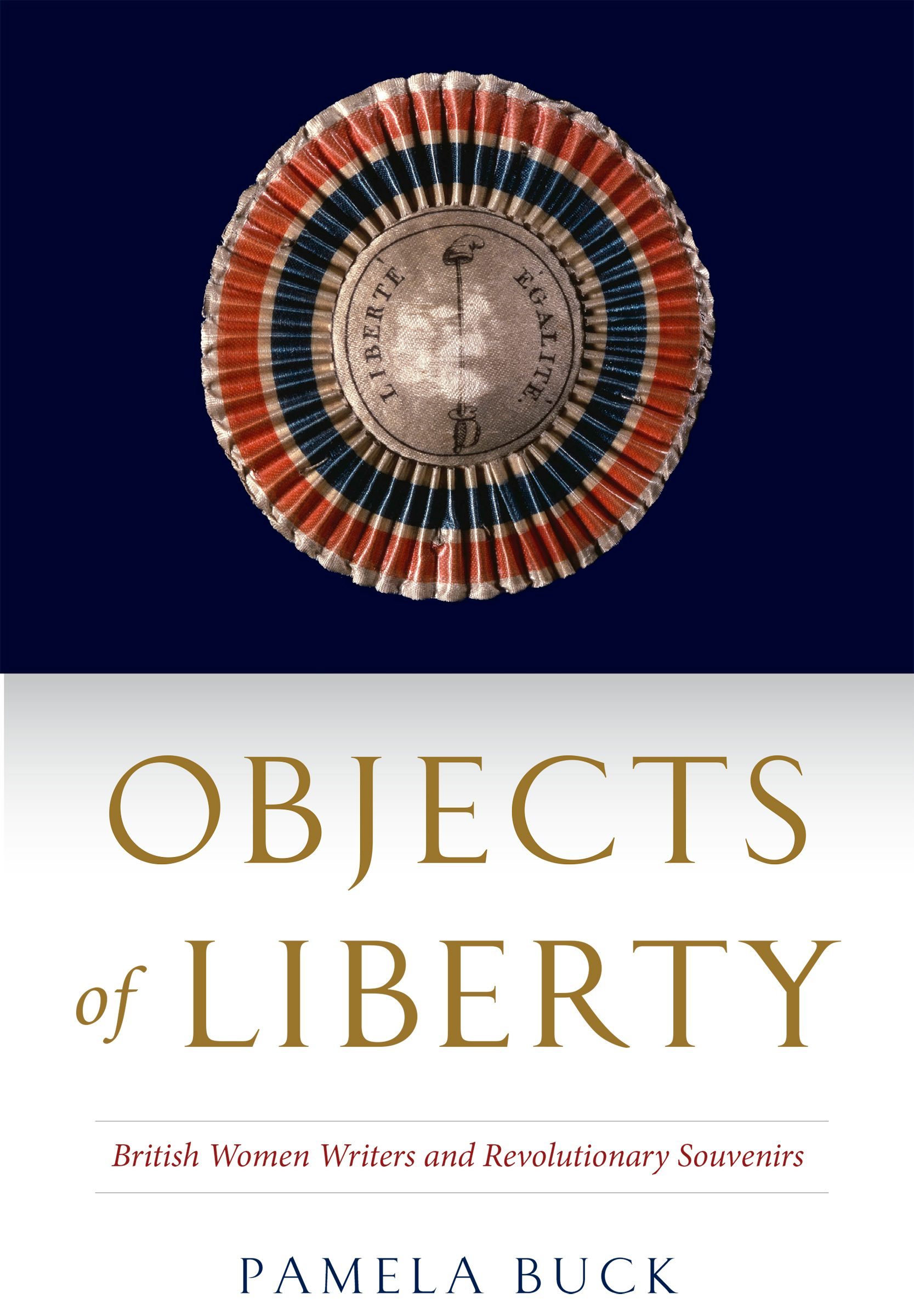
Five Questions: Pamela Buck on Objects of Liberty

      Comments Off on Five Questions: Pamela Buck on Objects of Liberty

Pamela Buck is Associate Professor of English at Sacred Heart University. She is a scholar of British Romantic literature whose work focuses particularly on gender, empire, and material culture. Recent publications include articles on Jane Austen and imperial trade (in LIT), recovering women’s travel writing (in European Romantic Review) and Anna Maria Falconbridge (in Women’s Writing). Her first book, Objects of Liberty: British Women Writers and Revolutionary Souvenirs, which we discuss below, has just been published by University of Delaware Press.

1) How did you first become interested in Revolutionary souvenirs?

Objects of Liberty began as a graduate seminar paper on Helen Maria Williams’ Letters from France in a course on the radical 1790s. I was struck by Williams’ collecting of small objects like tricolor ribbons, snuffboxes, and miniature models of the Bastille on her travels through Revolutionary Paris. She was essentially shopping for souvenirs, much as we do today. A souvenir is a small, relatively inexpensive object secured by a traveler as a memento of a journey and includes a wide variety of purchased or found objects, including keepsakes, relics, gifts, and physical fragments of a travel destination or experience. I noticed that it assumed an overtly political importance during the Revolutionary period. As I did further research, I discovered that other women writers participated in this trend, and I became interested in how they used the souvenir as a unique strategy to circulate revolutionary ideas and engage in the masculine realm of political debate.

2) What were the most important affordances of souvenirs for British travellers in France during the Revolutionary period?

Souvenirs allowed women to encourage support for revolutionary principles because they presented political events in appealing ways. Designed to be eye-catching, their attractiveness, simplicity, novelty, or humor could inspire collection or purchase, while their three-dimensionality encouraged physical engagement with them. Although ephemeral in nature, they rendered tangible the intangible, capturing moments and transforming them into memories.

As small objects, souvenirs scaled down large events to make the politics of the Revolution accessible to a broader public. Their diminutive size allowed them to be carried in pockets, held in the hand, and easily transported across borders. Women circulated souvenirs to provide visual representations of the conflict in France to an audience in Britain. By arranging and displaying them in domestic and private spaces, women brought controversial conversations into the home and used them to narrate political events and ideas.

A good example of this is a snuffbox Williams purchased that contained a picture of the Abbé Maury, whom Revolutionaries in France despised for supporting the old regime. Fixed on a spring, the image of the Abbé would have jumped out when the box was opened. Her snuffbox not only employed the sentiment of humor to provoke viewers’ laughter but also satirized a prominent political figure to encourage support for the Revolution. Despite their seemingly trivial nature, souvenirs afforded women a powerful means of conveying political ideas.  

3) How did women use souvenirs differently from their male contemporaries?

Collecting souvenirs was a standard practice of privileged Englishmen on the eighteenth-century Grand Tour that reflected their wealth and worldliness and increased their prestige at home. Female travelers who engaged in political tourism during the Revolutionary era used souvenirs to provide physical proof of eyewitness experiences and gain prestige in the form of authority. Souvenirs also gave women more opportunities for public involvement, allowing them to become political actors and advocate for citizenship. Although they were barred from voting or serving in Parliament, the fans, jewelry, and cockades they carried or wore publicized their political ideologies and allowed them to shape public opinion.

While men collected for power and control, women collected souvenirs to challenge dominant male narratives of empire and war. For instance, Charlotte Eaton redefined views of the Battle of Waterloo through souvenirs in A Narrative of a Residence in Belgium. While male tourists brought back body parts like teeth or skulls as war souvenirs that signified the conquest and plunder of empire, Eaton gathered tragedy souvenirs, such as packets of soldiers’ ashes, that served as objects of grief and mourning. Countering male collectors who presented the battle as a national victory, she conveyed the horror of war and balanced patriotism with the cost of conflict. In interpreting the male space of war through feminine concerns, she transformed the battlefield into a site of sympathy and commemoration.

4) How did you select the writers on whom your four central chapters and conclusion focus (Helen Maria Williams, Mary Wollstonecraft, Catherine and Martha Wilmot, Charlotte Eaton, and Mary Shelley)?

I chose to examine works by women writers that follow the pivotal moments of the period, from the Revolution Debate of the 1790s to the rise of Napoleon’s empire and his defeat at the Battle of Waterloo in 1815. Williams, who employed sentimental souvenirs to create sympathy for liberal ideas, was significant for marking a new direction in women’s political involvement during the early Revolutionary period. In response to Williams, Mary Wollstonecraft used peep-show souvenirs in An Historical and Moral View of the French Revolution to explain the violent turn of events in France and counter political spectacle during the Reign of Terror.

During the Napoleonic era, Catherine and Martha Wilmot utilized souvenirs in their journals to oppose Napoleon’s expanding empire and its threat to liberty. While Catherine collected a cabinet of curiosities in Italy to subvert his imperial acquisition of European art for the Louvre Museum, her sister Martha encouraged a political alliance between Britain and Russia through her exchange of miniature portraits with Princess Ekaterina Dashkova. As British tourists sought material reminders of their victory after Waterloo, Eaton employed souvenirs like panoramic maps and military relics to redefine notions of patriotism and national identity.

Although most studies of the period end here, I briefly trace the reemergence of ideas of liberty in the European nationalist movements of the 1840s. In the conclusion, I examine how Mary Shelley collected folk hero figurines, like those of Andreas Hofer and Toussaint Louverture, to evoke the democratic spirit of the Revolution and advocate for liberal reform in Rambles in Germany and Italy. Her work reveals how souvenirs persisted as a mode of political intervention for women and renewed the cosmopolitan vision of earlier writers.

5) What new projects are you currently working on?

I am currently working on several projects involving women writers and material culture in a global context. In an essay on Mary Ann Parker’s A Voyage Round the World, which documents the trade in animal products like feathers and skins from New South Wales, I demonstrate how Romantic interest in natural history and scientific collecting emerged with the rise of European colonialism. This essay is forthcoming in the volume Romantic Beasts, edited by Chris Clason and Michael Demson, from Bucknell University Press.

In another essay on archaeologist Amelia Edwards’ A Thousand Miles up the Nile, I argue that she criticizes the collecting of scarab beetle jewelry to contest British control of Egypt and Orientalist stereotypes about the Middle East. The piece is currently slated for the volume Pin-Ups, edited by Audrey Murfin, Sibyl Rae Bucheli, and Victoria Pettersen Lantz. These projects have me thinking how much I would love to write a second book on women travel writers, fashion, and imperialism.

I also will be contributing an introductory essay to an exciting new volume of The Cambridge History of Victorian Women’s Writing, edited by Carolyn Dever and Amy Kahrmann Huseby, that seeks to undiscipline Victorian studies by rethinking and reframing women writers of this period in a more global and inclusive way.

CfP: The Wordsworth Summer Conference, 2024

      Comments Off on CfP: The Wordsworth Summer Conference, 2024

Monday 5 August to Thursday 15 August
Rydal Hall, Cumbria
Call for Papers and Bursary Applications

Call for Papers

We invite proposals for twenty-minute papers on all aspects of William Wordsworth, his contemporaries and the Romantic period. Papers that identify a bicentenary theme, 1824–2024, will be welcomed but this is not intended as an exclusive requirement. Please note that participants presenting papers must attend as full participants for either Part 1 or Part 2, or the whole ten-day conference. 

Papers should not be longer than 2750 words.

All proposals for papers, bursary applications  (and references, if applicable) should be emailed by 12 noon (UK time) on Monday 29 April 2024 to

proposal.wsc@gmail.com

For more information on the conference and bursary applications, please see the attached PDF.

BARS/Wordsworth Trust Early Career Fellowship 2023 Awardees Announced

      Comments Off on BARS/Wordsworth Trust Early Career Fellowship 2023 Awardees Announced

The BARS Executive Committee working with Wordsworth Grasmere established the BARS/Wordsworth Trust Fellowship scheme in order to develop new approaches to the study of Wordsworth from unwaged and under-represented scholars. The fellowship offers on-site self-catering accommodation and £350 towards living expenses. The Wordsworth Trust will support the fellow in the development of activities or interpretation designed to examine the site and collection from different perspectives. Please do join us in congratulating the very worthy winners and their projects:

Rebecca Ferrier  – The Romantics as Early Adapters of Mindfulness through Movement

Adam Neikirk – ‘Writing like Wordsworth: Poetry, Emotion and Self-Understanding’ (deferred until 2024/2025)

Once they have completed their fellowships, each winner will write a brief report. These reports will be published on the BARS Blog and circulated through our social media. For more information about this scheme and other funding opportunities, please visit our website: www.bars.ac.uk.

Call for Papers: Women, Money and Markets (1700-1950)

      Comments Off on Call for Papers: Women, Money and Markets (1700-1950)

University of Sussex, Brighton

June 13th and 14th 2024

Our annual symposium is interdisciplinary in nature, bridging literature, material culture, gender studies and economic history, and aims to relate the debates of the period to modern day issues about the presence and position of women in the economy and media. As a well-established network of scholars from a range of disciplines, we welcome returning and new contributors each year.

We invite exploration, whether literary, historical or economic, of the experiences of women across the social spectrum, including submissions on a wide range of topics connected with women’s involvement in the marketplace and finance. Submissions in the form of individual papers, panels and roundtable discussions may be on the following themes:

  • Women participating in colonial economies, markets and/or trade;
  • Women involved in the receipt or delivery of relief; volunteerism; social and/or economic bonds forged between the poor and the non-poor; attitudes and emotions associated with wealth and poverty;
  • Women’s engagement in investment, banking, finance, gambling, or exchange, especially as documented through under-used sources;
  • Women as producers and/or consumers in the literary or other marketplaces (including, but not limited to, food, clothing, agriculture and raw materials)
  • Women contributing to economic theory and praxis;
  • The varying practices of women associated with currency, global and/or domestic markets and marketability;
  • Material practices associated with value, exchange and/or female creativity;
  • Representations of women at work or women’s involvement in: Trade and industry; professional services (such as law, finance, hospitality and the media); domestic service; the rural economy.

We particularly invite cross-cultural considerations of the above issues.

WMM members who are contributing to our edited collection, under contract with Boydell & Brewer, are welcome to present their chapter to the group.

For those submitting for the first time to Women, Money and Markets, please indicate if you would like your paper to be considered for publication in a current or future edited collection.

Please send 300-word abstracts to Emma Newport with an indication of your proposed format (individual paper, panel, roundtable, etc.).  If you are submitting a proposal for a panel, please include an abstract for each paper (up to 300 words each).

Deadline for submissions: April 1st 2024

Organisers: Dr Emma Newport (University of Sussex) and Dr Joyce Goggin (University of Amsterdam). For enquiries regarding the programme, please contact: e.newport@sussex.ac.uk or see womenmoneymarkets.co.uk