Stephen Copley Research Report: Alix Gallagher on Malta’s influence on Coleridge

My PhD examines respiratory embodiment in Romantic theatre, particularly that of S.T Coleridge. I was extremely grateful to use a BARS travel scholarship in October to visit the National Library of Malta theatre archive and Melitensia collection at the University of Malta, to study records from 1804-805 when Coleridge lived in La Vallette.

There has been limited work on the setting of Malta as influential to Coleridge’s dramaturgy, including brief mention in Donald Sultana’s authoritative book Coleridge on Malta (1969). Most attention has been paid to Coleridge’s political writing due to his job as administrator for the British protectorate in Malta. Hough and Davis (2010) have re-examined government records at Rabat and Greenwich, to form the perspective of Coleridge as an accountable civil servant.

During my visit, I questioned whether Coleridge’s stay on the island, where he sketched scenes and productions for the stage, was instrumental in Coleridge’s shift into a Romantic playwright and realised in a successful Drury Lane production after his return?

Given Coleridge travelled (only partly successfully) to improve his physical and mental health, and it was one of his most productive periods of journal writing, I aimed to explore the theatre and medical histories relating to Coleridge’s time on Malta with their overlapping contexts of imprisonment and respiratory metaphor. Were there physiological responses specific to the Malta setting, of quarantine or its different atmospheric climate for example, that inspired his new content on dramas and the spoken word? In addition to personal health, were there influential local productions that he encountered?

Limited, incomplete theatre records of 1804-1805 due to no freedom of the press are a challenge. Renowned local historian Paul Xuereb’s history of the Teatru Manoel, Valletta’s main performance space, notes the near absence of records 1804-1806 while William Zammit’s work on print culture in Malta discusses items destroyed or discarded in the transference of power between the Knights to the French, then the British. I am extremely grateful to Prof Marco Galea from the University of Malta for taking the time to meet with me, and to share his deep knowledge of Maltese theatre history including the Manoel Theatre on whose archives board he is a member.

Inside the Theatre Maoel, Valletta

The Manoel Theatre was attended by Coleridge and the Governor Alexander Ball and mentioned in Coleridge’s notebooks. It was therefore very important to study the late nineteenth-century handwritten manuscript of local musicologist and historian M.A Borg’s ‘Cronistoria’ in the National Library archive, the only document that combines theatre contracts, names of lead actors and soloists and some names of performances. The operatic libretti in the University of Malta’s ‘Melatensia’ archive from the period Coleridge lived in Valletta and San Anton, were also indicative of the performances Coleridge experienced, and wrote about, sometimes with disdain, in his notebook. I am grateful to Matthew Cuschieri at the University of Malta (Msida campus) for locating these and providing additional material on local folklore pertaining to vocal tradition and local ‘airs

In keeping with 19th Century slower modes of travel (and to save money), I had travelled by overnight train through Italy and used local ferries to reach the archives. This meant that my first view of the harbour and former quarantine island were from the water – as would have been the case for visitors and naval staff in 1804. It was a multi-sensory experience of the Maltese winds and Autumnal airflow which Coleridge met with theatrical observations. Coleridge’s new respiratory comments in his notebooks and letters, in response to Malta’s weather, its airs and temperature, are clearer to me now having experienced the climate’s comparative dryness. The Knights of the Order of St John used a softer Globigerina limestone to construct Valetta and the surrounding fortified cities that together form Il Kottonera (including Senglea where I stayed). There was a dryness and faint dustiness that felt unfamiliar to my lungs in the towns encircled by huge rock walls, looming cathedrals, and steep stone stairways. I recorded in my notebook feeling thirsty and dehydrated on land.

On the Ferry to the National Library archive

Travelling to Valletta meant I could walk to the site of Coleridge’s quarantine in Malta’s lazaretto on Manoel island. The hospital was recognised by John Howard’s An Account of the Principal Lazarettos in Europe (1789) for its vigorous enforcement of procedure. It is notable that, in the centuries since Coleridge was administrator of the hospital, the land has not been developed. I was excited that the hospital quarantine station ruins were still visible, and partly accessible, and struck by the soundscape of this remote isolation. I took recordings of the wind across the rocks and trees, to compare with Coleridge’s descriptions produced while impounded in quarantine on his return from Sicily. It was just in time. The land on Manoel island and its remaining lazaretto structure are about to be regenerated by construction company MIDI plc into offices, an underground car park and casino hotel complex. 

Ruins of Malta’s lazaretto on Manoel island

In conclusion, the research trip has brought my PhD’s project strands of respiratory health and affective theatre experience, into clearer focus. Malta is an excellent case study for Coleridge’s complex medical context that interweaves his illness self-identity with an evolving self-conceptualisation as a playwright. Without the support of this BARS travel scholarship, the visit and network to draw on in subsequent work with this material are unlikely to have happened.  

Alix Gallagher

Alix is a third year PhD candidate (part time, late career, early researcher) in the School of Critical Studies at the University of Glasgow. Alix’s AHRC funded inter-disciplinary project puts early nineteenth-century literary and performative context in dialogue with the history of breathing science and performers’ personal medical histories.  Alix teaches in London and runs creative writing interventions with students in mainstream and hospital school systems.

Email: a.gallagher.2@research.gla.ac.uk 

Twitter: Galixg 

Postdoc Opportunity: “Drinking Cultures: The Cultural Reception of Medical Developments Related to Alcohol in Ireland, 1700-1900.”

      Comments Off on Postdoc Opportunity: “Drinking Cultures: The Cultural Reception of Medical Developments Related to Alcohol in Ireland, 1700-1900.”

Closing date 8th December 5pm.

Applications are invited for two 36-month postdoctoral positions at University College Dublin working on the exciting interdisciplinary Wellcome Trust funded project “Drinking Cultures: The Cultural Reception of Medical Developments Related to Alcohol in Ireland, 1700-1900.” The “Drinking Cultures” project is the first long-view study to analyse the relationship between medical constructions of alcohol misuse and literary representations of alcohol consumption in Ireland from 1700-1900. Candidates should have evidence of research expertise in Medical Humanities or 18th-19th century Irish literature. 

Applications are particularly encouraged from those whose work involves studying topics such as: literary representations of alcohol or drug use; the medicalisation of habits and behaviours in the eighteenth or nineteenth centuries; the cultural dissemination of medical concepts or frameworks in literary texts in the eighteenth or nineteenth centuries; governmentality and the disciplinary apparatus in eighteenth or nineteenth century Irish culture. 

Informal inquiries should be directed towards Dr Lucy Cogan (lucy.cogan2@ucd.ie)

About the Role:

Applications are invited for two Temporary posts of Post-doctoral Research Fellow Level 1 within UCD School of English, Drama & Film. The successful candidates will work on the Wellcome Trust funded project “Drinking Cultures: The Cultural Reception of Medical Developments Related to Alcohol in Ireland, 1700-1900” under the direction of Dr Lucy Cogan. The “Drinking Cultures” project is the first long-view study to analyse the relationship between medical constructions of alcohol misuse and literary representations of alcohol consumption in Ireland from 1700-1900. The project’s multi-directional approach considers how the medicalisation of drunkenness 1) shaped depictions of the behaviour in Irish literature, 2) how these literary depictions impacted the wider culture, and 3) how culturally-embedded constructions of “problem” drinking among the Irish then influenced medical understandings via the deep-rooted association between Irishness and drunkenness, which still affects health policy today.

This is an academic research role, where you will conduct a specified programme of research supported by
research training and development under the supervision and direction of a Principal Investigator.
The primary purpose of the role is to further develop your research skills and competences, including the
processes of publication in peer-reviewed academic publications, the development of funding proposals, the
mentorship of graduate students along with the opportunity to develop your skills in research led teaching.

Information regarding how to apply can be found here:

https://www.timeshighereducation.com/unijobs/listing/357899/post-doctoral-research-fellow-school-of-english-drama-and-film/?TrackID=4

Call for Papers: BARS 2024 – Romantic Making and Unmaking

      Comments Off on Call for Papers: BARS 2024 – Romantic Making and Unmaking

The British Association for Romantic Studies is glad to launch the Call for Papers for its 2024 International Conference, Romantic Making and Unmaking. The text can be found below and on the dedicated conference website.

This year, BARS is testing an alternative model to try and provide both a good and affordable in-person experience and a strong and accessible programme for those unable to travel to Glasgow. More details below, but essentially, rather than streaming sessions from Glasgow, we’ll be asking in-person presenters to record their presentations themselves so we can make them available for a limited time in a digital archive, while also having two synchronous online days the week after the in-person conference, timed to allow presenters around the world to present live at a time that’s reasonable for them.

We hope you’ll consider joining us in Glasgow, online or both next summer – any questions, please feel free to email us on BARSConf2024@gmail.com.

The British Association for Romantic Studies 2024 International Conference

Romantic Making and Unmaking

In Person: University of Glasgow, Tuesday 23rd – Thursday 25th July 2024

Online: Thursday 1st – Friday 2nd August 2024

Plenary Speakers

John Gardner (Anglia Ruskin University)

Michelle Levy (Simon Fraser University)

Fiona Stafford (University of Oxford)

Textual Editing Plenary Roundtable: Elizabeth Edwards (University of Wales); Tim Fulford (De Montfort University); Craig Lamont (University of Glasgow); Alison Lumsden (University of Aberdeen)

Online Plenary: TBA

In Scots, the term ‘Makar’ means poet, but can also refer more widely to ‘[o]ne who fashions, constructs, produces, prepares, etc.’ (Dictionaries of the Scots Language). The British Association for Romantic Studies’ 2024 International Conference draws upon this plethora of meanings, inviting contributions that explore the cultural, social, political and artistic implications of making and unmaking.

The ways in which texts and artworks are constructed, framed, assembled and promoted preoccupied many Romantic-period creators, and Romanticism has long been at the forefront of editorial projects devoted to establishing, embedding or reimagining literary canons and canonicity. More broadly, in the wake of Enlightenment projects like the French Encyclopédie with its emphasis on craft, technical progress and artisanal knowledge, the industrial innovations of the Romantic period were fueled by a host of ‘makers’. These included artisans of scientific instruments, machines and processes, as well as the publishers, engravers, typesetters and printers who supported the burgeoning trade in books. The tension between mechanisation and artisanal skill was crucial in discussions of progress and protest, informing a tangle of discourses of improvement and decline that extend to the ecological thinking threaded through Romantic-period culture. We invite contributions on all these issues and on any work in Romantic studies that intersects with making and unmaking.

Topics that papers might address could include (but are not limited to):

  • Processes of artistic creation (drafting, revision, collaboration, manufacture)
  • Self-fashioning and the making and breaking of reputations
  • Editing, anthologising and reviewing
  • The negotiation of social value (including feuds, contentions and controversies)
  • Craft practices, industrialisation and mass production
  • Making and unmaking nations, regions and polities 
  • (Re)conceptualisations of canons, taste and aesthetics 
  • Making and unmaking genres
  • ‘Maker’s knowledge’ and Romantic science
  • Constructions and despoilations of the natural world
  • Modern processes of scholarly making (including editions and digital resources)

The conference invites both in person and online participation. The synchronous elements will consist of a three-day in-person event at the University of Glasgow, with a two-day digital event the following week. The in-person conference will not be streamed, but in-person participants will be encouraged to upload recordings of their papers, which will be made available in a digital archive accessible to both in-person and online participants for a limited time.

We invite two kinds of proposal: individual papers and full sessions. We are also happy to facilitate session calls.

Session Calls: To propose a potential session you would like to assemble, please email us directly with a description by Friday December 15th (using BARSConf2024@gmail.com). Specify whether your proposal is for an in-person or an online session. We will post accepted proposals on the conference website; potential participants can then get in touch with you directly so that you can submit full details ahead of the deadline using the session proposal form.

Individual Papers: To submit a proposal for a 20-minute paper, please fill in either the in person or online proposal form as appropriate. Both forms ask for a 250-word abstract, a biographical note of up to 100 words and contact details. The forms also have dedicated questions covering accessibility; food and accommodation for Glasgow; and time zones for the online days.

Glasgow paper proposals (in person): https://forms.gle/AWzhKxQtZHZh2jCJ9 

Online paper proposals: https://forms.gle/aJQXR7wDmSkcnpKL8 

Session Proposals: To submit a proposal for a full session, please fill in either the in person or online session proposal form as appropriate. The form asks for a session title, details of the theme, a description, and a list of the participants and their email addresses. We ask that each participant in a proposed session also submit an individual form using the appropriate link above – this is so we have their individual preferences and accessibility information.

Glasgow session proposals (in person): https://forms.gle/kVmqQjbhSM2yGwQm6 

Online session proposals: https://forms.gle/FgnAZzoberGYqvcJ7 

The deadline for submissions for full panels and individual papers is Friday 19th January 2024
Enquiries may be directed to the conference email account: BARSConf2024@gmail.com. For information and updates, please visit https://bars.ac.uk/conference2024/.

The BARS/Wordsworth Trust Early Career Fellowship 2023

      Comments Off on The BARS/Wordsworth Trust Early Career Fellowship 2023

We would like to invite Early Career Researchers who are not in permanent employment to apply for a one-month residential Fellowship with the Wordsworth Trust at Grasmere.

Two Fellowships are available January to March 2024.

Wordsworth Grasmere is centred around Dove Cottage, the Wordsworths’ home between 1799 and 1808, where William wrote most of his greatest poetry and Dorothy wrote her Grasmere journals. Their lives and writings are at the heart of the Trust’s collection of over 68,000 books, manuscripts and works of art; the collection also encompasses wider Romanticism and the ‘discovery of the Lake District’ 1750-1850.

This Fellowship follows one of the most exciting and transformative times in the Wordsworth Trust’s history. Our major NLHF-funded project ‘Reimagining Wordsworth’, completed in 2021, seeks to raise awareness and change perceptions of Wordsworth’s life and work, furthering his own wish for his poetry to ‘live and do good’. The site has been transformed: Wordsworth Grasmere now has a redesigned and extended museum, a new learning centre, a newly interpreted Dove Cottage and two new outdoor spaces alongside an extensive programme of engagement and activities in Cumbria and beyond.

The Wordsworth Trust is also committed to Arts Council England’s ‘Lets Create’ vision. We believe that by welcoming a wide range of influences, practices and perspectives, we can better understand our own collection and the stories it can tell, thereby enriching our public programmes. The purpose of this Fellowship is to help us achieve just that – to examine the site and collection from different perspectives, and to use these new perspectives and knowledge in public programmes – a display, an online exhibition, an activity for visitors and / or perhaps an event.

The most recent example of something similar is (Re)Acting Romanticism: Disability and Women Writers created by Harriet McKinley-Smith, a PhD student at Oxford University. See https://www.torch.ox.ac.uk/reacting-romanticism-disability-and-women-writers. A visitor to the display in the Museum at Grasmere wrote: ‘Thank you for the disability exhibit. As a woman with an invisible disability, I have never felt more visible’. The impact of this Fellowship in doing something similar could be substantial, not only in helping us shape the direction of our public programmes, but in its potential to bring about positive change in the way people see our subjects, collections and themselves.

We are open to your suggestions for subjects to research. However, we would be very interested to receive proposals which might lead to interpretation and learning activities relating to the colonial links and legacies found within the Trust’s site and collections; how the writings and art within the collection might help us develop a call to action to the climate crisis; or perhaps explore Romanticism and social inequality.

We are open to discussing what form of activity / display would work best for the subject and audience you choose. You will receive advice and training (as much or as little as you wish) from the Collections and Learning team, led by Jeff Cowton (Principal Curator and Head of Learning).

We particularly welcome applications from candidates that are under-represented, including candidates from low-income backgrounds, and/or candidates with disabilities (we are happy to discuss any reasonable adjustments that we can make).

The Fellowship provides on-site self-catering accommodation for one month; we would prefer the residency to take place as soon as is convenient to the applicant, if possible between now and the end of March 2024. The Fellowship also provides £350 towards travel and living expenses. All applicants must be members of BARS.

Application procedure: on no more than two sides of A4, provide your name, email contact details, institutional affiliation (if relevant), current employment status, a brief biographical note, a description of your PhD thesis, details of the proposed research and audience-based activity, and preferred period of residence. The successful applicants will show enthusiasm for audience engagement demonstrated in initial ideas of their proposed project.

Send the application as an attached Word file to Jeff Cowton (J.Cowton@wordsworth.org.uk) and BARS Secretary Dr Andrew McInnes (bars.secretary@gmail.com) no later than 15th December 2023. The successful candidate will be informed as soon in January 2024 as we can.

Between Text and Image: Print Media and Visual Culture in the Long Nineteenth Century

      Comments Off on Between Text and Image: Print Media and Visual Culture in the Long Nineteenth Century

Written by Adele Douglas, a PhD student in History at Manchester Metropolitan University. Adele’s project is on PETERLOO IN MANCHESTER; MEMORY, LEGACY, AND LOCAL IDENTITY 1819-2019

‘Between Text and Image’, which took place on 14 September 2023, was the latest in a series of collaborative events brought together by the Long Nineteenth Century Network and the Special Collections Museum, both at Manchester Metropolitan University. Inspired by the museum’s collection of nineteenth-century periodicals, this symposium brought together researchers from across the globe looking to reflect on the variety displayed across this dynamic medium.

This is the second Long Nineteenth Century symposium I have attended, the first being May’s ‘Decolonising the Nineteenth Century Collections.’ The two events followed a similar format, with coffee and networking to begin with in the museum space itself, allowing attendees to take in source material pertaining to the upcoming lectures and workshops. It is an excellent way of informally setting the scene, and the objects on display are good talking points – especially for attendees like myself who find small talk overwhelming – to be able to connect over a shared interest in the materials is refreshing.

The event proper kicked off with a plenary lecture from Jennie Batchelor, Professor of English at the University of Kent (about to move to the University of York). Her lecture focused on format, on how meaning is writ through stylistic and layout decisions as much as through the text and image. Using The Ladies Magazine as a means to explore these ideas, Prof Batchelor considered how publications directed at women project specific approaches to consuming the material and how format and style impact the reading experience. Using examples of articles published in the magazine pertaining to marriage, she argued effectively that The Ladies Magazine saw itself as spearheading a revolution in female manners and was designed to prepare young ladies for the ‘real world’ – by warning them of the danger of tyrannical husbands, for example. The examples of articles discussed highlighted the importance of ongoing context in magazines and periodicals and showed that magazines were not a stand-alone nor frivolous form of media, despite years of academic dismissal. This idea of ongoing context came into play as Prof Batchelor approached the topic of digitisation; accepting that most researchers will view nineteenth century periodical publications in this format and acknowledging the accessibility of a digital format. It is, however, important to account for the failings of digitisation to fully replicate the original reading experience and thus how much we can truly ‘know’ the publication as intended when only reading articles in isolation, driven by targeted keyword searches. 

After a short break, the symposium reconvened for the first panel session: Text and Image. The first speaker, Professor Emily Rohrbach from Durham University, focused on the work of poet Letitia Elizabeth Landon. Landon’s work is some of the most quoted within private scrapbooks and journals of the Nineteenth Century. Many of the scrapbooks held by MMU in the Sir Harry Robertson Page Collection contain lines of her work, either cut from magazines or transcribed by hand. Prof Rohrbach noted that despite her work lending itself to the medium of scrapbooking, and her own personal fascination with manuscript as a medium; most of Landon’s work was print work, appearing in magazines, monographs and gift books. However, by viewing poems published by Landon in The New Monthly Magazine, she argued effectively that Landon was aware of this secondary use of her work and structured it in order to appeal to the scrapbooker via use of format, quotation and epigraph. Dr Rohrbach’s enthusiasm for Landon’s work was genuine and evident throughout; and, as she stated at the closing of her lecture, this was a small insight into ‘a literary world that is both shared and individual.’


The second lecture in this section was by Dr Amy Matthewson (of both the University of Iceland and SOAS). Dr Matthewson focused on representation of Chinese culture during Nineteenth-Century conflicts- the Opium Wars and the Sino-Japanese conflict- focusing on one British publication, The Illustrated London News. This lecture was my personal favourite, potentially as it was closer to my comfort zone of examining historical sources, but also due to Dr Matthewson’s clear, well thought out and informative presentation. She noted that The Illustrated London News used a range of illustrative techniques, from traditional Chinese and Japanese wood block press to the ultra-modern medium of photography. However, some of the pictures were created in ways that today we would consider to be unscrupulous. Many of the illustrations were directly lifted from William Alexander’s late eighteenth century observational illustrations of China but reappropriated his celebratory and factual sketches to display the Chinese as warlike enemies during the conflicts. Dr Matthewson acknowledged the challenge depicting such far away conflicts must have been for the illustrators, and that the approach they took blended what the British public thought they knew about Chinese culture with new information; but did not shy away from the fact that many of these representations were both plagiarised and presented in a way we would now consider inappropriate- often captioned in ways that seem patronising, pandering to the idea the British public could not manage such ‘foreign’ material without guidance.
What linked the two lectures in this section is not just that intersection between text and image, but the concept of repurposing text and image, be that for personal or commercial reasons.

After a lunchbreak, the conference reconvened to look at one particular type of image- the caricature. Françoise Baillet, Professor of British History and Culture at Caen Normandie University, France, introduced us to the Punch Pocket Book. These books were produced yearly, at Christmas, ready for the next year. Part diary, part almanac, with a pleasing exclusive central cartoon by one of the leading Punch cartoonists- think Leech or Tenniel- and tables of information around topics as varied as contact details for Whitehall departments, or lists of population data for UK cities. Described as “a happy cumulation of business and pleasure,” the Pocket Book offered the Victorian public a portable centre of memory. Leatherbound, and with display cases available, this was a product designed to be retained after one had finished annotating it. Dr Baillet is part of an initiative to digitise these items, but believes, as she clearly articulated, that turning them into a durable resource raises questions not only about the reading experience (similarly to Dr Batchelor’s lecture around digitised periodicals), but around intimacy. The Pocket Book was designed to be used as a diary and this is reflected in the copies held in the Punch archive. Some have had the handwritten pages removed, others have left them in. Some have evidence of having been used by an entire family, not just one individual. This creates very different source material, as each copy, even those of the same edition, become very different documents. This juxtaposition of the public and private sphere creates a challenge for digital archivists, but the wealth of knowledge we can glean from the Pocket Books will be invaluable.


This was followed by Sourav Chatterjee, a PhD candidate at Columbia University, who introduced the symposium to his work on Basantak, or The Bengali Punch. Only in print for three years, and initially a reaction to attempts to curb press freedom, it took a stance against colonialism by mocking British officials in India. But, Chatterjee argued, it went deeper than pure imitation. In a climate where media suppression of local publications was contrasted by a deluge of British periodicals and newspapers (more often than not used as a vehicle for colonial soft power); to use the tropes often found in publications such as Punch to mock the colonial regime was an act of subversion. By using characterisations that were well known to local people, but not widely understood by the British, Basatak occupied the same satirical space as Punch and deconstructed the colonial narrative via the appropriation of one of the most potent mediums of the oppressor. 

Following the lectures on satire, the symposium ventured into the exhibition area for a short introduction by Dr Emma Liggins and Professor Brian Maidment to the new exhibition- Nineteenth Century Mass Media: Magazines, Annuals and Scrapbooks. This was coupled with an opportunity to view some of the collection that inspired the exhibition, and to hear Professor Maidment discuss how he had begun the collection of these periodicals upon arriving at what was then Manchester Polytechnic in the 1970’s.

The final plenary lecture was from Deidre Lynch, Professor of English Literature at Harvard University. Titled “’The diamond quit – with me the pencil take’: Albums and the Enduring Ephemeral,” Prof Lynch focused on the nineteenth century scrapbook as a piece of memory work. Noting that the contents often gravitate towards inscription poetry, memorialisation, even copies of gravestone inscriptions to document visits. This raises questions of context dependency; the example given by Prof Lynch of does a poem, etched onto Lake District stone by William Wordsworth, lose something when transcribed in pencil into a scrapbook in London? Scrapbooks are all about the impermanence of the printed media. More traditional media sources are often cut up to create the scrapbook, and the transience of paper as a medium becomes very clear via the typical scrapbooks hodge podge, layered effect. Prof Lynch noted that the title of her lecture was a nod to these ideas of transience: “the diamond quit” a reference to the arcane practice of tagging glass- windows, drinking glasses, etc- as famously demonstrated by Robert Burns in the Dumfries pub The Globe Tavern. That Burns’ efforts remain to this day speaks to the permanence of this method of inscription. To do this required access to diamond, and many prolific taggers had a diamond-tipped stylus specifically for this activity. Conversely, “the pencil take” is about a more transient, softer, impermanent method of inscription, and pencils were certainly more widely available than diamonds. Prof Lynch noted that despite the obvious contrast in the permanence of the mediums, glass can still break, drinking vessels can be replaced. In the end, one may as well write in pencil. The scrapbook straddles these ideas of permanence. At a time when the differences in print and self written media were hardening, the scrapbook, a transient medium for permanent feelings, collapses those divisions; holding a temporary, self created, often private album as cognate to other sites of memory or written epitaphs. 

As the day concluded, it became clear just how much all of these papers related to each other. Ideas of transience, of imitation and appropriation, of subversion and of the relationship the print media has to the personal acts of scrapbooking, journaling and diarising. The theme of digitisation loomed large, as the patchwork nature of both scrapbooking and magazine publication does not lend itself well to linear reading and each piece suffers from being divided from the whole. This understanding is crucial in an increasingly online world; and although the digitisation of historical artefacts has huge benefits in terms of accessibility, preservation, and costs there are drawbacks in terms of how this media is consumed. Are we further removing the researcher from the original, authentic reading experience? What shone through each lecture was the enthusiasm each speaker had for their medium, and their appreciation of the romance of print media. It is clear that we must not, in an effort to preserve and share widely these sources, lose the context of consumption they would have originally held and thus move further away from the creation of meaning full physical interaction with the material will create, over and over for each reader. 

The Long Nineteenth Century Network is co-directed by Dr Emma Liggins and Dr Sonja Lawrenson, and this series of collaborative events is organised jointly with Stephanie Boydell, Special Collections Curator at Manchester Metropolitan University. For more photos of the Nineteenth-Century Mass Media exhibition, please visit the Long Nineteenth-Century Network blog: https://long19thcenturynetworkmmu.wordpress.com/2023/10/27/between-text-and-image-print-media-and-visual-culture-in-the-long-nineteenth-century/

The exhibition will be up until August 2024, if you’d like to visit in person. Special Collections Museum is open Monday to Friday, 10-4 pm at All Saints Library, Manchester.

Please click below to watch a sample of the sessions recorded live at the event. These include plenaries by Professor Jennie Batchelor and Professor Deidre Lynch, as well as a paper presented by PGR contributor, Sourav Chatterjee.

Adele is a history PhD student at MMU, focusing on the commemoration and remembrance of the Peterloo Massacre. She is particularly interested in how collective memory and local mythology impact identity be that on a group or community, local, or national level. Adele is also a City Councillor in Manchester, and is the Deputy Executive Member dealing with libraries- the perfect role for her love of literature. Outside of history and literature, her main interest is music. She has see the Manic Street Preachers live over fifty times.

CfP: The Annual John Keats Conference- May 2024

      Comments Off on CfP: The Annual John Keats Conference- May 2024

John Keats in 2024: Prospects and Retrospections

Presented by Keats Foundation, and hosted at Keats House Hampstead

A Three-Day Keats Foundation Conference at Keats House, Hampstead, London

Friday 17 May – Sunday 19 May 2024

Keynote Speakers: 

  • Andrew Bennett
  • Ella Kilgallon
  • Jonathan Mulrooney

We invite proposals for 20-minute papers for presentation at the 2024 John Keats Conference. Our conference theme, John Keats in 2024: Prospects and Retrospections, has been broadly conceived to ensure that papers reflecting the full range of current Keats studies can be accommodated. Please email a paper proposal of 200-250 words, with a title and outline of your proposed presentation, to keatsconference2022@gmail.com to arrive by Saturday 17 February 12 noon UK time.  For obvious reasons, all papers should have a significant Keats dimension. 

Registration will open on Friday 1 March. 

To find out more about Keats Foundation, go to:

https://keatsfoundation.com/

For Keats House, please visit:

https://www.cityoflondon.gov.uk/things-to-do/attractions-museums-entertainment/keats-house

Please bear in mind that if your paper is accepted for presentation you should plan to attend for all or most of the conference programme. Registration covers administrative overheads, teas, coffees, wine reception, Conference Dinner, and so on, for the duration of the conference. 

To undergraduate and postgraduate students and unwaged we offer a concession fee. Except for the Conference Dinner on Saturday 18 May, meals during the conference are not covered by the conference fee. Overnight accommodation during the conference is wholly at the discretion of participants.

If you have significant funding deadlines please alert us to these.

Registration

Registration fees are as follows for the 2024 conference: 

The regular fee for institutionally affiliated staff is £200 per person, which includes the administrative charges for letters of attendance and signed receipts for reimbursements.

Concessionary rates for undergraduate and postgraduate students, as well as unwaged participants will be £100.

These fees include the Conference dinner on Saturday 18 May.

Day rates will be available, and these will not include the Conference dinner. Details about day rates will be made available after registration opens.

Further donations will be accepted with gratitude at:

https://keatsfoundation.com/support/

Donations will not affect consideration or acceptance of paper proposals; the decision of the conference organisers will be final. Details on how to pay the conference registration fee will be made available when registration opens at 12 noon on Friday 1 March 2024.

The Keats Foundation is a Registered Charity in the UK (No. 1147589).

BARS Digital Event: New Directions in Nineteenth-Century Medievalisms

      Comments Off on BARS Digital Event: New Directions in Nineteenth-Century Medievalisms

Join Kavita Mudan Finn, Katie Garner, Jonathan Hsy, Bryant White and Vanessa Iacocca on 30th November 2023 for a fascinating roundtable on rethinking nineteenth-century medievalisms.

This roundtable event uncovers new paths in nineteenth-century medievalism studies research by applying transnational, postcolonial, and global frameworks. Analyzing negotiations of power, politics, and culture across national boundaries through transnational medievalisms and putting medievalism studies into greater conversation with disciplines such as Postcolonial Studies and Ethnic Studies, the presenters showcase—and seek to inspire—exciting, new possibilities for nineteenth-century medievalism studies beyond insular paradigms or “container culture” approaches.

Our speakers include Kavita Mudan Finn (Independent Scholar), Katie Garner (University of St Andrews), Jonathan Hsy (George Washington University), and Bryant White (Covenant College). Topics will focus on: the reception of queens in museums, tombs, and architecture; mermaid legends and British transnationalism; greater possibilities for engagement between nineteenth-century medievalism studies and Black and Asian American Studies; and monstrosity, colonialism, and travel narratives in the Belgian Congo. The event is chaired by Vanessa Iacocca (Young Harris College).

Reserve your tickets here: https://www.eventbrite.co.uk/e/new-directions-in-nineteenth-century-medievalisms-tickets-753245376197

Revivalism: Interdisciplinary Perspectives

      Comments Off on Revivalism: Interdisciplinary Perspectives

Monday 19 February 2024 | Welsh School of Architecture |Cardiff University

Keynote Speaker: Dr Timothy Brittain-Catlin, University of Cambridge

The past often informs the present in many, interconnected ways. For example, Howard Colvin in his well-known essay on the ‘Gothic Survival and Gothick Revival’ offers a nuanced reading of medieval architecture’s perpetuation in C17–C18 Britain (‘Gothic Survival’) and the style’s quite separate revival. Like the ‘Gothic Revival’, references to and recreations of the past can take many different forms across the arts and humanities; these revivals can leverage mimesis, or perhaps they are more frivolous and based upon loose associationism. Revivals’ form, fidelity, function, and motivation are therefore varied and crucial to understanding and mapping the materiality and ideas from history to its continued relevance, recycling, and recreation in the present. 

This conference wishes to examine the legacies of the past and the past’s recreation under the broad label of ‘revival’ across time, place, and discipline: how and why has the past been reworked, recreated, or revived; what are the minimum requirements for work(s) to be considered a revival; can revivals be counter-cultural? The conference also wishes to examine how revivals have been interpreted (both positively and negatively); and how revivals can be and are set against the source material that inspired them.

20-minute papers on any aspect of revivalism across the arts and humanities are solicited for this in-person conference. Proposals that explore interdisciplinary manifestations of revivalism are especially welcome. Topics could include:

  • Art; Architecture; Applied design
  • Literature (fiction and non-fiction)
  • Revivalism, pastiche, and forgery
  • Historiography of revival
  • Interdisciplinary revivals
  • Motivation(s) for revivals/ism
  • Comparisons between revivals and the revied 

300-word proposals should be sent to the conference organiser, Dr Peter N. Lindfield, FSA, Welsh School of Architecture: LindfieldP@Cardiff.ac.uk no later than 24 November 2023.

CfP: Wordsworth Winter Conference

      Comments Off on CfP: Wordsworth Winter Conference


The Wordsworth Winter Conference will take place at the Jerwood Centre in Grasmere, UK, February 28 – March 2, 2024.

Featured speakers include Tim Fulford, Jessica Fay, and Tom Duggett. 

Francesca MacKenney and Jamie Castell will lead “Winter Sound Walks,” and we will have a musical evening with Caroline O’Shea, traditional Irish musician, & Ó Raifteirí.  

We invite 200-250-word proposals on the theme of “Romantic Inheritances,” in the broadest sense of the words. Please email your proposal, with a title and outline of your proposed presentation, to proposal.wsc@gmail.com by 20 November, 2023. 

A limited number of bursaries of £250 are available to postgraduates and early career post docs, on presentation of a single academic reference to support their paper presentation.  

Information about registration and lodging is available at https://www.wordsworthconferences.org.uk/ 

We look forward to seeing you in wintry Grasmere!

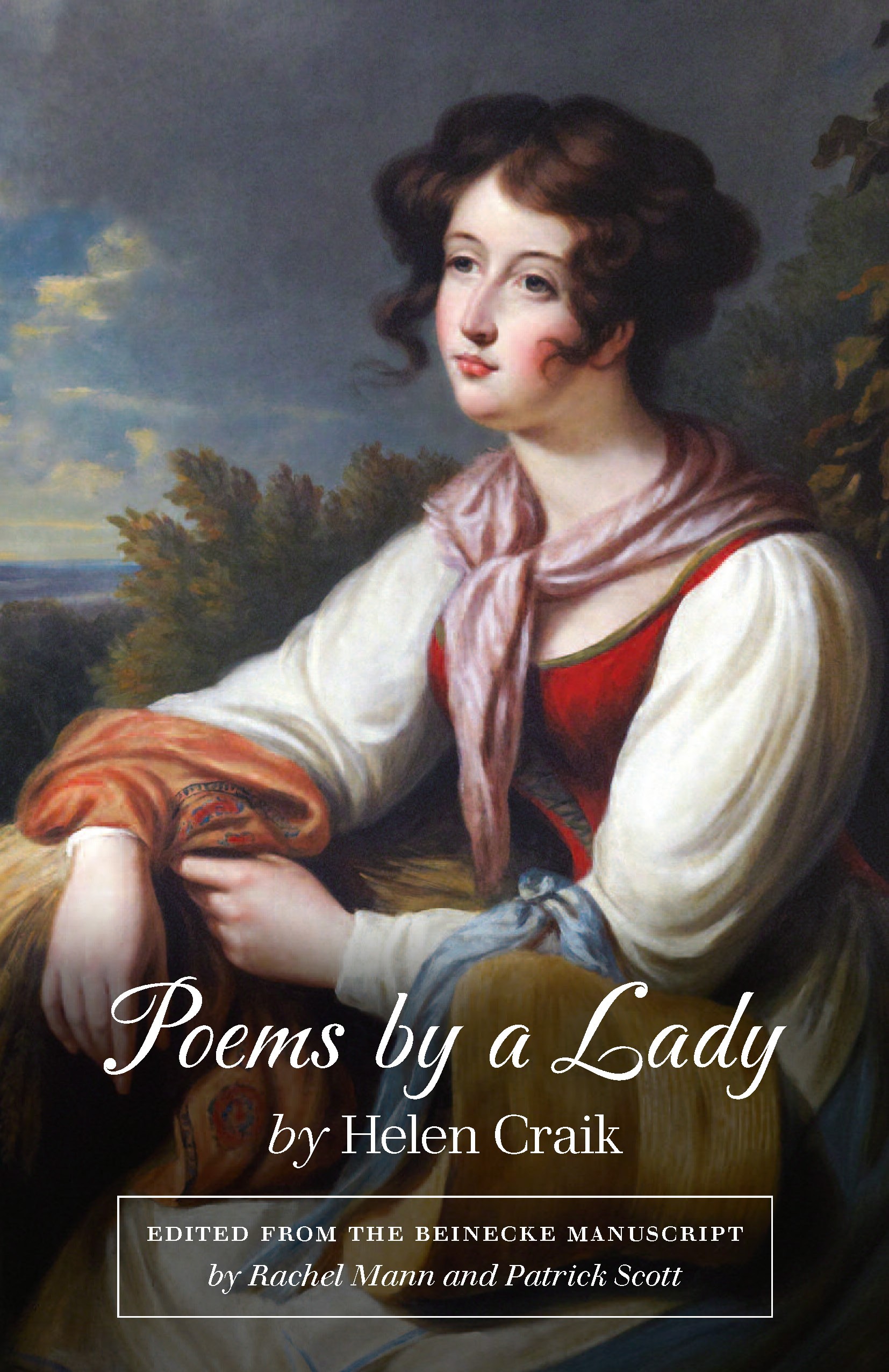
Five Questions: Rachel Mann and Patrick Scott on Helen Craik’s Poems by a Lady

      Comments Off on Five Questions: Rachel Mann and Patrick Scott on Helen Craik’s Poems by a Lady

Rachel Mann (RM) is an Instructor in Speech at the University of South Carolina. She has research interests in 18th century British literature, digital humanities, and ‘distant reading’; she has published articles in Review of English Studies, Eighteenth-Century Life, Hemispheres and Stratospheres and Debates in the Digital Humanities, and was co-editor for The Collected Poems of Gavin Turnbull Online.

Patrick Scott (PS) is Distinguished Professor of English, Emeritus, at the University of South Carolina, and Joint Editor of Studies in Scottish Literature since 2012.  For fifteen years he was also associate university librarian/director for Special Collections, which include the G. Ross Roy Collection of Robert Burns and Scottish Literature.  While he was originally a Victorianist (working on Alfred Tennyson and Arthur Hugh Clough, among others), his recent research has focused on Burns’s publication history and the Burns manuscripts, mostly in article form. His recent books include The Kilmarnock Burns: A Census (co-authored with Allan Young, 2017), a selection of Ross Roy’s essays on Burns (co-edited with Elizabeth Sudduth and Jo DuRant, 2018), Robert Burns: A Documentary Volume (2018), an edited volume The Ghost at the Feast: Religion and Scottish Literary Criticism (2020) and Robert Louis Stevenson: A Documentary Volume (2021).

Below, we discuss their co-edited edition, Poems by a Lady, by Helen Craik, published by the Association for Scottish Literature.

1) How did you first become interested in Helen Craik and her poetry?

RM: When Patrick first approached me about collaborating on the Craik edition my interest was sparked by the circumstances – the discovery of a manuscript that had long been thought lost. Add to that the very questionable rumors surrounding Craik’s abrupt departure from Arbigland, and you’ve got yourself a plot that seems to jump out of the pages of academic fiction. While I still love that aspect of this project, Craik’s manuscript poetry speaks to some of my earlier work and scholarly interests, which focus on the sociality of manuscript verse and the use of imaginative writing by women to explore alternative models of femininity, challenge dominant narratives, and engage politically and intellectually.

PS: As with Rachel, it was the manuscript itself that got me interested in Craik as a poet. I’d come on Craik originally through the Burns connection. Because they exchanged letters, she’s long been a fringe figure in Burns studies, but it’s only in the past 20 years or so, with Adriana Craciun’s work on her novels, that she’s been given critical attention in her own right. There are entries in, e.g. Orlando, the Oxford Dictionary of National Biography, and newer Scottish reference works. The poetry has been a gap. Some extracts were printed in 1919, but since then the manuscripts seemed to have vanished, and her poetry with them.   

Early in lockdown, someone emailed me about an apparently missing manuscript of Burns’s “Red red rose.” It turned out to be safe in the Lilly Library, Indiana University, and helpful librarians sent me additional scans, showing provenance from the Craik family, which took me to the story of Helen Craik, and so on to the recent reappraisal.  A few days after I wrote about the ‘Red red rose’ for the Glasgow Burns blog, saying Craik’s poetry was lost, I realized it might be trackable through Burns. It will surprise no one that there are much better records on Burns’s manuscripts than on Craik’s. It was the 4-line stanza that Burns had written on a blank page after borrowing the Craik poems that led me to their current location, in the Beinecke Library at Yale. Again, librarians proved amazingly helpful. Once I saw the Beinecke scans, I knew I wanted to get Craik’s poetry into print and asked Rachel to collaborate.

2) How did the collaboration work, and what were the trickiest challenges you faced in preparing and contextualising Craik’s manuscript poems for the press?

RM: We began work on this project the late summer of 2021, when COVID restrictions were still very much in place, so a lot of the collaboration took place by phone or over Zoom, and the research couldn’t have been done without digital sources and email help from librarians and archivists.  For the introduction, we each wrote sections, sharing drafts, and then met at the library to review it as a whole. 

I did almost all the initial transcription, and then for several months we worked through checking the text and drafting annotations online. The Beinecke manuscript is Craik’s careful fair copy, and the scans were good, but even so words and names and Craik’s punctuation and use of dashes could raise problems.  The verse-letters and satirical poems often give names with just an initial letter followed by asterisks or dashes; it’s not always clear who she meant, though sometimes scansion tells you the number of syllables to look for.  

Another challenge was dating the poems.  The Beinecke manuscript appears to be chronological, but few poems carry actual dates.  For some of the undated ones, we could match internal reference points with historical data. For example, in ‘To Miss D:’ Craik refers to the eruption of the Solway Moss, and so we can say with certainty that the poem had to have been written after 1771. Others were trickier. We know, from letters between William Craik and Dr. William Cullen in 1778-79, when Craik’s sick Elizabeth went to New Abbey to be treated with goat’s whey, so ‘To Mr. D: From Goat’s Whey Quarters’ probably dates around that time. This literary and historical sleuthing was enjoyable, but also time consuming, and led down a lot of rabbit holes and to dead ends.

PS: For most editing projects, annotation builds on previous editions. Because Craik’s poems have never been studied before, the annotation had to be researched from scratch. The challenge is seeing that something needs annotation: it can be tricky simply recognizing that Craik is quoting another poet, and finding who that is.  The headnotes for the narrative poems meant tracking down the sources or stories or germs of stories that Craik was reworking, which meant finding relevant contemporary sources, often in Scottish newspapers or periodicals.  Having sources online helps a lot, but the first match isn’t always the right one or the best one.  We were also trying to provide fuller biographical and social context for Craik; because our own library has the Ross Roy Collection of Robert Burns, there’s a lot of older material here on south-west Scotland in the late 18th century, but identifying the relevant recent scholarship meant crossing disciplinary lines, and some primary sources (such as Craik’s will) have only recently become available online.  A minor challenge because we are both used to Chicago or MLA style was dealing with very different formatting requirements. 

3) What are the most important insights we gain into Romantic-period history and culture by paying closer attention to manuscript poetry?

RM: In general, we gain a much greater awareness of the sheer volume of imaginative writing that was produced, by women especially. We can also see that manuscript poetry still played a vital role in literary circles and was not seen as less than or inferior to printed work. In some ways, then, Craik is remarkable precisely because, for her time, she was so unremarkable. Many women wrote and wrote often, without aiming at publication. Paying attention to manuscript poetry shows a range of concerns and styles that, as in this case, don’t necessarily fit into what we see as paradigmatically Romantic poetry. For example, in her dramatic monologues Craik explores extreme and unfettered emotions, violence, vulnerability, and madness, which we might call the sublime – however, Craik’s style could never be confused with William Wordsworth’s or Mary Shelley’s, nor, I would argue, could her aims. Likewise, her poems that focus on historical events, such as ‘Queen Caroline’, seem to be more about challenging dominant narratives than a rejection of Enlightenment ideals.

PS: Arguably manuscript poetry played a role in revising the ‘big six’ Romantic (American teaching) canon, though the main revisionary impulse came, not from manuscript discoveries, but from redirecting attention to critically-neglected published texts.  In recent decades, 18th century Scottish women poets have not been neglected – think of the huge ProQuest data base Scottish Women’s Poetry of the Romantic Era: An Electronic Archive (2007) and its introductory essays. There is now lots of good scholarship.  Close study of almost any non-canonical poet or text, manuscript or printed, can interestingly reset the cultural-historical map.

Poets like Craik who never published any of their work are different. There’s more recognition for Renaissance manuscript circulation. In Craik’s period, non-publishing poets have often been seen as unpublishable dabblers, though attitudes are changing. Michelle Levy’s Literary Manuscript Culture in Romantic Britain came out while we were working.  In 18th century Scottish poetry, as Ruth Perry, Sigrid Riewerts, and others have shown, women poets writing or collecting in the ballad tradition (such as Anna Gordon Brown) often circulated their work in manuscript; in Adriana Craciun’s neat phrase, there was a Border Spinstrelsy.  Craik didn’t collect ballads (though she reworked one), and she wrote very few songs. Juliet Shields’s recent essay (in the International Companion to Scottish Literature of the Long Eighteenth Century) seems relevant to Craik, when she suggests that there was a class factor in Scottish upper-class women not publishing their poetry; this rings true for the women poets Burns knew – Janet Little and Tibbie Shiels published collections, Craik and Frances Dunlop and ‘Clarinda’ did not; Elizabeth Scot of Wauchope’s poems were only published posthumously, Maria Riddell’s only after her husband died and she needed money.  In her Album Verses and Romantic Literary Culture, Samantha Matthews shows men as well as women circulating manuscript collections of their poetry, useful context for both Craik and Burns.    

There’s a special disruptive charge, though, in looking at fresh manuscript material, with no baggage of prior criticism. For the larger picture, Craik helps connect Scottish women’s poetry and ballad-influenced narrative poetry with Romantic-era Gothicism. Viewed close up, there is an unsettling tension between her neoclassical allusion-heavy couplets and her first-person narration of violence and horror. She read widely, but perhaps her relative geographical isolation meant that her mutation on her poetic inheritance was distinctive.    

Unpublished manuscript poetry also provides a kind of control group for identifying contemporary assumptions (publishers, readers, critics) as to what publishable poetry looked like.  If Craik’s quite varied novels can be generically pigeonholed as ‘Gothic” or ‘Minerva Press’, most of her poetry doesn’t fit a single category, and for much of it she had only herself to please. I’m also intrigued, as I hope others will be, by the possibility that Craik’s manuscript set the pattern for Burns’s Glenriddell Manuscript, and that her verse narratives may have affected his decision to recreate the legends about Alloway Kirk, originally prose, as his first and only narrative poem.

4) Which Craik poems are your own favourites, and why?

RM: To use George Neilson’s description, all those that evidence ‘Miss Craik’s preference for suicidal and murderous subjects’. In particular, I’m fascinated by ‘Under Sentence of Death’ and ‘The Earl of Caithness’. The former is Craik’s soliloquy for the Reverend James Hackman, who had murdered his ex-mistress in a fit of jealousy, a story that filled the newspapers in April 1779, and the latter imagines the Earl’s final moments and thoughts before committing suicide in April 1789, also widely covered by the contemporary press. These poems and others like them provided entry points and the impetus to learn about their real-life counterparts; like modern-day memes, they are palimpsestic. Literature has always appealed to me when it brings history to life. I’m interested in the way imaginative authors repurpose current events and news to suit their own ends and challenge dominant narratives.

PS: I think Rachel’s right that the narratives, both real life and Gothic-fictional, are likely to prove more significant for the bigger picture. Craik incorporated one of the fictional narratives into her first novel (she had a character read it aloud), and she used a prose version of another, ‘The Monk of la Trappe’, in Adelaide de Narbonne (1800).  ‘The Maid of Enterkin’ is ‘about’ the long aftermath of the ’45, and ‘Helen’ is a very non-ballad reworking of ‘Fair Helen of Kirkconnel’. 

But I find some of Craik’s shorter poems more immediately attractive. There are nearly 30 of them, and they certainly show her strong distinctive voice. On the surface she writes formal English, but she writes, in Stevenson’s phrase, with ‘a Scotch accent of the mind’.  Even in her preface, behind the conventional self-deprecation she’s teasing Robert Riddell more than herself, and the image of her walking solitary on the beach near Arbigland seems instantly anthologizable.  There’s a brio to her ‘Humble Petition’ ‘To R.O. Esq.’., cheekily asking a rich local landowner to give her and a friend ten thousand pounds each, because ‘Sans money we must also be sans beaux’.  Her social verve comes out in poetic charades and in satires on the flirtatious junior army officers temporarily stationed in Dumfries.  Her verse-letter from Arbigland to ‘Miss D—‘, a friend in Dumfries, when other local gentry had flocked there for ‘Circuit week’, guesses wittily at the local gossip, and dissects the family dynamics of the Craiks staying home. Her two poems ‘To a Gentleman’, dated 1782, were verse-letters teasing a (probably former) admirer who had left his card at Arbigland on a Sunday morning while she was off in kirk, listening to a sermon on retaliation. One of the appendices includes a later poem written after she’d left Arbigland, from a different notebook that is still missing, when a friend’s mother sent her a tartan handkerchief to remember Scotland, and instead she remembered the nephew who was inheriting her home of nearly 40 years who had commented incautiously that her departure ‘t’was all for the best’ (she claimed that ‘for once’ he ‘spoke truth’). And she can also write with affection and humanity to a wide range of friends in difficult situations.

5) What new projects are you currently working on?

RM: I’m working on a conference paper about Craik, but my main job focus (and contractual obligation) is to teaching, so I now have the opportunity to read and think before starting any new larger project.

PS: This is a touchy question for someone my age. Editing Studies in Scottish Literature still competes with ‘my own work’.  Smaller projects I’d like to finish up include an overdue essay about the list of the books Burns owned when he died and a recurrently-deferred article on the Roy Collection manuscript of Burns’s ‘Queen Mary’s Lament’. Longer-term projects on which much of the research is done include the first-ever collection of George Douglas Brown’s shorter writings and the first-ever edition of James Hogg’s Memoir of Burns.