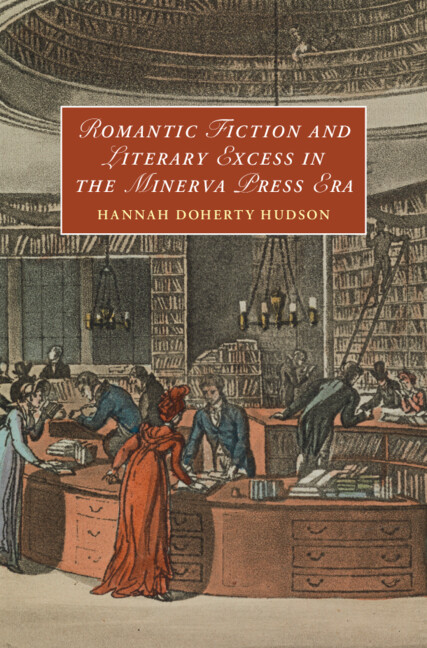
Five Questions: Hannah Doherty Hudson on Romantic Fiction and Literary Excess in the Minerva Press Era

      Comments Off on Five Questions: Hannah Doherty Hudson on Romantic Fiction and Literary Excess in the Minerva Press Era

Hannah Doherty Hudson is Associate Professor of English at Suffolk University in Boston. Her interests include Romantic-era fiction, intertextuality, periodical culture, the affordances of biography and the commercial history of print. Her new monograph, Romantic Fiction and Literary Excess in the Minerva Press Era, which we discuss below, was published by Cambridge University Press earlier this year.

1) How did you first become interested in the Minerva Press?

I first became interested in the Minerva Press while I was preparing for my PhD oral exams — I was doing a lot of reading about Romantic fiction and gothic novels and I started to notice that only one publishing house was ever mentioned by name in the scholarship I was working through. Before doing my PhD I had worked for a large trade book publisher with many, many imprints, so this caught my attention. I started to wonder what exactly the “Minerva Press” was, and why it seemed to be the only publishing company to have an imprint name that differed from the publisher’s name (e.g. Longman or Johnson). It was also very clear that the press’s name had a negative connotation, and I was very interested in the origins of the stereotypes surrounding the press. When I looked into it more deeply and discovered that the Minerva Press was the largest publisher of fiction, by far, in the period, I just really wanted to know how this massive group of novels — more than 800 of them, at a time when many publishers put out only a few novels a year — could have essentially disappeared from so much of literary history. I eagerly read the work of Dorothy Blakey and Deborah McLeod, and the scholarship (especially on the Gothic) that paid most attention to the Minerva Press, and then started to read as many of the novels as I could access. The bibliographic information in The English Novel, 1770-1829 (ed. Peter Garside, James Raven and Rainer Schöwerling) was also a crucial part of my early fascination with Press, both for the data it provided about the Press’s dominance, but also for the way it allowed me to observe potential patterns in titling, trends, and genre cues, which I could later follow up with more extended research.

2) How did you decide that excess would be the key term for your enquiry?

Excess was a theme that I didn’t explicitly identify until fairly far along in the process of writing the book. When I began this project, for my doctoral dissertation, I organized the chapters by genre (with one chapter for the Minerva gothic novel, one for the Minerva sentimental novel, and so forth). Some parts of that structure still remain in the book, but as I worked to revise it, I kept wrestling with the idea that I didn’t (just) want to talk about what Minerva novels were like — I also really wanted to explore their relationship with Romantic literary culture on a larger scale. As I started to think through the ways that Minerva novels were talked about, reviewed, imitated, and stereotyped, and to draw connections between them and the many other novels published during the Romantic period, I realized that the thing that united them all was a sense of, for lack of a pithier term, ‘too-much-ness’: there was an overwhelming number of novels, all of a sudden, and so readers, authors, and especially reviewers had to figure out how to cope with them, which they often did by establishing hierarchies that identified some (few) novels as worthy, and others as trash that could safely be ignored. What I really liked about the term ‘excess’ is that it captures the utter subjectivity of this process: who decides what is enough, and what is too much? Almost nobody wanted to argue that all novels were superfluous, so the constant problem was trying to draw and redraw the boundary of where sufficiency ends and excess begins. For most people, of course, there really was no such thing as an ‘excess’ of novels — a reader could happily choose as many or as few as they wanted, and the more choices, the better. Lack of access and scarcity were surely more of a problem for most average people who were reading novels at all. But authors worried that if there were too many books their own work might be lost or ignored, while critics were frustrated that they had more books to review than they could read, and irritated by the repetitive tropes of new genres. I was interested in understanding the influence that these conflicting pressures had on the evolution of the novel genre and, especially, on our own scholarly approaches to studying these novels.

3) What are the most important gains we stand to make as scholars by following your suggestion that we view the Romantic period as the Minerva Press Era?

When I made this argument I realized that it would likely be a polarizing one: I can’t even tell you how many times while writing this book I’ve been asked questions along the lines of: “how can you stand spending all your time reading these terrible books? Are any of them any good?” Clearly many scholars would be reluctant to rename the entire period after these novels! (For the record, I would say that some of them are good, many of them are bad, but, to me at least, all of them are interesting). There are a few reasons why I think this re-conception is really important and valuable, though. First, the ‘Minerva Press Era’ shifts the focus away from poetry alone to capture the popularity of novels and novel-reading in the Romantic period. I love Romantic poetry and teach it every semester, but I don’t think poetry in isolation captures the full spirit of the Romantic Period. It also reminds us that Minerva authors like Regina Maria Roche and Eliza Parsons, along with non-Minerva authors like Walter Scott and Ann Radcliffe, helped to define the terms on which novels were consumed. Additionally, thinking of the Romantic period as the Minerva Press Era turns our attention to the marketing and publicity that played such a key role in developing new genres and determining which novels would be praised and which maligned. For me, calling the period ‘the Minerva Press Era’ really reminds us that this was arguably the first age of industrial fiction production, and that literary works of all kinds, including those published by more prestigious presses or only circulated in manuscript, were written against — or in direct response to — this backdrop. The years around 1800 are such a tipping point in terms of changing print and paper technologies and the evolution of marketing, periodicals, and the novel itself, and re-centering the Minerva Press helps us to keep our critical eye on these crucial developments. In recent years many scholars have begun to do exciting work on the Minerva Press, all of which serves to reveal different facets of its importance to the period; it’s so exciting to me to see such a groundswell of interest in the Press and related topics. (Anyone interested in knowing more about the current state of the scholarship should absolutely read the recent special issue of Romantic Textualities dedicated to the Minerva Press, edited by Elizabeth Neiman and Tina Morin).

4) Which of the novels that you read for the project did you find most surprising and revealing?

This is such a hard one! There were so many, with all different kinds of surprises. One of my favorites has got to be Rosella, by Mary Charlton — I read this early on in the project and found it not only very funny, but also surprising in its extreme self-awareness about novels, and the reputation of popular, gothic, and women’s novels in particular (for those who would like to experience this novel for themselves, Natalie Neill has just completed a new edition, now available from Routledge). Now, having read so many more Minerva novels, I don’t actually find that quality surprising at all: because of the dismissiveness with which many of these novels have been treated by criticism, I didn’t initially expect them to be as clever, self-satirizing, and often metafictional as they are. This is not to say that some of them aren’t very silly, or flawed, or boring, but as a body the authors really do show an extremely high level of awareness of their own place in the market, the expectations their readers are likely bringing to the text, and the choices they are making in terms of genre. In the same vein, I was surprised by the elaborate playfulness of the marketing and publicity that surrounded a lot of these novels. William Lane, the founding publisher of the Minerva Press, wrote a mock-gothic advertorial in which all the places and characters were titles of Minerva Press novels, for example; later on, after the Minerva Press had ceased publication, I came across a satirical magazine piece in which the editors claimed to have received a letter from a “Czarina Amabelle St. Cloud,” who was devastated not to be able to publish with Minerva, and instead had sent them excerpts of her work and a long list of her novel-titles, which  imitate the typical Minerva two-part structure and include such gems as A Nympholept Lover; or, the Whispering Fungus and The Fatal Furbelow; or, The Tempted Templar.

5) What new projects are you currently working on?

Right now I am working on a new book, tentatively called Romantic Magazines and Imperial Knowledge: Commodity, Identity, Miscellany, which examines the role of the miscellaneous magazine (including prominent titles like the Lady’s and Gentleman’s Magazines, the European Magazine, and the Universal Magazine of Knowledge and Pleasure) in developing new models of imperial collection and knowledge-formation in the years around 1800. I have been working on this project on and off alongside the Minerva book for years, so I am really excited to be able to give it my full attention now. I seem to be drawn to projects that leave me absolutely swimming in reams of print—now that I’m done reading Minerva novels for the moment, I’ve turned to reading thousands of pages of magazines. But in some ways I would say both books are motivated by very similar questions and interests: I like paying attention to what real people were commonly reading in the Romantic period, even or especially if what they read was inexpensive, ephemeral, or now little-known, and I’m very interested in the systems that surround publication, including advertising, reviewing, and reception. I also like the surprises and weird discoveries that come with reading through a profusion of print sources: you really just never know what you’re going to find. I’m also working on a few articles relating to magazines, including one about magazine portrayals of revolution around the globe in the 1780s and 1790s, and another on Eliza Haywood’s periodical legacies. Finally, and unsurprisingly, I do have some more Minerva-related projects on the back burner as well.

Nineteenth Century Studies Association: Call For Papers, “Thresholds”, 45th Annual Conference

      Comments Off on Nineteenth Century Studies Association: Call For Papers, “Thresholds”, 45th Annual Conference

Louisville, Kentucky    March 14-16, 2024

Proposal Deadline: September 30, 2023

Website: https://ncsaweb.net/2024-conference-information/

From its early history as an important trading hub along the Ohio River, Louisville, Kentucky stood as an important gateway between the south and the north as well as between the east and west. As the city grew rapidly throughout the nineteenth century due to its favorable geography, it served as a threshold to nearby Indiana enslaved people longing for freedom and simultaneously as one of the largest centers for the trade and trafficking of enslaved individuals. Despite Kentucky remaining within the Union, many in the state sympathized with the Confederacy, and the political clout of Confederate soldiers returning after the Civil War earned Louisville its reputation as the city that joined the Confederacy after the war was over. During reconstruction and into the twentieth century, the city continued to wrestle with its history while also creating opportunities for those newly freed. Thus, the image of Louisville as a threshold offers fruitful ground for considering the individuals, institutions, conditions, and movements that shape the nineteenth century.

As an interdisciplinary organization, we welcome (15-20 minute) papers and submissions that explore thresholds from a broad range of perspectives, especially diverse national and international frameworks. In discussing physical manifestations of thresholds, papers may explore thresholds in nineteenth-century art, architecture, geography, history, literature, and material culture. Papers may address temporal thresholds into and from the long nineteenth century, including events, figures, and perspectives from the eighteenth through the twentieth centuries. Since thresholds also imply the midpoint from one state of existence to another or from one social status to another, we also welcome broader interpretations of the conference theme such as: thresholds between wilderness and civilization, ecological thresholds, threshold states (e.g. vampirism), visual thresholds, economic thresholds, musical thresholds, and ontological thresholds. Submissions may also address the abundant scientific and technological thresholds in the nineteenth century and the ways they shaped our modes of existence and understanding, e.g. electricity, the phonograph, atomic particles, and the standardization of time. While thresholds often imply advancing through a transition, papers may also conceptualize them as limits that are not transgressed. Topics on the state of nineteenth-century studies might also include thresholds of teaching and scholarship, academic labor practices, or innovative approaches to humanities education.

Please send 250-word abstracts with one-page CVs to ncsa2024@gmail.com  by September 30, 2023.

Abstracts should include the author’s name, institutional affiliation, and paper title in the heading. The organizers welcome individual proposals, panel proposals with four presenters and a moderator, or larger roundtable sessions. Note that submission of a proposal constitutes a commitment to attend if accepted. 

Presenters will be notified in November 2023. The organizers encourage submissions from graduate students, and those whose proposals have been accepted may submit complete papers to apply for a travel grant to help cover transportation and lodging expenses. See the sidebar at right for more information about conference grants. Questions about submissions or the conference may also be directed to: ncsa2024@gmail.com  .

Notices and Events: Davy’s Notebooks Project

      Comments Off on Notices and Events: Davy’s Notebooks Project

Dear all, 

We have a number of important things to tell you about. Firstly, I’m writing partly to urge you to please continue to transcribe Davy’s Notebooks. We are supposed to get everything done and online by the beginning of next year, but there’s still so much to do. Transcription rates seem to be slowing down and we still have about 1000 pages to transcribe. Please do as much as you can to get us over the finish line on time and encourage others to help too! 

Secondly, we have substantially revised and updated our online course on Humphry Davy and will run it again, with a start date of Monday 9th October 2023. You can enrol here: 

https://www.futurelearn.com/courses/humphry-davy

We’ve developed the course to include some of the findings that we’ve made during the last few years on the Davy Notebooks Project. This course will tell you about Davy’s life and career and give you some context to any transcription that you’ve been doing on the project (it may also be of interest to students, family, friends, etc etc).

The course has weeks on: Davy’s life and his historical times; his chemical experiments and lectures in the Royal Institution (we even recreated one of his spectacular demonstrations of how he thought a volcano worked!); the links between Davy, the Romantic poets (including William Wordsworth and Samuel Taylor Coleridge), and Mary Shelley’s Frankenstein, as well as some of Davy’s own poetry; the miners’ safety lamp he invented; and it closes with a week that thinks again about Davy’s legacy. 

The course is free and open to all. If you’ve done it before, you’ll hopefully enjoy the new material that we’ve included. There are some new steps, new activities, and lots of new resources which the project team have created over the past few years including online talks, articles, and blog posts. We’re hoping to show you some new aspects to Davy, including recently transcribed poems, some of the sketches found in his notebooks, first-hand accounts of Davy in the laboratory at the Royal Institution performing some of his most famous experiments, and evidence of his links to transatlantic slavery. 

As ever, you can do as much or as little of the course as you choose and take it at your own pace. That said, we’ll start each new week on the Monday and sum up on the Friday. Someone from the project team will be available every day to respond to your queries and help moderate the discussion.  

And, finally, the Davy Notebooks exhibition has opened at the Royal Institution in London in the building where the famous early nineteenth-century chemist Sir Humphry Davy worked and lectured in Albemarle Street in London from 1801-12.  

The exhibition is at the Royal Institution until Friday 3 November 2023. It will move to Northumberland County Hall from Wednesday 8 November 2023 to Friday 12 January 2024. The final destination is the Wordsworth Trust in Grasmere, where it will be installed from Tuesday 16th January 2024 to Saturday 23rd March 2024. The exhibition showcases a number of original Davy manuscripts and focuses on his lectures, geology, chemistry, and links with the slave trade, his poetry and the miners’ safety lamp known as the Davy lamp.  

There are a number of activities associated with the exhibition, including teaching resources for schools, a talk at Northumberland County Hall on the 15th November, a Davy Poetry Reading Workshop in Morpeth Library on January 11th, and a webinar for the Wordsworth Trust on 25th January. For more details, follow us on social media (@davynotebooks) or email davynotebooks@lancaster.ac.uk. And please do some transcription for us at https://www.zooniverse.org/projects/humphrydavy/davy-notebooks-project!

All best,

Sharon Ruston

The Davy Notebooks Project Team

17 September 2023

University Short Courses at Wordsworth Grasmere

      Comments Off on University Short Courses at Wordsworth Grasmere

Experience the magic of the archive and get up-close with the past with hands-on experiential courses at Wordsworth Grasmere.

‘…the highlight was most definitely the manuscript session: holding an original manuscript from hundreds of years ago in your hands and getting to read the same lines you studied is just an incredible feeling.’ – Student

‘I have a whole new appreciation for Wordsworth, poetry in general, and a whole new mindset that I would have never gained if it wasn’t for the people I met here and the experiences that I’ve had.’ – Student

These tailored experiential courses, which can be delivered in-person or online, will give your students the insights to interpret the past in new and imaginative ways. Skills in close looking, enquiry, discussion and problem solving will be invaluable both during and beyond their time at university. The writing and lives of the Wordsworths in Dove Cottage 200 years ago will come to life through detailed investigation of manuscripts, creative workshops – and simply spending reflective time in this very special place.

‘It was such a treat to explore the cottage and its grounds as well as the artifacts, manuscripts, and remnants of the Wordsworths’ lives. Jeff did such a wonderful job relating every object to not only their daily habits and creative work, but also to the art of museum curation. A great experience all around!’ – Professor Sophie Thomas, Toronto Metropolitan University, Canada

Courses are delivered by experts from the Curatorial & Learning team at Wordsworth Grasmere, who have been leading these courses for over a decade. One-day or multiple-day, online or in-person, there is something to suit every group, budget and schedule.

‘The students came away with the best sorts of learning: experiential, consequential, culturally sensitive, usefully difficult, and ultimately transformative. I hope to do this again many times in future years!’ – Professor Catherine Waitinas, California Polytechnic State University, USA

Find out more and book by visiting Wordsworth Grasmere’s website: https://wordsworth.org.uk/short-courses/

Call for Applications: John Galt Society Research Grant

      Comments Off on Call for Applications: John Galt Society Research Grant


The John Galt Society welcomes applications for a grant (of up to £300) to defray expenses incurred in connection with research into the works, life or influence of John Galt. Eligible expenses might include transportation to libraries or archives, lodging near libraries or archives (if distant from the researcher’s home), fees or technology costs involved in on-site or on-line access (such as copying or scanning, permissions or equipment requirements). Research projects should have the goal of shedding new light on Galt’s significance in literature, history, socio-political thought or economics. Projects that situate Galt in other fields are also welcome.

Eligible applicants are advanced graduate students (students enrolled in PhD programs at universities around the world); early career scholars (scholars whose doctoral degrees date no more than three years before the application and who have held a permanent or secure academic position for no more than three years), contingent faculty (scholars with PhD degrees who hold part-time or temporary academic positions) or independent scholars (scholars with PhD degrees who do not hold academic positions).

The Grant will be awarded annually. Previous recipients may apply for a second time, but preference will be given to first-time applicants. Applications should be emailed to the Administrator of the John Galt Society Research Grant (Dr. Craig Lamont, University of Glasgow, secjgs@gmail.com). Applications must include all of the following:

  • Applicant’s name, address, email address.
  • Applicant’s degree and employment status (date of PhD received or expected, institutional affiliation [or statement that the applicant is not affiliated], length of affiliation and whether the position is full-time or part-time, permanent or temporary.
  • Applicant’s cv.
  • Description (approximately 1,000 words) of Applicant’s project, specifying what portion or aspect of it is to aided by the Grant and what specific use of the Grant money will be made. The timetable for carrying out the research should also be indicated.
  • The name, address, email address and affiliation of a scholar whom the Applicant has asked to recommend the project. Applicants should make this request of a scholar familiar with the Applicant’s work and ask the scholar to send the recommendation directly to the Administrator of the John Galt Research Grant.

The deadline for applications is 31 January 2024.

Complete applications must be received by the deadline in order to be considered. The recipient will be announced at the time (usually in March) of the Annual General Meeting of the John Galt Society. It is expected that the research will be carried out and a report submitted within a year of the receipt of the Grant. It is expected that the recipient will join the John Galt Society (if not already a member) before making use of the Grant. Inquiries may be directed to Dr. Craig Lamont, Secretary-Treasurer of the John Galt Society and Administrator of the John Galt Society Research Grant (secjgs@gmail.com) or to Dr. Regina Hewitt, Chair of the John Galt Society (hwt87@earthlink.net).

Call for papers: Romantic Boundaries (special issue of Romantic Textualities)

      Comments Off on Call for papers: Romantic Boundaries (special issue of Romantic Textualities)

This June, the BARS Early Career and Postgraduate Conference gathered researchers from around the globe to celebrate and to appreciate Romanticism and its legacies at the University of Edinburgh by exploring the theme of ‘boundaries’ within the context of Romantic-period literature and thought. The Oxford English Dictionary defines the term ‘boundary’ as: ‘That  which serves to indicate the bounds or limits of anything whether material or immaterial; also the limit itself.’ Such a term seems at odds with the spirit of Romanticist thought, which has long been associated with mobility and boundlessness. Conference delegates aptly addressed the complexity of the concept through various representations of boundaries – both tangible and intangible – from a wide range of viewpoints. To continue such a diverse critical dialogue, in collaboration with Romantic Textualities: Literature and Print Culture, 1780–1840 (https://www.romtext.org.uk/), we plan to produce a special ‘Romantic Boundaries’ edition of the journal. To widen the scope of our scholarly conversation, not only do we welcome all the conference delegates to consider expanding their conference papers for publications, but we also invite researchers and scholars in general for submissions. 

Echoing our conference theme, topics of interest may include, but are not limited to: 

• Geographical and spatial boundaries; transnationalism 

• Borders, liminal spaces, and boundary crossing 

• Temporal boundaries 

• Dialogues between genres and disciplines 

• Translations and transgressions 

• Lived boundaries (including those pertaining to identity, such as gender, race, or sexuality) 

• Digital boundaries 

• Human and nonhuman boundaries 

• Boundaries and reception; public versus private writings 

• Past, present, and future limits of the field of Romantic studies and its canon 

Successful abstracts will suggest articles that broaden our understanding of Romantic boundaries by illuminating the elasticity and multiplicity of their meanings. For those who are interested, please submit 500-word abstracts with 5 keywords. Abstracts are due by 10  October 2023. The result will be announced by mid-November.  

Essays (5000-8000 words, including footnotes) that grow out of accepted abstracts will undergo peer review and are due by 31 January 2024

Please email submissions to Yu-hung Tien (yuhung.tien@ed.ac.uk), with a subject line (Romantic Boundaries, ‘Paper Title’, Author Name).  

Papers will be published in a special issue of Romantic Textualities (Summer 2024), guest edited by Professor Li-hsin Hsu, Professor Andrew Taylor, and Yu-hung Tien. 

Please note that the essay submission date and publication schedule are tentative and subject to change, depending on the reviewing progress. 

“Romantic Horizons: Pushing the Boundaries of Romantic Studies”, (Online Joint Symposium)

      Comments Off on “Romantic Horizons: Pushing the Boundaries of Romantic Studies”, (Online Joint Symposium)

Romantic Dialogues and Legacies, Department of English Studies presents a Transcontinental Joint Symposium featuring decorated panels from the University of Notre Dame, Indiana , USA and Durham University, UK. “Romantic Horizons: Pushing the Boundaries of Romantic Studies” will be held online and hosted via Zoom on November 17, 2023 at 3.30 pm UK time. The event focuses on a broad range of writers and themes from John Clare, Disability Studies, a re-discovered Henry Kirke White to the politics of Romantic reading, Jane Austen, PB Shelley as well as Hart Crane among others.

University of Notre Dame Panel

  • Laura Betz, “John Clare: Sonnets and Nests”
  • Essaka Joshua, “Disability Studies and Romanticism: Staging Interventions”
  • Greg Kucich, “‘We poor pilgrims in this dreary maze’: Henry Kirke White and the Broken Boundaries of the ‘Uneducated Poets'”
  • Ian Newman, “Beyond the Ballad: Sea Songs and Shanties”
  • Yasmin Solomonescu, “Reimagining Persuasion in British Romantic Literature”

Durham University Panel

  • Emily Rohrbach, “Romantic Contingencies and the Politics of Reading”
  • Sarah Wotton, “Post-Romantic Relations: Percy Bysshe Shelley and Emily Brontë”
  • Mark Sandy, “’The Silken Skilled Transmemberment of Song’ : P. B. Shelley, Romantic Quest, and Hart Crane”

The duration of each presentation is 15 minutes and each panel leads up to to an interactive discussion at the end of the event.

Register now for free: https://www.ticketsource.co.uk/romantic-dialogues-and-legacies/romantic-horizons-pushing-the-boundaries-of-romantic-studies/e-dgdqvm

Archive Spotlight: Humphry Davy’s Notebooks and the Navy

      Comments Off on Archive Spotlight: Humphry Davy’s Notebooks and the Navy

We really need your help in completing the project to transcribe Humphry Davy’s notebooks… Read on to see something of Davy’s life two hundred years ago and the kinds of scandal your transcription could unearth…  

In January 1823, Humphry Davy was asked by the Commissioners of the Navy Board to investigate why the copper sheeting on the bottom of ships was corroding, reducing the speed of these vessels greatly. He regarded the matter as one of national importance and immediately referred it to the Council of the Royal Society. They set up a Committee but it was Davy alone who investigated the matter. He was sent samples of the copper used to sheathe two naval ships, the HMS Batavia (a former floating battery that was disposed of in 1823) and Leonidas (a thirty-six-gun fifth-rate frigate launched in 1807). The way that Davy felt called to action, and the patriotic fervour with which he responded, was not unlike the earlier episode of the miners’ safety lamp in 1816. The two episodes would end in a similarly less than ideal manner. 

Sir Humphry Davy, Bt by Thomas Phillips

At this point in his life, Davy was largely a man of leisure, having married the wealthy widow Jane Apreece in 1812, been granted a baronetcy, and resigned from the work at the Royal Institution of Great Britain. He had been elected President of the Royal Society in 1820 and held a weekly soirée for the most eminent scientific men at his house; his letters from this period are replies to people who have sent him their latest books, their accounts of voyages, and who ask his advice on an array of subjects. Davy was highly aware of his status as PRS and would not be tainted by suggestions of monetary gain or reward. For example, and again in keeping with his work on the safety lamp that he performed gratis, he tells one respondent that as President of the Royal Society it would not be proper for him to comment on an invention that was to be patented. A patriotic call from the British Navy was a different matter. 

In 1824 Davy confidently assured the Admiralty and Navy Board that he had found a fool-proof solution: the fitting of zinc or cast-iron protectors. Davy was in Portsmouth from 19 to 23 February and there he experimented with the royal yacht Royal George, the twenty-eight-gun HMS Samarang, and the ten-gun brig HMS Manly. His method became known as ‘Davy’s protectors’ just as the miners’ safety lamp became known as the ‘Davy lamp.’ Unfortunately, what had worked in the laboratory did not work at sea and the electro-plating had a chemical side-effect. It resulted in the ships’ bottoms being fouled, thus slowing them down even more. The whole episode was a disaster for Davy who, nonetheless, maintained throughout that there was no problem. 

Byron had mentioned Davy’s safety lamp in Canto I of Don Juan: ‘Sir Humphrey Davy’s lantern, by which coals / Are safely mined for’. Davy, in turn, wrote some Don Juan-esque lines of his own in a short, private, unpublished poem in a notebooks called ‘On the Bubbles’, dated December 1823. Davy rewrote Byron’s famous line ‘This is the patent-age of new inventions’, which had alluded to Davy’s achievements, to echo the rhythm but put forward his own gripes. It is unusual for Davy to write satirically and the new tone of this poem borrows from Byron’s cynical perspective. The poem has recently been transcribed as part of our AHRC-funded project crowdsourcing transcriptions of Davy’s extant notebooks and begins thus in a rather struggling fashion: 

On the Bubbles
This is the age for humbug &

cant.

Whoever possesses them nothing

can want […]

The poem moves to consider the prevention of corrosion occurring on the copper bottoms of ships, which was clearly on Davy’s mind at this time. The manuscript reveals that Davy knew about Robert Mushet’s patent, awarded on 14 June 1823 for a ‘Process for Improving the Quality of Copper, and of Alloyed Copper, Applicable to the Sheathing of Ships, and to Other Purposes’, before there is mention of Mushet in Davy’s letters. Davy takes his revenge privately here in a poem, just as he had in another unpublished poem in the same notebook, where he gave vent to his true feelings on the safety lamp controversy: ‘Thoughts after the ingratitude of the Northumbrians with respect to the Safety Lamp’. In ‘On the Bubbles’, Davy attempts to imitate Byron’s voice and seemingly cavalier attitude: 

We have copper that will not disperse in the sea.

The patent secures it quite from decay  

And make it in voyages bright as the day, 

But every one knows who is not an ass

That the work of this copper depends upon brass

Davy is here criticising Mushet’s patent. Rather than the solution Mushet proposes, he thinks that the Navy’s ships need ‘Davy’s protectors’. Davy’s resentment is demonstrable in these lines, and he chooses to express it in a poem. Transcribing the notebooks has unearthed many moments like this: please do consider taking a look at the project and making such discoveries yourself!  

Check out the website: https://www.zooniverse.org/projects/humphrydavy/davy-notebooks-project

Sharon Ruston
Lancaster University

BARS/K-SAA Monograph Publishing Roundtable and Q&A

      Comments Off on BARS/K-SAA Monograph Publishing Roundtable and Q&A

An expert panel demystifies the process of publishing a monograph in Romantic Studies, responding to your questions.

Date and time

Wed, 27 September 2023, 17:00 – 18:30 BST

Tickets available here!

At BARS’ recent Romantic Boundaries conference, a roundtable on publishing in journals revealed there was considerable appetite for an event demystifying monograph publishing in Romantic Studies. In concert with the Keats-Shelley Association of America, BARS has put together a digital roundtable to try and help with this. This roundtable will be chaired by Matthew Sangster (University of Glasgow/BARS) and Kate Singer (Mount Holyoke College/K-SAA) and will feature the following contributors:

  • Rebecca Colesworthy, Senior Acquisitions Editor at SUNY Press
  • Ben Doyle, Publisher for Literary Studies at Bloomsbury (and formerly Emerald and Palgrave)
  • Tim Fulford, co-editor of the Liverpool University Press series Romantic Reconfigurations: Studies in Literature and Culture 1780-1850
  • Patricia A. Matthew, co-editor of Oxford University Press’s Race in Nineteenth-Century Literature and Culture series
  • Bethany Thomas, Commissioning Editor for Literature at Cambridge University Press

The roundtable will begin with short introductions, but the bulk of the time will be committed to answering questions. These can either be asked live or submitted in advance (please email matthew.sangster@glasgow.ac.uk and ksinger@mtholyoke.edu by Monday September 18th so we can pre-circulate to our contributors).

The roundtable will also include details for joining the K-SAA’s new mentoring program, including group and individual monograph advising.

https://www.eventbrite.co.uk/e/barsk-saa-monograph-publishing-roundtable-and-qa-tickets-705523789647

On This Day: Robert Bloomfield – 200 years

      Comments Off on On This Day: Robert Bloomfield – 200 years

The BARS ‘On This Day’ Blog series celebrates the anniversaries of literary and historical events of the Romantic period. Want to contribute a future post? Get in touch.

Today on 19th August 2023, we mark 200 years to the day of the death of Romantic poet Robert Bloomfield with this blog post by Emlyn David.

The 19th August marks the bicentenary of Robert Bloomfield’s death, with this anniversary offering an occasion to reflect on the poet’s works and his legacy. Bloomfield died in dire poverty at Shefford, Bedfordshire, aged fifty-six, forgotten by most of his contemporaries – but his death does not reflect the great popularity that some of his works enjoyed during his lifetime.

The poem that made Bloomfield’s reputation, The Farmer’s Boy (1800), can be considered as one of the bestselling poems of the Romantic era. Although Bloomfield first struggled to find a publisher, Capel Lofft finally agreed to publish the poem along with woodcuts by John Anderson, a Scottish wood-engraver and a pupil of Thomas Bewick. It sold an estimated 51,000 copies and was translated into French, German and Italian, with some excerpts translated into Latin. New editions regularly appeared throughout the nineteenth century.[1] As the title of his major work suggests, Bloomfield is one of the many local or regional poets who are associated with the labouring-class tradition of poetry of the late eighteenth century. Many authors of humble origin found a place for their writings on the literary market of the time, a trajectory that Bloomfield describes with great humour in the epitaph he had written for himself (an epitaph dated April 1823, but which was never actually used):

First made a Farmer’s Boy, and then a snob / A poet he became, and here lies Bob.[2]

Bloomfield nevertheless represented much more than the tail end of this poetic fashion. His poems reworked the pastoral and georgic traditions and inspired poets of a younger generation, most notably John Clare, to revive them in their poetry. Clare lamented the death of his “departed brother bard” in a letter dated 7 March 1825 to Joseph Weston:

“I deeply regret that ill health prevented our correspondence & that death prevented us from being better acquainted I sincerely loved the man & admired his Genius.”[3]

Clare regularly mentions Bloomfield’s works in his correspondence. He praises him highly, especially when comparing him with other poets concerned with the depiction of rural life, like George Crabbe. Clare insists on Bloomfield’s proximity with and his intimate knowledge of the subjects of his poems, which endow his poetry with a sincerity that is absent from Crabbe’s works:

“[Crabbe] knows little or nothing about [the peasantry] compared to [Bloomfield], who not only lived among them, but felt and shared the pastoral pleasures with the peasantry of whom he sung”.[4]

According to Clare, the authentic quality of Bloomfield’s works is what makes him “the most original poet of the age & the greatest Pastoral Poet England ever gave birth too [sic].”[5]

Bloomfield’s works represent and celebrate his native landscapes and the customs of his village, giving pride of place to popular culture in literary texts destined to a polite readership. “It will be observed that all my pictures are from humble life, and most of my heroin’s servant maids”[6], he writes in the preface to his collection Wild Flowers; or Local and Pastoral Poetry (1806). Storytelling is at the centre of his poetry, and Bloomfield always underlines the role of old women as the repository of a cultural knowledge that is central to a community while depicting them as skilful narrators. His poems give a vivid and often enthusiastic description of rural life, while emphasizing the physical discomfort, exploitation and exhaustion that come with rural labour.[7]

He inspired both poets and painters. John Constable – another artist known for his love of his native landscapes – used lines from The Farmer’s Boy as a poetic catalogue tag to his painting The Wheatfield, which he exhibited in 1816 [8]:

No rake takes here what heaven to all bestows / Children of want, for you the bounty flows!

Bloomfield’s poetry reminds us that the places we know best can be an inexhaustible source of wonder and delight. His love of nature and of the landscapes he knew so well accompanied him during his entire life, and on his grave at All Saints’ Church, Campton, Bedfordshire, one can read:

Let his wild native wood notes tell the rest.

To help us leave behind this bicentenary and hope for future celebration of Bloomfield’s works, why not take the time to read and enjoy a poem that was published posthumously in The Remains of Robert Bloomfield, and let his own words “tell the rest”:

The Flowers of the Mead

How much to be wish’d that the flowers of the mead

The pleasures of converse could yield;

And be to our bosoms, wherever we tread,

The reasoning sweets of the field!

But silent they stand,—yet in silence bestow, 5

What smiles, and what glances impart;

And give, every moment, Joy’s exquisite glow,

And the powerful throb of the heart.[9]

Emlyn David

Emlyn David is a first-year English Literature PhD student at the University of Bordeaux-Montaigne.  Her PhD research focuses on the representation of folklore and popular culture in 19th-century Scottish literature, more specifically in the works of James Hogg, George MacDonald and R.L. Stevenson. Other research interests include Romantic poetry, labouring-class poetry and the representation of oral storytelling in the works of authors of the eighteenth and nineteenth centuries. 


[1] Bloomfield, Robert. « The Farmer’s Boy (1800) ». The Collected Writings of Robert Bloomfield. Edited by Tim Fulford, John Goodridge and Sam Ward. Editorial Introduction. Pars 1-7. Romantic Circles, August 2023, https://romantic-circles.org/editions/bloomfield_poems/editions.2019.bloomfield_poems.8FarmersBoyPt1.html.

[2] Bloomfield, Robert. « The Author’s Epitaph ». The Collected Writings of Robert Bloomfield. Edited by Tim Fulford, John Goodridge and Sam Ward. Romantic Circles, August 2023, https://romantic-circles.org/editions/bloomfield_poems/editions.2019.bloomfield_poems.39AuthorsEpitaph.html.

[3] John Clare to Joseph Weston, 7 March 1825. The Letters of Robert Bloomfield and His Circle. Edited by Tim Fulford and Lynda Pratt. Romantic Circles, August 2023, https://romantic-circles.org/editions/bloomfield_letters/HTML/letterEEd.25.399.html.

[4] Clare, John. The Letters of John Clare. Edited by Mark Storey, Oxford University Press, 1985, p.302.

[5] Clare, John. The Letters of John Clare. Edited by Mark Storey, Oxford University Press, 1985, p.300.

[6] Bloomfield, Robert. « Wild Flowers, or Pastoral and Local Poetry (1806) ». The Collected Writings of Robert Bloomfield. Edited by Tim Fulford, John Goodridge and Sam Ward. Romantic Circles, August 2023, https://romantic-circles.org/editions/bloomfield_poems/editions.2019.bloomfield_poems.21WildFlowersPt1.html.

[7] John Goodridge. « Storytellings: “Old Women’s Memorys” ». John Clare and Community, University Press., 2013, pp.169-189.

[8] Rosenthal, Michael. « Constable and Englishness ». The British Art Journal, vol. 7, no 3, 2006, p.43.

[9] Bloomfield, Robert. « Poems from the Remains of Robert Bloomfield (1824) ». The Collected Writings of Robert Bloomfield. Edited by Tim Fulford, John Goodridge and Sam Ward. Romantic Circles, August 2023, https://romantic-circles.org/editions/bloomfield_poems/editions.2019.bloomfield_poems.36RemainsPt11.html.