PGR/ECR Spotlight: Dr Maria Elena Capitani, ‘Reprising Romanticism: Romantic Re-Creations in Contemporary British Theatre (1980-2020)’

      Comments Off on PGR/ECR Spotlight: Dr Maria Elena Capitani, ‘Reprising Romanticism: Romantic Re-Creations in Contemporary British Theatre (1980-2020)’

Please enjoy the following by Dr Maria Elena Capitani as she introduces us to her fascinating research project.

In early 2022, I started working as a postdoctoral research fellow at the University of Parma on the project “Reprising Romanticism: Romantic Re-Creations in Contemporary British Theatre (1980-2020s)”, under the supervision of Gioia Angeletti (PI) and Diego Saglia (internal member). This project is based on their solid expertise and strong profile in Romantic studies, especially Romantic-period theatre – they are members of BARS and members of the Centro Interuniversitario per lo Studio del Romanticismo (https://site.unibo.it/cisr/it), which I joined in May 2023. We also share research interests in contemporary British theatre, with a special focus on rewritings, adaptations, and appropriations. Moreover, this project benefits from the expertise of three external members – Mireia Aragay (University of Barcelona), Andrea Peghinelli (Sapienza – University of Rome), and Graham Saunders (University of Birmingham) – who assess, validate or correct our findings and results at regular intervals. Specializing in contemporary British theatre from different perspectives, these scholars bring their different strengths to this innovative project.

Rewriting, reimagining, and adapting the past – and particularly earlier literary phases, works, and figures – are key features of contemporary British drama and theatre. Since the 1980s, the British stage has seen a persistent return to the nation’s literary and cultural heritage as a means of exploring present-day issues. This is by now a widely studied phenomenon, particularly in relation to rewritings of Greco-Roman drama and Shakespearean adaptations. On this basis, “Reprising Romanticism” addresses a neglected area within this broader field. This phenomenon presents a variegated canon, ranging from the 1980s to the present and comprising well-known authors and plays as well as less familiar ones – a corpus of works of different typologies, originating on the contemporary English and Scottish stages, as well as in radio or digital media. 

It is no surprise that the Romantic heritage should be the object of sustained theatrical reimaginings; instead, what is remarkable is that this corpus, its performance history, and cultural significance have not yet been investigated as a cohesive phenomenon. Indeed, there is a visible lack of comprehensive knowledge and critical contributions about a substantial body of texts and performances that amounts to a cultural manifestation in its own right. Addressing this deficit, the project aims to produce transformative research that will put dramatic rewritings and recreations of the Romantic age on the map as a multifaceted and resonant phenomenon. 

Through a mixed approach combining theatre studies and Romantic-period literary studies, we aim to reconstruct and analyse contemporary dramatic/theatrical investments in Romantic materials as a significant and pervasive object of study on a par with the much more widely examined and well-established Neo-Victorianism. Ultimately, the outcomes of the project will offer a newly delineated and critically focused cultural category to the international community of scholars specializing in contemporary drama and theatre, Romantic studies, adaptation, and appropriation.

Our project originates from the existence of a corpus of contemporary plays on Romantic-period themes, which includes: 

– Liz Lochhead, Blood and Ice (1982) 

– Howard Brenton, Bloody Poetry (1984) 

– Tom Stoppard, Arcadia (1993) 

– David Greig, Consider the Dish (1993)

– Lucy Gough, Head (1996) 

– George Costigan, Trust Byron (1997)

– Simon Rae, Grass: The Life of John Clare (2003)

– Jez Butterworth, Jerusalem (2009) 

– D. C. Moore, Town (2010)

– Nick Dear, Frankenstein (2011) 

– Helen Edmundson, Mary Shelley (2012) 

– Isobel McArthur, Pride and Prejudice* (*sort of) (2018) 

– Laura Wade, The Watsons (2018) 

– Carl Miller, Frankenstein (2019) 

– Rona Munro, Frankenstein (2019) 

– Margaret Lynn Rose, Shelley: A Diet for Peace (2022)

The scholarly and critical state of the art appears extremely developed and solid in relation to general criticism on adaptation, appropriation, and rewriting, with landmark contributions such as Christian Moraru, Rewriting: Postmodern Narrative and Cultural Critique in the Age of Cloning (2001); Linda Hutcheon, A Theory of Adaptation (2006); and Julie Sanders, Adaptation and Appropriation (2006). Contemporary reworkings of certain canonical authors and areas such as Shakespeare, Jane Austen or Victorianism have also been examined from a variety of points of view with stimulating results. More relevantly, the emerging field of theatre adaptation has been recently explored by Margherita Laera in Theatre and Adaptation (2014) and Kara Reilly in Contemporary Approaches to Adaptation in Theatre (2018). 

As for reprises of Romantic-era themes and materials in drama, as well as other genres and media, the state of the art is patchy, if not altogether inadequate. There are essays on the best-known plays in the corpus indicated above (e.g. Arcadia and Blood and Ice); poetry (e.g. Paul Muldoon’s “Madoc”); or single authors (e.g. Byron). However, no systematic studies of the phenomenon – in itself, or in a specific genre – are available. An exception is a 2012 collection on the digital dissemination of William Blake’s work (Blake 2.0, ed. S. Clark et al.). The intersections between Romanticism and Postmodernism have been investigated in Edward Larrissy’s edited collection Romanticism and Postmodernism (1999). The same year also saw the publication of Biofictions: The Rewriting of Romantic Lives in Contemporary Fiction and Drama, ed. by Martin Middeke and Werner Huber, examining contemporary novels and plays reimagining Romantic lives from a postmodern perspective. 

This panorama makes clear that there is a lack of specific studies on rewriting and intertextuality about Romantic-era works, authors, and narratives in contemporary British theatre and drama. Therefore, there is ample scope for our project to produce knowledge that will prove to be transformative in several disciplinary areas. “Reprising Romanticism” seeks to put ‘Neo-Romanticism’ on the critical map and simultaneously stimulate new research in this field (e.g. Romantic presences in twentieth- and twenty-first-century fiction and poetry). Ultimately, it aims to promote further the relevance of Romanticism as a major force of modernity in contemporary literature and culture.

The first outcome of the project was a workshop held in May 2022 at the University of Parma. Vicky Angelaki (Mid Sweden University) and Andrea Peghinelli presented the joint paper “Engagements with Landscape in Contemporary British Theatre”, while my contribution was entitled “‘Please Put the Head in the Pot. You’re Losing the Script’: Lucy Gough’s Keatsian Remediation for BBC Radio 4”.

Our next objectives comprise the creation of a web page with searchable lists of works and authors, a timeline, information on performance and reception histories, bibliographic references, iconography, links to useful resources, and other materials; a conference involving senior and early career scholars; a collection of essays, with contributions by the members of the research team and selected papers delivered during the conference.

For information on the project, you can write to me at mariaelena.capitani@unipr.it 

Thank you for your interest! 

I will keep you posted!

Dr Maria Elena Capitani holds a BA and an MA in English and French from the University of Parma (Italy), by which she was awarded the title of ‘Doctor Europaeus’ in 2016. In 2014 and 2015 she was a Visiting Scholar at the Universities of Barcelona (Spain) and Reading (UK). Her research interests lie in twentieth- and twenty-first-century British literature and culture, with a special focus on drama, fiction, identity, intertextuality and adaptation/translation for the stage. She has presented papers at international conferences across Europe and published various articles and book chapters on contemporary British drama. She teaches Anglophone Literatures at the University of Parma, where she is currently working as a postdoctoral researcher on the project “Reprising Romanticism: Romantic Re-Creations in Contemporary British Theatre (1980-2020s)”. She is also writing her first book Contemporary British Appropriations of Greek and Roman Tragedies: The Politics of Rewriting (Palgrave Macmillan). Maria Elena is a member of “Gender, Affect and Care in Twenty-First Century British Theatre”, a three-year research project funded by the Spanish Ministry of Science and Innovation (PID2021-126448NA-I00) (PI: Clara Escoda, University of Barcelona).
History Lab+ Committee Roles – deadline 1 December

      Comments Off on History Lab+ Committee Roles – deadline 1 December

Are you post-doc or writing up your PhD?

Did/does your PhD involve historical research?

Want to support a network of your peers, locally and nationally, while further developing your own skills and professional connections? AND have fun doing it?

Whatever sector you do / want to work in – academia, GLAM, publishing, banking and finance, anything! –  

We are looking for people like you to fill the following committee roles…

Secretary

  • Devise committee meeting agendas in collaboration with the Co-Chairs and Treasurer (committee meetings are tri-annual)
  • Convene each committee meeting (poll the committee to find out members’ availability, invite and collate officers’ written reports, and circulate the agenda, written reports, and Zoom/Teams link to committee members) 
  • Minute each committee meeting
  • Circulate minutes and action points to committee members after each meeting 

Treasurer

  • Devise committee meeting agendas in collaboration with the Co-Chairs and Secretary (committee meetings are tri-annual)
  • Negotiate annual budget with the Institute of Historical Research 
  • Manage budget and keep accounts
  • Apply for external funding in consultation with Co-Chairs and individual event organisers, where needed 
  • Submit a report to each committee meeting
  • Attend each committee meeting

Membership Officer (to be assisted by the Regional Ambassador team) 

  • Be the main point of contact for new members
  • Work with Regional Ambassadors to increase membership
  • Work with event organisers to encourage speakers and attendees to join History Lab+
  • Work with Communications Officers (COs) to add our sign-up survey to the History Lab+ webpage and to develop mechanisms by which members can update their details 
  • Maintain and update the membership database and national mailing list
  • Ensure that History Lab+ is compliant with the law and the Institute of Historical Research’s privacy policies 
  • Submit a report to each committee meeting (committee meetings are tri-annual)
  • Attend each committee meeting

Got an excellent idea for an original training, networking, peer-support or research event?

There is also scope for any member of the committee to…

  • lead or assist with the organisation of national events (incl. the History Lab+ annual conference), hosted in person at the Institute of Historical Research, online, or using a hybrid format
  • contribute to History Lab+’s annual action plan
  • to speak at History Lab+ events

The cost of travel to in-person events and accommodation will be covered.

To apply for any of the above positions, please write to the Co-Chairs, Sarah Wride (s.r.wride@googlemail.com) or Kathy Davies (K.Davies1@shu.ac.uk), with up to 500 words reflecting on the experiences and skills that make you right for the position, by 1 December 2023. You are also most welcome to get in touch with Sarah or Kathy if you have any questions at all about a role or the application process. 

Dined (Holland House Dinner Book, 1799-1806) now available!

      Comments Off on Dined (Holland House Dinner Book, 1799-1806) now available!

Dear all, 

I am pleased to say that Dined is now available! This resource is the fruit of my labours digitising the first Holland House dinner book (covering 1799–1806) (https://dined.qmul.ac.uk). There’s also a short blog released on the British Library website to publicise and give some introduction about the resource (https://blogs.bl.uk/untoldlives/). 

All the best, 

Dr Will Bowers

BARS/K-SAA Digital Event Recording Available: Monograph Publishing Roundtable

      Comments Off on BARS/K-SAA Digital Event Recording Available: Monograph Publishing Roundtable

At the British Association for Romantic Studies’ recent Romantic Boundaries conference, a roundtable on article publishing revealed that there was considerable appetite for an event demystifying monograph publishing in Romantic Studies. In concert with the Keats-Shelley Association of America, BARS has put together a digital roundtable to try and help with this. 

Please click here for the link to YouTube.

The roundtable is chaired by Matthew Sangster (University of Glasgow/BARS) and Kate Singer (Mount Holyoke College/K-SAA) and features the following contributors:

– Rebecca Colesworthy, Senior Acquisitions Editor at SUNY Press
– Ben Doyle, Publisher for Literary Studies at Bloomsbury (and formerly Emerald and Palgrave)
– Tim Fulford, co-editor of the Liverpool University Press series Romantic Reconfigurations: Studies in Literature and Culture 1780-1850
– Patricia A. Matthew, co-editor of Oxford University Press’s Race in Nineteenth-Century Literature and Culture series
– Emily Sharp, Commissioning Editor for Literary Studies, Edinburgh University Press
– Bethany Thomas, Commissioning Editor for Literature at Cambridge University Press

In the video, Kate mentions the K-SAA’s Monograph Mentoring project – the sign-up form for this can be found here: https://forms.gle/ajXwYE8syps6GTCZA.

**********************************************
Look out for further BARS Digital Events over the coming months!

BARS Biennial Conference Announcement: Glasgow 2024

      Comments Off on BARS Biennial Conference Announcement: Glasgow 2024

THE BRITISH ASSOCIATION FOR ROMANTIC STUDIES is pleased to announce that the 2024 International Biennial Conference will be held at the University of Glasgow. An in-person conference will take place between Tuesday 23rd July 2024 and Thursday 25th July 2024, with online elements taking place around the in-person event (exact dates to be determined).

Following the postponement caused by the COVID-19 pandemic, our last conference – hosted jointly with the North American Society for the Study of Romanticism – at Edge Hill University in Summer 2022 was our largest and most varied yet. BARS/NASSR 2022 followed three successful conferences (Cardiff 2015, York 2017, Nottingham 2019), as well the online ‘Romantic Disconnections/Reconnections’ international conference in summer 2021. These recent gatherings have seen our attendance grow and diversify, and delegate feedback has been very positive. 

Building on this momentum, we are very much looking forward to working with the University of Glasgow in continuing to build on the successful BARS model to try and find the best balance of in-person and digital provision. A Call for Papers will be published later in October and further information will be circulated in the coming months.

Coleridge Conference 2024

      Comments Off on Coleridge Conference 2024

The Coleridge Conference will take place, next year, at Dove Cottage/The Jerwood Centre, Grasmere, 29 July-2 August 2024. This will be the first time the Conference has been run in the Lakes, where Coleridge wrote ‘Dejection’ and The Friend. The conference will follow the BARS Conference and precede the Wordsworth Conference in Rydal. The keynote speaker is Nigel Leask, Regius Professor at the University of Glasgow and author of The Politics of Imagination in Coleridge’s Critical Thought and Stepping Westward.

You are invited to submit, by 30 October, proposals for papers of 20 minutes’ length, on any topic to do with Coleridge. Some will be published in The Coleridge Bulletin.

There will be some bursaries for grad students and the unwaged. Send your paper proposal to BOTH  fulfat62@gmail.com AND joanna.taylor@manchester.ac.uk by 30 October 2023. Make sure you WRITE YOUR NAME AND EMAIL ADDRESS IMMEDIATELY UNDER THE PROPOSAL. ALSO ENSURE YOU PUT ‘COLERIDGE CONFERENCE PROPOSAL’ IN THE SUBJECT LINE OF THE EMAIL. State if you wish to be considered for a bursary and why.

Numbers will be limited by the capacity of the Jerwood Centre, so you are urged you to submit your paper proposal promptly — latecomers may find there’s no room left.

This will be the first Coleridge Conference at which delegates find their own residence — though we will lunch and dine together each day. In Grasmere there are many hotels, BnBs, AirBnBs and a youth hostel with both shareable and single-occupancy rooms (no dorms). There is also a campsite. We won’t be rating accommodation or liaising between delegates and accommodation, except to say, now, that the nearest hotel to the venue is the Daffodil (though pricier) and that TripAdvisor reviews are very helpful. 

BECAUSE PLACES IN GRASMERE FILL UP RAPIDLY, WE STRONGLY SUGGEST THAT YOU RESERVE A ROOM MANY MONTHS IN ADVANCE — CANCELLABLE IF YOU TURN OUT TO BE UNABLE TO COME.

The Love Letters and Poems of Anna Beddoes, Humphry Davy and Davies Giddy — an open access online edition

      Comments Off on The Love Letters and Poems of Anna Beddoes, Humphry Davy and Davies Giddy — an open access online edition

How does a woman brought up in the era of sensibility – the revolutionary era of the 1780s and 90s – write about love and sex when free of the self-censorship that comes with publication? The love letters of Anna Beddoes are one of the few bodies of writing from the period in which we can access a woman’s romantic and erotic voice unmediated by ‘propriety’. Anna (1773-1824) was the wife of the doctor, chemist, poet, political campaigner and social reformer Thomas Beddoes (1760-1808). The Beddoes were friends of Coleridge, Southey, Thomas and Josiah Wedgwood, James and Gregory Watt, and Thomas and Catherine Clarkson. Born an Edgeworth, Anna was connected though family ties and friendships not just to her sister Maria but also to the Darwins and the Aikins. Based in Clifton, Bristol, where her husband established the Pneumatic Institution to research the curative effects of gas inhalation, where Coleridge and Southey planned Pantisocracy and gave political lectures, and where Wordsworth worked on his ‘Lines Composed a Few Miles above Tintern Abbey’, Anna was at the hub of a group of intellectuals and experimentalists pioneering new kinds of science, medicine, politics and poetry. She was an unconventional woman, with advanced ideas about women’s conduct and language, and she put these ideas into practice in her intimate correspondence and relationships. Between 1799 and 1809, she engaged in at least three love affairs — with William Wynch (1750-1819), and with two men of science who would go on to become Presidents of the Royal Society — Humphry Davy (1778-1829) and Davies Giddy (1767-1839). Letters survive from each of these relationships, mainly hers rather than her lovers’,  the overwhelming majority being to Giddy. In this open access online edition, we present them fully annotated, and in a format designed to replicate as far as possible Anna’s informal habits of lineation and punctuation. We also present the poems that Anna exchanged with Davy and Giddy — a rich resource of manuscript verse written after the style of Mary Robinson and Wordsworth.

https://beddoes.dmu.ac.uk/annabeddoes/index.html

LitSciConf Call for Papers

      Comments Off on LitSciConf Call for Papers

International Conference of Three Societies on Literature and Science
University of Birmingham, 10-12 April 2024

For 2024, the annual conferences of the British Society for Literature and Science (BSLS) and the European Society for Literature, Science and the Arts (SLSAeu), together with the biennial conference of the Commission on Science and Literature (CoSciLit), will be combined into a single meeting. This will be the first time that these three societies have joined together to share research at the many intersections of literature and science. The conference will be held at the University of Birmingham, UK, over 10-12 April 2024. Confirmed plenary speakers include Brian Hurwitz, Emeritus Professor of Medicine and the Arts at King’s College London; Isabel Jaen Portillo, Professor of Spanish at Portland State University; and the Directors of the Birmingham Institute of Forest Research, the Birmingham Institute for Sustainability and Climate Action, and the Institute for STEMM in Culture and Society at the University of Birmingham. 

In addition to the main programme, there will be tours available of the Lapworth Museum of Geology, the Barber Institute of Fine Arts, Winterbourne House and Garden, and the National Buried Infrastructure Facility, with an additional optional visit to the BIFoR FACE forest research facility and the Ruskin Land forest site on 13 April. The conference will be semi-hybrid, with differential pricing for attendance in person and online and for waged and unwaged participants. Papers may be presented in person or online, and online delegates will be able to watch the plenary sessions live and recordings of papers from other panels. There will also be a follow-up session online (date to be confirmed) for all delegates, including a panel for postgraduate students specifically. For more details of the conference as planning develops, please see the conference website. For other enquiries about the conference, please email the conference organiser, Prof John Holmes (j.holmes.1@bham.ac.uk), directly. 

We would like to hear about as wide a range of research on literature and science as possible, so there will be no set theme for this conference. We welcome proposals for papers of 20 minutes and for panels of 90 minutes including three or more speakers and time for questions from the audience.  Individual papers may be delivered in person or online, and panels may be in person, online or combine presentations in both formats. We especially welcome panels and presentations reporting on collaborations between literature scholars or writers and natural scientists; showcasing the work of research institutes and networks; or taking stock of the state of the field in specific regions or countries. We encourage participation by scientists and creative writers as well as scholars, and we are happy to consider papers on creative writing, teaching practice and public engagement as well as research. While papers should be presented in English, we are keen to hear about literary and scientific texts and encounters in any language, from any period and from anywhere in the world. 

Please send proposals to litsciconf@contacts.bham.ac.uk by 18:00 (UK time) on Friday 1 December 2023. Proposals should be up to 250 words for individual papers or up to 750 words for a panel. Please include a biography of up to 50 words per speaker and specify whether you hope to attend the conference in person or online. Proposals will be evaluated by a panel drawn from all three societies. 

The conference fee will be waived for two graduate students in exchange for written reports on the conference, to be published in the BSLS newsletter. If you are interested in being selected for one of these awards, please mention this when sending in your proposal. To qualify you will need to be registered for a postgraduate degree at the time of the conference.

John Holmes
Professor of Victorian Literature and Culture, University of Birmingham, UK
President, Commission on Science and Literature

Jenni Halpin
Professor of English, Savannah State University, Georgia, USA
Chair, British Society for Literature and ScienceAura Heydenreich
Chair of Modern German Literature, Friedrich-Alexander-Universität Erlangen-Nürnberg, Germany
President, European Society for Literature, Science and the Arts

BARS Announcement: Dr Andrew McInnes appointed as Secretary

      Comments Off on BARS Announcement: Dr Andrew McInnes appointed as Secretary

Dear BARS Members, 

Following the election of Dr Jennifer Orr to Vice President, the Executive is delighted to announce that Dr Andrew McInnes has been appointed as Secretary. 

On behalf of BARS, we would like to welcome Andrew to the role, and look forward to working with him over the next two years.

If you would like to contact Andrew, please email BARS.secretary@gmail.com.

We would also like to thank Jennifer for her work as Secretary from 2018 to 2023, and particularly for performing the role alongside serving as Vice-President in recent months. 

A list of our current Executive and their contact details are available here:https://www.bars.ac.uk/main/index.php/executive/ 

Very best wishes,
Amy Wilcockson, on behalf of the BARS Executive

Stephen Copley Research Report: Serena Qihui Pei on Thomas Manning

      Comments Off on Stephen Copley Research Report: Serena Qihui Pei on Thomas Manning

Firstly, I would like to take this opportunity to express my deep gratitude to BARS for offering me a Stephen Copley Research Award in support of my research trip to China for the project on Thomas Manning. I used the funding to carry out my research in the National Historical Archive, Peking University and Fudan University. Through these experiences, I gained more information about Manning’s record in China, which has been forgotten for centuries. 

At the library in Peking University, I found the very first publication on Thomas Manning in China – the Chinese translation of Clements R. Markham’s Narratives of the Mission of George Bogle to Tibet and of the Journey of Thomas Manning to Lhasa, which was published in 2002. The book was entitled with a poetic line before its direct translation from the original title: “Knocking on the door of the snowy plateau” (Original texts: 叩響雪域高原的門扉). For many years, in mainland China, Manning’s name only exists in Chinese Tibetology among Chinese academic research. For example, there is one article entitled “Notes on Thomas Manning’s Journey to Lhasa according to Chinese sources” written by the influential Tibetologist professor Liu Shengqi in English in 2014. This is the only publication from mainland China about Manning, except that translation of Markham’s Narratives.

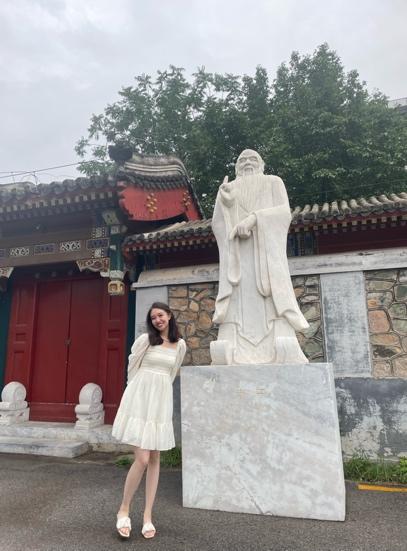
A person standing next to a statue

Description automatically generated

(the sculpture of Laozi in Peking University)

My research in the National Historical Archive was fruitful, as there exist a series of documents about Manning, which were sent by Yang Chun and Qing Hui, (the Ambans, who were given order by the Emperor as local officials in Tibetan area) to the Emperor Jiaqing, dated through the period from 1811 to 1812, the time when Manning was in Tibet. This is the only place in the mainland China, as found so far, containing the first-hand materials about Thomas Manning. We can see that, as for Chinese people, it is more striking to know that Manning was the first European to visit Lhasa since the Capuchins, and to know that unlike his predecessors, George Bogle and Samuel Turner, Manning followed a proper procedure to apply for an official permission to visit Lhasa as a foreigner from Calcutta. Although, they shared the same ultimate goal: reaching Beijing through the pathway from Tibet, and Manning must have been inspired by their previous plan after experiencing all the obstacles on entering interior area of China, when he was in Canton. However, his ultimate goal was luckily kept unknown to Tibetan officials, as they thought that Manning was one of the missionaries. Particularly, in one document in the Nationalities Category of the Historical Archive in Beijing, dated on the 14th day of the 12th month of the 16th year of Jiaqing (same as January 27, 1812), it is recorded that Manning attempted to secretly preach Christianity in the guise of a Buddhist pilgrim. (Original texts: “夷人馬吝… 假借朝佛之名,希圖暗中傳教.” And ‘馬吝’ is the Chinese name for Manning given by those Tibetan officials.)

After my visit in Peking University, I visited Fudan University in Shanghai, where I had a wonderful discussion with Professor Chen Zhenghong, one of the leading experts in Chinese Special Collections and Rare Books. He mentioned that several books in Manning’s Chinese book collection are rare books indeed. For example, one Daoist work Zhuangzi (ca. 3rd BC, the second Daoist canonical masterpiece after Dao De Jing), one Confucianist work Xing Li Da Quan (ca.1415) and some secular novels in Ming and Qing Dynasty. In the meantime, he gave me much practical advice on the development of archival research skills.

Once more, I’d like to express my deepest gratitude to BARS for offering me a Stephen Copley Research Award. With its support, I gained better understanding of Thomas Manning’s life in China with more helpful first-hand materials about Chinese officials’ attitudes towards him at that time as well as his stay in Tibet. I was inspired so much by those archival materials which I found during my research trip in the National Archives, Peking University and Fudan University. From these experiences, I obtained new ideas of my project, and helpful suggestions from local experts on those specific questions.

Serena Qihui Pei

Serena Qihui Pei is a PhD candidate at University College London. Her research interests focus on British Romanticism and its connections to China and Chinese traditions, such as culture, literature, and philosophy. Her current project explores the life of Thomas Manning in China as well as his Chinese book collections, to investigate Manning’s understanding of old Chinese philosophies; particularly, Daoism and Confucianism.