Five Questions: Simon Kövesi on John Clare: Nature, Criticism and History

      Comments Off on Five Questions: Simon Kövesi on John Clare: Nature, Criticism and History

Simon Kövesi is Professor and Head of the Department of English and Modern Languages at Oxford Brookes University.  He tweets as @kovesi1.  He has published widely on contemporary fiction (with a particular focus on the Scottish novelist James Kelman), on working-class literature and on the relationship between writing and the natural world.  At the heart of his work, though, is his abiding interest in and love for John Clare, on whom he has published numerous essays and book chapters.  He is the editor of the John Clare Society Journal and the co-editor (with Scott McEathron) of New Essays on John Clare: Poetry, Culture and Community (Cambridge University Press, 2015).  He has recently led a high-profile campaign to highlight the threat posed to Clare’s archives by ongoing local authority cuts.  His passion for Clare’s work has also led to his being one of the very few academics to have sparred with a straw bear on the silver screen.  Below, we discuss his most recent monograph, John Clare: Nature, Criticism and History, which was published by Palgrave in September 2017.

1) What first drew you to John Clare?

I was an undergrad on an exchange year at the University of North Carolina at Chapel Hill.  It was clear to me then that the world needed my dreadful poetry, and (boldly) I showed it to a Professor of Romanticism, the brilliant Robert Kirkpatrick, who took pity on me, and kindly invited me to an evening poetry group at his house.  I’d written this nostalgic thing about watching a fox doing a wee – I suppose I was missing seeing them rifling through the bins of suburban London (to this day I’ve never actually seen a fox doing a wee).  Nevertheless, making the best of it, Kirkpatrick read us Clare’s ‘The Vixen’.  I’d never known of anything poetical about a fox and I’d never read any nature poetry of such precise clarity, all propelled by sharp, delicate sympathy, yet beneath no ostensible organising ego.  I stopped writing poetry straight away, and thankfully.  That was in 1993 – 200 years after Clare was born – and so it happened to be a great year for high profile celebrations and publications about his work.  When I returned to Glasgow for my final year, I became obsessed.  More often than not, I read Clare instead of revising for finals.  Early on, the rich pickings of his nature poetry were extended for me by the stylisations and politics of his (seemingly) wild language; by the capitalisation of land he occasionally protests about; by his diverse insights into folk culture and local traditions; by his unique prose; by his inversions of accepted valuations of nature; by his lyrical verse (which can be nothing but ego of course); by his playfulness, his cheekiness, his political lubricity, his isolation.  Like so many, I was haunted by the sad, depleted, often-romanticised story of his life.  At the start, however, it was his late love poetry that grabbed me most of all and that was the focus of my PhD with John Goodridge.

2) In your new book, you contend that ‘nature, feeling, fidelity persist as limitations on readings of Clare’, tracing the longstanding currency of characterisations such as ‘down-to-earth’ that serve to place and constrain him.  To what extent do you think that modern criticism of Clare is still shaped by the social and critical conditions of his original reception?

Those terms come from very early comments on his work.  I argue in the book that while they have been blown apart by the best of Clare criticism, they have been latently reaffirmed by the polemical accommodation of Clare to the agendas of contemporary green criticism especially, particularly because criticism can have a deaf ear, or a ham-shaped fist, when it comes to class.  The old model of Clare as ‘honest John’ does harm to the way we read his work – many have said so but it still creeps back.  Many critics reveal discomfort in the way they deal with Clare’s class; often, this manifests through treating his work as simple documentary evidence of landscaped fact, or a kind of social realism – as if he’s not capable of slippery, literary sophistication.  Partly this is Clare’s own fault – he often romanticises his agency out of the window – he denies his art and artfulness even in the manner in which he frames its conception.

In the book I also explore the ways critical awkwardness with Clare’s class can sometimes be downright insensitivity.  Calling Clare ‘homeless’ for example, is an historical nonsense, and yet it has such traction in Clare criticism, as it works well for a prevalent version of his relationship to land, or his supposed full-spectrum alienation.  But ‘homeless’ is now a dead metaphor in Clare, and if anything serves to stop us thinking about the subtlety and variety of his versions of ‘home’, and his constant, learned attention to people without one.  Perhaps because of its origins in conservation, but also because of founding tensions with the left and industrially-born socialism, ecocriticism has never been great on class; this is compounded in Clare studies by an understandable confluence between the sentimentalising of Clare’s location with the turn to the local in moralising green criticism – which of course many green critics worry about.

From all kinds of politicised critical approaches, you can track tendencies to reduce Clare to a kind of naïve holy fool whose knees and identity wobbled if he walked beyond the bounds of his parish – and that modelling (down to Clare himself of course – or at least partially so) has been entrenched by the blunter end of green criticism, but also by the crass end of historicism which can only see straightforward autobiography in a poem like ‘The Flitting’ (there’s certainly a reductive channel of class prejudice in assuming every time Clare writes ‘I’ it is uncomplicatedly and ‘honestly’ him).  Clare said himself in one of his most unbelievable and deliberately fragmentary poems – the wilfully fraudulent ‘Child Harold’ – that his life had been ‘one chain of contradictions’.  He did wear a green suit to go dining with his new London Magazine friends who all wore ‘sable’ – but a rich friend bought it for him.  Clare did mostly live in Helpston throughout his life, but that doesn’t mean he wanted to stay there.  Clare did write himself into a tradition of anti-enclosure poems, which have convinced everyone of their veracity, but we should not forget that he worked in enclosure gangs for many years, wrote his best nature poetry after enclosure, and continued to do so after he’d left Helpston – and by no means all of it is looking back to a pre-enclosure Edenic childhood – not at all.  Clare did thresh in a barn from the age of 8 or 9 – but by his own account, he suffered deep and lasting trauma over it.  He did that labour alongside his father so that he could help pay for his schooling, not because he lusted after labour.  He fantasised about having a domestic servant – we ignore these elements if we want honest John back.

It’s indicative of the romanticisation of Clare that no one has ever asked, before me, why he was able to find work in lime kilns.  Why were there so many lime kilns across the countryside in the Romantic period?  The answer is obvious: lime was pretty much the only material cheaply available that could help drain, fertilise and regulate the acidity of newly-enclosed land.  Lime was the main tool of enclosure and Clare helped make it, just before his launch as a poet; indeed the lime-kiln money was supposed to go towards funding his first publication of poetry.  It doesn’t mean he is a hypocrite – and I don’t care about it morally at all – it just means he is not a green messiah.  If we judge him, we have to be completely unhistorical to do so.  He was a poor labourer, and working in enclosure gangs or slaking lime in a kiln was decent money, if offering extremely low social status.  The only thing he seems to have worried about when working the enclosure gangs was the ‘wild and irregular habits’ of the itinerant men he was working with: not the ‘wild and irregular’ countryside they were enclosing.  I think critics need to start incorporating the moral messiness of Clare into their valuation of him – else we’re just forging self-affirming narratives and forgetting the contingencies of a life lived.  We don’t think any the less of the poems Wordsworth and Coleridge wrote, just because Lyrical Ballads was designed to fund a trip to Germany.  Clare is robust enough for these paradoxes, these tensions and multiplicities, to surface.  Too much criticism of Clare is sentimental and patronising – delicate, even.

3) In seeking to move beyond that echoing phrase from By Our Selves – ‘John Clare was a minor nature poet who went mad’ – which occluded aspects of Clare’s life and art do you think should be emphasised more strongly?

We need to think about what we do when we emphasise Clare’s ‘lack’ of education.  What did he gain by not having a ‘formal education’?  What forms of knowledge and routes to understanding did he have open to him that other poets ‘lacked’?  Could Byron play the fiddle like Clare?  What does Byron’s poetry lack because he didn’t go to the pub and listen to storytellers spinning folk narratives?  It’s as if academics just don’t know what to do with writers who have never been to a lecture, and so we flock to the poets who have.  People like us, right?  What we tend to do is express astonishment at writers like Clare and move awkwardly on: that’s the history of the reception of working-class writing in academia in a nutshell.  Clare’s education was incredibly complicated – it needs much more attention.

In the book, I talk about ‘place’ being not just a liberation for Clare – it was not merely a ‘positive’ platform for his locally ‘botanising’ focus.  Place was also a narrowing problem: being placed, knowing his place, keeping to his place, being regarded as ‘down to earth’ – the organicist impulse is still prevalent in contemporary criticism and you can see it in the accident of phrasing sometimes.  Clare talks about feeling like a donkey tied to a post in his relation to Helpston.  Too often we turn what was a severe limitation on the life of this poorest of poets, conflate it with a certain mood in some poems, and construct a magical green or folksily happy commitment to place, particularity and soil.  This move can be dangerously patronising, dismissive of material suffering, and can mean we ignore Clare’s constant changes of mood and temperament – let alone his shifting desires.  To shift all of this into blanket ‘alienation’ is also to obfuscate things.  Clare loved London, he loved travelling to the largest seasonal body of water in England (Whittlesea Mere – drained by one of his patron’s sons when Clare was in an asylum), he loved going beyond the ‘edge of the orison’ – he wasn’t ruined by doing so.  And he loved Helpston too – but he resented its parochialness, the lack of anyone to talk to about books, and wanted it to move closer to London.  There is a funny early poem where he speculates what his fantasy home will be like one day, when he’s made it, and while the house he builds for himself is determinedly rural, someone else will be doing the labour and chores while he writes, and there’s no family around to bother him, just a maidservant.  He hated being poor and not being able to buy the books he wanted, or food for his kids, or travel.  It is amazing we have to say this, but the fact is Clare criticism ignores it.  The fraudulent Reverend of a quack who ran Clare’s asylum – Matthew Allen – thought in 1840 that the only reason Clare needed help was what we would now call ‘anxiety’ over money coupled with a poor diet across decades.

There’s no romance in poverty, rural or urban, just as there’s little romance in hand-work or pre-mechanised agriculture – pre- or post-enclosure – though Clare does manage to squeeze a good deal of emotive nostalgia out of it, for sure.  He can be sentimental and conservative, as much as he can cry for reform and protest against the monied and the greedy.  His politics are as slippery as his accounts of grammar: in this mobility he is the most Byronic of poets.  Like all good poets, Clare is an unstable subject, and we need to be aware of that much more – and stop reducing a very long writing career to a moment of fury, passion or creative depression.  I think some of his greatest poems are not about enclosure or nature: they are about human poverty, about social mores, about status, ignorance and prejudice.  And to answer the question directly, Clare could have been a great satirist but nobody encouraged him, for example, when he wrote ‘The Parish’, while his sonnet parodying Wordsworth’s use of enjambment is brilliant, and his reworking of Byron by way of poetical masculinist empowerment is as foul as can be.  He also writes light comic verse of which John Hamilton Reynolds and Thomas Hood would have been proud.  He is so knowingly playful in rummaging amongst others’ styles and techniques – a sociable yet solitary magpie – stealing shiny bits – lining his own poetic nest.

4) Which of Clare’s works do you think are particularly ripe for reconsideration from a broader range of perspectives?  Which texts would you select for an undergraduate seminar to try and give a balanced sense of his value and achievements?

In Clare studies this is a sore point.  There just are not enough editions of his verse – particularly cheap ones or selections with good scholarly notes.  There are some good collections but they do not yet amount to easy access to the full range of his work.  I hope scholars reading this blog will one day produce their own editions of Clare, according to a wide variety of editing principles and presentational styles.  Imagine the possibilities of a manuscript-based facsimile edition online, with all sorts of reading texts (as the Cornell Wordsworth called them), of all the variants – which included (rather than demoted) lifetime published texts too?  That’s got to be the future of editing Clare.  To answer the question, I think Clare’s work offering social commentary does not get enough attention: sometimes it is satire, sometimes straight narrative, sometimes polemic, and some prose moments are also unique in the period; the letters can be really pointed in this area.  We have good engagement with the nature poetry, for sure, though I think more emphasis on the work of the early 1830s would reveal some real gems – and I think it is in this period that Clare’s writing about nature becomes super-sophisticated.  Though most commentary would have it that after leaving Helpston he loses his mojo, the poetic evidence just does not support it.

5) What new projects are you currently working on?

A big travelling exhibition of Clare portraits, original manuscripts, books and ephemera, to kick off in January 2020, 200 years after the publication of Poems Descriptive.  It’s a good time to take Clare on the road, I hope – just need to locate some funding.  I’ve just signed a contract with Palgrave to co-write a book with Bridget Keegan entitled The Occupations of Labour: Labouring-Class Writers, 1800–1900; this will group what shoemaker Chartist poet James Dacres Devlin (one of my personal favourites) called ‘hand-producer poets’ into their occupations for thematic consideration.  With Erin Lafford, I am putting together a collection of new Clare essays to propose to a publisher soon.  The longer-term book I’ve been chewing on for a while now is to be called British Literature and Poverty: 1800–2000, and the reading for that is opening up all sorts of new avenues for me.  It’s probably too big a project to ever finish, but I’m happy to give it a go.  Before any of that, I’ve got to finish an essay on poverty in the Romantic period – especially in agricultural improvement debates – and another on Clare’s reading, and rewriting, of Byron.

The BARS Blog: Call for Contributors  

      Comments Off on The BARS Blog: Call for Contributors  

The British Association for Romantic Studies (BARS) is looking for contributors to write for our blog: an online collection of news/notices and longer posts, all of which celebrate and promote research in Romanticism. Would you like to contribute to a) The ‘Archive Spotlight’ series or b) The ‘On This Day’ series?

Please get in touch by sending a short pitch of what your post will include, and a short bio. Final posts should be around 1000 words.

Further details:
‘Archive Spotlight’:

Posts should be a blog about your experience of using an archive. You could use the space to discuss one or two things of interest you found at the archive, perhaps things that are intriguing, but that you cannot fit into your thesis, book, or other written work.

The post could also be an account of the archive itself as well as some things you’ve studied there that relate to the Romantic Period (1770-1830). You could focus more on the latter if you prefer. Previous examples can be found here.

‘On This Day’:
This is a Romantic bicentenary series that has been running since July 2015. We have been inspired to create this series following the popularity on Twitter of the ‘OnThisDay’ hashtag. We want to present a catalogue of #OnThisDay blog posts that relate to events happening exactly 200 years ago. The premise of the blog is to give readers a snapshot of 1818 in 2018 (and on into 2019 and beyond!), relevant to that month or even that particular day. The series is also a part of #Romantics200.

The best way to get a feel of this series is to read our excellent posts from past contributors. You can see all the posts here.

If you have any questions or would like to make an informal enquiry about writing for us, please get in touch with Anna Mercer (BARS Blog Editor): mercerannam@gmail.com

Stephen Copley Award Report: Eleanor Bryan, The British Library

      Comments Off on Stephen Copley Award Report: Eleanor Bryan, The British Library

A report from Eleanor Bryan (PhD candidate, University of Lincoln) who was awarded a BARS Stephen Copley Award.

See the full list of 2018 winners here.


Eleanor Bryan – Stephen Copley Award Report

The Stephen Copley Award funded my visit to the British Library Doctoral Open day on Monday 19th March. The purpose of the open day was to acquaint new PhD students with the variety of resources that the British Library offers, and to explain the best ways of using its services and navigating its collections, both physically and online. This particular open day took an interdisciplinary approach to the British Library’s nineteenth-century collections and, as such, provided a holistic overview of a plethora of potential resources. Presentations were given by a host of librarians, all with different areas of expertise, who provided information on the nineteenth-century printed collections, modern archives, and manuscript collections.

My research focuses on dramatic adaptations of Gothic novels, namely Mary Shelley’s Frankenstein, and Bram Stoker’s Dracula. I was therefore particularly interested in the British Ephemera collections, which include playbills, prints, and drawings. The other doctoral students and I were able to peruse some of the historical manuscripts. We were shown a variety of eclectic ephemera and librarians demonstrated how to find specific items and then subsequently source other more obscure items that may be connected but not the result of an initial search.

My day at the British Library far exceeded my expectations, and I would recommend their Doctoral Open Days to anyone and everyone, regardless of discipline, who is in the first few months of their PhD. I now feel much more confident in my own skills as a researcher and feel more equipped to seek out relevant material that will be of use to me. I am therefore extremely grateful to the BARS Stephen Copley Award for funding my visit as it will prove to be of great value to my thesis.

Research Fellowship Opportunity: The Armstrong Browning Library

      Comments Off on Research Fellowship Opportunity: The Armstrong Browning Library

An opportunity for those researching nineteenth-century literature and history, via Holly Spofford:

The Armstrong Browning Library (ABL), located on the campus of Baylor University, is a world-renowned research center and rare-collections library devoted to nineteenth-century studies.

The ABL has established a Three-Month Research Fellowship for leading scholars from outside Baylor. Prof. Dino Felluga (English, Purdue University) served as the inaugural fellow during fall 2017, and Prof. Clare Simmons (English, Ohio State University) will serve as the fall 2018 fellow.

Applications are being accepted for fall 2019, and are due by Sept. 7, 2018. $28,000 will be transferred directly to the Fellow’s home institution in three equal installments to help cover expenses incurred by this Research Fellowship. In addition, the Fellow’s initial travel to, and final return journey from, Baylor will be covered, as will lodging in well-furnished, high-quality apartments. Finalists will be notified by Oct. 10, 2018, and will be interviewed before the end of October.

Inaugural BARS Chawton House Travel Bursary Awarded

      Comments Off on Inaugural BARS Chawton House Travel Bursary Awarded

The executive committee of the British Association for Romantic Studies (BARS) and the trustees of Chawton House are delighted to announce the winner of the inaugural BARS Chawton House Travel Bursary: Francesca Kavanagh, who is a PhD candidate at the University of Melbourne. Her research project examines the production of spaces of intimacy in practices of letter-writing, annotation, and commonplacing.

All scholars working on Romantic-Period women’s writing are eligible to apply for this scheme.  The BARS Executive Committee has established this award in order to help fund expenses incurred through travel to, and accommodation near, Chawton House Library in Hampshire, up to a maximum of £500.

Recipients are asked to submit a short report to the BARS Executive Committee, for publication on its website, and to acknowledge BARS and Chawton House in their doctoral thesis and/or any publication arising from the research trip. Please join us in congratulating Francesca on her award.

– Daniel Cook, University of Dundee

Stephen Copley Research Awards 2018 – the winners

      Comments Off on Stephen Copley Research Awards 2018 – the winners

The BARS Executive Committee has established these bursaries in order to support postgraduate and early-career research within the UK. They are intended to help fund expenses incurred through travel to libraries and archives necessary to the student’s research. As anticipated, this year we received a large number of applications, many of which were of a very high quality indeed. Please do join us in congratulating the very worthy winners. Romanticism is alive and kicking, we’re pleased to say!

  • Eleanor Bryan (University of Lincoln)
  • Mary Chadwick (University of Huddersfield)
  • Lauren Christie (University of Dundee)
  • Octavia Cox (University of Oxford)
  • Valerie Derbyshire (University of Sheffield)
  • Eva-Charlotta Mebius (University College London)
  • Hannah Moss (University of Sheffield)
  • Harrie Neal (University of York)
  • Emma Probett (University of Leicester)
  • Lieke van Deinsen (Radboud University Nijmegen)

Once they have completed their research trips each winner will write a brief report on their projects. These will be published on the website and circulated through our social media. For more information about the bursaries, including reports from past winners, please visit our website.

– Daniel Cook
Bursaries Officer, BARS
University of Dundee

Five Questions: David Stewart on The Form of Poetry in the 1820s and 1830s

      Comments Off on Five Questions: David Stewart on The Form of Poetry in the 1820s and 1830s

David Stewart is Senior Lecturer in Romanticism at Northumbria University.  He has published widely on figures including Lord Byron, William Hazlitt, Leigh Hunt, Robert Southey and Charles Lamb and on topics including short fiction, ephemerality, paradox, commerce, mass culture and the politics of style.  His first monograph, Romantic Magazines and Metropolitan Literary Culture, was published in 2011 and considered the qualities of the extraordinary wave of periodicals that burgeoned in the period after the Napoleonic wars.  His new book, The Form of Poetry in the 1820s and 1830s: A Period of Doubt, which we discuss below, has just been published by Palgrave.

1) When do you first remember encountering the poetry of the 1820s and 1830s, and what led you to want to write a monograph about it?

For a long time I didn’t know that I was writing a book about it.  I’d been teaching Leigh Hunt’s Story of Rimini for a few years and kept having fascinating discussions with students who loved it, and yet found it oddly unstable, almost, but not quite, laughable.  There are some kinds of poetry that we don’t quite know how to read: do we look for a deep and serious philosophy or a buried political context beneath the surface, or do we delight in its seemingly superficial charms?  I found some other poets who provoked the same reaction in me, and I realised what linked them was that they fell somewhere between ‘Romantic’ and ‘Victorian’ poetry.  A poem like Rimini might be the beginning of a poetic history that never quite took shape.  The usual story is that the poetry market collapsed in the mid-1820s, and the few poets who did produce poetry were not very good.  The fact that neither part of this is true (the market did not collapse, and these poets are just joyous to read) was something I wanted to correct.  Equally, though, I kept coming back to my own unstable reactions to these poets: the wavering uncertainty with which we view this hinterland might be its most valuable feature.  I wanted to bring the period’s poetic scene to a fuller attention, but without giving it the firm outlines of a clearly demarcated ‘literary period’.

2) Your subtitle characterises the two decades as ‘a period of doubt’, a doubt manifested both in poets’ responses to their contexts and in later critics’ attempts to frame their achievements.  How can working to understand the doubts that poets struggled with help us to gain a better understanding of their cultural moment?

I find doubt a fascinating state of mind.  Doubt can be active, even aggressive, but it can also be comic, a matter of being baffled; it might even produce wonder.  It is not a fixed state; instead, when we are in doubt we can test things out, we can speculate on what things are, or how things might be.  Byron writes so well about doubt in Don Juan, and I like especially these lines in Canto 1: ‘What is the end of Fame? ‘tis but to fill / A certain portion of uncertain paper: / Some liken it to climbing up a hill, / Whose summit, like all hills, is lost in vapour’.  The poets of this period are remarkable partly because they thought so often, and so playfully, about the possibility that critics like me might come along and sift and sort them into a period.  The form that that writing takes – the fact that it is on ‘uncertain paper’ – is the means by which it can be transmitted to future readers, but equally is itself a matter that prompts doubts.  Are some ways of ‘filling’ that paper (some metrical techniques) more ‘certain’ of Fame than others?  Are some kinds of paper (some methods of publishing) more ephemeral, more ‘uncertain’, than others?  The lesson that I hope I’ve taken from these poets is that doubt can be a pleasure.  To ‘gain a better understanding’ of this ‘cultural moment’ means, I think, accepting that we’ll always be groping around in vapour.

3) Introducing the book, you stress the divide between emergent formalist and commercial aesthetics, and also discuss the prominence of light verse during the period, but you stress that these three strands have more in common than the discourses surrounding them often admitted.  How would you characterise the defining qualities of these three modes, and what are the main things that unite them?

One of the real pleasures of writing this book has been getting back to reading poetry attentively.  We tend to associate this kind of ‘formalist’ close reading with a detached idealism, and also with only particular kinds of poet.  One group of poets might seem to fit that model.  I discuss the young Browning and Tennyson, but also poets like Hartley Coleridge, George Darley, and Thomas Lovell Beddoes who have always found ‘fit audience, though few’, admirers who pride themselves on hearing the delicate modulations of their metre.  We can place these poets as the first buds of a Victorian aestheticism that comes into full bloom with Walter Pater.  They are opposed to another group associated especially with the material form of their commercial books: the poets of the literary annuals, Felicia Hemans, and Letitia Landon.  These poets use metres, of course, but metre is deemed an irrelevance in books that are merely objects for display in the drawing room.  A final group – Thomas Hood, Winthrop Mackworth Praed, John Hamilton Reynolds, for example – provide something like what Kingsley Amis calls ‘light verse’: punning, bright-eyed wit that skims over the surface of society, valuable for the very perfection of the metrical surface they create and polish.  The attempt to create oppositions between kinds of poet is important, most particularly the role that gender plays in that process.  But they all share a curiously enabling doubt about categorisation.  Landon, for example, plays brilliantly with verse form and its relation to the books in which she appears; that tactic is mirrored by George Darley who, when he was not writing poems about fairies, was busy writing abusive articles about Landon.  The fact that Darley, Hood, and Hemans are all bound up in the green silk covers of the annual The Amulet in 1828 suggests some of the possibilities and perplexities this culture presents.  All of them think carefully, and with a disarming self-consciousness, about the place their poetry might have in culture, and how their poetry might form itself (metrically and materially) for readers in their own time and in an unguessable future.  It’s a conversation that is worth tuning in to, particularly in our own critical moment as we attempt to rethink critical methods like ‘formalism’, ‘historicism’ and ‘book history’.

4) If you were selecting a few key poems as standard-bearers for the poetry of this period (for a MA seminar, say), which would these be?

This feels like a slightly mischievous question: I feel uncomfortable with the idea of ‘standard bearers’, poets marching under the banner of a territory that I would prefer to remain bewitchingly vague!  But no MA seminar can try to cover everything.  Some of these poets are well known: Hemans, Landon and Clare need no introduction for Romanticists.  There’s been excellent recent work on poets I look at like Hartley Coleridge and Thomas Lovell Beddoes.  Others will, I hope, prove more interesting than they have hitherto: George Darley and Winthrop Mackworth Praed especially.  I end with a section on the young Tennyson, who hardly needs my help to find fame, and consider how his work starts to change when we place him alongside Clare, Landon, Praed, Hood, Hunt and others.  I think we might learn the lesson from the editors of annuals like The Amulet and Friendship’s Offering: place a diverse selection of poems together, and see what chance lights are thrown out.  If I had to choose one poem, though, that gives a glimpse of what I love about this period, it’d be Praed’s ‘The Fancy Ball’ from the New Monthly Magazine of 1828.

5) What new projects are you currently at work on?

I’m working on place and fiction in the Romantic period.  My focus is on the Anglo-Scottish borderlands, and on writers including Walter Scott, Allan Cunningham and James Hogg.  There’s a relationship between humour, lies, fiction, and the experience of movement that I want to track.  I’ve been approaching it from a longstanding interest in this ‘region’ and these writers, but also via theories of place and mobility in geography and anthropology.  The anthropologist Tim Ingold’s work has been a revelation for me, as has work that sits between the creative and the critical by Rebecca Solnit and Kapka Kassabova.  I have an article on James Hogg that is the first fruit of this work: it should be coming out in The Yearbook of English Studies in a special issue on the 1830s.  I’ve also got a piece about Wordsworth and parody coming out this year in European Romantic Review.  I secretly want to write something about V. S. Naipaul’s The Enigma of Arrival, but don’t tell anybody, least of all my research lead.

Report from the BARS/Wordsworth Trust Early Career Fellow 2018

      Comments Off on Report from the BARS/Wordsworth Trust Early Career Fellow 2018

Dr Lucy Linforth arrived at Dove Cottage just a few days ago to take up her position as the BARS/Wordsworth Trust Early Career Fellow. She will spend the next month living, researching and collaborating with others in Grasmere. Here’s an initial report from Lucy: 

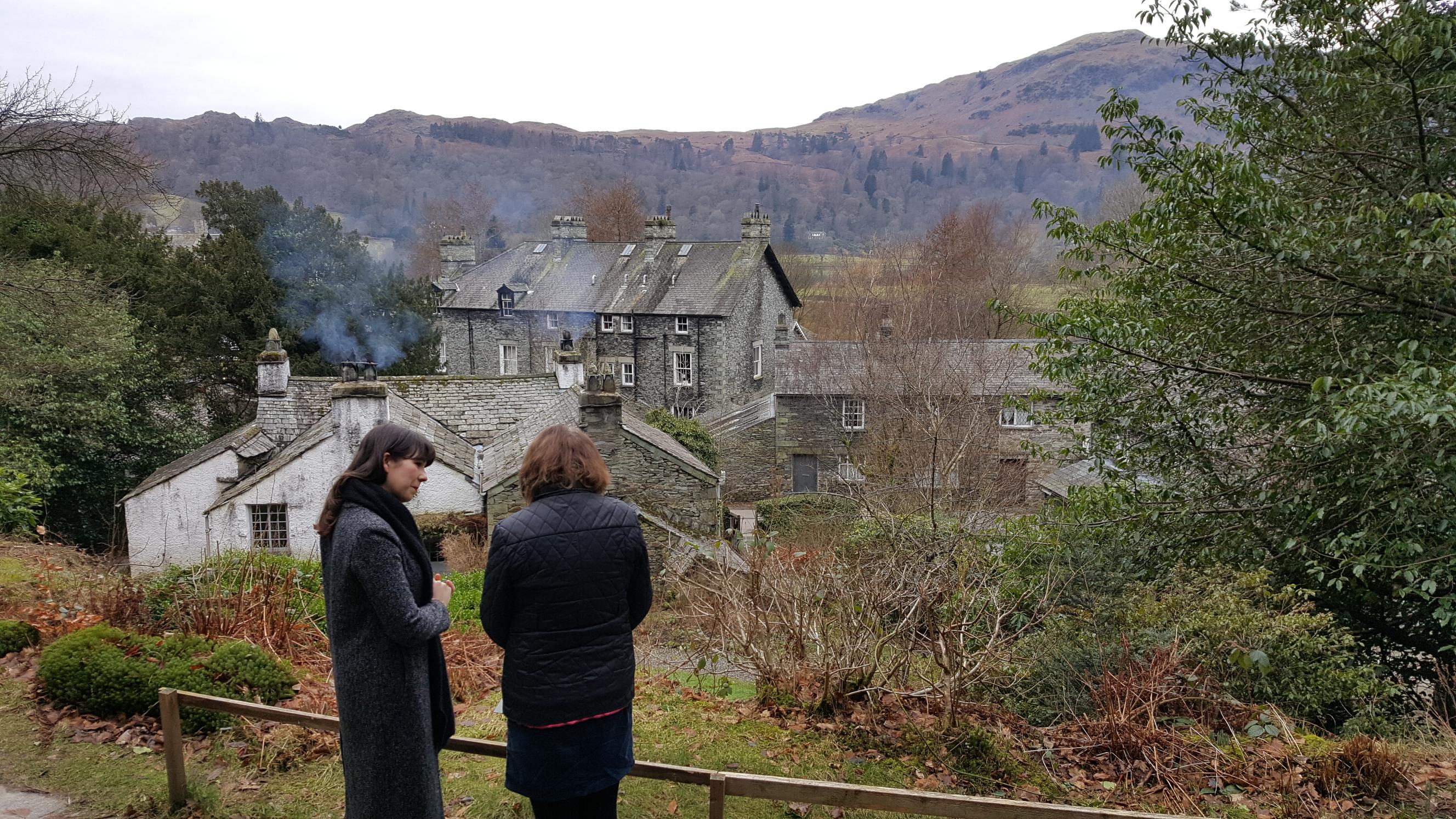
I am visiting Dove Cottage in Grasmere for the month of February, for the BARS and Wordsworth Trust Fellowship, during which time I will be exploring Wordsworth’s material world, including his home and the objects housed there, as well as the collections held by The Wordsworth Trust in both the Wordsworth Museum and at the Jerwood Centre. Though Wordsworth is most often admired as a poet of the mind, my research will focus upon Wordsworth’s poetry and the material world: his fascination with ‘the life / In common things’, a fascination which appears so often in his poetry (The Prelude 1.117-8). Over the coming weeks, it is my hope that I will be able to suggest opportunities for connections between poems and objects at Dove Cottage, and which may ultimately result in an invitation to visitors to engage with both objects and poetry in new ways. For my first two days here, I’ve been enjoying a thorough exploration of Dove Cottage, a visit to the Wordsworth Museum and exhibitions, and I have also spent time at the Jerwood Centre, which contains a vast repository of letters, books, paintings, and artefacts. Owing to the thick layer of snow which has fallen since I’ve arrived here at Grasmere, the smoke curling upwards from the chimneys at Dove Cottage only adds to the welcoming feel of the cottage, warm and homely amidst the cold but beautiful snow-covered hills all around.


Lucy standing with Senior Guide Hazel Clarke overlooking Dove Cottage on the first day of her fellowship


A bit more about Lucy and her research background:

I have recently completed my PhD at the University of Edinburgh. My doctoral thesis, titled ‘Fragments of the Past: Walter Scott, Material Antiquarianism, and Writing as Preservation’, explored the antiquarian materiality of Scott’s fiction. Working closely with the material collections exhibited at Abbotsford, I explored Scott’s participation in contemporary antiquarian practices such as collection and conservation, and suggested that Scott’s fictions frequently acted as textual extensions of his material practices to offer spaces in which the material past could to be preserved and exhibited. My research interests lie in the material culture of late eighteenth and nineteenth-century literature, including Gothic literature, antiquarianism, graveyard poetry, and ballads. I currently work as an Education Assistant at the Palace of Holyroodhouse, and also as a Heritage Engagement Assistant at Abbotsford, the Home of Sir Walter Scott in the Scottish Borders.

– Lucy Linforth

Report from ‘Romantic Novels 1818’ – Mary Shelley’s Frankenstein

      Comments Off on Report from ‘Romantic Novels 1818’ – Mary Shelley’s Frankenstein

Here is a report by Merrilees Roberts from the first ‘Romantic Novels 1818‘ seminar. This series is sponsored by BARS and seminars are held at the University of Greenwich. 

BARS also provides bursaries to support postgraduates and early career researchers who wish to attend. You can find more information on the application process and see details of upcoming seminars in the series here.


A Discussion of Mary Shelley’s Frankenstein (1818) with Dr James Grande

Romantic Novels 1818 Seminar January 2018


James Grande delivered a fascinating paper on Frankenstein intended to spark ideas about how to capture the neglected ‘1818’ context of the novel’s first edition, which comprised only 500 copies sold mostly to circulating libraries. Grande took James Chandler’s England in 1819: The Politics of Literary Culture and the Case of Romantic Historicism as an inspiration for thinking through a microhistory of 1818 which would capture the novel’s historical – rather than literary – context. Resisting the critical orthodoxy of readings focused on biographical and ‘family romance’ narratives about the Shelley-Godwin family, Grande suggested possible ways of thinking through Frankenstein’s reception in 1818. These included setting the dedication to Godwin in the context of the repressive measures enforced by a government wishing to quash continuing debates fostered by 1790s radicalism, and research which shows that in this decade the fiction market was actually dominated by female authorship. This perhaps throws an interesting light on Percy Shelley’s support of and collaboration in the project. Another important consideration was the articles appearing in the same periodicals containing reviews of Frankenstein – those which express anxiety about the melting of the polar ice-caps, and which provide an unwittingly significant frame narrative to the novel.


University of Greenwich campus


Particularly interesting to me was the idea that the death of Princess Charlotte in November 1817 provides a more compelling analogue for the novel’s implicit preoccupation with the dangers of childbirth than Mary Wollstonecraft’s death in 1797. The idea that the changes in the weather throughout Europe following the eruption of Mount Tambora in 1815, which created the so-called ‘year without a summer’ in 1816, was in some sense a causal factor of both the composition of Frankenstein and the continuing apocalyptic mood of this post-revolutionary period also offers an interesting point of relation to the burgeoning scholarly interest in eco-criticism and philosophies of matter.

– Merrilees Roberts

Five Questions: Tom Mole on What the Victorians Made of Romanticism

      Comments Off on Five Questions: Tom Mole on What the Victorians Made of Romanticism

Tom Mole is Reader in English Literature and Director of the Centre for the History of the Book at the University of Edinburgh.  He has published extensively on Byron, Romantic-period celebrity, periodicals and print culture.  His recent books include The Broadview Introduction to Book History and The Broadview Reader in Book History (both with Michelle Levy); he is also a member of the Multigraph Collective, which authored the recently-released Interacting with Print: Elements of Reading in the Era of Print Saturation.  His new book, What the Victorians Made of Romanticism: Material Artifacts, Cultural Practices, and Reception History, which we discuss below, was published by Princeton University Press.

1) How did you come to realise that you wanted to write a book about what the Victorians made of Romanticism?

This project grew out of my previous work on Romanticism and celebrity culture.  One of the things I discovered in that research was that people at the beginning of the nineteenth century often talked about celebrity as a second-rate kind of fame.  Celebrity was a kind of fleeting recognition you received in your own lifetime; true fame was usually posthumous, but it lasted much longer.  Once the idea was established that these two kinds of fame were mutually exclusive, it became easy to assume that people who had been famous in their lifetimes – Byron, Scott – would be forgotten after their deaths.  Lots of people actually said that these poets would be forgotten.  And yet they weren’t.  So my starting question was – why?  What kinds of cultural work were necessary to keep those writers in the public eye?  That question, in turn, led me to others, as I started to uncover what I’ve come to call the web of reception – all the material artefacts and cultural practices that shaped the reception of Romantic writers and their works.

2) In your second chapter, you set what you’re doing in the book against a tradition of ‘punctual historicism’ that privileges moments of composition, first publication and initial reception.  What are the principal kinds of insight that you believe we can gain by turning to longer and more diverse reception histories?

The trouble with punctual historicism, as I see it, is that it focuses on one context to the exclusion of all others.  This can make literature seem like something that’s tied to a particular historical moment – the moment of its production – and that cannot operate outside of that moment.  But one of the things that makes literature special is that it outlives its moment of production.  I don’t want to go back to the old idea that great literature transcends its historical moment and becomes timeless because it appeals to some kind of universal humanity.  Instead, I want a kind of criticism that recognises that works of literature can be reactivated in historical moments beyond the imaginations of their authors, and even that they might make their most important impacts when they are redeployed in new historical, social, political and media contexts.

3) After an initial section on the web of reception, your book mainly focuses on four media through which Victorian culture remade Romantic-period authors and texts: illustrations, sermons, statues and anthologies.  How did you come to select these four media to make your case, and were there others that you explored during the process of composition?

These four strands of the web of reception give me a broad range to explore.  They allow me to take in artefacts and practices, verbal and visual responses to Romanticism, mass-produced books and one-off sculptures.  They allow me to tell stories of remediation, as works produced in one medium were mediated through another to new audiences.  These strands of the web also constitute their own self-aware traditions, so that, for example, anthologies refer back to earlier anthologies and sustain an ongoing debate about what a good anthology should be like.  But I could certainly have divided my material along other lines.  Photography is discussed in relation to both illustrations and statues, but it could have had a section of its own.  There are other strands of the web, and I hope I’ve identified enough that other people will be able to unpick them, taking up where I’ve left off.

4) You argue convincingly that ‘complex acts of selective forgetting’ were as crucial as acts of memory for Victorians making use of Romantic poets and their works.  What, for you, are the most telling things that the Victorians sought to forget, either about the individual poets you examine (Wordsworth, Byron, Shelley, Scott and Hemans), or about the Romantic-period generations more generally?

It wasn’t surprising to learn that the Victorians found Shelley’s atheism to be a problem. But I was surprised to discover the lengths they went to in their effort to forget it. First, they claimed that his atheism wasn’t important for his poetry.  Second, they went so far as to argue that his poetry carried a Christian message, even if Shelley the man would have denied it.  More generally, commemorating the Romantics meant forgetting many of their political commitments.  This wasn’t just true for radicals like Byron and Shelley, but also for a Tory like Scott – the problem wasn’t a particular set of political views, it was politics per se.  Romantic poets had to leave political commitments behind them as they were absorbed into the canon of English Literature.  Some critics have approached reception history through the lens of cultural memory – but I think that cultural memory studies are only helpful up to point.  We need to grasp that this process is as much about motivated forgetting as it is about remembering.

5) What new projects are you currently working on?

I have a number of articles coming out: one about the connections between celebrity and anonymity in the Romantic period; one about John ‘Walking’ Stewart, the Romantic pedestrian traveller and philosopher; and two about Byron – ‘Byron and the Good Death’ and ‘Byron and the Difficulty of Beginning’.  After that I have some ideas for another book, but it’s really too early to talk about them at the moment.