Call for Articles: Polygot Women as Agents of Transfers in the European Romantic Public Space

      Comments Off on Call for Articles: Polygot Women as Agents of Transfers in the European Romantic Public Space

Call for Articles

Polyglot Women as Agents of Transfers in the European Romantic Public Space

We are pleased to invite submissions for an edited volume entitled Polyglot Women as Agents of Transfers in the European Romantic Public Space, edited by Antonella BRAIDA and Céline SABIRON to be submitted to Palgrave Macmillan.

Background and Rationale

This volume builds upon the scholarly dialogues initiated during two conferences held at the Université de Lorraine, Nancy:

  1. Cultural Transfers in British Romanticism: Women Writers and Translation as Mediation and Book Circulation (June 2023): This conference explored the nature and impact of translation on the reception of literary works and cultural productions during the Romantic period. It highlighted women’s presence in the public sphere, the recovery of women’s work and its often marginal place in literary history, and the importance of experiences, networks, and salons—not just through written texts but also via social interactions.
  2. Transcultural Women and European Romanticism (April 2024): This conference addressed issues related to women’s posthumous invisibility and interdisciplinary methods to reverse this process. It provided insights into British women’s hybrid spaces, such as the significance of libraries for eighteenth-century women travelers like Anna Miller; the role of reviewing novels, travel writing, and historical essays by figures like Mary Margaret Busk; and the contributions of translators and cultural mediators like Mary Wollstonecraft and Anna Laetitia Barbauld, who made scientific knowledge accessible through poetry.

Please submit proposals to celine.sabiron@univ-lorraine.fr and antonella.braida@univ-lorraine.fr  by 30 January 2025.

Call for Applications: The BARS President’s Fellowship 2025

      Comments Off on Call for Applications: The BARS President’s Fellowship 2025

In June 2020, the British Association for Romantic Studies announced its unequivocal support of the Black community, its condemnation of all forms of racism and its commitment to practical action. In response to the enduring and systemic damage caused by racism, the BARS Executive commenced a programme of initiatives focused on the histories and literatures of People of Colour. Among these initiatives is the BARS President’s Fellowship, which was officially announced at the 2021 summer virtual conference, Romantic Disconnections/Reconnections

The President’s Fellowship is open to scholars from Black, Indigenous and other minority ethnic backgrounds working on any aspect of Romantic Studies to support research, teaching and/or public outreach expenses of up to £1500. Expenses may include, but are not limited to, costs emerging from: travel and accommodation for research-focused or archival visits; photocopying and digitisation; caring commitments; producing and circulating teaching resources; organising and delivering public outreach activities; setting up and running networks or collaborations; set up and maintenance costs for online platforms such as blogs and websites.

BARS invites applications from postgraduate, early career and independent scholars. Awards will be made based upon the significance and relevance of the project rather than upon the career status or affiliation of the applicant. A postgraduate must be enrolled on a PGR programme; an early career scholar is defined here as someone who holds a PhD but has held a permanent academic post for less than five years by the application deadline. Application for the award is competitive and cannot be made retrospectively. Applicants are encouraged to consider applying for the maximum amount, if appropriate, although applications below the threshold will not adversely affect the judgement of the awarding panel. Please indicate any relevant existing funding – match funding (whether cash or in-kind) will be looked upon positively. We anticipate awarding one President’s Fellowship in any given year; in exceptional circumstances, additional awards may be made. Successful applicants need not be based in the UK, but must be members of BARS before taking up the award.

The inaugural 2023 President’s Fellowship awardee was Ifemu Yaa Omari (University of Wolverhampton), for a project on Mary Prince. For a write-up of Ifemu’s award, see here.

The 2024 awardee was Dr Yasser Shams Khan (Qatar University), for a project titled ‘Staging the Orient: A Study of Oriental Scenography on the Romantic Stage’.

Please download and complete the linked form when applying for this scheme:

The name(s) of the recipient(s) will be announced on the BARS website and social media.

The awardee or awardees will be expected to work with BARS on a report or other project dissemination activity. This could take the form of a written piece for the BARS Blog; a video or podcast; or a talk or a digital event. We are open to suggestion and applicants are invited to pitch an idea for this element of the award in the application.

Applications and informal queries should be directed to the Bursaries Officer, Dr Gerard McKeever (gerard.mckeever@ed.ac.uk) at the University of Edinburgh. If you require further guidance about the funding aspects of the scheme, please feel free to contact the Treasurer, Professor Mary Fairclough (bars.treasurer@gmail.com).

There will be one round of the BARS President’s Fellowship in each calendar year: the closing date for the 2025 round will be 5pm on Friday, 8 November 2024. In usual circumstances, applicants will be informed of the panel’s decision within four weeks of this closing date. It is anticipated that the successful applicant(s) would take up their award as close to the commencement of 2025 as practicable.

Call for Applications: The BARS Open Fellowship 2025

      Comments Off on Call for Applications: The BARS Open Fellowship 2025

The Open Fellowship is available to scholars at any career stage undertaking exceptional work at the forefront of Romantic studies to support research expenses of up to £2000. Expenses may include, but are not limited to, costs emerging from: travel and accommodation for research-focused or archival visits; photocopying and digitisation; caring commitments; producing and circulating teaching resources; organising and delivering public outreach activities; setting up and running networks or collaborations; set up and maintenance costs for online platforms such as blogs and websites.

Awards will be made based upon the significance and relevance of the project rather than upon the career status or affiliation of the applicant. This award is highly competitive and cannot be made retrospectively. Applicants are encouraged to consider applying for the maximum amount, if appropriate, although submitting applications below the threshold will not adversely affect the judgement of the awarding panel. Please indicate any relevant existing funding – match funding (whether cash or in-kind) will be looked upon positively. We anticipate awarding one Open Fellowship in any given year; in exceptional circumstances, additional awards may be made. Successful applicants need not be based in the UK, but must be members of BARS before taking up the award.

The inaugural 2023 Open Fellowship awardee was Dr Patricia Matthew (Montclair State University) for a project titled ‘Trust and the Archives: New Methodologies for Inclusion’.

Please download and complete the linked form when applying for this scheme. 

The name(s) of the recipient(s) will be announced on the BARS website and social media.

The awardee or awardees will be expected to work with BARS on a report or other project dissemination activity. This could take the form of a written piece for the BARS Blog; a video or podcast; or a talk or a digital event. We are open to suggestion and applicants are invited to pitch an idea for this element of the award in the application.

Applications and informal queries should be directed to the Bursaries Officer, Dr Gerard McKeever (gerard.mckeever@ed.ac.uk) at the University of Edinburgh. If you require further guidance about the funding aspects of the scheme, please feel free to contact the Treasurer, Professor Mary Fairclough (bars.treasurer@gmail.com).

There will be one round of the BARS Open Fellowship in each calendar year: the closing date for the 2025 round will be 5pm on Friday, 8 November 2024. In usual circumstances, applicants will be informed of the panel’s decision within four weeks of this closing date. It is anticipated that the successful applicant(s) would take up their award as close to the commencement of 2025 as practicable.

BARS Executive Appointment: Digital Events Officer

      Comments Off on BARS Executive Appointment: Digital Events Officer

The BARS Executive is looking to appoint a Digital Events Officer to take the lead in co-ordinating our ongoing series of digital panels and roundtables and to contribute to the Exec’s future planning around digital engagement.  The Digital Events Officer’s primary responsibility is to be the lead organiser for a regular series of digital events, which can include panels and roundtables solicited via calls issued to the BARS membership as well as collaborations with partners and directly programmed events.  BARS Digital Events seek to include a diverse range of voices; all line-ups must feature at least one postgraduate or early career scholar.

The BARS Digital Events Officer is expected to:

  • Chair the BARS Digital Events Committee.
  • Work actively with the BARS Communications Team.
  • Propose, arrange and approve a programme of digital events each year.
  • Approach and invite speakers (usually via Calls for Papers).
  • Agree the formats of events with presenters.
  • Create publicity materials and co-ordinate bookings.
  • Evaluate the success of events and modify subsequent programming accordingly.
  • Contribute to BARS’ plans regarding digital symposia and conferences.
  • Take an active part in the discussions of the BARS Executive, working with other officers to help achieve the association’s aims.

The role would suit someone with experience of event organisation, digital skills (for creating events pages and managing social media) and a strong knowledge of the current landscape of Romantic Studies.

If you would like to apply, please send an Expression of Interest (up to one page) discussing what attracts you to this role, the skills you would bring and what you’d like to do if appointed to the BARS Secretary, Andrew McInnes (bars.secretary@gmail.com), copying in the President, Matthew Sangster (matthew.sangster@glasgow.ac.uk).  Please also give us a sense of your experience with a short CV (up to two pages) or similar document.  The deadline for submissions is Friday 8th November 2024.

John Galt Society Research Grant

      Comments Off on John Galt Society Research Grant

The John Galt Society welcomes applications for a grant (of up to ₤500) to defray expenses incurred in connection with research into the works, life or influence of John Galt. Two types of research projects—archival and digital—are eligible.

Archival research projects: these projects take a long-established approach to research. They involve traveling to archives, libraries, museums or other relevant locations and examining material holdings. The outcomes they project will usually be anchored in print, though that basis does not preclude ebooks. Eligible expenses might include transportation to the chosen sites and/or lodging near them. For projects that are closer to completion, they might include permissions fees or fees connected with copyediting, indexing or other components of manuscript preparation.

Digital research projects: these projects take new or experimental approaches to research. They might involve extensive use of online archives or digital collections; they might seek to discover how technologically enhanced approaches enable examination of large quantities of playbills, letters, records of other items and how quantitative investigations affect qualitative results. They might aim to create curated websites, collections or electronic editions that combine and present print, images and interactive elements, or they might link to tours of historically significant locations, such as the “Galt Way” of sites connected with Galt’s life and work in Scotland, or they might map areas around the globe that figure in his life and work. The outcomes they project will usually have some digital components, or they might be performances, recordings or videos. Eligible expenses might include costs of project-specific equipment or internet services sufficient to carry out the needed research. For projects closer to completion, they might include permissions, licensing or website hosting fees. For web hosting, some discussion with the Society will be required to help establish the estimated longevity of the project and plans to maintain the website.

There may be some overlap between these two types of projects. Applications may describe both components, and if awarded the grant, researchers may apply the funds to the component of their choice if the grant will not cover both. The grant is not intended to fund all projects fully; it is intended, rather, to add to other funding sources or to make expenses more manageable for researchers without other funding sources.

In all cases, the projects should have the goal of shedding new light on Galt’s significance in literature, history, socio-political thought or economics. Projects that situate Galt in other fields are also welcome.

Eligible applicants are advanced graduate students (students enrolled in PhD programs at universities around the world); early career scholars (scholars whose doctoral degrees date no more than three years before the application and who have held a permanent or secure academic position for no more than three years), contingent faculty (scholars with PhD degrees who hold part-time or temporary academic positions)
or independent scholars (scholars with PhD degrees who do not hold academic positions).

The Grant will be awarded annually. Previous recipients may apply for a second time, but preference will be given to first-time applicants. Applications should be emailed to the Administrator of the John Galt Society Research Grant (Dr. Craig Lamont, University of Glasgow, secjgs@gmail.com). Applications must include all of the following:

►Applicant’s name, address, email address.
►Applicant’s degree and employment status (date of PhD received or expected,
institutional affiliation [or statement that the applicant is not affiliated], length of affiliation
and whether the position is full-time or part-time, permanent or temporary.
►Applicant’s cv.
►Description (approximately 1,000 words) of Applicant’s project, specifying what
portion or aspect of it is to aided by the Grant and what specific use of the Grant money
will be made. The timetable for carrying out the research should also be indicated.
►The name, address, email address and affiliation of a scholar whom the Applicant has
asked to recommend the project. Applicants should make this request of a scholar
familiar with the Applicant’s work and ask the scholar to send the recommendation
directly to the Administrator of the John Galt Research Grant.

The deadline for applications is 31 January 2025. Complete applications must be received by the deadline in order to be considered. The recipient will be announced at the time (usually in March) of the Annual General Meeting of the John Galt Society. It is expected that the research will be carried out and a report submitted within a year of the receipt of the Grant. It is expected that the recipient will join the John Galt Society (if not already a member) before making use of the Grant.

Inquiries may be directed to Dr. Craig Lamont, Secretary-Treasurer of the John Galt Society and Administrator of the John Galt Society Research Grant (secjgs@gmail.com) or to Dr. Regina Hewitt, Chair of the John Galt Society (hwt87@earthlink.net)directed to Dr. Craig Lamont, Secretary-Treasurer of the John Galt Society and Administrator of the John Galt Society Research Grant (secjgs@gmail.com) or to Dr. Regina Hewitt, Chair of the John Galt Society (hwt87@earthlink.net)

Romantic Poets in the Wild #5: Jodie Marley

      Comments Off on Romantic Poets in the Wild #5: Jodie Marley

We (meaning us) are back with another Romantic Poets in the Wild. This week we are featuring poetry by Jodie Marley!

A poet and scholar in a ‘natural’ habitat.

Jodie Marley (she/her) researches William Blake and his cultural legacy. Her current projects include a monograph exploring Blake’s nineteenth- and twentieth-century reception; her PhD (2022) focused on Blake and the Celtic Twilight. She has published articles in the Bulletin of the John Rylands Library, VALA: The Journal of the William Blake Society, and Good Horoscope. Her personal interests include poetry and dance.

Here is what Jodie had to say about the following poem, entitled “Consuming and consumed”:

This is a poem I hadn’t touched in years. I had it in mind when Adam sent out the call for poetry ‘inspired’ by Romanticism, and distilled something that was much more complicated. My process is very intuitive. I write reams and reams and return later to refine. It’s a constant stream of consciousness with images gleaned from everywhere. I think this comes from being a diarist for decades. I’m very used to spilling my experiences, my encounters with others, onto a page, and experimenting with what forms. 

I remembered this piece as much more Blakean than it seems now. If it is Blakean, then it’s in the attitude rather than the form. It reminds me a bit of Blake and John Varley arguing over fortune telling. That said, it seems I have pinched some of Blake’s core motifs: flames, fire, furnaces, heart-gorges. There’s an adaptation of a Yeats line too, but I’ll leave that to you to find. Reading it back the poem also reminds me of the opening of one of my favourite films, Cléo de 5 à 7, where the protagonist has an awful reading. The cards appear in colour, the camera flicks up in black and white to two women interrupting each other, increasingly tearful. Ultimately, the protagonist accepts her gloomy fate. The film resumes in monochrome.

When I was editing, I saw Oothoon in the narrator, in her hunger and in her defiance of guilt, and her faith in her voice against all odds. Since writing this poem the first time, I’ve researched women Romantic prophets Dorothy Gott and Joanna Southcott, and I see them in here too. Again, I don’t think those were conscious inclusions. 

Without giving too much of myself away, the poem details feelings of guilt, regret, thoughts about Catholicism and ‘seeing’ in the mediumship sense. I am the grandchild of Irish immigrants on all sides and inherited a French Tarot deck from my mother. My family is very Catholic but conversely very open to seeing spirits. I am, disappointingly, the only woman in my family not to have seen one, although I’ve had several ‘supernatural’ experiences that cannot be explained.


Consuming and consumed

Between two pillars,
a woman upstanding.
Cardamom on my tongue
sucks dry the urge to speak
I’m not the conduit
(this time).

Her moon face flickers inwards, eyes
tightly coiled and kohled
if the spirits swirl around us
why does her blood shoot back
from her fingertips
as I hold her cold, knotted hands?

‘You’ve no boundaries’, she says
as my sweat wells into her palms.
We were one when our eyes locked,
when my forearms unstuck
from laminated tablecloth
when she prophesied
as my face burned
it’ll be easy for me to leave him
my feet never touch the ground.

This seer, conversing daily with spirits,
catches in me a glimpse
of her once sullied reflection.
She tells me,
I am a holy woman
burdened by the withering flesh of men
I must bear with forgiveness,
as their memory dims
my spirit refines.

(this woman, sitting
between two wooden beams
at a round sticky table
is as Catholic in spirit
as my grandmother
hands burdened by guilt exchanged
burning between our palms)

If I am a holy woman
consumed by the flesh of men
why must I bear her and them both?
to repent this hungry heart of mine.

Eyelids flicker back
my hands rest on the table
by a pack of yellowed cards
I’m shaking –
the espresso or the ecstasy?

My feet never touched the ground,
it was easy for me to leave.


You can find Jodie on social media at the following places: @jodie_l_marley on X/Twitter; on Bluesky @jodielmarley; on Instagram @jodie.e.eternity. You can also reach her at jodie.l.marley@gmail.com.

We hope you enjoyed this one; I certainly did! Join us next time for poetry by Yu-Hung Tien.

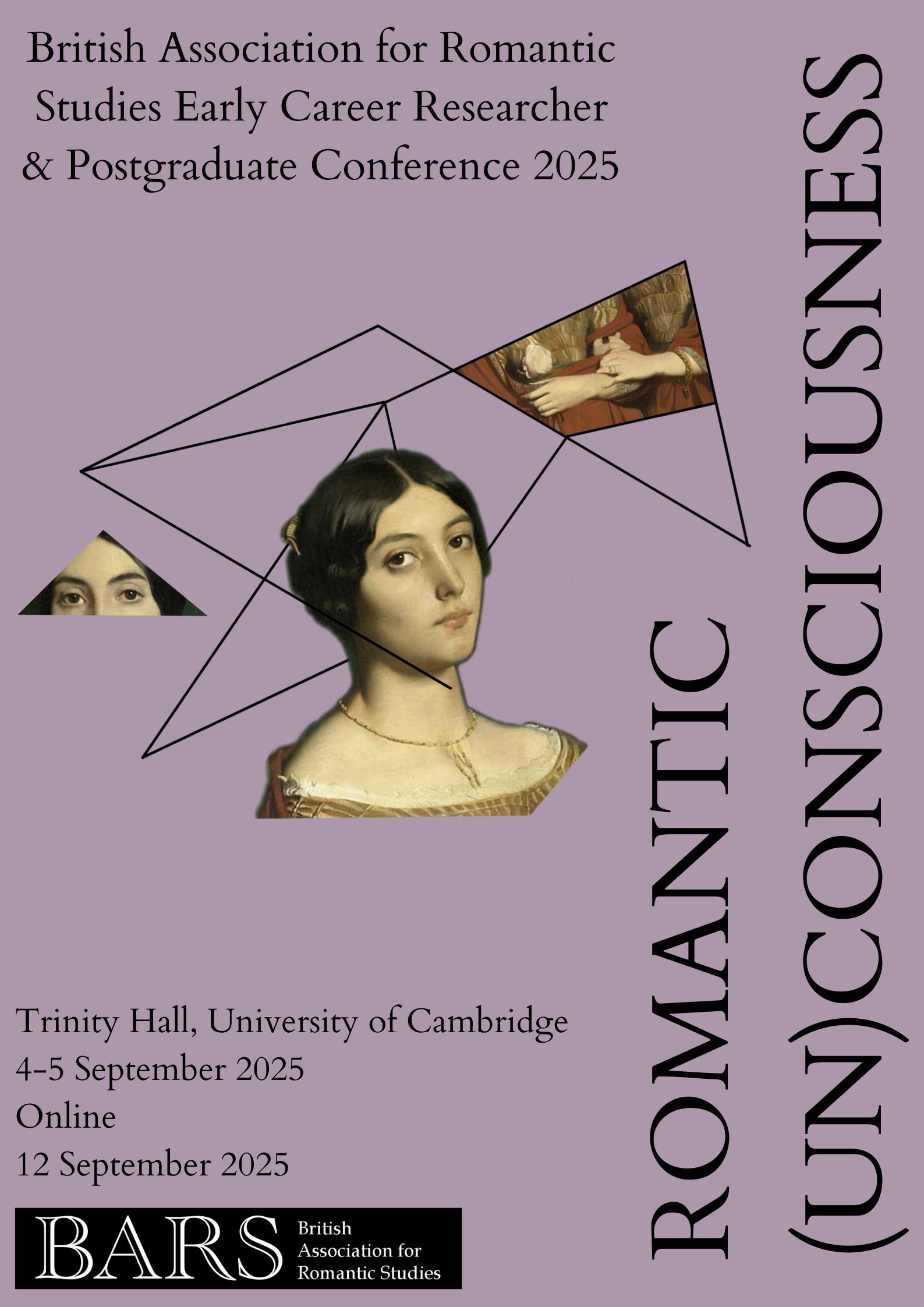
Call for Papers: BARS PGR & ECR Conference 2025 ‘Romantic (Un)Consciousness

      Comments Off on Call for Papers: BARS PGR & ECR Conference 2025 ‘Romantic (Un)Consciousness


Trinity Hall, University of Cambridge
4th-5th September 2025 & Online, 12th September 2025
 
Keynote Speakers Include:

Dr Rowan Rose Boyson (King’s College London)

Dr Christopher Bundock (University of Essex)
 
“No man’s knowledge here can go beyond his experience.” 
 

– John Locke, An Essay concerning Human Understanding (1689)
 
“The Dream is a second life. I have not been able to pierce without shuddering these doors of ivory or horn which separate us from the invisible world.” 
 
“I thought I understood that a link existed between the external world and the internal world; that inattention or mental disorder alone distorted the apparent relationships, – and that this explained the strangeness of certain paintings, similar to these grimacing reflections of real objects which move on troubled water.”
 

– Gérard de Nerval, Aurélia  (1855)
 
“One understands something most easily when one sees it represented. Thus, one understands the I only insofar as it is represented by the Non-I. The Non-I is the symbol of the I, and its sole purpose is to serve the I’s understanding of itself. One understands the Non-I similarly, that is, only insofar as it is represented by the I, which becomes its symbol.”
 
“The beginning is a concept that comes later. The beginning originates later than the I; therefore, the I cannot have begun.” 
 

– Novalis, Das Allgemeine Brouillon (1798 – 1799)
 

The Romantic period marked the start of a new way of thinking about human experience and its relation to the surrounding world. Scientists, philosophers, writers, and artists throughout Britain and Europe challenged preconceived ideas about human consciousness and placed an emphasis on exploring the space of the subjective imagination. British and European Romanticism’s philosophical, literary, and aesthetic output illustrates the complex and varied debates that surrounded the topic of consciousness or, as the Romantics would have described it, the imagination. 

 
The 2025 BARS Early Career Researcher and Postgraduate Conference invites explorations of the theme of ‘(un)consciousness’ within the context of Romantic-period ideas and cultural production. The conference will unite early-career and postgraduate researchers whose work considers the concept and representations of ‘consciousness’ from as wide a range of critical perspectives as possible. 
 
Topics of interest may include, but are not limited to:

  • Conceptions of the Romantic Self (and Other)
  • Romantics and the history of emotions
  • Altering states of consciousness
  • Romantics and affect studies
  • Self-conscious poetry, prose, and drama
  • Romantic theories of the mind e.g. in science, philosophy, the arts
  • Mind/body (dis)connection
  • Relationship between the mind and the world
  • Romantic Epistemology
  • Symbolism and Dreams
  • the Sublime, the Beautiful, and the Uncanny
  • Temporality, spatiality, and consciousness in Romanticism 
  • Ecological and Climatological (un)consciousness
  • Romantic and Panpsychism
  • Political (un)consciousness
  • Comparative Romanticisms and global consciousness 
  • Race and consciousness

Please submit 250-word abstracts for 15-minute papers, along with 100-word biographies through the forms below: 

Online Paper Proposals:     SUBMIT HERE

In-Person Paper Proposals:     SUBMIT HERE

We also welcome 600-word proposals for pre-arranged panels, to be submitted by a panel chair, including individual abstracts and biographies from all panel speakers (3 papers per panel), through the following forms:

Online Panel Proposals:     SUBMIT HERE

In-Person Panel Proposals:     SUBMIT HERE

All speakers listed on a prearranged panel are also asked to fill in and submit the individual paper form. This is to ensure that we are aware of any individual preferences, as well as all delegates’ access and dietary requirements.
​​

The deadline for submissions is Monday 6th January 2025.

​Please direct all enquiries to bars.postgrads@gmail.com.

Conference Organisers: Zooey Ziller (University of Cambridge), Cleo O’Callaghan Yeoman (Universities of Stirling, Glasgow, and Edinburgh), Kate Nankervis (University of York)

Five Questions: Omar F. Miranda and Kate Singer on Percy Shelley for Our Times

      Comments Off on Five Questions: Omar F. Miranda and Kate Singer on Percy Shelley for Our Times

Omar F. Miranda is Associate Professor of English and Comparative Literature at the University of San Francisco. His work examines literatures of the eighteenth and nineteenth centuries, especially their transnational, global and diasporic contexts. He is the editor of On the 200th Anniversary of Lord Byron’s Manfred: Commemorative Essays (Romantic Circles, 2019) and an open-access abridged teaching edition of Mary Shelley’s 1826 novel, The Last Man (Romantic Circles, 2023). He serves as Vice-President for Academic Outreach on the board of the Keats-Shelley Association of America (K-SAA).

Kate Singer is Mary Lyon Professor of Humanities at Mount Holyoke College. Her work explores gender, sexuality and race in the Romantic period, with a particular focus on affect, media and nonhuman ecologies. She is the author of Romantic Vacancy: The Poetics of Gender, Affect, and Radical Speculation (SUNY, 2019) and co-editor (with Ashley Cross and Suzanne L. Barnett) of Material Transgressions: Beyond Romantic Bodies, Genders, Things (Liverpool University Press, 2020). She serves as the President of the Keats-Shelley Association of America.

Their edited collection Percy Shelley for Our Times, which we discuss below, was published earlier this year by Cambridge University Press.

1) How did you decide you wanted to put together a new essay collection on Percy Shelley?

Back in 2019, Omar was in conversation with Bethany Thomas at Cambridge University Press about the fact that there hadn’t been a recent Percy Shelley volume, and he approached Kate about putting together a collection, since at a recent K-SAA Awards dinner at the MLA conference, we had bonded over a discussion on Shelley and Prometheus Unbound, particularly the orbs passage from Act IV.

One of the things that was really important to us then, and now: we were not simply editing a collection of essays on Shelley for 2024 (or any particular date) because such didn’t seem to align with how we were reading Shelley. Our interest and readings of his poetry and prose took us to what it means to revisit Shelley and to reread him in future moments and places. “Shelley for Our Times” is, therefore, not a reference to our contemporary moment today but is intended to open up Shelley to the biggest and most overlapping “our” possible — according to Shelley’s very own principles. Our point was really that this collection is not codifying a Shelley that is Kate’s and Omar’s, one that we own in our place and time as “a book sealed,” but rather these pages were meant as a shared and contagious space to unfold Shelley to everyone’s readings: ours, yours, theirs, other “ours.” 

Our argument is that Shelley’s poetics offers a methodology that elicits multi-temporal, iterative conversations occurring through multiple times and spaces, among myriad audiences. When we get questions about how reading Shelley in 2024 is different from reading Shelley in 2016 (when we met) or in 2018/9 (when we were first imagining the collection), or when we get asked about who the book did and didn’t cite and why (what scholarship we are bringing forward and what we are not), our response typically goes back to our core readings of Shelley and our argument. Shelley asks us to read his work at multiple times and places at once, not at discrete empirical instances. We could not literally include everyone or every germane citation, but that doesn’t mean lack of importance or relevance.

2) How did you go about gathering your contributors?

We went to the people who were interested in extending Shelley through a close attention to Shelley’s words and ideas themselves. We were especially motivated to reach a broad global network of scholars, and we wanted ideally to cross what we sometimes see as the US-British divide. What we really hoped to do was talk with our colleagues around the world about Shelley and the future of Shelley studies. There are, of course, people we asked who did not have time, and there were many more people on our list, and we sadly did not have enough space to allow for all of our desired authors, which means — once again, that this volume should be seen as the beginning of something much bigger, something truly Shelleyan. (This is true for our introduction and the further reading as well. We were really hindered by space and went through, we cannot tell you, how many dozens of revisions.) 

3) In your introduction, you discuss Shelley as ‘an arch poet of relation’.  What drew you to Shelley’s poetics of involvement and relationality as the lodestar for this bicentennial collection?

As Shelley moved further and further away from England, he remained fascinated by how poetry and art can, and must, bring us together. We thought it was the perfect way not only to invite entry into Shelley — especially by younger readers — by exploring his precociousness but also to investigate his sophisticated theories of interconnection. This is why the essays in our book — and the authors — treat such an array of subjects: because, as we insisted, they are based primarily on Shelley’s own artistry and practice.

We also saw “relation” as an invitation to do what we only just began in the book. For instance, we did not engage Édouard Glissant’s now famous theory on the Caribbean as a space of relationality — the multiple forms of a world in constant motion and transition. Here is one exciting way to expand Shelley by engaging what we argue in the book

The framing also has something to do with our working through our sense of Shelley’s entangled notions of futurity and history — and the sometimes Anglo-American bifurcation between a nineteenth-century historicist Revolutionary Shelley and a contemporary theory-boy Shelley. The more we talked, the more we felt we couldn’t think about Shelley’s notions of multiverse historicity without also thinking about his conceptions of contemporaneity and futurity, to which he then adds all sorts of other temporal and spatial relations. But, perhaps most significantly, we wanted to present the Shelley speaking to and with different audiences and “contexts” and people (and alongside all us interlocutors) across and within different times. It was one of the reasons why we held several panels and roundtables in the US, the UK, and virtually — to foment these conversations through iterative spacetimes. Our goal was to refine our sense of Shelley’s “historicism” and then open it up via thinking about the different forms of relationality his poetics explored, what we came to think of as multi-temporal and interconnected historicisms. We still worried, however, that our readers and interlocutors might understand “arch poet of relation” in a sloppy, melting-pot kind of way. We wanted to emphasize that we were not reaching here for an out-of-touch “wokeness.” We were also keen to try to resist a naive presentism that is looking for a nascent identity politics within Shelley. We hoped that each essay might pose a different constellation of specific relations — that is to say a series of historical and influential coordinates that also thinks critically about Shelley’s method of putting them together at varying junctures.

4) How did you choose how to order and organise the twelve essays?

We thought of multiple ways of arranging the sequence of chapters. We considered, for example, beginning with Mary Fairclough’s essay on action at a distance, which from the inception of the book we felt was a kind of key allegory for Shelley’s relationality. We also considered beginning with Gerard Cohen Vrignaud’s essay on hope and hopelessness to lay to rest the “ineffectual adolescent” stereotype, or beginning with Omar’s piece about Shelley in exile to emphasize the book as a kind of intellectual and material diaspora. But the order we ultimately agreed to envisioned an approach that might invite in academic and younger readers by building first from Shelley’s thinking about concrete relations between particular groups of people and then onto his more abstract thinking about the affects, sciences, ontologies, and other processes that bind us together. We loved the idea of perversely offering Fuson Wang’s essay early on as it reconceptualizes Shelley as a poet of old age and debility, redrawing assumptions about Shelley’s temporal and material predilictions. We were especially interested in confronting questions about Shelley’s complicity in some of the main systems of coercive relations of his day — imperialism, settler colonialism — those perennial questions of whether the liberal-but-potentially-not-radical Shelley was a possibly bad actor in certain regards. What does it mean for Shelley to have remained politically silent on the issue of the Atlantic slave trade, as Mathedlina Nagubodi argues, while his work directly inspired the politics and political theory of indigenous peoples and Black Civil Rights activists, as Nikki Hessell and James Chandler respectively show? Could Shelley offer any guide or inspiration to Black poets and legislators on ways of holding the pain of African enslavement’s wakes, as Julie Carlson considers? Or what about understanding the impulse to harm as a legacy of Enlightenment thought, what Alan Richardson describes as “dark empathy”? These essays precede examinations of larger affective categories of relationality, which several of our authors were separately interested in exploring, including sympathy, hope, and mobility/displacement. The book ends with the broadest of Shelleyan connection-making, as it considers Shelley’s notions of the environment (Ross Wilson’s essay), the opening up of gender through nonbinary and nonhuman being (Kate’s), and the aspirational legacies of how mediation, poetry, and imagination can continue to change a world in which we find ourselves (Joel Faflak’s piece). All the while, the order of chapters from the particular to the more capacious corresponds with our central argument about opening up Shelley to continued future readings through his own art and ideas.

5) What other projects are you each working on?

Kate is working on a new book on shapeshifting tentatively titled Shapeshifting and Models of Change: Race, Queerness, and Disability in Equiano and Beyond. It attempts to rethink how we understand change in the so-called age of revolution by looking at recurring allegories of material and bodily change as they speak to changes in environment, sex-gender systems, enslavement, and the consolidation of medical impairment. It is a way for us to think about alternative models for socio-political and personal change as well as to uncover incipient forms of intersectional being. She is also looking forward to the publication of several edited clusters of essays first written for the Black Studies and Romanticism conference, which think in varying ways about the need for Black Studies approaches within Romantic period literature, as well as an edited special issue on Transing Romanticism that showcases work of young queer and trans scholars, who reveal how a variety of forms of gender crossing rewrite the Romantic period as indelibly one of gender transition — and transitioning understandings about gender-sex systems.

Omar is currently working on a book project provisionally titled, Romantic Exile and the Rise of Global Celebrity. Much like Percy Shelley for Our Times, it aims to open up our scholarly discourses by turning back to the historical moment of Byronic celebrity. It will show how minority artists and activists played a critical role in the industry in which Byron and the craze of Byronism participated – an influence hitherto unacknowledged in our scholarship but overtly acknowledged by Byron himself. Through his examinations of lyric and exile in the period, he is also working on another monograph that tracks an alternative genealogy for the Romantic-era lyric tradition. In 2026, he anticipates publishing a second – and bicentenary – edition of his abridged teaching version of Mary Shelley’s The Last Man.

In the spirit of opening up, moreover, both of us are co-editing another volume alongside Bakary Diaby, Arif Camoglu, and Gaura Narayan: The Routledge Handbook to Global Literature and Culture in the Romantic Era. This collection of over 30 essays will provide an enlarged understanding of the era as a cross-cultural, trans-regional, and transnational set of interlocking aesthetic and political concerns. This includes deliberate attention to oral histories, narratives of rebellion and abolition, and other emancipatory and activist expressions around the globe. The volume departs all the while from conventional transatlantic and transpacific frameworks as well as temporal paradigms corresponding with teleological imperialist conceptual frames by centering the Global South. The volume will be published next year.

Romantic Poets in the Wild #4: Ciaran O’Rourke

      Comments Off on Romantic Poets in the Wild #4: Ciaran O’Rourke

RPW is back with more poetry, the thing everybody loves! This week we have Dublin-based poet Ciaran O’Rourke. O’Rourke is a widely published poet whose second collection, Phantom Gang, was longlisted for the Dylan Thomas Prize in 2023. His third collection is forthcoming from The Irish Pages Press.

Ciaran O’Rourke in the wild.

These poems, entitled “John Clare Enclosed” and “The Commons,” take their inspiration from the life and writings of the Romantic poet John Clare. I’ll let the poet himself say a few words here:

The poems I submitted are from my second collection, Phantom Gang (The Irish Pages Press), which was longlisted for the Dylan Thomas Prize in 2023. They are meant, of course, as a tribute to Clare, a “loss-eyed wilder-man”, who was also, at different points in his life, a kind of “hierophant // of dirt-in-bloom / and revelry”. In writing them, I wanted to sift through the swarming static of contemporary history to a new zone of clarity, where the spectres (of poverty, displacement, homelessness, environmental corrosion) that so ruled Clare’s world two centuries ago might be recognised afresh in our own – “our age / of wilting seas // and homesick, lock-out blues.” Both poems are filled with quotations and semi-quotations from Clare’s own work, so I think of them as echo-chambers rather than memorials: “Is this, then, our one inheritance, / the ache where voices grow? // My poem’s a lifted echoing, / as if they might continue.”

JOHN CLARE ENCLOSED

John Clare, your eagle’s nose
grows wise and flat

on the else unsmelt
suppressions of the earth.

You knew the world particulate
and true – and here you sit,

demure in inky water-colours,
bright-berry-eyed and stately,

a water-jug at rest
in elbow-distance down the tray.

A boyish elder-look, like light,
breaks across your face; you stare

as if an age of plenty, long ago begun
in green delight and common-song,

had all dissolved, a memory,
to noise and nothingness,

some bleak beyond
that slips your faded, folding

fist of bones, for now –
though the groan (or grin)

that’s surfacing, the watch you keep,
would make a merry mix.

My own un-peasant hunger
knows no muck or grass,

the sodden thing like bread
you supped for miles

that kept your famine-fingers clean,
but longs, in indolence, sweet-bitterly,

for you yourself, restored:
a five-foot shadow,

lit by wind and all at large
a-down the ringing heath –

when time, like verse,
was gentle, coarse and full.

I’ve heard the very sun
would touch the earthen rim, far-off,

and lead you on… perhaps to this,
(my wisp of want, a lark’s desire),

to hale the air of once, and ever,
meeting no enemy & fearing none.


The Commons

Sean, our common earth’s in smoke,
the shadow-rule

of feasting, famine-fed conspirators
(a sleek elite) extends

to every nook
where gladness one-time grew.

‘Tis like a sunbeam
in the mist
, said some other

loss-eyed wilder-man
of love, like you

a grey-sky-sodden
hierophant

of dirt in bloom
and revelry: John Clare,

whose digger’s life
and empty-bellied sorrowing

you praised as permanent
and true

in this, our age
of wilting seas

and homesick, lock-out blues.
With quick largesse,

your bursting blend
of magnanimity and vim,

in a liquor-flux of inspiration,
you reeled his verse

from memory, and pictured
peasant-crowds alit

with world-transforming rage.
I trod home across

the mossy, rain-
bewintered city’s wreck

in quietness, alive
and less alone.

To feel at all: an act
of intimate dissent,

as gentle-hearted heretics
have ever felt and known.

Is this, then, our one inheritance,
the ache where voices grow?

My poem’s a lifted echoing,
as if they might continue.


Join us next time when we’ll be reading poetry by Jodie Marley! See you then!

Adam Neikirk

Announcement: the Keats-Shelley Poetry and Essay Prize 2024

      Comments Off on Announcement: the Keats-Shelley Poetry and Essay Prize 2024

Keats-Shelley Prize 2024

2024’s Keats-Shelley Poetry and Essay Prizes are open. The Chair of this year’s
judging panel is the acclaimed writer, broadcaster and historian Tom Holland.

Poets are asked to write a new work inspired by this year’s prize theme of “Exile”,
chosen to commemorate the 200th anniversary of Lord Byron’s death in Greece.

Keats-Shelley essayists are invited to write on any aspect of the work and/or lives of
the Romantics and their circles. 

Keats-Shelley Prize winners receive £1000. Two highly commended entrants in each
category will receive £500. All winning poems and essays will be published in The Keats-
Shelley Review and on the Keats-Shelley website.

Deadline for all submissions is 10am (GMT) on 31 January 2025.

More information and how to enter both prizes visit www.keats-shelley.org or click here.

Have a question about 2024’s Prize? Email: prizes@keats-shelley.org

Keats-Shelley Prizes Return to Celebrate the Bicentenary of Byron’s Death

Today the Keats-Shelley Memorial Association announcesthe launch of the Keats-Shelley Prizes.
In celebration of the bicentenary of Lord Byron’s death, the theme for this year’s prizes will be
‘Exile’.

The prizes include the Keats-Shelley Prize for essays and poems and the Young Romantics Prize,
also for essays and poems, open to those aged 16 to 18yrs. Entrants are welcome from around
the world.

The Chair of this year’s prizes will be acclaimed author and historian Tom Holland. Returning as
judges for this year’s poetry prizes will be award-winning poet Will Kemp and Professor Deryn
Rees-Jones, and for the essay prizes Professor Simon Bainbridge and Professor Sharon Ruston.

Past poetry prize winners include the Poet Laureate Simon Armitage, Pascale Petit, Paul
McMahon and Pat Borthwick.

Entrants to the Keats-Shelley Prize and Young Romantics Prize poetry competitions should submit
a poem, contemporary in style, on the theme of ‘Exile’. The Keats-Shelley essay prize will remain
open, with entrants able to explore any aspect of the life and work of the Romantic writers.

Entrants to the Young Romantics Prize essay competition should submit an essay on one of the
following subjects: In what ways are Romantic-period writers relevant today? or “Mad, bad and
dangerous to know”: How important is a knowledge of Byron’s life to an understanding of his
poetry?

Prize submissions open on Wednesday 4 September 2024 and close at 10am (GMT) on Friday 31
January 2025, with winners announced in April 2025. The winners of the Keats-Shelley essay and
poem prizes will each receive £1,000, and the two runners-up £500. The Young Romantics essay
and poem prize winners will each receive £700 and the two runners-up £300 each.

For more information and to enter the prizes from 4 September 2024 visit www.keats-shelley.org

For Press Enquiries: Marcus Stanton: marcus@marcusstanton.co.uk | 07900 891 287 or
Catrin John: catrin_john@icloud.com | 07932 623 554

Notes to Editors

About the Keats-Shelley Memorial Association

The Keats-Shelley Memorial Association is a charity founded in 1903 to promote and celebrate the
work of the Romantic poets. As well as running the annual Keats-Shelley and Young Romantics poetry and essay prizes, it publishes the Keats-Shelley Review and is the custodian of the Keats-Shelley House in Rome, the house beside the Spanish Steps where John Keats died in 1821. The house has been a museum dedicated to the English Romantic poets since it opened to the public in 1906 and offers a unique outreach programme of lectures and events.

About the Keats-Shelley Prizes

Inaugurated in 1998 by the Keats-Shelley Memorial Association, the Keats-Shelley Prize encourages people of all ages to respond to the work of the Romantics with their own original poem or essay. Essayists can explore any aspects of the life or work of the Romantic writers. Poets are asked to respond to a set theme, which changes every year, however they like, provided that the poem is contemporary in style.

The Young Romantics Prize was inaugurated in 2015 to discover and promote young talent and to foster an early love and appreciation of the Romantics among young people. Running in conjunction with the Keats-Shelley Prize, it is aimed at poets and essayists aged between 16 and 18yrs. Entrants are encouraged to respond to the work of the Romantics by writing their own original poem or essay. Essayists are asked to respond to either of two set questions inspired by the life or work of the Romantic writers, and the poets to respond to a theme which changes from one year to the next.

Previous Chair of Judges have included Fiona Sampson, Simon Barnes, Michael Rosen, Liz Lochhead, Baroness Floella Benjamin, Prof. Richard Holmes, Dame Carol Ann Duffy, Salley Vickers, Colin Thubron, Dame Penelope Lively, Jack Mapanje, Janet Todd, Ann Wroe, AN Wilson, Jonathan Keates, Stephen Fry, James Fenton, Ian Gilmour, Miranda Seymour, Grevel Lindop, Tom Paulin, Claire Tomalin and Sir Andrew Motion.

For more information on the Prizes and all aspects of both the Keats-Shelley Association’s work and the Keats-Shelley House visit: www.keats-shelley.org

About the 2024 Prize Judges

Professor Simon Bainbridge

Professor Simon Bainbridge is a long-standing Judge of the essay Prizes. He teaches and writes at the University of Lancaster. His main research interest is in the relationship between the writing of the Romantic period and its historical context. He is the author of Napoleon and English Romanticism (Cambridge University Press, 1995), British Poetry and the Revolutionary and Napoleonic Wars (Oxford University Press, 2003) and Mountaineering and British Romanticism: The Literary Cultures of Climbing, 1770 – 1836 (Oxford University Press, 2020) and the editor of Romanticism: A Sourcebook. He has published in journals such as Romanticism, Romanticism on the Net and The Byron Journal and has written essays and entries for An Oxford Companion to The Romantic Age: British Culture 1776-1832, Romanticism: An Oxford Guide, The Blackwell Companion to European Romanticism, and The Oxford Handbook of British Romanticism. He is a Trustee of the Wordsworth Trust and the Wordsworth Conference Foundation.

Tom Holland

Tom Holland is an award-winning historian and broadcaster. He has published seven works of non-fiction for adults – the latest being PAX War and Peace in Rome’s Golden Age – and three aimed at young adults, the most recent, Wolf Girl, published in 2023. Holland has adapted Homer, Herodotus, Thucydides and Virgil for the BBC, and his translajon of Herodotus was published in 2013. In 2007, the Classical Associajon Prize was awarded to Holland for ‘the individual who has done most to promote the study of the language, literature and civilisation of Ancient Greece and Rome’. He has made documentaries for both the BBC and Channel 4, presented Making History for Radio 4, and is the co-presenter, with Dominic Sandbrook, of the global hit podcast, The Rest Is History. In 2024 the Sandford St Marjn Trustees’ Award was presented to Tom Holland.

Will Kemp

Will Kemp is a writer of poems, short stories and novels. He is Assistant Editor at Valley Press, teaches Creative Wrijng at York University and undertakes reviews for Dream Catcher and other magazines. He has won the Keats-Shelley Prize, Cinnamon Short Story Competition, Debut Collection Award, Cinnamon Pamphlet Competition and Envoi International. He has also been well-placed in many others.

Will has had three full poetry collections published, as well as an award-winning pamphlet and 450 poems and short stories in leading journals such as: Aesthetica; The Guardian; The Interpreter’s House; Iota; Magma; The North; Orbis; Other Poetry; Poetry News; The Rialto; The Shop; The Times. His debut short story collection, Surviving Larkin, was published recently by Valley Press. His fourth full poetry collection, In Another Life, will also be published shortly by Valley Press.

He regards a commendation in the Keats-Shelley Prize 2006 as the turning point in his writing career since it spurred him on during a time of self-doubt.

Professor Deryn Rees-Jones

Deryn Rees-Jones was born in Liverpool with family links to North Wales, and she later studied English at the University of Bangor, before completing a literature PhD at Birkbeck College, University of London. She is Professor of Poetry at the University of Liverpool. She won an Eric Gregory award in 1993 and The Memory Tray (Seren, 1995) was shortlisted for the Forward Prize for Best First Collection. Her other works are Signs Round a Dead Body (Seren, 1998), Quiver (Seren, 2004), and a groundbreaking critical study of twentieth-century women’s poetry, Consorting with Angels (Bloodaxe, 2005), which was published alongside her accompanying anthology Modern Women Poets (Bloodaxe, 2005). Deryn’s selected poems, What It’s Like to Be Alive, was published in 2016 and is a Poetry Book Society Special Commendation.

In 2004 Deryn was named as one of Mslexia’s ‘top ten’ women poets of the decade, as well as being chosen as one of the Poetry Book Society’s Next Generation poets. Deryn has considerable experience as a poetry judge, including the National Poetry Competition, the T.S. Eliot Prize, the Costa Prize (Poetry) and every two years chairs the judging panel for the English Association’s Michael Murphy Poetry Prize for a best first collection of poetry.

Deryn’s most recent book is Paula Rego: The Art of Story, the first full-length survey of one of the most distinctive and important modern artists. Her most recent books of poems are Erato (Seren 2019) shortlisted for the T S Eliot Prize and Welsh Book of the Year, and Hôtel Amour (Seren 2025). She is the editor of the award-winning Pavilion Poetry series for Liverpool University Press, and a Fellow of the Royal Society of Literature.

Professor Sharon Ruston

Professor Sharon Ruston is a long-standing Judge of the Prize essays. She is Chair of Romanticism in the English Literature and Creative Writing department at the University of Lancaster. Her research specialism concerns the relations between the literature, science and medicine of the Romantic period, 1780-1820. She has published The Science of Life and Death in Frankenstein (2021), Creating Romanticism (2013), Romanticism: An Introduction (2010), and Shelley and Vitality (2005). She co-edited The Collected Letters of Sir Humphry Davy for Oxford University Press (2020) and led the AHRC-funded project to transcribe all of the Davy’s notebooks: https://wp.lancs.ac.uk/davynotebooks/.