Amy WilcocksonComments Off on BARS 2024 ‘Romantic Making and Unmaking’ Conference Report by Sharon Choe
Many thanks to Sharon Choe for her excellent report on the BARS Conference 2024!
This year’s biennial BARS conference was held at the beautiful University of Glasgow. With the theme of ‘Making and Unmaking,’ the conference promised to be a collection of interesting and insightful approaches to the topic within various fields. And indeed, it was a rich conference with so many interesting papers that it proved difficult to select panels to attend. The opening plenary by Michelle Levy set the tone for the week, with a thought-provoking readdressing of the relationship between women writers and the making of the printed book. Levy proposed that it is important to complicate the role of publishers when addressing the printed book, since they were not just money-driven, market-based entities, but they had opinions and influence, thus allowing women writers agency and opportunities to collaborate.
As a scholar with connections to Blake Studies, I attended as many Blake papers as possible throughout the week (a more in-depth review of them can be found via the Global Blake Network). What stood out to me here was how this theme allowed for a beautiful crossover between the art and text of Blake that is a huge part of the field, but rarely discussed in such fullness as demonstrated at BARS 2025. From Hannah McAuliffe’s paper on the making/unmaking of the individual plates of the illuminated books on the first day, to Tara Lee’s talk on epigenesis and preformation in Blake on the last day, there was a fantastic range of scholarship from early careers and PhDs in the field.
A fantastic panel on Wednesday was ‘Bardic Liberties,’ where the idea of ‘Making and Unmaking’ were explored through the lens of abolitionist narratives, poetry, and perspectives. Rhys Kaminski Jones examined Iolo Morganwg, the ‘bard of liberty,’ and the discourse of bardic freedom, suggesting that Iolo does not equate Wales with Africa in his poetry, but rather presents a sympathetic observer and voice. Kaminski Jones proposed that Iolo reveals an anxious commitment to bardic purity, since commerce and ethics blend within the bardic to reveal a complex relationship between liberation and overarching economic structures at play. Julia Carlson then spoke on Thomas Clarkson’s 1808 riverine map that presents a timeline of abolition. Carlson rethinks the idea of remaking time and idea of history through these fold-out time charter maps that accompany larger volumes of historical accounts. Although these maps were usually sold separately, by including his own within his History of the Abolition of the Slave Trade, Clarkson invests in a material expression of abolitionist commitment. The unfolding plates implicate readers in the active participation of abolition, while the figurative language of rivers connects Clarkson’s audience more intimately to the continent of Africa.
To finish the panel, Chris Townsend posed an ethical conundrum: what is at stake when thinking about or reading abolitionist poetry? He argued that the commodification of the poetic form capitalized on the slave trade, and so what was produced during the period could look a lot like virtue signaling and an opportunistic, capitalist venture. Townsend’s discussion spoke to what Kaminiski Jones was suggesting with Iolo, that the capitalist gain of selling abolitionist poetry and narratives makes it harder to know where to draw the line within artistic or textual representation. The paper also touched upon Clarkson, before suggesting that market economics determines slavery, and therefore there is a false dichotomy between humanitarianism and capitalism. Is de-colonization a literal transaction? Townsend asked, and the panel concluded with a thoughtful philosophical introspection: since reputation equals profit, as scholars interested in abolitionism with REFs to consider and publications to produce, we too must think about our own reputation and what we gain by studying such texts.
Sharon Choe is a Marie Skłodowska-Curie Postdoctoral Fellow at the University of Copenhagen. She holds a PhD from the Centre for Eighteenth Century Studies at the University of York (2022), and her thesis examined how the artist-poet William Blake used Old Norse culture to create a disabled body politic in his poetry.
Sharon’s current EU-funded project, DEATHRIT, examines representations of Norse “Viking” death and ritual in eighteenth-century British literature, suggesting that Anglo-Nordic cross-cultural exchange was vital to British nation formation during the period. Her research also includes developing a new theoretical approach to the body politic metaphor. This builds on her prior work in Disability Studies to consider death and ritual within visions of nation-building.
Amy WilcocksonComments Off on BARS 2024 ‘Romantic Making and Unmaking’ Conference Report by Liz Wan
BARS extends our thanks to Liz Wan who has put together this wonderful conference report for us regarding 2024’s Biennial Conference held in Glasgow!
Thanks to the titanic efforts by the conference team (led by Professor Matthew Sangster), this year’s BARS Conference, themed as “Romantic Making and Unmaking”, materialised as a gargantuan success. The in-person sessions took place at the University of Glasgow from 23rd July to 25th July 2024, but they were bookended by the pre-conference Byron Society Annual Scotland Lecture and Reception on the 22nd and post-conference day trip to New Lanark on the 26th. With over 250 on-site delegates, one can imagine the challenges in organisation, but the committee and helpers, who were all smiles throughout, ensured the smooth running of each component of the conference. As there were four plenary talks or roundtables and nine parallel sessions with eight to nine panels each, participants had an abundance of choices. While the papers centred on the conference theme, creativity abounded in the topics, which ranged from material and print cultures, literary and physical extraction of materials, innovation, science, travel and landscapes, preternatural realms, corporeality and mentation, artistic media, translation, politics, and beyond in the Romantic world. It is my honour and pleasure to proffer a smorgasbord of my experience there.
The plenaries were all eye-opening. Professor Michelle Levy gave the first one, “Women Writers Making the Printed Book”. Starting with the question of whether books were “not written but made”, she took us through a journey of bookmaking, contending how authors were separated from the book manufacturing process, and showing numerous examples of letters between female writers and publishers which helped reconstruct the outlook of book production. We were directed to a rich resource, The Women’s Print History Project, for more.
On the second day, we were treated to the “Textual Editing Plenary Roundtable”, during which each seasoned editor (with Professor Alison Lumsden in absentia) shared their unique stories and insights on scholarly editing. Dr Elizabeth Edwards introduced her work of critical advocacy, including her project Curious Travellers: Thomas Pennant and the Welsh and Scottish Tour (1760-1820). Professor Tim Fulford engagingly and humorously narrated his editing journey as a “Gothic romance” of detective work; stressed the importance of collaboration with numerous examples of his projects including those on Robert Southey, Thomas Beddoes, Henry Kirke White, and Humphry Davy; and enthused about writing footnotes: “It’s an addiction”. Dr Craig Lamont highlighted some of his experience of editing Robert Burns, and presented an impressive horizontal bar graph depicting the lengths of time taken to produce scholarly editions of authors such as James Boswell, Tobias Smollett, and Thomas and Jane Carlyle. Together, the panellists demonstrated how editing is a labour of love and perseverance, but they all finished, especially during the Q&A, on a positive note to encourage everyone to go for it and learn on the job.
Later that afternoon, Professor John Gardner gave an astounding plenary, “Remains, Reuse & Reinventing”, which fused his passions for both engineering and literature. He first discussed the connections between the Industrial Revolution and Romanticism and how writers responded to the iron gun wars and Anglo-Chinese war. Professor Gardner then metaphorized literature as machines or engines, drawing on the relationship among machines, power, and oppression. His rich talk also covered four major Romantic machines, Percy Shelley’s design of a steamship, his engagement with and reconstruction of a nail from the Crystal Palace, and his recommendation of collaborating with museums for more discoveries.
Professor Fiona Stafford’s talk, “‘To Sing and Build the Lofty Rhyme’: A Keynote on Keystanes’”, drew the conference towards its close on a high note. Ruminating on metaphorical making and unmaking, she discussed Yeats’s “Adam’s Curse”, Charles Lamb’s shock at seeing the manuscript of Milton’s “Lycidas”, and Charlotte Smith’s allusion to Milton in “To the Shade of Burns”, to elucidate how poetic lines can be changeable, before moving to Burn’s (crafted) spontaneity in “Tam o’ Shanter”. Through close reading, particularly of rhymes, pauses, and metaphors, Professor Stafford examined Burns as a “maker”, a user of masonry language, and a master of wordplay. By posing the daunting questions of whether the metaphorical or physical experience is more powerful, and what is real and unreal in the poem, Professor Stafford showed how Burns’s poetry can transcend time and space, and how the poet draws connections only to dismantle or release them again.
Lorem Ipsum has been the industry’s standard dummy text ever since the 1500s.
The parallel panels were no less captivating than the plenaries, only it was painful pleasure/ pleasurable pain to have to pick only one at a time. Due to similar time and space constraints, it is regrettably impossible to report on all that I attended. As a Mary Wollstonecraft enthusiast, “Editing Wollstonecraft” was an absolute favourite. Dr Laura Kirkley argued for the inclusion of Wollstonecraft’s translation of Jacques Necker’s Of the Importance of Religious Opinions in the feminist’s works because it shows her ideological intervention and reflects her ideas on sentiment, cognition, and imagination. Professor Mary Fairclough unravelled the story of the attribution of The Female Reader to Wollstonecraft and how the anthology revealed the treatment of religion based on Anna Barbauld’s Devotional Pieces. Professor Emma Clery championed for a new edition of Wollstonecraft’s letters, asserting that it should be disentangled from William Godwin’s narrative, assuring us that there are existing holographs that yet to be published, and sharing news about her current re-editing of the letters with techniques to date and decipher the letters. Professor Lisa Vargo delineated her process of editing Wollstonecraft’s contributions for the Analytical Review, remarking the intertextuality in her book reviews and how they disseminated cultural capital. She then mentioned some challenges regarding the attribution of Wollstonecraft’s essays and solutions such as scrutinising the initials, comparing the diction, and using stylometry. I will never forget how my heart raced from the excitement.
Lorem Ipsum has been the industry’s standard dummy text ever since the 1500s.
Other than the stimulating papers, we were treated to various synaesthetic experiences. A lunchtime exhibition of William Blake’s artwork by the Special Collections of the University Library on the first day, three sets of Romantic Scottish violin duets after the Conference Dinner at the atmospheric Òran Mór (a church that has been converted to a multi-purpose venue) on the second day, and a musical performance of Robert Burns’s The Jolly Beggars at the University Chapel on the last day, etc., all contributed to making Romantic literature come alive and concocting unforgettable memories.
Lorem Ipsum has been the industry’s standard dummy text ever since the 1500s.
Overall, BARS 2024 was a special conference to remember. I would like to thank the brilliant committee members and volunteers for all their thoughtful work, my fellow delegates for the intellectual inspiration and conviviality, and BARS for their generous Bursary for Postgraduate and Early Career Speakers, which has enabled me to participate in this meaningful event.
Liz Wan is a DPhil candidate in English Literature at Mansfield College, Oxford. Her thesis explores dreams as a narrative strategy in the novels of Mary Wollstonecraft, William Godwin, and Mary Shelley; other interests include the Enlightenment, (coastal) Gothicism, translation, and comparative literature. Her Twitter/ X handle is @lizyywan.
Amy WilcocksonComments Off on BARS/BAVS Nineteenth-Century Matters Fellowship 2024-2025 Awardee Announced
Nineteenth-Century Matters is an initiative jointly run by the British Association for Romantic Studies and the British Association for Victorian Studies. Now in its eighth year, it is aimed at postdoctoral researchers who have completed their PhD, but who are not currently employed in a full-time academic post. Nineteenth-Century Matters offers unaffiliated early career researchers a platform from which to pursue their research, while also organising an academic event on a theme related to nineteenth-century studies or a workshop focused on an aspect of professionalisation.
BARS and BAVS are thrilled to announce that the Nineteenth-Century Matters Fellowship 2024-2025 has been awarded to Dr Amy Waterson. Dr Waterson will be affiliated with Royal Holloway, University of London until September 2025.
Lorem Ipsum has been the industry’s standard dummy text ever since the 1500s.
Amy Waterson completed her doctoral studies earlier this year, graduating from the University of Edinburgh in July. Her PhD research examined how nineteenth-century realism was influenced by contemporary scientific developments, through the novels of George Eliot, Thomas Hardy, and Henry James. She is in the early stages of expanding her thesis into a monograph, provisionally titled Altruism, Science, and Narrative in the Novel. As Nineteenth-Century Matters Fellow, she will organise a research event titled Nineteenth-Century Legacies.
Amy is current editor of the BAVS Newsletter. She has been a fiction reader for the James Tait Black award and was editor in chief for FORUM: The University of Edinburgh’s Postgraduate Journal of Culture and the Arts between 2020 – 2021. She is a previous winner of the Patrick Tolfree essay prize, hosted by The Thomas Hardy Society. You can follow Amy on X at @ireadoldbooks.
For more information about this scheme and other funding opportunities, please visit our website: www.bars.ac.uk.
Adam NeikirkComments Off on CfP: 2025 John Keats Conference: John Keats at Hampstead
We invite proposals for 20-minute papers for presentation at the 2025 John Keats Conference. Our conference theme, John Keats in 2025: John Keats at Hampstead, has been broadly conceived to ensure that papers reflecting the full range of current Keats studies can be accommodated. Please email a paper proposal of 200-250 words, with a title and outline of your proposed presentation, to keatsconfsecretary@gmail.com to arrive by Friday 14 February 12 noon UK time. For obvious reasons, all papers should have a significant Keats dimension.
Adam NeikirkComments Off on Women’s Studies Group 1558-1837 Bursary Scheme: Applications now open for 2024-2025
The Women’s Studies Group 1558-1837 (WSG) is offering a bursary of £750 to an early career researcher*, independent scholar or PhD student who is a member of the WSG. The bursary is intended to support research in any aspect of women’s studies in the period 1558-1837 for new or continuing interdisciplinary or single-discipline projects.
The deadline for bursary applications is 15 December 2024, and the successful applicant will be announced in January 2025. For further information, and to apply, please visit the WSG website.
Applications are considered by the WSG committee. The money will normally be paid on presentation of receipts. The successful applicant will be expected to give a paper at a WSG meeting in person or via Zoom in the 2025-2026 seminar season. The contribution of the WSG bursary should be acknowledged in any resulting publications.
*Early career researcher is ‘an individual who is within eight years of the award of their PhD or within 6 years of their first academic appointment’ (AHRC).
Adam NeikirkComments Off on Stephen Copley Research Report: Roseanna Kettle on Romantic Transpennine Connections in London’s Archives
This August I was thrilled to be able to make a much-needed trip to London, with the aim of viewing several collections related to my doctoral research, thanks to the help of the BARS Stephen Copley Award. As I am currently working on redrafting my thesis for publication, it was vital to me that I felt no stone had gone unturned, and this was especially pertinent given how much the early years of my doctoral study had been affected by the limitations of the COVID-19 pandemic and subsequent archival closures. As my research concerns the literary circles active in the north of England c. 1770-1842, I strove to prioritise archival visits to Liverpool, Sheffield, Manchester, and my local York archives, rather than making an expensive and time-consuming trip to London. This was sufficient to produce a finished thesis, but now that it’s being primed for publication, it was necessary for these blind spots to be addressed. Luckily, the Stephen Copley Award provided me with the opportunity to visit a variety of relevant and exciting sites across the Greater London area.
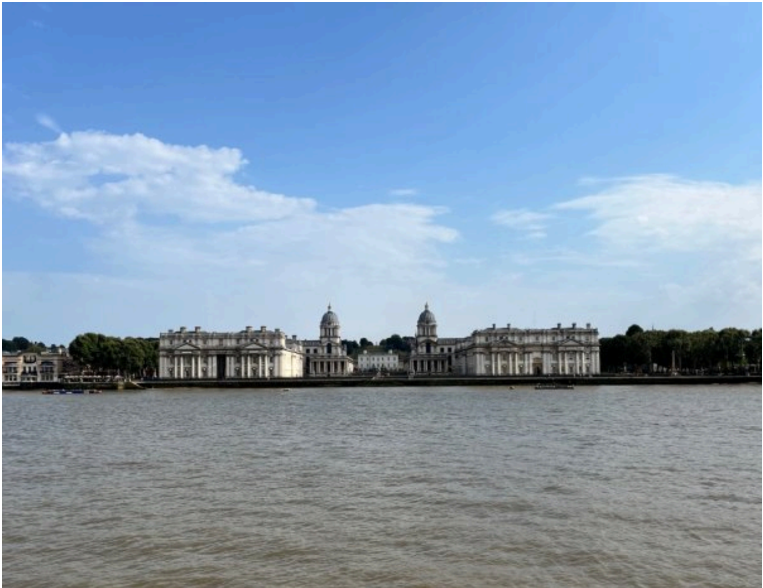
Above: The Old Royal Naval College at Greenwich, as viewed from the Isle of Dogs
First, I visited London Metropolitan Archives in Clerkenwell. The purpose of this first visit was to view a number of commonplace books and poetry albums, which served the double use of tracking circulation and readership of regional writers’ works in the capital, and also working as a comparative for the different forms and organisational styles which commonplacing practises might manifest. Commonplacing is a more recent research interest of mine, and I was astounded by the level of organisation employed by compilers such as Thomas Whitby, who utilises a thematic alphabetised index to locate commentary on various subjects across his extensive document.[1] Furthermore, this document featured an inserted introduction from a printed book, detailing the purposes of his composition. These purposes included nurturing practical self-reliance, the instruction of others in a variety of subjects, and use in conversation, placing men ‘above the necessity of vain repetition, such as women and ignorant persons fall into for want of matter’ (!). This suggested that Whitby’s efforts were very intentionally oriented around self-improvement, contributing to an existing scholarly and social tradition, as well as one that was also self-consciously gendered. Interestingly, these collections located in the City of London, from compilers very much bound up in civic life there, did not evidence the spread of transpennine authors I predicted that they might, with such conspicuous omissions as the Sheffield poet James Montgomery (1771-1854) who, as we’ll see, was very popular in other circles.
The next day took me to the Natural History Museum, to track down some of the surviving letters between the Liverpudlian poet and polymath William Roscoe (1753-1831) and his colleague in studies of the natural sciences, Sir Joseph Banks. This proved to be a revealing series of letters, evidencing the extent of these two men’s involvement in one another’s various practical and theoretical endeavours, not least how much Banks contributed to Roscoe’s efforts to reform the moss lands surrounding Manchester in the early nineteenth century.[2] Likewise, Roscoe’s letters to the botanist and banker Dawson Turner, suggest a dedicated friendship between the two interlocutors, where professional and personal matters are often heavily intertwined with one another. This complex relationship also brought Roscoe in touch with Turner’s wife, the artist Mary Palgrave, whose etchings were met with his effusive praise.[3] This visit also yielded another opportunity to view a commonplace book in the form of Samuel Pickworth Woodward’s document, pictured below and compiled across the 1830s and 40s.[4] Much like Whitby, Woodward makes a list of thematically similar entries in his book, but also involves a list of poets and prose authors with page numbers for each of their contributions to his collection. Woodward’s favoured authors include several transpennine writers, namely Montgomery, Roscoe, the Liverpool-born Felicia Hemans, and the Mancunian authoress Maria Jane Jewsbury (1800-1833). Many of these authors, such as Montgomery and Hemans, are common in poetic albums such as these; they found a great deal of success in popular periodicals such as the Saturday Magazine, as well as in gift-books and annuals, suggesting these were the primary materials from which commonplace entries were largely sourced. This commonplace book also had the added feature of being a collaborative work, with the initials of the friend or relation who entered it into the book included art the bottom of each entry. In doing so, it forms an example of a phenomenon observed by Jillian Hess, whereby commonplacing becomes a method of testifying to the importance of, as well as itself strengthening, a compiler’s close relationships.[5]
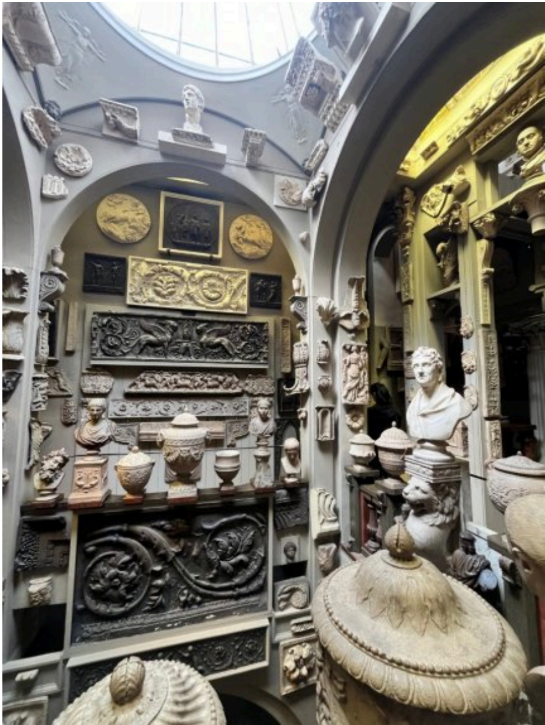
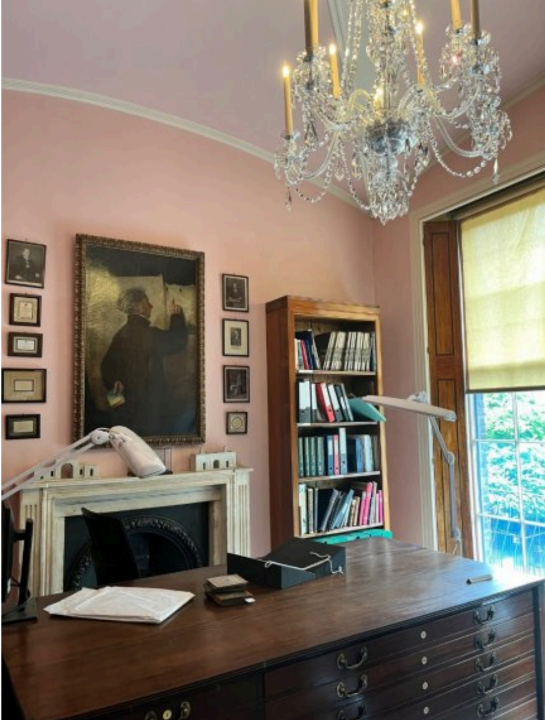
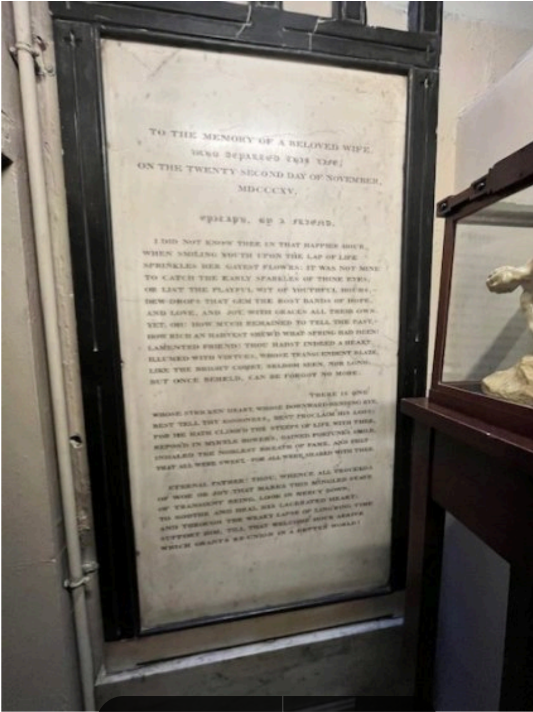
Next was Sir John Soane’s Museum, which formed a particular highlight of my visit not merely for its beautiful exhibition, but also its remarkable archival collections. The draw for my visit was a collection of letters between Soane and the Sheffield writer Barbara Hofland (1770-1844), following her removal to London in 1811. Along with the collections at the Natural History Museum, this pack of letters really helped to flesh out my understanding of the practical and often deeply emotive relationships between transpennine literary producers and their friends in more metropolitan climes. These letters revealed a far more intimate and involved relationship between Soane (and his wife, Elizabeth) and the Hoflands than I had anticipated. Soane was frequently a sounding board for Hofland’s literary productions, while she lent him her candid opinions on various controversies within the Royal Academy.[6] Soane assisted Hofland in procuring an apprenticeship for her son Frederic with fellow architectural professionals in Yorkshire, and Hofland encouraged Soane to further his political aspirations[7] Most poignant, however, was Hofland’s response after the death of Elizabeth Soane in 1815, lamenting to her mother that ‘Mrs Soane is dead –suddenly dead […] she sought me unknown, unintroduced; invited me for the express purpose of being good to me a stranger in London, uncared for by any one, struggling with great difficulties and my past distresses as well as my past situations utterly unknown’.[8] This was clearly a relationship with profoundemotional significance, and one Hofland was eager to commemorate, not only offering Soane her company and commiserations in his time of mourning, but also eventually composing the epitaph for Elizabeth’s tomb.[9] The visit to the Museum was thoroughly enjoyable, with a particularly comfortable and attractive workspace and really amenable, understanding staff members contributing to an overall fulfilling and productive day of work. The house itself was amazing, and I was able to view parts of the exhibit relating to Elizabeth Soane, including the inscription penned by Hofland for her tomb.
Top: The upper level of Soane’s museum, complete with a bust of Soane. Middle: The office space of the Soane archives, next door to the Museum.
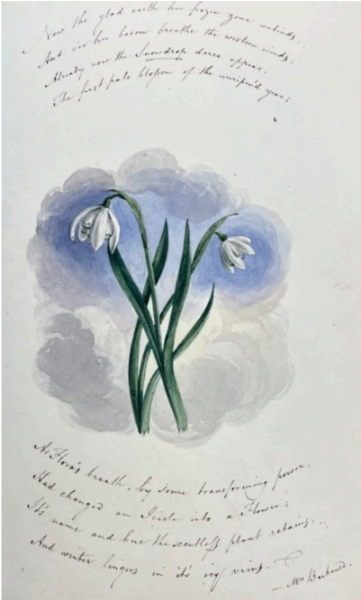
The final two days of my trip were occupied with visiting Hackney Archives, located in the CLR James Library in Dalston, with the intent of accessing material relating to the Aikin-Barbauld circle and their surviving connections to Warrington following the family’s move to Stoke Newington. Almost immediately however I was amazed to see how integrated this archive was within the area’s community library, with families and children freely exploring the collections, and the library’s summer reading challenge including an exercise prompting young readers to view archival items. This really helped demystify the archive for library users and gave off the impression that Hackney’s inhabitants are readily encouraged to explore their local histories, forming an example many archival sites across the UK might follow. The staff here were immensely friendly and helpful, and the items I selected proved very interesting indeed. Letters penned by Anna Laetitia Barbauld and her brother John Aikin delved into such topics as sugar boycotts, their shared web of dissenting contacts, and Annabella Milbanke’s impending (albeit doomed) marriage to Lord Byron.[10] Furthermore, this archive held a few commonplace books featuring Barbauld’s poetry, seen rather beautifully illustrated below.[11] Quite apart from the more organised documents by Thomas Whitby, Jane Field’s commonplace, like Woodward’s, seems to feature contributions from family and close friends, and as demonstrated, also features many decorative visual pieces, ranging from watercolour paintings, detailed pencil sketches, to insertions of engravings and postcards. This was not always spontaneous, however, as small pencil notes from Jane show she did plan to arrange her book in a particular way, inscribing “Draw an Ivy Wreath” on the head of the page below – but, as you can observe from the photograph, she didn’t always end up following these instructions!
Top: A watercolour illustration from the commonplace book of Jane Field for Anna Laetitia Barbauld’s short lyric ‘The Snowdrop’.
Besides this, the archives also yielded the entire spread of John Aikin’s Athenaeum (1806-1808), a magazine which commemorated many of his connections to writers across the transpennine region. In its poetry selection can be found works by Roscoe, Montgomery, the Liverpudlian sailor-poet Edward Rushton (1756-1814), and the labouring writer Charlotte Richardson (1775-1825), resident in York. This selection evidences the mixture of middling writers utilising a more conventional “polite” poetic register with the writings of labouring authors, though admittedly those with influential dissenting connections, many of them Aikin’s friends and associates across the country. Moreover, this magazine attests to the interest of liberally-minded nonconformists such as Aikin in literary matters alongside scientific, industrial, and commercial discourses. Each issue comes complete with an insight into contemporary ‘Arts, Manufactures, &c.’, involving such revolutionary advances as the development of coal-gas for lighting both industrial and urban sites. Here, literary discourse is not at odds with these more industrially-minded insights; in fact, this seems to have been a feature Aikin’s readers particularly enjoyed, with one commentator writing in 1807 to commend the Athenaeum’s inclusion of ‘curiosities in the manufactures of our country’, delighted to see that they have ‘a place along with the literary curiosities which adorn your pages’.[12] Far from being mutually exclusive, here literary production and industrial innovation are drawn into conversation with one another, displaying the faith in their synthesis which liberal dissenters such as Aikin espoused.
All in all, my visit to London as provided by BARS not only provided further evidence to help support the arguments presented in my thesis – especially those suggestive of the nationwide influence of regional authors, and the coexistence of literary and technological discourses – but also to add further nuance to my observations, with the full confidence of having utilised all of the resources available to me. I’d like to thank the BARS committee for making this journey possible, as well as the librarians and archivists at the Metropolitan Archives, the Natural History Museum, Sir John Soane’s House and Hackney Archives, who made it so easy and so enjoyable too! If any researchers of the Romantic perio find themselves considering other options for research besides larger collections at the National Archives or British Library, I truly can’t recommend these sites enough.
Roseanna Kettle is a recent doctoral graduate from the University of York’s Centre for Eighteenth-Century Studies (CECS). Her research interests include poetry associated with regional Britain, the literature of industrialism, labouring-class literature, and regional cultures of reading in the Romantic period. She has a forthcoming book chapter on the poetry of labouring women in Yorkshire, projected for publication with Boydell & Brewer in Summer, 2025.
[1] London Metropolitan Archives, Thomas Whitby, Commonplace Book (undated MS, c. 1832-1844), CLC/515/MS00202/001; for more on the purposes of commonplacing, see Roseanna Kettle, ‘The Commonplace Book of Edmund Pear (c. 1829 – 1834)’, Keats-Shelley Journal+ Special Issue: Commonplacing and Commonplace Books, vol. 1, ed. by Kacie L. Wills and Olivia Loksing Moy. [2] Natural History Museum, Letter from Sir Joseph Banks to William Roscoe, c. Sept 1809, Botany Manuscripts, MSS ROS 180. [3] Natural History Museum, Letter from William Roscoe to Dawson Turner, 20 May 1822, Botany Manuscripts, MSS ROS 4916. [4] Natural History Museum, Samuel Pickworth Woodward, “Poetic Gleanings” (Commonplace Book, c. 1838), General Manuscripts, L. MSS WOO. [5] Jillian M. Hess, How Romantics and Victorians Organized Information: Commonplace Books, Scrapbooks, and Albums (Oxford: Oxford University Press, 2022), p. 194. [6] Sir John Soane’s Museum, Letter from Barbara Hofland to Sir John Soane, 31 March 1814, Correspondence of Sir John Soane III, H9. 7; Letter from Barbara Hofland to Sir John Soane, 10 Nov 1813, H9.3 [7] Letter from Barbara Hofland to Sir John Soane, 5 April 1814, H9.9; Letter from Barbara Hofland to Sir John Soane, 29 Aug 1816, H9. 28. [8] Letter from Barbara Hofland to Mrs. Wreaks [undated, c. 1815], H9. 16, pp. 1-3. [9] Letter from Barbara Hofland to Sir John Soane [undated, c. 1816], H9. 21. [10] Hackney Archives, Letter from John Aikin Jr. to Anna Laetitia Barbauld, 20 Nov 1791, Letters and Associated Material from Stoke Newington Library, M3710, p. 2; Letter from John Aikin to J. Cooper Walker, 15 Apr 1799 M3712; Letter from Anna Laetitia Barbauld to Mrs. Taylor, 29 Dec 1814, M3732, pp. 2-3. [11] Hackney Archives, Commonplace Book of Jane Field, 1834, M4388. [12] Anonymous, “On Cotton Spinning”, The Athenaeum, a Magazine of Literary and Miscellaneous Information, 1 Jun 1807, vol. 1.6 (p. 571).
Amy WilcocksonComments Off on Call for Papers: Teaching in a Time of Crisis
As we begin another academic year, history feels both more fragile – and more essential – than ever. In a world of global pandemics, political unrest, environmental collapse, the cost of living crisis, and the financial devastation of Higher Education, educators and students are navigating a shared sense of precarity. We are tasked with understanding a relentlessly changing present through the lens of the past, all the while remaining profoundly uncertain about our economic, institutional, and personal futures.
How do we equip students to connect the dots between history and climate collapse? How do we talk about historical injustice and inequality in ways that strengthen ongoing struggles for justice? These questions are not just about curriculum change—they’re about pedagogical transformation. They’re about how we teach history when the world feels like it’s falling apart, and how we prepare our students to navigate all this chaos. As educators, we must adapt our methods, rethink our pedagogies, and explore innovative ways to engage students while addressing the complexities of the present moment.
A unique collaboration between HistoryLab+, HistoryLab, and History UK, ‘Teaching in a Time of Crisis’ seeks to bring together educators, historians, researchers, and practitioners to explore how history education can navigate and respond to contemporary crises. Our conference will be held at the University of Warwick on 29 May 2025.
We invite papers that might address the following themes:
Teaching history during global crises
Historiography and public memory in times of crisis
Innovative and decolonizing pedagogies
The role of historians as public intellectuals
Ethics and teaching contested histories
Teaching climate history amid environmental crises
The future of history education
Teaching history outside of history courses
Teaching in school contexts
History uptake and history as a career choice
As part of our commitment to accessibility and engagement, we also welcome proposals for online sessions. These should follow the same guidelines as in-person ones, and we particularly welcome innovative formats that leverage the strengths of virtual conferencing.
Submission Guidelines:
We welcome proposals for individual papers, panels, workshops, roundtable discussions, and other creative and critical formats. To submit, please send a pitch of up to 200 words as well as a title, presenter’s name(s), institutional affiliation(s), and contact information to ihrhistorylab@gmail.com with the Subject Line ‘Teaching in a Time of Crisis’
Submissions are encouraged from educators, graduate students, independent scholars, and practitioners involved in history education at all levels.
Submission Deadline: 17 January 2025 at midnight
Notification of Acceptance:14 February 2025
HistoryLab+ and HistoryLab are pleased to offer a limited number of bursaries to defray travel and accommodation expenses. To apply for a bursary, please note your interest in your proposal email. We particularly encourage applications from graduate students, as well as those who are unemployed, in between jobs, or in precarious work.
Amy WilcocksonComments Off on Contributors required: The Year’s Work in English Studies
The Year’s Work in English Studies is an annual review of scholarly work on English language and literatures written in English from 601 to the present; expert critical commentary is provided for each essay and book covered. YWES is the largest and most comprehensive work of its kind and the oldest evaluative work of literary criticism.
Applications are now open to contribute to two chapters, ‘The Eighteenth Century’ and ‘1780-1830: The Romantic Period’. Our aim is to build a new team to cover ‘The Novel’ section for the ‘1780-1830: The Romantic Period’ chapter and to find writers to support the existing teams covering all other sections across both chapters (‘General and Prose’, ‘Poetry’, ‘The Novel’ (18thc), and ‘Drama’).
All contributors get to keep review copies of books. YWES pays contributors at the rate of £8 per page of the printed volume. But this is also an opportunity to stay up-to-date with relevant publications in your field and to join a supportive community of reviewers, editors, and publishers.
Get in touch with Sarah Wride, the Associate Editor for both chapters, at s.r.wride@gmail.com if you have any questions.
To apply, please submit a copy of your CV and the role/s that you are interested in to Sarah at the same email address. If you have not yet published, please include a writing sample (of no more than 5000 words) and ask someone who knows your work well to write a brief reference on your behalf outlining your suitability for the role/s.
The deadline is 1 December 2024; scholars at any career stage are warmly encouraged to apply.
Adam NeikirkComments Off on Romantic Poets in the Wild #6: Yu-Hung Tien
Romantic Poets in the Wild is back again with the poetry of Yu-Hung Tien. Yu-Hung Tien is a BIPOC poet and now doing a PhD in English at the University of Edinburgh, UK. Originally from Taiwan, Yu-Hung studied in such cities as Taipei, Berkeley, Shanghai, and Durham. Throughout his professional career, Yu-Hung has tried to underpin the value of approaching Anglo-American literature through a Taiwanese lens. His most recent work, ‘“The Earth reversed her Hemispheres”: A Transhemispherical Reading of Dickinson’, appears in The Emily Dickinson International Society (EDIS) Bulletin’s ‘Voices Outside the US’ Column.
Yu-Hung used to serve as a PGR Rep for BARS (2022-2024) and a Communications Fellow for K-SAA (2022-2024). He is now part of the EDIS’s 2025 International Conference postgraduate planning committee, bringing the conference back to his home city, Taipei. (https://2025edisinwenshan.wordpress.com/).
Yu-Hung Tien in the wild.
Yu-Hung has provided us with a background statement concerning his creative writing practice:
The more I study Romantic poetry, the more I am inspired to drop down my thoughts, encapsulating them into my verses.
The infinite possibility seeded in Romantic poetry has started to haunt me since I did my undergraduate in Taiwan. This is why I decided to study for a Master’s degree in Romantic poetry at Durham University, UK, and to carry on this passion to my PhD journey. In my current project, which explores the 19th-century Anglo-American poetic transmission, Emily Dickinson plays a significant role. I am particularly drawn to the dialogic quality enmeshed in her poetry. I thus try to incorporate my personal and critical responses to and interpretations of her works into my verses and to experiment with how, for someone like me with distinctive racial, gender, cultural and linguistic backgrounds from Dickinson, can invoke creative poetic conversation with her.
This is the brief background in which my poem series, “My Letters to Emily Dickinson,” was composed. Letter I reflects my encounter with her, showing how I foster an inextricable intellectual bond with her poetics. Letter II embodies the struggle that I have experienced as a BIPOC poet and the solace that I found in Dickinson. Echoing what Dickinson claims “This is my letter to the World / That never wrote to Me –,” I hope that through my letters to my poetic mentor, some self-reflective notes and urgent messages crystalizing the under- represented voices can be sent out to the world.
My Letters to Emily Dickinson
Yu-Hung Tien
I
“There is no Frigate like a Book / To take us Lands away” “The Robin’s my Criterion for Tune – / Because I grow – where Robins do –” “Because I see – New Englandly – / The Queen, discerns like me –” —Emily Dickinson
Outside of my window
A volcano about to glow
I reckoned it was yours, Distinct
And mine remained, Extinct –

I decided to book a flight
To make this binding tight
Eager to see my Destiny
Is this Modernity?

I landed in your lands
For me are “Lands away”
Nowhere for me to firmly stay
Visions into Sands –

“New Englandly”, you siren
But I found no robin’s sound
It was the river that I found
I heard your melodies round!

“The Robin’s” your “Criterion for tune”
“Discerning” as you were
I claimed this river that of mine
To feel the way, you are

My volcano began to glow!
This time I learned to flow
In the river where we merged
My destiny emerged –
II
“Split the Lark – and you’ll find the Music –” “Now, do you doubt that your Bird was true?” —Emily Dickinson
I found a mansion with no flaw
And then I found a crack
Or just a crack within my soul
I felt I was stuck

The only Darkness it was Me
That Tainted the Outer Bright
I decided to mask myself
Like that pretentious Knight

The only way – I thought –
Could make myself alive.

Someone’s knocking, I respond
Who claims “Diversity”
No one greets me in the end
This Hall of Vanity –

There is another call, I hear –
Ask me to “Split the Lark”

This is the only way, she says
To “find the Music” out

No lark appears in my Sight
But just the endless dark
I thus intend to pause my Sigh
To let my spirit park

The colors start to bloom
Inward diversity
Permeate that mansion
And make it no longer bright

I wake up from a dream
A dream of fantasy
Fantasizing my old days’ dream
Dream of my destiny

“Now, do you doubt that your Bird was true?”
I finally see this line
My lark is always here, I’m sure
Its abode is also mine!

No crack in this mansion
No crack within my soul
It was the hole that cracked my soul
To let my own Lark grow!
I hope that you enjoyed this week’s poetry–uplifting us as we get into the darker days of the year … Tune in next time when we will be featuring the poet Linda Collins!
Amy WilcocksonComments Off on Past President’s Report 2024
Past President’s Report 2024
Anthony Mandal (Cardiff University, UK)
During my term as BARS President between 2019 and 2024, our community has experienced massive changes. Between 2020 and 2022, the world succumbed to a devastating global event, with the COVID-19 pandemic ravaging communities and irrevocably disrupting our lifestyles and working habits. The pandemic was accompanied by other transformative events. The final separation instituted by the 2016 Brexit Referendum came into effect on 31 January 2020. The callous murder of George Floyd in May 2020 led to global protests at racial injustice and institutional prejudice, leading many organisations including BARS to reflect on how to translate revulsion into practical action. Alongside these, the intensification of conflicts has brought global disruption and the tragic loss of human lives at a massive scale, first between Russia and Ukraine in early 2022 and then between Gaza and Israel late in 2023. Months of war have continued, and I would like to take this opportunity to join the call for a ceasefire and the restoration of human life and dignity in both theatres of conflict.
Amidst this turmoil, the BARS Executive has sought to face these challenges by being responsive to the needs of our community. Indeed, it has been heartening to see something of ‘a return to normal’ in the eighteen months or so that have closed out my term as President, which itself had been extended by a year owing to the pandemic. Membership numbers have remained buoyant and are currently sitting at just over the 500 mark. Our funds also are strong: during the pandemic years, we amassed quite a ‘war chest’, with plenty of reserves for future activities. Since then, and as outlined below, we have widened and diversified our expenditure in supporting BARS members’ activities, which is eating away healthily at our surpluses. As we move forward to the next phase of BARS activities, we will need to balance our income generation with our expenditure to ensure best value for money, alongside maintaining as many of our existing initiatives and developing more.
While we may have faced challenging times, BARS has remained an active community, both online and in person. I am grateful to my fellow members of the Executive – past and present – who have devoted their energies to numerous initiatives with generosity and passion. We produced a series of digital resources for scholars in response to the pandemic and in the wake of the Black Lives Matter crisis, which can still be accessed on the BARS Blog. Alongside these specific measures, BARS has sought to continue its regular business as much as possible. The BARS Reviewhas published issues regularly, notwithstanding the logistical challenges of passing copies of books between publishers and reviewers. The BARS Blog has been phenomenally active in sharing details about all thing Romanticism related, as well as keeping conversation going through series such as ‘Five Questions’, ‘On This Day’ and more recently ‘The BARS Examiner’. We have continued to run our BARS First Book Prize, with the last two being chaired by Francesca Saggini (2021 Prize) and Simon Kövesi (2023 Prize), and I’d like to reiterate thanks to the 2021 and 2023 panels, as well as extend my congratulations to this year’s winner, Stephanie O’Rourke, for her book Art, Science, and the Body in Early Romanticism(2021).
*
One of the key successes in our response to the pandemic has been our Digital Events Series, which launched in November 2020. This series, for which we’ve run nearly thirty events, will shortly be entering its fifth season this autumn. Visitors can also catch up on the back catalogue on the BARS Digital Events YouTube channel. Our forays into the digital world have been expanded by the recent launch of our TikTok channel, which complements the longform YouTube recordings with short content that focus on a single issue, author or locaiton.
The experience of running the Digital Events fed itself into our first online conference, Romantic Disconnections/Reconnections (2021), which sought to respond directly to the challenges raised for our community by COVID-19. This event spanned six days and allowed us to engage with Romanticists from around the world. It also built in no small measure upon our very early experience of running an online conference in the pandemic, when we had to take the swift decision to move our Postgraduate and Early Career conference, appropriately titled Romantic Futurities, to an online format; this ran in June 2020.
Our next attempt at merging the in-person with the digital was the phenomenal New Romanticisms conference run by Andy McInnes (now our Secretary) at Edge Hill University two years ago, and organised jointly with the North American Society for the Study of Romanticism (NASSR). This conference was truly hybrid, in that Andy – much to his credit – oversaw the simultaneous organisation of New Romanticisms live both online and in person throughout its four days. In attempting to address our local and global audiences, this meant meeting the challenge of overseeing digitally focused and on-campus activities for hundreds of delegates. We also trialled a slightly changed running schedule in an attempt to make the conference more accessible, by moving it away from its traditional weekend conclusion into an in-week event that began on a Tuesday and concluded on a Friday.
Our next PGR/ECR conference, Romantic Boundaries, was again able to draw together on our experiences in the post-pandemic era in June 2023, with a full return to campus – this time at the University of Edinburgh. These trials and successes germinated into the structure for our most recent conference, also held in Scotland: BARS 2024, Romantic Making and Unmaking. The theme of Making and Unmaking in many ways continues a thread of conference themes that have focused on intertwined issues: Boundaries in 2023; New Romanticisms 2022; Disconnections/Reconnections 2021; Futurities 2020; and Facts and Fantasies 2019. Based on our experiences and the time available, the BARS Executive agreed to deliver a model of on-campus events followed closely by an online event, overseen by two different teams. The Glasgow event was a tremendous one! We had around 250 delegates in attendance and numerous panels, plenaries, roundtables and special events. This was ably complemented by two days of online conference that followed a week later, which fielded around sixty papers from scholars from across the world.
I’d like to reiterate my thanks to the organising teams of the on-campus and online events. For the on-campus conference, Matt Sangster and the team at Glasgow, especially Cleo O’Callaghan Yeoman and Will Sherwood, and the University of Glasgow’s School of Critical Studies Operations Team, particularly Katrina McNeil, Marie Meechan and Tim Perry, for their support with the Eventbrite. For the online conference, Andy McInnes, Isabelle Murray, Francesca Saggini, Cassie Ulph, Rosie Whitcombe and especially Amy Wilcockson. Of course, a conference wouldn’t be anything without its presenters, so I would like to extend my thanks to our 300+ plenaries, speakers, roundtable contributors and chairs.
*
This year, we have seen the reinstatement of our popular Chawton Fellowships – we are currently offering two awards per year, with one of these open to ECRs and the other open to all members. The Chawton Fellowships joins other regular long-standing schemes such as our Stephen Copley Research Awards, Wordsworth Trust Early Career Fellowships and the Nineteenth-Century Matters Early Career Fellowship (jointly supported by the British Association for Victorian Studies). We also have our President’s Fellowship aimed at researchers from a minority ethnic background and about to enter its third year, and our Open Fellowship, which supports innovative work of any kind in Romantic studies. I would like to extend my congratulations to the various award holders in each of these schemes, whose rich and diverse interest keeps our research at the forefront of the field.
During the past five years, the Executive have sought to build and improve on our principles and practices, in order to make them more transparent and accountable, while promoting the inclusivity, accessibility and diversity at the heart of our practices. We have established protocols for the reviewing and reporting of any of our competitions for bursaries and awards. In particular, we have sought to make standing for the BARS Executive a more open process, making use of online tools to platform and allow the membership to vote for candidates.
*
I can’t say that the past five years as President of BARS has been without its challenges – little did I know when I stood on the stage for the first time after my election in Nottingham back in the summer of 2019 what would be coming up just half a year later. That said, it has been my honour and my pleasure to serve BARS during these challenging years. I have said ‘We’ rather than ‘I’ in these reflections because BARS has been very much a team, indeed a family, with whom I’ve been honoured and humbled to have worked with such a wonderful and generous group of people.
I would like to extend my thanks to past and outgoing members of the Executive for their contributions: Ian Haywood, Gillian Dow, Tess Somervell, Anna Mercer, Daniel Cook, Paul Stephens, Colette Davies, Cassie Ulph, Mark Sandy, Amanda Blake Davis, Yu-Hung Tien and David Fallon.
I’d also like to share best wishes and thanks to the current Executive: Jennie Orr, Andy McInnes, Mary Fairclough, Yimon Lo, Amy Wilcockson, Gerard Lee McKeever, Jason Whittaker, Caroline Anjali Ritchie, Cleo O’Callaghan Yeoman, Zooey Ziller, Kate Nankervis, Charlotte May, Jeff Cowton, Emily Paterson-Morgan, Francesca Saggini and Carmen Casaliggi.
Thanks also go to our various Digital Fellows and Communications Assistants of the past few years: Jack Orchard, Francesca Killoran, Isabelle Murray, Rosie Whitcombe and Adam Neikirk.
A special huge mention goes to Matthew Sangster, our President as of 2024. Many of you already know Matt, which is unsurprising given his unceasing commitment to our Association. For many years, he has taken on a range of roles beyond his previous one as Website Officer, often mentoring and supporting, as well as leading other members of the Executive in uncounted ways. I can think of no better person to whom I could pass on the mantle of President in these coming years. With the support of an amazing Executive, I’m certain BARS will move on to greater heights as we enter the second half of the 2020s, and I’m grateful we’ll have Matt’s wisdom and passion leading the way in this. Many congratulations!