Adam NeikirkComments Off on Romantic Poets in the Wild #3: Jedediah Pumblechook
Byron Bicentennial Closet Dramas
by Jed Pumblechook, final year student of History and English at University College Cork
Is that you, Jed?
Editor’s note: RPW is back again with something different! This time we are looking at the Byronic ‘closet dramas’ of one Jedediah Pumblechook. Because of problems with formatting and other quality loss issues, this post will contain links to three of the plays as they appear on Jed’s personal website, rather than the full text as usual. I’ll also include Jedediah’s introduction to their work here:
Perhaps it was fortunate, perhaps not, that my secondary school education glanced past both the first and second generation Romantics (Wordsworth earned a slightly longer glance every Spring). Hence, my interest developed on my own terms, in my own ambling time and in pain-free ignorance of what was either an Hendecasyllable or a Dactylic hexameter.
Pleasingly, and despite studying English literature, this carry-on has persisted to my current and final year at university. While thoroughly enjoying Yeats and Kavanagh, Donne and Milton – and an odd lady who writes poems about ducks – my passion for the Romantics has remained, and intensified.
As I was managing to avoid both the traps set for undergraduates laid by Shelley, the seductive and compelling admirers of Keats, the awestruck fans of Coleridge’s recreational troubles – I noticed Byron stood alone and untouched (unless serious woo-ing required She Walks in Beauty). I soon, I believed, discovered why. In my reading, he was as slippery to get a handle on as a bear wrestling a particularly dexterous salmon. Distracted by the luminous beauty of it’s skin and eye, he can’t claw him long enough to enable dissection, before the fish, amused by the game, leaps high and swims voluptuously away.
This, though, is one of the great thrills Byron gives us. He lets us in and out of his mind with the hypnotic subtlety of Salome, then it’s off with our comfort as the seventh veil of Juan’s declensions fall to the earth.
These little closet dramas were inspired by The Byron Society of America’s project https://www.unclosetingbyron.com/. I use only unbothered Byron poems (Southwell features prominently) and hilarious incidents in his life and letters.
Of course, these are just a few of Jed’s many productions. You can read as many as you like on the website. Tune in next time when we’ll have a return to poetry with Romantic-inspired writings by Ciaran O’Rourke!
And don’t forget to check out the previous RPWs if you missed them. Click here.
Adam NeikirkComments Off on CFP: British Society for Literature and Science Conference 2025
The twentieth annual conference of the British Society for Literature and Science will take place at Lancaster University, on 10th – 12th April 2025 in person.
Keynote talks will be given by:
Dr Kanta Dihal (Imperial College London),
Sydney Padua (Buckinghamshire New University), and
Professor Michael Whitworth (Merton College, Oxford).
Registration details and costs will be available soon. If there is sufficient interest, there will also be the opportunity to visit The Wordsworth Trust, in Grasmere, on Sunday 13th April.
The conference will continue online on Thursday 8th and Friday 9th May to enable wider participation; those who attend the in-person conference are welcome to also attend the online conference. The online keynote talk will be given by Dr Debapriya Sarkar (University of Connecticut). There will be a fee of £10 for the online conference to cover admin costs.
The BSLS invites proposals for twenty-minute papers, or panels of three papers, or roundtables, on any subjects within the field of literature (broadly defined to include theatre, film, and television) and science (including medicine and technology). The BSLS remains committed to supporting and showcasing work on all aspects of literature and science.
Abstracts of no more than 200 words, together with the name and institutional affiliation of the speaker, should be submitted via this form. Please state clearly whether your paper is to be delivered at the in-person or online conference. Proposals for panels should include a separate proposal for each paper. The closing date for submissions is Friday 15November 2024.
Conference bursaries: the in-person conference fee will be waived for two PGR members in exchange for written reports on the conference, to be published in the BSLS Newsletter. If you are interested in being selected for one of these awards, please mention this when sending in your proposal. You must be registered for a PhD at the time of the conference.
About the Conference: the in-person conference will be held at Lancaster University, which is a campus university, and we have booked a number of ensuite rooms for delegates onsite. All talks, tea breaks and lunches will take place in the fully accessible George Fox Building (more details here: George Fox Building – accessibility). The conference dinner will take place onsite at Barker House Farm. Delegates can apply for a pre-school place for childcare at Lancaster University Pre-School Centre.
Membership: all conference delegates are required to be members of the BSLS in order to attend the conference (£26 waged/£11 unwaged): https://www.bsls.ac.uk/membership/join-us/. There will also be the opportunity to join or renew membership when you register for the conference.
Adam NeikirkComments Off on CFP: Romantic Shock and Surprise
Call for Papers: Romantic Shock and Surprise
2025 Symposium of the London-Paris Romanticism Seminar
Sorbonne Université, Paris, Friday 16 – Saturday 17 May 2025
Keynote speakers: Christopher Miller (College of Staten Island, CUNY),
Stephanie O’Rourke (University of St Andrews)
The ‘shock of the new’ is a phrase normally associated with Modernism but the aesthetics of shock has its roots in Romanticism, where notions of originality, novelty and surprise combined with the concept of the sublime and other theories of affect to create compelling new descriptions of art’s disruptive powers. Keats’s dictum that poetry ‘must surprise by a fine excess, and not by singularity’ is one example, posing the paradox that art can be simultaneously startling and unobtrusive. Shelley’s provocative account of how poetry ‘strips the veil of familiarity from the world’ to lay bare the ‘naked and sleeping beauty’ beneath is another, one of many anticipations in Romantic thought of Ezra Pound’s injunction, a century later, to ‘make it new’, or of the theory of defamiliarization propounded by the Russian Formalists. A third instance can be found in Wordsworth’s ambition, at least according to Coleridge, to ‘give the charm of novelty to things of every day’ in his contributions to the Lyrical Ballads project.
This disruptive, defamiliarizing power was not confined to professedly innovative art. Archaism – the ‘shock of the old’ – was an equally potent force, exemplified by the Gothic novel (or Schauerroman, ‘shudder-novel’), in which violent subject matter and fabricated medieval pasts were used to generate readerly frissons from emotions of fear and repugnance. The German Sturm und Drang movement in drama and melodrama was a related development, condemned by Wordsworth as a corrupting influence whose effects were to be counteracted by more subtle and salubrious forms of imaginative stimulation (the adjectival qualifiers of ‘gentle shock of miId surprise’ in ‘There was a boy’ are an index of this recalibration). According to Christopher Miller,[1] another strand in this complex web of generic displacements and rivalries was the appropriation by Romantic lyric poetry of the dynamics of surprise associated with eighteenth-century adventure narrative, now transposed into unexpected sequences of mental ‘events’ and linguistic special effects. Wordsworth’s ‘Surprised by Joy’ is the paradigm but such unpredictable lyric ‘plots’ were ubiquitous.
One of the drivers in this new affective poetics was political. When Shelley in his romantic epic The Revolt of Islam spoke of the ‘shock and surprise’ of ‘earthly minds’, he was remembering the psychic turbulence of the French Revolution, whose traumatic legacy for former liberals he sought to alleviate with his own immersive story of failed but redemptive revolution. The Marquis de Sade likewise connected the violence and extravagance of the Gothic novel with ‘the revolutionary shocks with which the whole of Europe resounded’ in the wake of 1789. Hazlitt drew similar parallels in The Spirit of the Age, much of which is devoted to analysis of the public addiction to a literature built around sensations of shock and surprise (‘A poem is to resemble an exhibition of fireworks … that surprise for the moment, and leave no trace of light or warmth behind them’).
Another driver was science and technology. Public interest in the rapidly developing science of electricity, including the invention of the Voltaic pile, generated a rich metaphorical vocabulary for describing aesthetic experience. As Stephanie O’Rourke has shown,[2] the idea that powerful artworks could produce responses equivalent to ‘electric shock’ gained widespread currency, as did the idea that electrical currents were analogous to other forms of rapid, high-energy transmission, notably the spread of revolutionary politics. Theatres harnessed the emergent technology to create startling new stage spectacles, encouraging a similarly spectacular acting style (as Coleridge famously remarked, seeing Edmund Kean act ‘was like reading Shakespeare by flashes of lightning’). Other scientific and cultural fields contributed their own share of shocks and surprises, challenging writers to match their discoveries and reinforcing the idea that the ‘march of intellect’ was anything but straightforward.
This two-day symposium will explore the sources and effects of this new poetics, examining manifestations of aesthetic shock and surprise across a wide spectrum of Romantic literature from Britain and beyond. We invite proposals for 20-minute papers on any aspect of this broad theme. Topics may include but are not confined to:
shock and excess in the theory of the sublime
Romantic shock and the eighteenth-century emphasis on the new
affect theory and the cognitive poetics of shock and surprise
shock and surprise in the literature of revolution
tales of the unexpected in Romantic prose and verse
shifting thresholds of aesthetic shock; ‘shock fatigue’
gendered aesthetics of surprise and shock
shock and surprise in Gothic fiction, poetry and drama
shell-shock and post-traumatic stress in the Romantic literature of war
shock as a propaganda tool in anti-slavery literature
rhetorical and grammatical production of surprise
analogies between scientific and literary shock
shock and surprise in the language of advertising
flashes, explosions and other spectacular effects on the Romantic stage
Please send title of paper and abstract (300 words), with brief CV, to Laurent Folliot lfolliot@yahoo.fr and David Duff d.duff@qmul.ac.ukby 1 December 2024
Scientific Committee: Professor Caroline Bertonèche (Université Grenoble Alpes/ Société d’Études du Romantisme Anglais), Professor David Duff (Queen Mary University of London), Dr Laurent Folliot (Sorbonne Université), Professor Jean-Marie Fournier (Université Paris Diderot), Professor Sophie Laniel-Musitelli (Université de Lille/ Institut Universitaire de France), Professor Marc Porée (ENS Ulm, Paris).
Norfolk Record Office Archive Centre Martineau Lane Norwich NR1 2DQ
Programme
In the late eighteenth and early nineteenth centuries, Norfolk and the city of Norwich experienced an extraordinary cultural efflorescence. In these years, Norwich became a centre of vibrant literary and intellectual activity supporting a substantial, educated population nurtured by its newspapers, its Theatre Royal, public library (1784), and its numerous debating and discussion clubs and coffee shops. Norwich’s citizens actively debated the leading political, social, and cultural issues of the day, including the American War of Independence, the transatlantic slave trade, the French Revolution and civil and religious liberty more widely. This culture of political activism extended to the nearby port of Great Yarmouth. In 1796, the famous London radical poet and lecturer, John Thelwall, arrived in Great Yarmouth to deliver his historical lectures, an event that ended in serious rioting when opposing loyalist forces deployed a naval pressgang to disrupt the proceedings.
This symposium is being held to mark the generous donation of manuscripts, by the John Thelwall Society to the Norfolk Record Office which includes affidavits of witnesses to and victims of this politically motivated assault and the recent discovery of a new manuscript copy of Thelwall’s poem, ‘The Orphan Boy”.
9.30-10.00:Registration and coffee
10.00-10.10: Welcome and Introduction: Peter Kitson (University of East Anglia)
10.10-11.10: Nicholas Roe (University of St Andrews), ‘John Thelwall at Pontic Hill’.
11.10-11.30: Coffee break
11.30-12.15: Penelope Corfield (Royal Holloway, University of London), “Norwich radicalism’.
12.15-13.15:Lunch
13.15-14.00: Steve Poole (University of the West of England), ‘‘The Suppression of Radicalism in England c.1796-1798’.
14.00-14.45: Judith Thompson (Dalhousie University/University of Kings College, Halifax Nova Scotia), ‘John Thelwall in Norfolk: Orphan Boys and Female Citizens’.
14.45-15.05: Refreshments
15.05-15.55: James Wood (University of East Anglia), ‘“Jermyn Pratt, David Service, and Poetic Electioneering.”
15.55-16.40: Hana Hill (UEA), “Amelia Opie and Radical Norfolk.”
16.40-17.00: Closing Remarks: Peter Kitson (University of East Anglia).
There will also be a walk in Norwich to visit the Octagon Chapel and other relevant locations on Saturday morning for those interested.
Adam NeikirkComments Off on Dramatic Reading: Lord Byron’s Sardanapalus
At the end of October, Red Bull Theater is bringing Lord Byron’s Sardanapalus (1821) to the NYC stage; the dramatic reading will feature only equity actors and directors and will be recorded professionally and made available around the world for six days following the live production.
In-Person Performance InfoFor tickets to the Thursday, October 24th live performance at Sheen Center’s Loreto Theater in the West Village, click here: https://www.redbulltheater.com/sardanapalus Use promo code LORDBYRON20 for 20% off discounted rate. Join other colleagues at the show, during the reception following the performance, and at the Stuart Curran Symposium at NYU on the following day.
This event commemorates the 2024 Byron Bicentennial and is co-sponsored by the Byron Society of America, Keats-Shelley Association of America, and the Keats-Shelley House in Rome. For questions, reach out to ofmiranda@usfca.edu.
The Early Caribbean Society is pleased to announce Global Equiano, a global, virtual, free, and accessible event that opens fresh conversations about enslaved and free Black people as they navigated spaces dominated by violent, colonial forces, and considers the Black Atlantic futures they imagined.
In our program we gather scholars, artists, curators, writers, and community from several countries to talk and think together about Equiano and his legacies, and also about diasporic Black, African, Caribbean, and Black Atlantic identities and their relationships to place and time.
Our format intentionally breaks the form of the ‘conference’ to offer something more conversational and free-form, that gives space for listeners to think and even create along with the speakers. We hope these virtual salons inspire other ideas and responses to the myriad topics raised by considering Equiano as a site for broader engagements.
We look forward to you joining us on our YouTube channel on 20 and 21 September and to availing of the digital archive that will be created by this event. Please share widely. All are welcome.
Warmly,
Kerry Sinanan, Désha Osborne, Alex Milsom, Kate Singer
Adam NeikirkComments Off on “Ephemeral Monsters”: Representations of Revolutionary Energy in William Wordsworth’s The Prelude (1805) and Mary Shelley’s Frankenstein (1818) by Dan Street
Editor’s introduction: As part of our ongoing spotlight on PGR/ECR series, the BARS Comms Team has commissioned this scholarly work from Dan Street, a PGR student at the University of Glasgow. Dan has written his own introduction to the post.
Author’s introduction: This blog post is an excerpt from an essay written for Professor Nigel Leask’s fourth-year ‘Romanticism and Revolution’ class at the University of Glasgow in the spring of 2024. While researching the two texts’ themes I became engrossed in Wordsworth’s radical movements across France and then back to the Lake District in the early 1790s. My childhood home on the south-eastern fringes of Lakeland is around three miles from Book 10’s ‘Romish chapel’ on Leven’s Sands, where the poet celebrates Robespierre’s death, so Wordsworth’s work has an added resonance. I then relished investigating connections between The Terror’s ‘ephemeral’ energy and that of Frankenstein’s creature, drawing close critical parallels between the two phenomena. I like to think that (not least through my appreciation of Raymond Williams) I am continuing Wordsworth’s radical Lakeland legacy in my own small way.
Harry Dickinson observes that the shockwaves of the French Revolution resounded across Europe as the continent engaged in a titanic struggle between monarchy and republicanism. The historian argues that the seismic events in France from the 1790s to the 1820s ‘polarized British society into the friends and enemies of the French Revolutionary cause’ (2011: 1). The hegemonic sentiment of the British state – engaging in total war with its expansionist neighbour France – afforded little consideration for the radicalism of William Wordsworth and Mary Shelley. Yet much to the chagrin of hegemonic mechanisms, William Wordsworth’s Book Tenth of The Prelude (1805) and Mary Shelley’s Frankenstein (1818) represent aspects of revolutionary energy as positive, even vital, forces; and argued that the bloodshed and terror of revolution demonstrated were necessary in the fight against Europe’s ancien régime.
In Book Tenth of The Prelude Wordsworth’s autobiographical speaker roams the streets of Paris in 1792, a city gripped by the violence of Maximilien Robespierre. Shelley, writing in 1818, proposes a European retrospective in the time shortly before Switzerland came under attack from the expansionist Napoleon in 1798 (Ferber 2010: 95). I argue that while the historical context of both texts is from a period when the lofty principles of the Revolution were turning sour – Saree Makdisi’s ‘impossible’ 1790s – the descriptions of ‘desolation and dismay’ in Paris and the creation’s (i.e., the monster’s) ‘hideous’ countenance represent revolutionary energy as speaking to Britain’s subversive sympathies with the French republican cause (Wordsworth [1805] 1995: l. 20; Shelley [1818] 2012: 36).
In an uncanny alignment with Shelley’s later text, Wordsworth opens his book-length poem with monstrosity. The Wordsworthian speaker recounts the violence of August and September 1792, when Louis XVI was overthrown, followed by the terrorism of the September Massacres (Shaw 2015: 422; Doyle 2019: 117):
Lamentable crimes, ‘Tis true, had gone before this hour, the work Of massacre, in which the senseless sword Was prayed to as a judge; but these were past, Earth free from them for ever, as was thought – Ephemeral monsters, to be seen but once, Things that could only show themselves and die! (Wordsworth 1995: ll. 31-38).
That the revolutionary monsters scouring Paris are only temporarily powerful speaks to Shelley’s text and resonates with the sense that the revolutionary power of Frankenstein’s creature is inorganic and electrifying, sudden and shocking. The seismic massacres went on for four days and left some 1,400 victims guillotined (Doyle 2019: 52). Chris Doyle writes that a ‘panic-stricken’ Paris lived in uncertainty, thoughts swirling that such horror could spontaneously rise once more amid the powder keg of rival factions (ibid.). Philip Shaw’s more reserved perspective views Book Tenth as a lament for the lofty ideals of the revolution, claiming that the blank verse ‘recalls a by now familiar sense of numbness and detachment’ from the poet as he passes the bodies of the Swiss guard, piled high in the Parisian streets (2015: 422). Shaw’s assertion is validated when considering Wordsworth’s heartbreak of leaving Anette Vallon and his infant child in Book Nine. Although Wordsworth’s republicanism ran deep, he struggled to condone the Jacobins’ aims, led by a bloodthirsty Robespierre. The extremism is – after all – arguably the main reason why Englishman Wordsworth must return home. If he had stayed he would have faced execution by the terrorists due to his nationality; and so it proved – Britain would be at war with France in the coming months of January 1793.
In Frankenstein, the diegetic world is heavily gothicised, in homage to Jean-Jacques Rousseau. There begins a sublime description of the ‘gigantic’ creature roaming across the jagged Arctic ice and his ‘emaciated’ pursuer (Shelley 2012: 13, 14). Young Frankenstein, in recovery from the ordeal, is described as ‘cultivated’ and ‘self-educated’ (16). Further – with echoes of Jean-Jacques Rousseau, godfather of the French Revolution – the young scientist hails from Geneva in Switzerland, from ‘one of the most distinguished’ families ‘of that republic’ (18). Pamela Clemit highlights this revolutionary connection between the creature, Victor, and the birthplace of Rousseau when she writes that in June 1816 as the Napoleonic Wars were finally over, the Shelleys took ‘their second continental tour to Geneva’ hoping to learn more about the history and geography of events that had shaped the last two decades (2003: 30). This European tour, in a nascent age of peace, prompted Mary Shelley to reflect that: ‘The revolution which [Rousseau’s] writings mainly contributed to mature, and which, notwithstanding the temporary bloodshed and injustice with which it was polluted, has produced enduring benefits to mankind, which all the chicanery of statesmen, not even the great conspiracy of kings, can entirely render vain’ (ibid.). Writing after the ceasefire, Shelley is further from the bloodshed than Wordsworth. Shelley viewed this violence as a ‘temporary’ evil that produced many political ‘benefits’. In 1805, Wordsworth could not be sure of France’s course and so took a negative view of Napoleon’s expansionism. In the opening pages of Frankenstein, the fleeting, sublime image of the creature evokes a distillation of fast-moving electrical energy as the nimble creature crosses the ice, accentuated further by Frankenstein’s cultivated upbringing in that cradle of revolutionary philosophy, Geneva.
Both Wordsworth and Shelley’s texts subvert monarchic discourses of Britain in the Romantic era with representations of revolutionary energy as an uncomfortable yet ultimately positive force. Wordsworth perceives amid the conflict that the September Massacres only served to heighten tensions. He is exasperated and frustrated when recalling his time in Paris. But his adjective ‘ephemeral’ speaks to an apparition or a sharp shock of violence in the longue durée of history that will ultimately bring greater civility to the Western world. Shelley’s geographical context is purposefully situated in Rousseau’s birthplace to accentuate that the philosopher’s ideas outlasted Louis XVI’s secretive mechanisms. The creature’s frightening agility speaks to the meteoric career of Napoleon as he invaded Switzerland, a republic; the despot giving Britain’s monarchy its largest conflict to date. These sharp shocks of animalistic, revolutionary anger can ultimately offer a more egalitarian world.
Amy WilcocksonComments Off on BARS President’s Fellowship 2024 Report: Archival research for “Staging the Orient: A Study of Oriental Scenography on the Romantic Stage”
In June 2020, the British Association for Romantic Studies announced its unequivocal support of the Black community, its condemnation of all forms of racism and its commitment to practical action. In response to the enduring and systemic damage caused by racism, the BARS Executive commenced a programme of initiatives focused on the histories and literatures of People of Colour. Among these initiatives is the BARS President’s Fellowship. The 2024 Recipient of this award was Dr Yasser Shams Khan, whose Fellowship report is below:
This project, “Staging the Orient”, evolved out of my doctoral research on racial representations of black characters in Georgian-period Drama. As someone who was initiated into the magnificent world of late eighteenth-century theatricality, I became all too aware of Benjamin’s thesis that “there is no document of civilization which is not at the same time a document of barbarism”. Just as tales of civilization ride upon the back of barbaric conquests, and benevolent gestures disguise crude calculations, in a similar vein racial representations on stage perform affective attachments and desire which are simultaneously controlled and contained through mechanisms of othering. Along with black characters, the late eighteenth-century theatrical stage was replete with characters and settings from the Orient, and once I had completed my PhD, with its focus on blackness, I was curious to further explore the racial spectrum as it was performed on stage during the Romantic period. In retrospect, it seems that the historical circumstances in which I was working facilitated the direction of my research.
In the wake of the death of George Floyd, when I was still at Oxford, a number of graduates including myself were asked to give a flash talk on racism for a research seminar in Eighteenth Century Literature. I chose to speak about academic neutrality and what it means to us when confronted with issues that demand that we take a position. Failing to take a stand through scholarship is also a political stand and a potentially divisive one, which engages in an act of omission, a silencing of voices. This form of academic neutrality is equivalent to the slogan that became popular in the BLM protests: Silence is Violence. Such a sentiment is even more relevant today with what is going on in Gaza. Our silence is the death of Palestinians. I made a case then for “political” approaches to literature arguing that our research is always already shaped by political objectives, whether conscious or unconscious. The way the question is posed, the methods of inquiry, and the criteria of what counts as a legitimate answer all have political implications. Because our discipline is defined by its historical context, limited by what is available, preserved, and documented, it requires critical strategies to cut through, to make visible, to hear the voices of protest that are drowned by the deafening silence of neutrality.
I laid out two strategies that helped shape my own subsequent research on “Staging the Orient”. The first was to uncover archives that narrate an alternative account, challenging popular conceptions used by those in power to justify their present dominance. The assumption here is that the full story hasn’t been told. There is always more to uncover. We just have to look deeper and further. I thus sought to explore how Muslim characters and scenarios from the Eastern Empires (Ottoman and Mughal) were dramatized on the British stage, advancing critical questions relating to identity, imperialism, and Orientalism. The story I wanted to explore was how critically overlooked technical innovations of stage designers and scene painters informed Oriental discourse and shaped the aesthetic mediation of contemporary political issues that embroiled a commercial empire.
The second strategy was to consider how to get past dominant, disciplinary ways of seeing things as they are? I sought to break away from conventional disciplinary methods and explore methodologies that would allow me to make sense of set designs and scenic paintings, as well as the underlying perspectivism that overdetermined the spectatorial gaze in performances that embodied and depicted Oriental scenes. I had thought of using the available technologies of visualization which might help me better understand how to comprehend visual spaces as spaces of performance. This approach to the little explored visual-performative archive might offer an alternative way of understanding the Romantic period, which has been primarily interrogated through a study of its texts.
So I had a project in mind which would focus on scenography rather than the conventional approach to actors and characters, and I was equipped with a somewhat experimental methodology that would combine archival research, technologies of visualization, and a theoretical framework that goes beyond semiotics into the reconstruction of the emotive feel of a place. But since 2021, after having completed my DPhil at Oxford, I was unemployed and under lockdown due to the Covid epidemic. I was also no longer in the UK. I needed funds to access the archives for this project to come into its own.
I had been a member of BARS since 2017, having presented my paper on “The Political Valence of the Noble Savage” at a BARS conference on Romantic Improvement at the University of York. I was very much impressed by the Association’s commitment to encouraging diversity in the discipline, evident in the range of topics covered in the conference panels as well the diversity of participating speakers. It was a thrill to encounter eminent scholars in person and the whole experience of the conference further encouraged me to challenge my understanding of Romanticism as it was taught to me. Knowing the support that BARS has repeatedly given to young scholars and early career academics, I applied for the BARS President’s Fellowship in the hope that they would see the potential of my project on “Oriental Scenography”. I was absolutely delighted to hear the news that I had been offered the 2024 BARS President’s Fellowship.
I spent my summer in the UK, primarily in London and Oxford, where I went through the Grieve Family Collection of Theatrical Designs stored in the Senate House Library, the British Library manuscripts, and the Bodleian Libraries, particularly the John Johnson Collection of Theatrical Ephemera and the F. B. Brady Collection at Christ Church Library.
I encountered a number of hurdles, but the primary one was that the British Library had suffered a cyberattack and so they were only accepting manual requests with a daily limit of eight items. In the limited time that I had, I had to prioritize which materials to look at and which to overlook. Much of their online material was inaccessible. The second hurdle was that the Theatre and Performance wing of the Victorian and Albert Museum were undergoing renovation and the material would only be available by spring next year. Despite these setbacks, I did manage to procure material that would be of great value to my project, particularly the large set designs stored in the Senate House Library and the extensive toy theatre archives at Christ Church Library.
Since this was an archival trip, I was feverishly trying to make the most of the time by storing as many images pertaining to Oriental scenography as I was allowed to access. I had an upcoming NASSR conference in Washington DC and I wanted to present some of my findings in a paper on Tipu Sultan and the Anglo-Mysore wars as they were performed at Astley’s Amphitheatre in the 1790s. This would be the first presentation of my project which would be credited to the support offered by BARS for facilitating the necessary archival research.
In the conference paper, “Tippoo Saib at Astley’s Amphitheatre: Exploring the Scenic Atmosphere of Theatrical Orientalism”, I sought to present how the phenomenological experience of such performances unsettles the otherwise stable significative understanding of Oriental discourse. By reading the evidence that I had procured during the archival trip visually, I attempted to create an imaginary map of the landscape and thus position the actors and objects in the play, visualizing their movements through the world constructed onstage.
As a quick summary then of what I attempted to do in my analysis of Astley’s Tippoo performances is to highlight three things:
1. The performative interactions of bodies with architectural design and the activation of space through movement.
2. Focus on perspectivism, viewpoints, and sightlines to figure in the spectator as an essential element of the set-design and as central to determine the politics of the [back]ground.
3. The narrative identity of spaces derived from the composition and movement of bodies within a scene through which I attempted to disclose the configuration’s political and rhetorical force.
To consider all these elements together is to take scenography as a means of disclosing the theatrical experience through the visualization and imaginative activation of space.
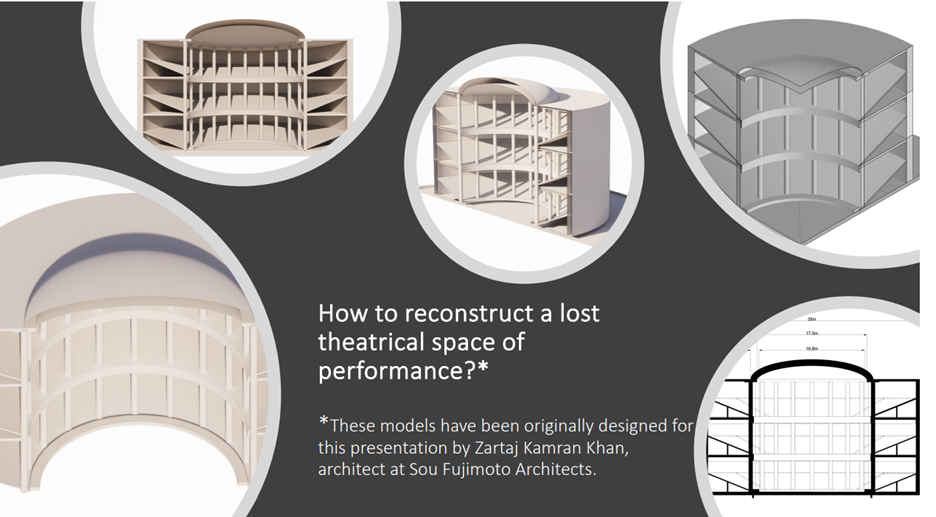
I sought the help of an architect, Zartaj Kamran Khan, who works at Sou Fujimoto Architects, to build 3D-models of Astley’s Amphitheatre which you can see below. These models are based on the visual material that I had procured during my recent archival visit. Although this is still a work in progress, I have much hope for the project once I get around to organizing all the material I managed to gather.
As a final comment, I would like to take inspiration from my fellow Black academics and activists who have repeatedly said that one of the first steps towards creating a more inclusive community is to first identify the dominance of “invisible”, “neutral” ways of seeing and doing things. We need to see the word “neutrality” as connected to words like neuter (to castrate, to cut out, to not offer the possibility of reproducing – alternative cultures, voices, ways of being and becoming); but also connected to words like neutralisation (a euphemism for destroying and killing). I am thus suggesting a politics of scholarship that moves beyond the ideal of neutrality of the nonpartisan sort. Rather, I would insist on recognizing the limits of our conceptual frameworks as anything but neutral and to extend the boundaries of our moral imagination to see radical alternatives in how to be human and how to reimagine our social reality and community and I hope our modest academic efforts might work towards this ideal.
Figure 1: A Slide from my presentation at the NASSR conference in Washington DC depicting the 3D models of Astley’s Amphitheatre.
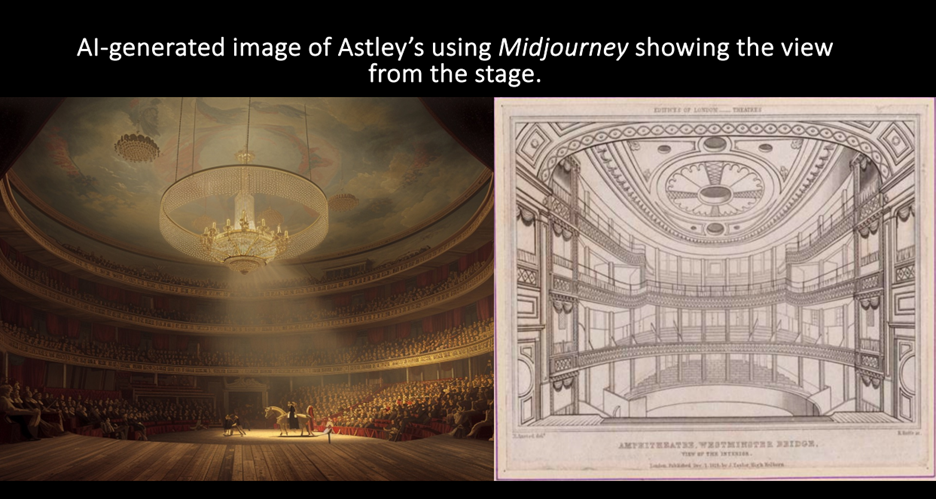
Figure 2: AI-generated image of Astley’s using Midjourney showing the view from the stage.
Yasser Shams Khan
Dr. Yasser Shams Khan is an Assistant Professor at the Department of English Literature and Linguistics at Qatar University. He has published articles in Studies in Romanticism and The Eighteenth Century: Theory and Interpretation and contributed a chapter to the forthcoming The Cambridge Companion to Romanticism and Race. His areas of interest include the theatre and culture of the long eighteenth century, race and imperialism, and critical theory and aesthetics.
Adam NeikirkComments Off on Romantic Poets in the Wild #2: Colin Harker
Colin Harker in the wild.
RPW is back with another poet who has been inspired by the Romantics and/or Romantic themes–this week, as we move into autumn/winter months, we have a writer deeply moved by, in her own words, ‘themes of terror and desire.’ I’ll let Colin continue below:
‘Part of what has always drawn me to British and Irish Romanticism is the complex way in which the poets and authors of this movement engage with themes of terror and desire. I have always been drawn to the texts that explore death in unusual ways, such as the imaginative necromancy of William Godwin’s “Essay on Sepulchres” and the desirous ghost in John Keats’s “This living hand” (my favorite of all of Keats’s poems). With my poem “The Lover’s Ghost,” I wanted to explore the idea of a not-merely-metaphysical ghost, one whose physical desires are still very much intact. What if death isn’t the end of desire but only the beginning of some new, unimaginable desire? “Bluebeard’s Ghost” plays with the themes of curiosity and transgression that make that particular legend so fascinating – I enjoyed pairing the language of Eden with my take on the character of Bluebeard, giving an insight into the twisted logic of my poem’s protagonist as he patiently and politely explains himself to his intended victim.’
Colin Harker lives in Maryland, writing tales of dread and desire that meld body horror with supernatural terror. Her novel The Feast of the Innocents (2022) is set in the politically turbulent climate of 17th-century Scotland, focusing on a Priory haunted by ritualistic murders and a French assassin with a taste for theatrical torture. Her short stories “The Hand of Glory” and “Let Nothing You Dismay” have appeared in the award-winning horror podcast The NoSleep Podcast.
Both these featured poems will be appearing in her forthcoming collection Thorns: A Book of Poems.
Lover’s Ghost
Here lies one whose flesh once burned And strained as sweating dust and dew; Whose frame all earth’s desires learned Yet here a different lust pursues.
He shall remember, he shall know All the lusts he felt before; His thirst shall only gall and grow, What once desired, desires more.
Who can tell the hungry earth To stop its mouth and panting lung? Who can bid the rotting soil Bite the wanting of its tongue?
Shed no tear upon his grave Lest it fall and find his dust; They do not sleep but only wait: His dust, his soul, and all their lusts.
Bluebeard
For, he says, the world is wicked And you, my dear, are made of glass And for all that I must possess you, I shall never let you pass.
Our bower is a kinder Eden, For if you break my single law You shall never be an outcast, But still remain within my walls.
Do you see them there, my darling? The pretty sinners gone before? Each one in her mother’s jewels Each one in the veil she wore?
If, my dear, your God is jealous, With what word am I adorned? I, the serpent’s fruit you suckled, I, divine law that you scorned?
Tell me, sweetheart, at this hour With all your courage and your fear, You tasted boldly of my secrets, But were they worth these bitter tears?
Tune in next time when we will feature the Byronic closet dramas of Jedediah Pumblechook!
Amy WilcocksonComments Off on The BARS | Folger | Wordsworth Early Career Fellowship
The British Association for Romantic Studies | Folger | Wordsworth Trust Early Career Fellowship programme invites and supports early career researchers to spend a month in residence at the Wordsworth Trust at Grasmere.
The BARS Wordsworth Trust Early Career Fellowship began in 2017. This year the partnership is joined by The Folger Institute and will be offering FOUR month-long Fellowships to run concurrently, ideally in November 2024. Two Fellowships will be for UK scholars, and two for scholars based in the USA.
For 2024/25, the Fellowships are open to scholars from Black, Indigenous and other minority ethnic backgrounds working on any aspect of Romantic Studies who also:
hold a PhD
are not in permanent employment OR, have held a permanent academic post, but for less than five years by the application deadline
The Trust is centred around Dove Cottage, the Wordsworths’ home between 1799 and 1808, where William Wordsworth wrote most of his greatest poetry and Dorothy wrote her Grasmere journals. Dove Cottage opened to visitors in 1891, with the first museum opening in 1935 to coincide with the bequest of the Wordsworth family archive to the Trust. The Trust’s collection has grown to 65,000 books, manuscripts and works of art, but at its heart remains the manuscript poetry, prose and letters of William and Dorothy Wordsworth.
In 2021 the site reopened as Wordsworth Grasmere after a £6m conservation and reinterpretation project, ‘Reimagining Wordsworth’ (see www.wordsworth.org.uk). We welcome about 30,000 visitors a year, with very positive feedback. The major new museum includes displays on the Wordsworths’ lives in Grasmere and the story of how William’s greatest poem, The Prelude, was written. A similar transformation is taking place across our activities, with programmes of school education, events and community outreach extending across Cumbria, especially into areas where people face barriers to access. For example, in the 12 months up to March 2024, the Trust facilitated 6,400 engagements with children and young people.
We are not prescriptive as to what Fellows will research – we invite Fellows to investigate and interpret the collections and the stories they hold and to use their time in Grasmere to help us and our audiences see the Wordsworths, the place and its collections through a new lens. Fellows might like to consider, for example, how to identify and make heard underrepresented voices, and to answer questions such as ‘what afforded this poet the time and space to write?’. But to reiterate, the research undertaken may proceed in whichever direction the Fellow wishes to take within the scope of the collection.
There will also be opportunities for the Fellows to be involved in the creation and delivery of learning activities at the Trust. These may range from sharing research with staff and volunteers, to preparing and delivering activities for our daily visitors, to working alongside our staff in activities for school pupils, students and people facing barriers to learning.
Each Fellow will be given £750 and offered a room in a house with shared bathrooms and kitchen at a cost of £350 for the month (including energy and council taxes) onsite at Wordsworth Grasmere. The accommodation is shared with trainees and interns (from the USA) and is part of the community of staff settled around Dove Cottage. Those travelling from the USA will be offered extra to cover travel.
Selection Process
Application for the awards is competitive. Applicants are requested to write outlining the subject area they wish to study; what it is they wish to learn and any areas of the Trust’s work they wish to be involved with (maximum 1 page A4). They should also send a recent CV.
Deadline for applications: Sunday 29th September at midnight
Decisions made by: Friday 4th October
Arrival in Grasmere: 1st November 2024
Applications to be sent to Victoria Mitchell v.mitchell@wordsworth.org.uk. Shortlisting will be completed with a representative of each of the three partners.