Adam NeikirkComments Off on HELPING TO RUN THE CLARE SOCIETY
From Sue Holgate, Chair of the John Clare Society Committee
We should like to invite Clare Society members new and old to consider joining our committee, which has a number of vacancies coming up due to retirements. There are also many opportunities to help in other ways too, especially with our annual Festival and other events. No specialist knowledge needed – we welcome all abilities and talents, and feel that many of our members may have something to contribute, even if it is a small role and even if the time they have available is limited.
We especially welcome academics, Romanticists, Victorianists, Clare-lovers, natural historians and poetry readers. If you are not a JCS member you can still help out with our annual July Festival (which needs a lot of ‘rebuilding’ after the lockdown years), and with other events.
Involvement in running a literary society and its activities can be very rewarding for young and old alike. For students, postgraduates and junior academics it can help build valuable experience, offer impactful collaborative opportunities, and boost your CV.
The Society depends entirely on voluntary work by ordinary members, and has done so successfully for the past 43 years. Please help us to continue to our second half-century of celebrating John Clare and his world. Contact me for more information.
Adam NeikirkComments Off on Nineteenth Century Studies Association: Call For PAPERS, “Fusions of Culture, Time, and Space,” 46th Annual Conference New Orleans, Louisiana March 27-31, 2025
If America were a melting pot, New Orleans would be its capital. Even before the United States gained control of the city with the 1803 Louisiana Purchase, New Orleans had been usurped from indigenous peoples and changed hands several times between the French and Spanish. This amalgamation of inhabitants created complex and fascinating fusions of people, culture, language, food, music, and systems of belief which have become ubiquitous within the city’s history and its identity. Throughout the 19th century, New Orleans had the second-largest port in the United States, contributing to a steady stream of visitors, migrants, enslaved people, and new settlers that spread throughout the South and the quickly expanding nation. New Orleans is also renowned for its strategic importance during the various rebellions, skirmishes, and wars of the long 19th century. The city’s resilience is evident in the many economic alterations made over the last two hundred years and its ability to recover from man-made and natural events like slave rebellions, race riots, outbreaks of yellow fever, and hurricanes. Despite many moments of trepidation about the city’s future, it remains today a dynamic fusion of past and present that exemplifies the diversity of the US and the growing global intersections between nations which define the 19th century on a worldwide scale.
This call welcomes proposals for papers of 15-20 minutes in length from a broad range of disciplines and perspectives that explore the literal, figural, and abstract understanding of the notion of fusion or fusions in the long-nineteenth century, particularly those of culture, time, and space. Topics might include the fusion of people through forced or voluntary migration through the lens of the literary, historical, art historical, musical, or biological. Papers may engage in critical discussions of food or music, performance or play as aesthetic fusions of culture. Temporal fusions might be explored through the study of science (both factual and fictional), the supernatural, material and materiality, liminality, spiritualism, mysticism, or voodoo. Submissions could consider spatial fusions through the lens of micro- or macro- economics, architecture, landscape, geographical boundaries and borders, or the vast expanse of outer space. Papers might also consider pedagogical fusions, fusions of disciplines, fusions of theoretical perspectives, or other abstract understandings of the theme. Finally, papers might explore instances where fusion is conspicuously absent.
We also encourage proposals for various types of conference engagements beyond the standard panel presentation of papers including, but not limited to: round table discussions, “speed-dating” sessions, poster sessions, creative and/or practical workshops, fireside chats, panels which combine both research and practice etc.
We are inviting scholars and enthusiasts on Friday 6th September to the University of Glasgow’s Advanced Research Centre for a day symposium dedicated to the life, works and legacy of Scots poet Robert Fergusson.
This symposium commemorates 250 years since the death of the influential poet, Robert Fergusson (1750-1774). A key Scottish poet of the eighteenth century, Fergusson’s career was prolific: despite having only six creative years, Fergusson’s output of over one hundred poems and songs is substantial. His poems were written in English and Scots, and often heavily influenced by the reality of his Edinburgh surroundings. His most famous poems include Auld Reikie, ‘The Ghaists: A Kirkyard Eclogue’, ‘Leith Races’, and ‘The Daft-Days’.
With a mix of academic papers and creative contributions, this symposium will allow reflection on Fergusson’s works and legacies, through re-examining lines of literary transmission.
Programme:
9:00 – Registration opens
9:30 – Welcome and Introduction to Project Fergusson Rhona Brown (University of Glasgow)
9:45 – P1: Amy Wilcockson (University of Glasgow), The Romantic Legacies of Robert Fergusson.
10:15 – P2: Charlotte Lauder, (University of Stirling), “Periodicals Poet(s)”: Robert Fergusson, Robert Garioch and the Textual Legacies of Scottish Magazine Culture.
10:45 – P3: Alan Riach (University of Glasgow), Fergusson,Hugh MacDiarmid and Samuel Johnson’s English: Direct Language and Insidious Implications.
11:15– Comfort break
11:45 – P4: Frank Ferguson (Ulster University), Which Rabbie is oor Rabbie?: Robert Fergusson and Ireland, Influence, Legacy and Afterlives.
12:15 – P5: Jennifer Orr (Newcastle University), ‘Thrice famous Fergusson’: Robert Fergusson and Ireland.
12:45 – Lunch Break
13:45 – P6: Ainsley McIntosh (University of Edinburgh), ‘Myself, and the other fellow’: Robert Fergusson, Robert Louis Stevenson, and Literary Representations of Disability.
14:15 – P7: Mhairi Lawson (The Guildhall School of Music and Drama, London), Singing Fergusson: Robert Fergusson’s Songs in ’The Royal Shepherd’, ‘Artaxerxes’ (Edinburgh 1769) and ’The Scots Musical Museum’ (1787-1803).
14:45 – Comfort Break
15:10 – Clare Thompson (Mitchell Library), Celebrating the Scottish poet Robert Fergusson (1750 – 1774): An Exhibition
15:30 – Martin Travers, Kieran McKenzie and Clare Yuille, (Braw Clan), Crown of Straw: Raisin The Deid.
16:30 – Closing comments Rhona Brown (University of Glasgow)
16:45 – Programme ends
For more information, please see the social media pages on X and BlueSky.
I first met Jamison Oughton through an old Facebook group entitled ‘Contemporary Romantic Poetry’ and we have been friends for many years. We connected over our shared enthusiasm for the Romantics and their style of writing, swapped poems and literary critiques, and frequently discussed the meaning of Romanticism and Romantic writing. I wanted Jamison (who I shall refer to as ‘Oughton’ below) to be the first creative writer to be featured in this new series, which is focused on artists and writers who have been directly inspired by the legacy of Romantic writing. There is a lot to unpack in this idea, but ‘Romantic Poets in the Wild’ plays on the double meaning of who counts as a ‘Romantic poet’ and what being ‘in the wild’ really means: are they to be found somewhere in our world, or are we making excursions into theirs through imitation, allusion, and moments of prayer?
It’s my pleasure then to introduce a few of Oughton’s poems to you and to comment briefly on their themes and style. Oughton was born in Abington, Pennsylvania in 1975 and was a founding member of the Dust Poets and the Plus Group in Raleigh, North Carolina. These were radical literary organizations that focused on what Jamison calls the ‘socialization of poetry,’ asking how we could transform our society into a place more suitable for poetry and poets. Such philosophical and revolutionary ideas are notably Shelleyan and we see Oughton attempting to write his way into a position of transcendental critique that strives to set the world into a certain kind of order, an order closely related to his control of poetry’s musical features. Along with Percy Shelley, Oughton considers Byron, Poe, Beddoes, Crowley, Lovecraft, George Darley, Thomas Chatterton, and Thomas Overbury as formative influences.
THE SNAKE AND THE EAGLE
One was the water, when the Sun would touch
The ocean with its fingers, beckoning
A spirit to rise up, a mist, a ghost,
A voice that was a dream when it would sing.
One was the lightning, flashing on the world
An eye that penetrated what we are,
And held the mirror to mankind, and wept
And laughed, at what we could be, and how far
Away we were. The Lightning and the Mist
Mingled in conversation, and could see
The Truth the other saw, and from them came
A scripture that could teach the world to be
The dream which God was weaving when he woke
And breathed the Universe into the air,
The Eden lost within us, if we heed
The prophecy they gave the world in prayer.
In ‘Lines Written Upon the Current Age,’ Oughton laments that we have come to live in a ‘hopeless’ time in which the idea of inspiration has lost its power. Shelley appears, like the titular poet of Wordsworth’s sonnet ‘Milton,’ as a kind of ghost of possibility. But in true Shelleyan fashion, he is invoked not as a spirit of the vanished past, but as a genius of the future. Writing with an intense focus on poetic meter and rhyme, Oughton is able to take a very painful feeling of isolation and alienation–two forces that indeed permeate our age–and weave it into a song-like texture of avowed self-reliance.
LINES WRITTEN UPON THE CURRENT AGE
This age is not poetic—there are things
Of Beauty, yes, and hearts that are alive,
And all the glory of which a poet sings,
But it is hopeless. Wherefore should I strive
To speak, when not one ballad will survive
The breath that lifts it? The inspired pen
No more can change the world. God knows that I’ve
Tried, and it was all in vain, for men
Never shall know, or feel, the golden age again.
They listen not, when some new Shelley claims
That he has seen the Ghost of Poesy;
They laugh at him, and call him lowly names,
They say his Mind is filled with Lunacy,
But he goes on, and struggles hard to see
Magic in all the darkness, and a light
To guide him far beyond the midnight Sea,
Beyond the borders of this Age of Night,
And into some new World, where everything is bright.
They say he is a dreamer, but they know
Nothing about his dreams, for they cannot
See even a shadow of the Thoughts that glow
Within his Mind, and as Prometheus taught
Forgiveness, so has he forever sought
The secret key, the lost Utopian key,
And found it in the Ocean of his Thought,
Down in the darkness of the deep, blue Sea,
Where Truth is always found, and Immortality.
‘On Once More Dipping My Feet in the Lake of Prometheus’ shows how a single act, framed in imagery taken from natural scenes, can become an emblem for the artistic power of creation. Oughton’s versification mirrors the slow, careful movements of the water, and in true sonnet fashion, his poem expresses a single idea striated across its fourteen pentameter lines.
ON ONCE MORE DIPPING MY FEET IN THE LAKE OF PROMETHEUS
“I stand beside a wide, far-reaching lake,
A silent lake, all motionless and still,
The air contains a strange, unnatural chill,
And yet the world of nature is awake.
I sit beside the lake, and let my feet
So softly, slowly, through the surface break,
So slowly, that they almost do not make
Those little vanishing waves of rings complete.
But one small ring is formed, and as it goes
Away into the night, it does not start
To perish, or weaken, but instead it grows,
Like words beneath the subtle hands of Art,
Into a greater circle that outward flows
Away from its original, beating heart.”
Oughton has mentioned to me that he does not know why he puts his poems into quotation marks, except that they sometimes come to him like dialogue that has been overheard.
INSPIRATION
“Inspiration is a devilish thing,
It comes and goes, like moonlight through the trees;
It flees from us, when most we wish to sing,
And turns from one who falls upon his knees—
I bow and beg, sweet Muse, that you will bring
Clothes for these thoughts, which otherwise will freeze
To nothingness, once Time’s cruel winter comes
And every feeling, every passion, numbs.
Clothe my dark dreams with words, and make them speak
To all that care to listen to the song
Of one whose heart is withered and is weak,
And burdened with a history of wrong—
Dress up my thoughts, and if my readers seek
The undressed Truth, then let their search be long,
For I prefer my poems be artistic,
And not the naked mumblings of a mystic.
And so I conjure the Imp of Inspiration,
That Phantom of Fancy, Imagination’s Ghost,
To make my words the music of creation,
And make them mean the meaning that is most
Like lightning, or some like illumination.
It matters not, as long as they can boast
A power and a purity which can charm
The bracelet off of any woman’s arm.
—It’s fading now! I see the embers glowing!
A few quick breaths—now see the flame arise?
Even as it flees, the comet’s tail is flowing
Like a volcano erupting in the skies!
Look up! Look up! For soon it will be going
Where every comet goes before it dies—
The never-ending, eternal Darkness, where
No God or Muse can hear a poet’s prayer.”
Although he is not an overtly political writer, Oughton has recently used poetry as a way to comment on the noticeably divisive political climate in America:
WRITTEN DURING THE SOLAR ECLIPSE OF 2017
“A Nation, on which the Sun had shown
For centuries, was bathed in shade,
And one, who thought himself alone
The Life-Star, a new chaos made
Of all that was good, and just, and free,
And hearts grew blind that gazed to see.
So was the world, when Heaven grew
Into a symbol of the Times.
And we, the poets, felt and knew
That if we caught the Moon with rhymes,
Then maybe, some, though few, would see
Soon Hate itself eclipsed would be.”
I want to thank Jamison again for being the first writer featured in this new series, and I think he is an exemplary poet ‘in the wild’ who is working in a self-consciously Romantic style while still attempting to cultivate his own voice and literary persona. I think his poetry shows that Romanticism, while sometimes described as a cultural response to disenchantment, can also be a kind of repository for the feelings that don’t fit neatly into our modern lives, with their emphasis on utility, gain, and hierarchical organization. Figures like Percy Shelley–and for me, Samuel Taylor Coleridge–can become like symbols themselves of a different reality that still has the glimmer of a possible future about it.
If you’re wondering if he has published a book, he has! It is titled Songs of the Cleophite and may be a little difficult to find, but it is out there (you could also get in touch with Jamison directly about acquiring a copy). He is currently working on a second volume entitled Vinum Daemonum, rumored to be a collaboration with the hermetic poet Jeffrey Wooley (also a member of the Dust Poets and Plus Group).
I hope that you enjoyed this brief glance into a working poet’s oeuvre. Tune in next time when we will be featuring the writer and poet Colin Harker!
Adam NeikirkComments Off on Call for Contributors: Romantic Poets in the Wild
This call for contributors simultaneously announces a new series on the BARS blog, ’Romantic Poets in the Wild’ (RPW for short)! This will be a series that features creative writers, artists, and creative-critical writers who have been inspired by the Romantics and Romantic writing—broadly defined of course—and who will be in dialogue with our BARS blog communications team about their work and creative process.
We are hoping to feature writers and writing that might be outside of the academic and artistic mainstream, hence ’in the wild’! We are especially interested in hearing from people who might be working on the margins or from underrepresented groups. New and emerging creative voices are also very welcome.
So if this sounds like you, we encourage you to submit! What are we looking for?
Poems about Romanticism, or in a ’Romantic’ style
Creative-critical essays and reflections on Romantic poetry and prose
Short stories and microfiction inspired by/about Romanticism
Artwork and images (original—no AI please!) dealing with Romanticism
Anything else that fits the theme of creativity + Romanticism!
We are hoping to eventually curate a diverse array of creative products celebrating our contemporary creative relationship with the Romantics and Romanticism, and would love to hear from you!
To get in touch with an expression of interest, you can reach out to our comms assistant Adam Neikirk on Twitter/X (@tweets4thedead) or by email adamneikirk@gmail.com. And please share this call with your friends and colleagues!
Amy WilcocksonComments Off on The Shelley Conference 2024: Posthumous Poems, Posthumous Collaborations – Conference Report
Lydia Shaw, Shelley Conference Postgraduate Helper, here details for the BARS Blog, an overview of the Shelley Conference:
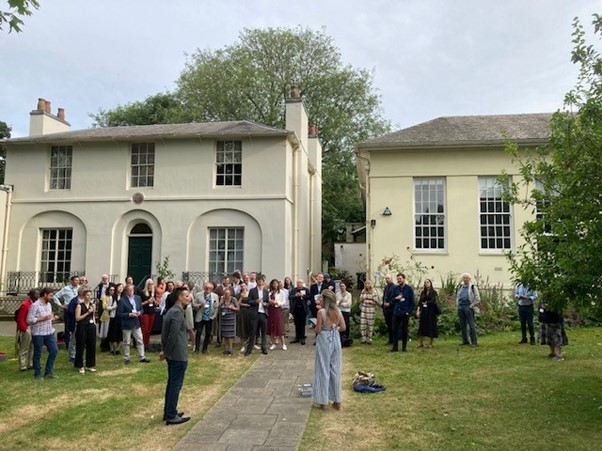
‘The Shelley Conference, Posthumous Poems, Posthumous Collaborations’ took place on 28-29th June 2024 at Keats House in London. On the eve of the conference, Mark Sandy gave a beautiful pre-conference lecture titled ‘‘Waters on a Starry Night’: Shelley’s Poetic Reflections on Wordsworth’. The lecture discussed touchstones between Percy Shelley and Wordsworth’s poetic imagery with a focus on haunting loss, absent presences, vacancy and effervescent similes that took us on a ‘poetic quest for the unseen’, to borrow Sandy’s words.
The following morning saw the beginning of the first full day of the conference. The day began with opening remarks by Amanda Blake Davis on the continuing importance of collaboration to Shelley Studies, especially in Anna Mercer’s approach to Shelleyan collaboration in the 2017 Shelley Conference and in her monograph, and within Shelley’s own circle during and after his lifetime (i.e. The Liberal).
The first set of panels were The Liberal and ‘Posthumous Existence’. Following a coffee break were the panels ‘Affect and Co-Creation’ and ‘Mary as Editor’. I attended the ‘Affect and Co-Creation’ panel which consisted of a fascinating talk by Katy Boyer on Shelley’s corpse and the relation between Percy Shelley’s drowned body and his poetry. Merrilees Roberts explored Mary, Jane and Percy’s collaborative grief in ‘The Choice’ and lyrics to Jane Williams. Lisa Vargo gave a paper on ‘The Zucca’ and Mary Shelley’s role as editor, seeing the poem as a sort of dialogue between Mary and Percy.
Another short break was followed by the parallel panels on ‘Twentieth Century Touchstones’, and a panel consisting of musicality and considered silences, aptly named ‘Sound and Silence’. Camila Oliveira Querino gave a brilliant paper on ‘‘Music’ and other Posthumous Poems set to music’. This was followed by a more contemplative paper on ‘Silence and Sympathy in ‘Julian and Maddalo’’ by Elspeth Askew that considered the role and value of silence in the poem. The panel was closed by Amanda Blake Davis’s excellent discussion of ‘Arboreal Soundscapes in ‘The Woodman and The Nightingale’’ which explored subjective responses to objective sounds in the poem, the experience of writing through sound and the significance of Shelley’s identification of specific trees such as the poplar.
Next was lunch in the garden of Keats House followed by the Plenary Panel ‘Editing the Dead’. The panel consisted of talks by Will Bowers, Nora Crook, Paul Hamilton and Valentina Varinelli with fruitful discussions on Mary Shelley’s role as editor, the ‘Jane poems’ and how they substitute and consummate Percy Shelley’s feelings for Jane, and questions surrounding the publication of the Posthumous Poems. The plenary panel was followed by a drinks reception to launch volumes 5 and 6 of The Poems of Shelley (Longman Annotated English Poets), hosted by two of the editors of the volumes, Will Bowers and Mathelinda Nabugodi. The event culminated in a brilliant and moving speech by Kelvin Everest, who shared his experience of editing Shelley for Longman.
The summer weather continued for the second day of the conference with opening panels on ‘Uncovering Editions’ and ‘Shelleyan Disruption’. The former took place in the Nightingale Room and included talks by Andrew Hodgson, Gary Kelly and Keerthi Vasishta on Thomas Lovell Beddoes, Milner and Sowerby’s editions of Shelley and the role of Leigh Hunt as editor.
A brief coffee break preceded the second set of parallel panels on ‘Beyond the Human’ and ‘Transnational Shelley’. The former saw a fantastic discussion by Paul Stephens on ‘Shelley’s Theory of Economic Value’. Touchstones between the value of land and the transformation of nature into human property were also compellingly explored by Sola Ogunbayo and Yuan Ge.
These parallel panels were followed by another short coffee break before the final panels of the conference on ‘Conversation and Influence’ and ‘Translations’. The former, chaired by Andrew Lacey, saw fantastic talks by Laura Blunsden on ‘‘Alastor’, Wieland, and Shelley’s Symbolic Mind’ and Oliver Clarkson’s ‘Wordsworth After Shelley’, and my own paper on ‘The Poetics of the Ocean and Human Potentiality in Shelley’s ‘Julian and Maddalo’’.
Saturday’s roundtable saw Kate Singer and Omar F. Miranda discuss the recently published Percy Bysshe Shelley for Our Times (Cambridge University Press, 2024) with respondents Mark Sandy and Jennifer Wallace. Singer elegantly described the purpose of the book being to ‘ripple the water of thinking about Shelley’ and the aims of the editors (Singer and Miranda) to create a book that reflects not only our current times but future times. Sandy summed up the value of such a book, and the continued importance of studying Shelley, as that we see something in him, in his ideas, that mirrors back to ourselves.
Following this exciting roundtable was the keynote lecture by Ross Wilson. This engaging lecture drew attention to Shelley’s persisting concern with the posthumous condition, from the Posthumous Fragments of Margaret Nicholson to themes of posthumousness, living again, ceasing to live again, and fragmentary forms as recurrent in Shelley’s corpus. Shelley’s concern with the posthumous condition was strikingly considered in the fragment ‘On Life’, wherein Wilson reflected upon Shelley’s remarkable claim that ‘in living we lose the apprehension of life’. This phrase was, of course, adopted as the title for Wilson’s seminal 2013 monograph on Shelley.
In his capacity as Conference co-organiser, Andrew Lacey delivered some heartfelt closing remarks, thanking his co-organisers Amanda Blake Davis, Paul Stephens and Merrilees Roberts, together with the PG Helpers Keerthi Vasishta and Lydia Shaw, and to Rob Shakespeare and the brilliant staff at Keats House.
Closing the conference was Omar F. Miranda and Kate Singer with a drinks reception and raffle on the front lawn of the Keats House, hosted by the Keats-Shelley Association of America.
‘The Shelley Conference, Posthumous Poems, Posthumous Collaborations’ was filled with inspiring talks, dynamic discussion, the exchanging of ideas within a supportive community and will no doubt be the birthplace of new Shelleyan collaborations to come.
Lydia Shaw has recently completed her PhD at Durham University. Her thesis refigures Byron and Shelley’s poetics in relation to current environmental discussions. In examining these two Romantic poets’ engagements with, and treatment of, the Italian landscape, she employs environmental discussions of interconnection to interrogate the conceived divisions between human and nature. Lydia was a recipient of The Byron Society PhD Bursary in the years 2022/3 and 2023/4.
Amy WilcocksonComments Off on The Shelley Conference 2024: Posthumous Poems, Posthumous Collaborations – Exhibition Report
Keerthi Vasishta, Postgraduate Helper at the Shelley Conference 2024 discusses below the exhibition at Keats House which ran alongside the conference:
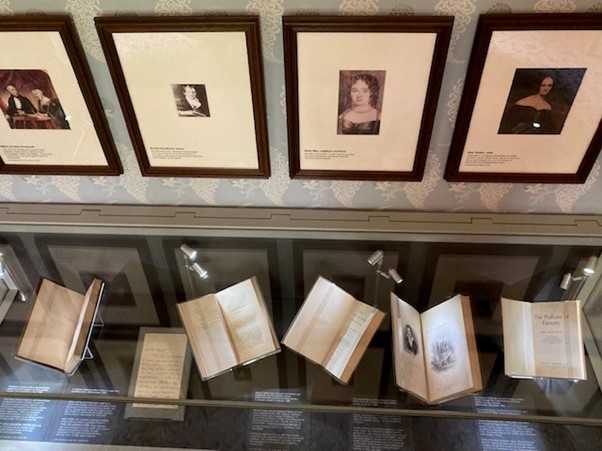
The Shelley Conference 2024 featured a special exhibition from the collections of Keats House inspired by the 1824 Posthumous Poems, corresponding with the theme of this year’s conference. The volume Posthumous Poems was edited and compiled originally by the recently-widowed Mary, who worked through her grief to produce the book. On display at Keats House is a first edition of Posthumous Poems (1824) ed. by Mary Shelley (John and Henry L. Hunt), the first of the many posthumous publications of Percy Shelley’s writing. Dr. Andrew Lacey, University of Lancaster and the official ‘interpreter’ for the exhibition, explained the thinking behind the items on display:
The Shelley relics collected in our exhibition illustrate Mary Shelley’s careful superintendence of Percy Shelley’s posthumous reputation over almost two decades, and, taken together, gesture towards the diverse nature of Shelley’s various literary afterlives.
Percy Shelley has been subject to constant reinvention and rediscovery by successive generations since his untimely death in 1822. Therefore, Lacey’s gesture towards the ‘diverse nature of Shelley’s various literary afterlives’ creates an exciting moment for readers of Percy Shelley coming to the exhibition. In viewing the physical object, readers conversant with the language and history of Percy and Mary Shelley’s first posthumous collaboration, were instantly transported to the world of 1824.
Seeing the book is a transformative moment. The conference was suddenly not just about words, not about arguments, not about ideas. The materiality and historicity of the events and people under scrutiny came to life to the participants. Any ideas and arguments one might have arrived with to the conference had to reckon with the lived history of the objects on display. Words fall away in viewing the Posthumous Poems because participants were witnessing a testimony of one remarkable woman’s labour and love for her remarkable husband. It is a testimony also to the birth of one of the greatest editorial efforts on the work of any single poet, an object therefore unlike any other, demanding the attention of viewers. As Lacey explained further,
Although, for Mary, the years after Shelley’s untimely death were blighted by grief and adversity, they were also marked by remarkable industry and productivity. The obstacles that Mary successfully negotiated were many, making the establishment of her ‘Collected Shelley’ – a fitting monument to the Shelley that she knew – an all the more remarkable achievement.
It takes a village to nurse a child, and it is much the same with the Shelley’s Posthumous Poems as well as Percy Shelley’s posthumous afterlives and reputation. Mary Shelley’s ‘Autograph letter to Leigh Hunt, undated but c. 23 December 1839’, placed beside Posthumous Poems hints at the many hands that came together to make Shelley the poet we know today. The text of this letter details Mary Shelley’s anxieties in answering G.H. Lewes, who was compiling a life of her late husband (Lewes’ work remained unpublished). Confessing the difficulties to Leigh Hunt, a long-time friend of the Shelleys, Mary shares her continuing pain from the loss of her husband more than a decade and a half prior. She writes in her letter to Hunt, ‘I cannot write or speak of Shelley to any purpose according to my views without taking a seal from a fountain, that I cannot bring myself yet to let flow’. The imagery of a sealed fountain is powerful in describing her volcanic grief while she wrestled with the memory of late husband. Shortly before this, Mary Shelley had headlined a complete collection of Percy Shelley’s poems, with both the preface and the editorial work done by Mary herself. This book, on display at Keats House was titled The Poetical Works of Percy Bysshe Shelley and was published by London publisher Edward Moxon in 1839. The interpretation to the book at the exhibition quotes Mary’s troubles in the effort of creating the volume:
Editing the poems and drafting the Notes caused Mary Shelley considerable distress: in her journal, she writes: ‘I almost think that my present occupation will end in a fit of illness’, adding ‘I am torn to pieces by Memory’ (12 February 1839)
Yet, Percy Shelley’s posthumous publication and reputation were growing further thanks to Mary’s efforts. Published late in 1839, although bearing 1840 on the title page was Essays, Letters From Abroad, Translations and Fragments, by Percy Bysshe Shelley ed. by Mary Shelley (London, Edward Moxon), the first edition of which is also on display at the Keats House exhibition.
If Mary’s labours were the heart of the conference and the thinking around Percy’s early posthumous reputation, the exhibition at Keats House showcases the diversity of Shelley’s after-lives. Like a leviathan, Percy Shelley’s reputation grew in breadth and scope since his death into the following centuries. His name and reputation had such value that the self-professed ‘psychic’ Shirley Carson Jenney produced The Fortune of Eternity, by Percy Bysshe Shelley, Taken Through the Clairaudience of Shirley Carson Jenney, Psychic (Illfracombe, Stockwell, 1950), on display at Keats House. The book, Jenney claimed was, as the interpretation notes: ‘transmitted wholly thro’ clairaudient dictation’. The final word on the display interpretation of Jenney’s piece has this to say:
‘While of limited scholarly value, The Fortune of Eternity stands as testament to the fact that Percy Shelley remained a subject of occultist interest well into the twentieth century.’
Here, the transformative moments of the exhibition at Keats House to the participants of Shelley Conference 2024 were complete. Not only was Percy Shelley posthumous reputation real, but here was evidence (though a hoax) of Percy Shelley having an actual ‘afterlife’!
Keerthi Sudhakar Vasishta is a PhD student at Durham University.
Adam NeikirkComments Off on Mary Shelley and the New Woman: Grant Allen’s uses of the Shelleys’ marriage
A new ‘Romantic Reimaginings’ post, written by Chloe Wilcox, revisits the Canadian science writer Grant Allen’s 19th-century novel The Woman Who Did and its adaptation of the marriage of Percy and Mary Shelley into fiction.
Content warning: suicide, eugenics
The fraught circumstances of Mary and Percy Shelley’s marriage continue to cause no shortage of controversy, frequently being the first thing people ask me about when I mention my interest in Percy Shelley. After a gradual estrangement from his first wife Harriet in Spring 1814, Percy announced his love for Mary Godwin that June.1 However, Harriet and Percy remained legally married, and Harriet was pregnant with a child who would be born in November.2 On the 10th of December 1816, Harriet’s body was found following her suicide, and Mary and Percy were married only 20 days later.3
Grant Allen’s The Woman Who Did (1895) is one text that engages with this controversy. Although not particularly popular today (perhaps for good reason), it was amongst the most popular of the fin de siècle’s New Woman novels, achieving nineteen editions within a year of publication.4 Its protagonist Herminia consistently refuses to marry her partner despite the substantial obstacles that this presents her and her daughter with throughout the novel. It ends with Herminia’s suicide, which Allen presents as a ‘martyrdom’: she awaits death ‘with hands folded on her breast, like some saint of the middle ages.’5
In The Woman Who Did, Mary and Percy Shelley’s marriage is cited in a speech by Herminia as an example of behaviour she wishes to avoid:
Brave women before me have tried for a while to act on their own responsibility, for the good of their sex; but never of their own free will from the very beginning. They have avoided marriage, not because they thought it a shame and a surrender, a treason to their sex, a base yielding to the unjust pretensions of men, but because there existed at the time some obstacle in their way in the shape of the vested interest of some other woman. When Mary Godwin chose to mate herself with Shelley, she took her good name in her hands; but still, there was Harriet. As soon as Harriet was dead, Mary showed she had no deep principle of action involved, by marrying Shelley. […] Now, I have the rare chance of acting otherwise. I can show the world from the very first that I act from principle, and from principle only.6
The marriage is taken as evidence of Mary’s lack of integrity, in contrast to Herminia. Herminia is ‘ahead’ of society—Allen argued in response to a negative review that the reviewer was ‘just as much behind his own age as my Herminia was in front of it.’—whilst Mary’s actions are seen as a reflection of her failure to move beyond her society.7 Because Herminia’s political strategy is primarily one of personal choices, the personal lives of these authors are treated as politically significant. As Herminia argues when praising Percy Shelley’s integrity later in the novel,
Not less but more than most of us is the genius bound up with all his might to the highest moral law, to be the prophet and interpreter of the highest moral excellence. […] that’s why I can never admire Shelley enough, who, in an age of slavery, refused to abjure or to deny his freedom, but acted unto death to the full height of his principles.8
Herminia’s views on the role of the author as a prophet are very similar to those of her author, as laid out in his introduction to The British Barbarians published later that same year, in which we find yet another Shelley reference:
Not to prove anything, but to suggest ideas, to arouse emotions, is, I take it, the true function of fiction. One wishes to make one’s readers think about problems they have never considered, feel with sentiments they have disliked or hated. The novelist as prophet has his duty defined for him in those divine words of Shelley’s,
‘Singing songs unbidden till the world is wrought To sympathy with hopes and fears it heeded not.’ 9
A starkly different interpretation of the same marriage, however, is found in Allen’s 1890 essay ‘The Girl of the Future’, in which he lays out his system of eugenics. He argues that, when given the education and freedom to do so, women will naturally choose, in his eyes, a more ideal partner to have children with.
There have been in the past and there are even now among us a few educated and emancipated women. […] And such women as these—our Mary Wollstonecrafts, our Mary Godwins, our George Sands, our George Eliots—have one and all shown themselves supremely contemptuous of man-made or slave-made ethics. They have gone where they would, and followed their own divine internal promptings. They have known that a Shelley or a Chopin was better worth loving than a fat, complacent, sleepy-headed bourgeois. These are the people who point the way for humanity; the mass slowly follows the finger-post of genius.10
Whilst this marriage is, to Herminia, proof that Mary Shelley was unable to move beyond her contemporary society, in ‘The Girl of the Future’ it serves as proof of the opposite: that she was so far ahead as to ‘point the way for humanity’. We thus see the malleability with which Allen treated the Shelleys as biographical figures. Their 1816 marriage serves as an easily recognisable event which he can assign varying significances to depending on his argument.
Chloe Wilcox is a second-year undergraduate studying English Language and Literature at St Hugh’s College, University of Oxford. She has previously written for the BARS Review and created videos on Percy Bysshe Shelley’s biography and reception for the BARS TikTok page. She is also interested in Shelley’s poetics and politics.
Footnotes
1 Richard Holmes, Shelley: The Pursuit (London: Harper Perennial, 2005), pp. 226, 232. 2 Holmes, Shelley, p. 273. 3 Holmes, Shelley, pp. 352, 355. 4 Lyssa Randolph, ‘“The Romance of Race”: Grant Allen’s Science as Cultural Capital’, in Grant Allen: Literature and Cultural Politics at the Fin de Siècle, ed. by William Greenslade and Terence Rodgers (Abingdon and New York: Routledge, 2016), p. 66. 5 Grant Allen, The Woman Who Did (Oxford: Oxford University Press, 1995), pp. 139, 140. 6 Allen, The Woman Who Did, p. 45.
7 Grant Allen, ‘The Woman Who Did’ (Correspondence), The Academy, 9 March 1895, p. 215. https://www.proquest.com/historical-periodicals/woman-who-did/docview/8379745/se-2. 8 Allen, The Woman Who Did, p. 75. 9 Grant Allen, The British Barbarians (New York and London: G. P. Putnam’s Sons, 1895), pp. 9-10. https://hdl.handle.net/2027/aeu.ark:/13960/t6d22jp25 10 Grant Allen, ‘The Girl of the Future’, The Universal Review, May 1890, p. 62. https://www.proquest.com/historical-periodicals/girl-future1/docview/4214293/se-2?accountid=15181
Amy WilcocksonComments Off on Call for Papers: Global Blake Symposium – Musical Afterlives
Call for Papers: Musical Afterlives
Global Blake Symposium: Musical Afterlives is a one-day symposium exploring the musical settings of Blake’s poetry as well as his inspiration on classical and popular artists.
When: 4 November 2024
Where: Online Event
Keynote Speaker: Barry Miles
If Horatio’s famous quote “Ut pictura poiesis” seems incontrovertible when we look at William Blake’s illuminated books, “Ut musica poiesis” could be the next unquestionable truth when one comes across the thousands of musical renderings inspired by Blake’s verses.
As posed by one of the greatest Blake scholars, G. E. Bentley Jr., his work is more than a topic or theme for music, it is, above all, reason for music. So much so, that today William Blake is one of the most celebrated English-language poets set to music, having inspired a myriad of renderings, ranging from Hubert Parry’s classical hymn Jerusalem (1916) to Patti Smith’s panegyric In My Blakean Year (2004). The answer to such popularity is not an easy one. There is a conjunction of factors that may help to explain the extensive use of his work by artists who revolutionized the artistic scene in the second half of the 20th century, which encompasses form, content and the profound transformations of his literary reception over the years. This unordinary phenomenon suggests that Blake’s ideas and aesthetics resonate with the crises and issues of the modern and contemporary world, having found in the digital and multimedia context of the 21st Century a breeding ground for further expansion.
The aim of this symposium is to present a comprehensive discussion of Blake’s reception in music in order to understand not only the genesis and motivations of the phenomenon, but also its endurance in the digital age, when multimedia and intermediality play a central role in the dissemination of literature. It also encompasses the articulation of word, sound and image in the appropriation of his work, which ranges from album covers and posters to music settings. We welcome proposals for papers of 20 minutes on Blake’s Musical Afterlives.
Amy WilcocksonComments Off on BARS Executive: Appointed Positions 2024-2026
Dear BARS Members,
The BARS Executive is a friendly and collegial gathering of Romanticists from a wide range of career stages, which supports activities and initiatives in the field undertaken by the BARS Membership. Being part of the Executive gives you the opportunity to shape Romantic studies in the UK, and to meet our ambitions to provide a variety of financial support, events, training and resources for Romanticists both at home and overseas.
Over recent years, the Executive has been working to open up the processes for selecting the Exec more expansively, as well as to create structures that maintain the robustness and ‘institutional memory’ of the committee. To this end, we undertook to split elections of the Executive into two separate biennial cycles, while exploring more substantive constitutional changes that reflect our principles and modernize our structures in the longer term.
Following the elections confirmed at BARS 2024 in Glasgow, we invite submissions of interest for the following posts to span an initial two-year term to summer 2026 (re-electable/renewable for a second term to 2028).
Appointed Positions (Executive and Co-opted)
To be selected by a review panel made up from members of the current Executive Committee:
Website Editor
Schools & Education Liaison
Submitting your Expression of Interest Please send Expressions of Interest with a two-page CV including a brief description of your research to the BARS Secretary, Andrew McInnes (bars.secretary@gmail.com), copying in the President, Matthew Sangster (matthew.sangster@glasgow.ac.uk). Your Expression of Interest should outline the particular skills, experience and passion you would be able to bring to the relevant roles. The deadline for submissions is Monday 26 August 2024.
Role descriptions:
Website Officer
The BARS Website Officer is expected to:
Handle the technical maintenance of the main BARS website, the BARS Blog and The BARS Review, periodically updating the designs and installations.
Update the BARS sites with information as required by the officers of the Exec.
Maintain the domain registrations and hosting account employed for BARS’ web presence (including working with the Treasurer to make payments).
Serve as Technical Editor of The BARS Review, conducting final checks for articles, creating and uploading galleys, and setting up and publishing issues (using Open Journal Systems).
Work with the Communications Officer and Assistant(s) on the digital aspects of BARS communications.
Serve on BARS committees (such as Digital Events) as required.
Play a full role in the Exec’s activities and discussions.
For this role, experience working with WordPress or a similar content management system is essential; experience with Open Journal Systems or the willingness to learn how the system works is essential; and some previous experience of website administration (via hosting tools and phpMyAdmin) would be an advantage.
Schools & Education Liaison:
The BARS Schools & Education Liaison Officer is expected to:
To promote BARS and the study of Romantic-period literature to school teachers and pupils
To liaise with schools and related organisations to encourage engagement with Romantic-era literature
To work with external partners in the education sector to promote outreach and widening participation activities that relate to Romanticism.
To engage with Examination Boards in ensuring the provision of Romantic literature within the UK National Curriculum.
To work with others in developing pedagogic resources for teachers and pupils.